
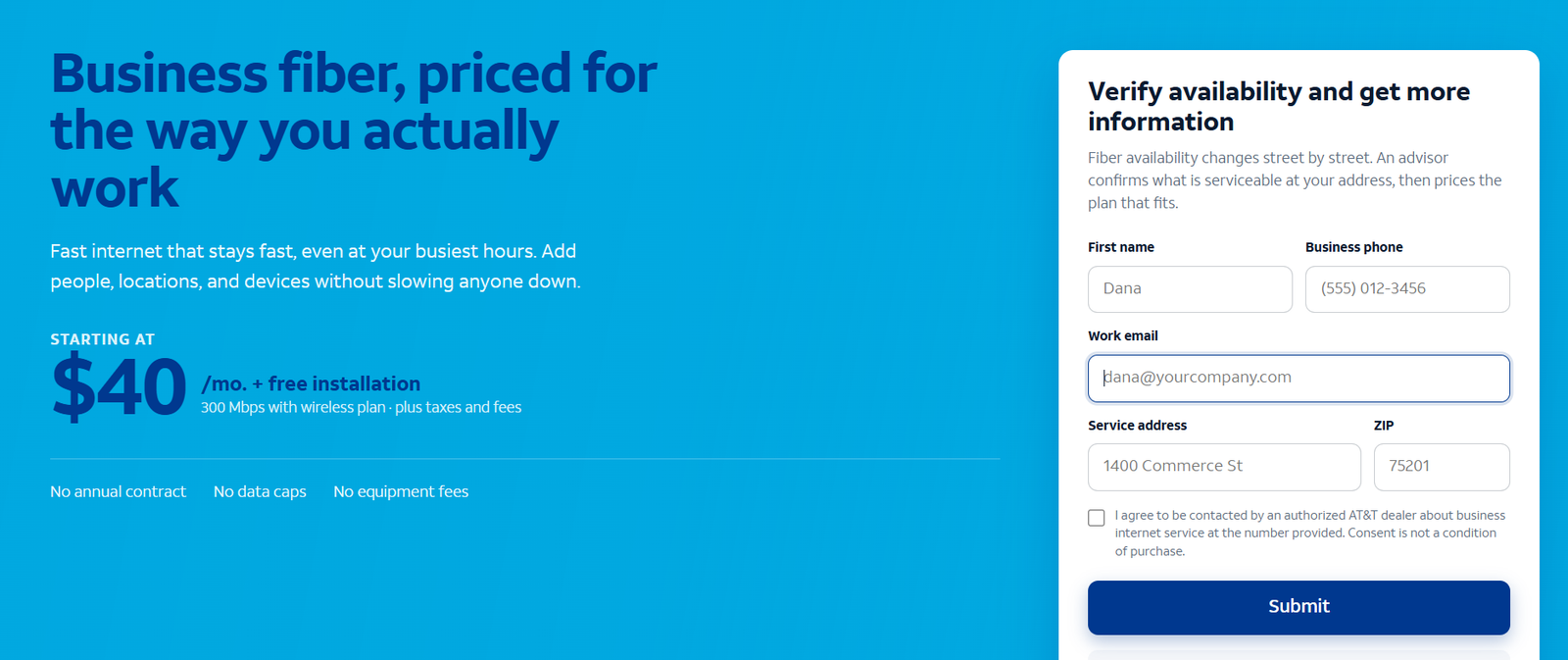
The short answer: AT&T Business Fiber runs from 300 Mbps to 5 GIG in symmetrical speed tiers, with list pricing that spans roughly $70 to $285 per month. Bundled pricing — typically with AutoPay, paperless billing and an eligible wireless line — starts around $40 per month for the 300 Mbps tier. Every tier includes symmetrical upload and download speeds, ActiveArmor security and, on current plans, no annual contract, no data caps and no equipment fees. The right tier for your office depends on headcount, upload workload and how much headroom you want for growth, which this guide breaks down tier by tier.
See current AT&T Business Fiber pricing for your address
Check which speed tiers are available at your business location and what each one costs per month.
AT&T Business Fiber Pricing at a Glance
The table below summarizes what each AT&T Business Fiber speed tier costs, based on prices observed on the AT&T business marketplace on October 20, 2026. Treat every figure as approximate: prices can change, promotions come and go, and the exact price at your address depends on availability and current offers. Confirm the current price before you order.
| Speed tier (symmetrical) | Bundled price observed* | List price (approximate) |
|---|---|---|
| 300 Mbps | ~$40/mo | ~$70/mo (low end of the published range) |
| 500 Mbps | ~$60/mo | ~$100/mo |
| 1 GIG (1,000 Mbps) | ~$90/mo | ~$140/mo |
| 2 GIG (2,000 Mbps) | ~$135/mo | Between ~$140 and ~$285 — confirm the current price |
| 5 GIG (5,000 Mbps) | ~$235/mo | ~$285/mo (high end of the published range) |
*Bundled prices were observed on the AT&T business marketplace on October 20, 2026 and typically require AutoPay and paperless billing plus an eligible AT&T wireless line on the same account. If you do not combine services, expect to pay the list price. Two prices are worth memorizing before you read on: the entry point is about $40 per month bundled (300 Mbps), and the step from 1 GIG to 2 GIG bundled is roughly $45 per month — useful context when you size your tier below.
What Each Business Fiber Speed Tier Costs
Every AT&T Business Fiber tier is symmetrical — uploads match downloads — which is the single biggest pricing distinction from cable, where you pay for downloads and get a fraction of the speed on uploads. Here is what each tier costs and who it is actually for.
Fiber 300 Mbps Pricing: The Small-Office Starting Point
At roughly $40 per month bundled (about $70 list), Fiber 300 is the entry tier and the one most small offices should start with. Three hundred symmetrical megabits comfortably supports a team of up to about 8 to 10 people doing typical office work: email, cloud apps, VoIP calls and HD video meetings. The symmetrical part matters more than the number: 300 Mbps up means cloud backups finish, large files upload in minutes rather than hours, and a video call never competes with a file sync for bandwidth. If your office mostly downloads and rarely pushes large files to the cloud, 300 Mbps will feel generous. The main reason to skip it is headcount growth — if you plan to double the team within a year, starting at 500 Mbps avoids an early upgrade call. Annual cost at the bundled rate is about $480, which makes it one of the cheapest business-grade connections available at any speed.
Fiber 500 Mbps Pricing: The Growing-Team Tier
Fiber 500 runs about $60 per month bundled (about $100 list) — a $20 monthly step up from 300 for 67 percent more speed in both directions. This is the tier for offices of 10 to 20 people, or smaller teams with upload-heavy work: marketing agencies pushing video to clients, architecture firms syncing CAD files, medical offices uploading imaging. The math that justifies it: 500 Mbps up moves a 10 GB file in under three minutes, versus more than four minutes on 300 Mbps — small per file, but it compounds across a team doing it all day. At about $720 per year bundled, it is the tier where most growing businesses land after their first year on fiber, and it is cheap insurance against the slowdowns that come from running too close to capacity at peak hours.
Fiber 1 GIG Pricing: The Sweet Spot for Busy Offices
At about $90 per month bundled (about $140 list), 1 GIG symmetrical is the best value per megabit in the lineup and the tier our business internet speed sizing guide recommends as the default for offices of 20 to 40 people. One gigabit up and down absorbs nearly everything a mid-size office throws at it: dozens of concurrent video calls, continuous cloud backups, VoIP for the whole floor, guest Wi-Fi and security cameras — simultaneously. The bundled price is the headline: $90 per month for symmetrical gigabit with no data caps and no equipment fees is difficult for cable to match once you factor in what cable charges for comparable upload speeds. Annual bundled cost is about $1,080. If you only remember one price from this guide, make it this one: 1 GIG at ~$90 bundled is the value tier.
Fiber 2 GIG Pricing: The Heavy-Upload Tier
Fiber 2 GIG costs about $135 per month bundled, with list pricing sitting somewhere between the 1 GIG list price (~$140) and the top of the range (~$285) — confirm the exact current list price before ordering, since it was not separately published at the time of writing. Two gigabits symmetrical is for offices where uploads are the business: video production houses, software teams pushing builds and containers, data-heavy research, or any office running its own servers that serve content outward. It also suits 40-plus-person offices where the per-person math still works: $135 per month across 50 people is under $3 per person per month. The jump from 1 GIG to 2 GIG bundled is about $45 per month — if your team regularly saturates a gigabit upstream, that $45 buys the headroom that keeps everything responsive at 3 p.m. on a Tuesday.
Fiber 5 GIG Pricing: The Maximum Business Tier
At about $235 per month bundled (about $285 list), 5 GIG symmetrical is the fastest AT&T Business Fiber tier and is priced for offices that treat connectivity as infrastructure, not a utility bill: headquarters, call centers, multi-tenant buildings sharing one connection, or businesses running bandwidth-intensive services for customers. Five gigabits in both directions means even a hundred-person office rarely sees congestion, and large uploads — full system images, 4K video masters, database replication — move at speeds where the bottleneck becomes the computer, not the connection. Before ordering 5 GIG, verify two things: that your internal network can actually use it (you will need multi-gigabit switches and Wi-Fi 6E/7 access points to see the benefit on individual devices), and that your address qualifies for the tier — not every fiber-served address can provision the top speed. For everyone else, 5 GIG is a useful ceiling to know about, not a tier to buy today.
Bundled vs List Pricing: How AT&T Business Fiber Discounts Work
The gap between bundled and list pricing is the most misunderstood part of AT&T Business Fiber pricing, so here is how it works. The list price is the standalone monthly rate for the fiber service. The bundled price is a discounted rate available when you combine the fiber service with qualifying conditions — typically enrollment in AutoPay and paperless billing plus an eligible AT&T wireless line or plan on the same business account. On the 300 Mbps tier the difference is roughly $30 per month ($70 list versus $40 bundled); across the lineup the bundled discount is the single biggest lever on your bill.
Three things to know before you count on the bundled price. First, the wireless line that unlocks the discount has its own monthly cost — AT&T business wireless plans start from around $30 per line per month with multi-line and AutoPay conditions — so the bundle only saves money if the business already needs, or can use, wireless lines. Second, discounts can require the services to stay on the same account and in good standing; moving the wireless lines elsewhere can return the fiber price to list. Third, promotional pricing sometimes layers on top of bundled pricing for the first 12 months — always ask what the price becomes when the promotion ends, and get the post-promotion price in writing. None of this is a reason to avoid the bundle; it is a reason to price the whole account, not just the fiber line.
Business Fiber vs Cable and 5G: Price Comparison
Fiber pricing only makes sense in context, so here is how it compares to the realistic alternatives. Cable business internet typically advertises high download speeds — 300 Mbps to 1 Gig down — at monthly prices that often land in the $70 to $200 range depending on speed and market, but uploads are a small fraction of downloads (commonly 20 to 35 Mbps up on a 1 Gig-down plan), and the price usually excludes the symmetrical performance fiber includes. When you compare on upload speed per dollar, fiber wins at every tier: $40 per month for 300 Mbps up versus a cable plan that charges more for one-tenth the upload. Our fiber vs cable comparison walks through the full trade-offs.
AT&T Internet Air for Business — the 5G fixed-wireless option — sits at about $65 per month list for Standard and about $105 for Premium, or roughly $40 and $80 bundled after AutoPay and wireless discounts. That makes Internet Air Standard bundled ($40) price-matched with Fiber 300 bundled ($40) — but the products are not equivalent: fiber delivers consistent symmetrical speeds while 5G speeds vary with signal and network conditions. See our Internet Air for Business pricing breakdown for the full Standard vs Premium comparison. The pricing takeaway: where fiber is available at your address — check with our fiber availability guide — it is usually the better value per reliable megabit; where it is not, Internet Air is the budget-friendly wireless alternative.
Fees, Equipment and Installation: The True Monthly Cost
The monthly tier price is most of the story, but not all of it. Here is what sits around it. On current AT&T Business Fiber plans there is no annual contract required, no data caps and no equipment fees — the Wi-Fi gateway is included, which removes the $10-to-$15 monthly rental fee cable companies commonly charge. That single difference can be worth $120 to $180 per year against a cable plan with rented equipment. Professional installation is typically included with new orders; business fiber installs are technician visits, not self-installs.
The costs that can surprise you are the ones tied to your building, not the plan. If your address needs construction to bring fiber to your suite — a new drop, riser work, or trenching — there can be a one-time build cost, sometimes waived with a term agreement and sometimes not; always get construction scope and cost in writing before you commit. Inside your office, you are responsible for power where the gateway sits and any internal wiring beyond the demarcation point. If you want your own router behind the AT&T gateway, budget for the hardware, though many small offices run fine on the included gateway. Taxes and regulatory fees vary by jurisdiction and sit on top of the advertised price, so the number on your bill will be a little higher than the tier price — ask for an all-in estimate when you order.
Disclaimer: Ortelcom.com is an independent publisher, not AT&T and not an official AT&T website, and is not endorsed by AT&T. Links in this article are affiliate links to ortelcom.com/recommends/ — we may earn a commission at no extra cost to you. Product names, prices, speeds and offers were checked on the date shown in this article, can change without notice, and availability depends on your business address. AT&T trademarks belong to their owner. This information is for general guidance only — please confirm final pricing, terms and availability on the provider’s page before you order.
Which Business Fiber Tier Is the Best Value for Your Team Size
Price per megabit falls as you climb the tiers, but the cheapest tier that fits is the best value — unused speed is wasted money. Use this as a starting point, then confirm with the sizing math in our speed guide.
Solo to 8 people: Fiber 300 (~$40 bundled) is the value pick. A consultant, small agency or retail office will not saturate 300 symmetrical megabits, and the $480 annual cost is hard to beat for business-grade service.
8 to 20 people: Fiber 500 (~$60 bundled) hits the sweet spot. The $20 monthly step over 300 buys meaningful headroom for video-heavy days, and $720 per year is still less than many cable 1 Gig plans once equipment fees are added.
20 to 40 people: Fiber 1 GIG (~$90 bundled) is the default recommendation. At this headcount the per-person cost drops under $5 per month per person, and the symmetrical gigabit absorbs peak-hour load with room to spare.
40 to 80 people, or upload-intensive work: Fiber 2 GIG (~$135 bundled) earns its keep when the team regularly pushes large files outward or runs services that serve customers. Below 40 people, buy it for the workload, not the headcount.
80+ people, headquarters, or shared-building connections: Fiber 5 GIG (~$235 bundled) is infrastructure-grade. Verify your internal network can use multi-gigabit speeds before ordering — otherwise the extra capacity sits idle.
Two buying rules apply at every size. First, buy for your peak hour, not your average — the 3 p.m. video-call crush is what your team will remember, not the quiet 7 a.m. average. Second, recheck annually: a team that grows from 12 to 25 people should move from 500 Mbps to 1 GIG, and the upgrade is usually a plan change, not a new installation.
How to Lower Your AT&T Business Fiber Bill
You cannot negotiate the published tier prices much, but you can materially lower what you pay. Combine with wireless if the business already pays for AT&T wireless lines — the bundled discount (roughly $30 per month on the entry tier) is the largest single saving available, and our AT&T Business Fiber plans guide explains how the bundle fits together. Enroll in AutoPay and paperless billing even if you skip the wireless bundle, since those discounts stack on most offers. Right-size the tier — the most common overspend is a 20-person office sitting on 2 GIG because nobody rechecked after the team shrank; dropping one tier can save $45+ per month with zero noticeable difference. Ask about current promotions before ordering, especially reward cards and first-year pricing, and get the post-promotion price in writing so the second year holds no surprises. Audit annually: compare your current tier against actual usage and headcount each renewal cycle, and step down — or up — to match. Finally, avoid paying for speed your network cannot deliver: a 2 GIG plan behind a gigabit router is a 1 GIG experience at a 2 GIG price.
Business Fiber Pricing Limitations and Fine Print Worth Reading
An honest pricing guide includes the caveats. Availability gates everything: the prices above mean nothing at an address that does not qualify for fiber — run the availability check first, because no discount applies to a service you cannot order. Promotional prices expire: first-year or reward-card offers revert to standard pricing, so budget on the ongoing rate, not the teaser. Bundled pricing has conditions: AutoPay, paperless billing and eligible wireless lines must remain in place; lose one and the fiber price can step back toward list. Speeds are “up to”: fiber is far more consistent than cable or 5G, but provisioned speed is a maximum — your devices, Wi-Fi and internal wiring determine what you actually experience. Business fiber and residential fiber are separate products: the residential price you saw advertised for your home does not apply to the business product at your office, even at the same street address. And prices change: the figures in this guide were observed on October 20, 2026 — always confirm the current price, in writing, before you order.
Business Fiber Cost Examples: 8-Person, 20-Person and 35-Person Offices (With Stated Assumptions)
The examples below use the bundled prices observed on October 20, 2026. Assumptions for all three: the address qualifies for fiber with no construction charges, the business meets the bundled-pricing conditions (AutoPay, paperless, eligible wireless line), taxes and fees are excluded, and prices have not changed since observed. Your actual cost will differ — confirm before ordering.
Fiber 300 Cost Example: 8-Person Marketing Office
A boutique agency with 8 staff, mostly in cloud apps and video calls, takes Fiber 300 at ~$40 per month bundled: about $480 per year. No equipment rental fee, no data-cap overage risk. Compared with a typical cable business plan at a similar download speed — often $80+ per month before a $15 equipment rental — the office saves roughly $600+ per year while getting triple the upload speed. If the team grows past 12 people, the plan steps to Fiber 500 (~$60), a $20 monthly increase.
Fiber 1 GIG Cost Example: 20-Person Professional Services Firm
A 20-person firm with heavy video conferencing and continuous cloud backup takes Fiber 1 GIG at ~$90 per month bundled: about $1,080 per year, or under $5 per person per month. The symmetrical gigabit means the nightly 500 GB backup completes in just over an hour instead of running into the workday. A comparable cable setup — 1 Gig down with ~35 Mbps up plus rented gateway — would typically cost more per month while delivering a fraction of the upload performance, which is why this tier is the value sweet spot.
Fiber 2 GIG Cost Example: 35-Person Software Company
A 35-person software company pushing builds, containers and large datasets takes Fiber 2 GIG at ~$135 per month bundled: about $1,620 per year. The $45 monthly step over 1 GIG is justified by the upload workload — engineers pushing multi-gigabyte artifacts several times a day feel the difference immediately. If the workload is lighter than expected after six months, stepping back down to 1 GIG saves ~$540 per year with no installation visit required.
The bottom line on AT&T Business Fiber pricing: most offices should expect to pay between ~$40 and ~$135 per month bundled depending on tier, with 1 GIG at ~$90 the value sweet spot for teams of 20 to 40. Start with the tier that fits your headcount and upload workload, combine with wireless for the bundled discount if it fits your account, and recheck the tier annually as the team changes. Check current AT&T Business Fiber plans and pricing for your business address to confirm the exact price before you order.
AT&T Business Fiber Pricing FAQs
How much does AT&T Business Fiber cost per month?
List pricing spans roughly $70 to $285 per month across the 300 Mbps to 5 GIG tiers. Bundled pricing — with AutoPay, paperless billing and an eligible wireless line — starts around $40 per month for 300 Mbps, $60 for 500 Mbps, $90 for 1 GIG, $135 for 2 GIG and $235 for 5 GIG, based on prices observed on October 20, 2026. Prices can change and vary by address.
What is the cheapest AT&T Business Fiber plan?
Fiber 300 is the cheapest tier: about $40 per month bundled or about $70 list, with 300 Mbps symmetrical speeds, no annual contract, no data caps and no equipment fees on current plans. It suits offices of up to about 8 to 10 people.
Is AT&T Business Fiber really $40 per month?
The ~$40 price is the bundled rate for the 300 Mbps tier, observed on October 20, 2026, and it requires meeting the bundle conditions — typically AutoPay, paperless billing and an eligible AT&T wireless line on the same account. Without the bundle, the same tier costs about $70 per month list. Taxes and fees are extra in both cases.
How much does AT&T Business Fiber 1 GIG cost?
About $90 per month bundled or about $140 list, with 1,000 Mbps symmetrical speeds. It is the best value per megabit in the lineup for most offices and the tier recommended by default for teams of 20 to 40 people.
Are there data caps or equipment fees on AT&T Business Fiber?
On current plans there are no data caps, no annual contract and no equipment fees — the Wi-Fi gateway is included. That removes the $10-to-$15 monthly rental fee many cable plans charge, which is worth $120 to $180 per year.
Does AT&T Business Fiber pricing include installation?
Professional installation is typically included with new orders. What is not always included is construction: if fiber must be built to your suite, there can be a one-time build cost. Get any construction scope and cost in writing before you commit.
Can I get a discount by bundling AT&T Business Fiber with wireless?
Yes — bundling with an eligible AT&T wireless plan is how the bundled prices (from ~$40/month) are unlocked, and the discount versus list is roughly $30 per month on the entry tier. The wireless lines have their own monthly cost, so price the whole account. See our fiber and wireless bundle guide for how the combination works.
Which AT&T Business Fiber tier is the best value?
For most offices, 1 GIG at ~$90 per month bundled: the lowest cost per megabit among the tiers most businesses actually buy, with enough symmetrical headroom for 20 to 40 people. Smaller offices (under ~10 people) get better value from Fiber 300 at ~$40 bundled, since unused speed is wasted money.
Do AT&T Business Fiber prices go up after the first year?
They can if you ordered under a promotion — first-year pricing and reward-card offers revert to standard rates when the promotion ends. Ask for the post-promotion price in writing when you order, and budget on the ongoing rate rather than the teaser.
Is business fiber pricing different from residential fiber pricing?
Yes. Business fiber and residential fiber are separate products with separate pricing, terms and support. A residential price advertised for a home does not apply to the business product at an office, even at the same street address — always price the business product for a business location.
How does AT&T Business Fiber pricing compare to cable?
On headline download speed, cable business plans often look similar ($70–$200/month range). On upload speed per dollar, fiber wins decisively: ~$40/month buys 300 Mbps symmetrical uploads on fiber, while a cable plan at a similar price typically delivers 20–35 Mbps up. Factor in cable’s equipment rental fees, and fiber’s total cost is usually lower for genuinely comparable performance.
What speed tier do I need for my office size?
As a rough guide: up to ~10 people, Fiber 300; 10–20 people, Fiber 500; 20–40 people, 1 GIG; 40–80 people or heavy uploads, 2 GIG; 80+ people, 5 GIG. Work through the real math in our business internet speed sizing guide before you commit, since upload-heavy workloads can justify a higher tier at a smaller headcount.

