
AT&T Business Fiber vs Spectrum Business Internet is the classic fiber vs cable internet decision for small businesses: AT&T brings symmetrical fiber with uploads that match downloads, while Spectrum Business brings cable with big download numbers, tiny uploads, and no-contract simplicity. The short verdict: choose AT&T Business Fiber if your business lives on video calls, cloud backups, or large uploads — symmetrical speeds are transformative and cable cannot match them; choose Spectrum Business Internet if you want no contracts, a free modem, and the lowest hassle factor, and your uploads are light. This 2026 comparison breaks down spectrum business pricing, business cable uploads, and where each option genuinely wins, based on published plans.
Want symmetrical uploads for your business? See current AT&T Business Fiber plans and promos — final pricing and availability vary by address and current promotions.
Looking for the fiber-first option?
Check whether AT&T Business Fiber serves your office and compare the 300 Mbps to 5 GIG speed tiers.
Key Takeaways: Fiber vs Cable Internet for Business
For a closer look at the plans themselves, see our AT&T Business Fiber overview.
- AT&T Business Fiber is symmetrical: 300/300 Mbps up to 5,000/5,000 Mbps. Spectrum Business Internet is asymmetrical: up to 1,000 Mbps down but only 10–35 Mbps up.
- Business cable uploads are the bottleneck — Spectrum’s top Gig plan offers 1,000 Mbps down but just 35 Mbps up, while AT&T’s 1 GIG plan offers 1,000 Mbps in both directions.
- Spectrum Business pricing starts at $65/mo for 500 Mbps down; AT&T Business Fiber starts at $60/mo list ($40/mo with an eligible AT&T wireless bundle) for 300 Mbps symmetrical.
- Spectrum wins on simplicity: no contracts, free modem, free desktop security, 30-day money-back, and a 3-year price guarantee on Ultra and Gig plans.
- AT&T wins on performance: no data caps, ActiveArmor security, included Wi-Fi gateway, and upload speeds 15–50x faster than Spectrum’s.
- For video-heavy offices, the upload gap alone usually decides this fiber vs cable internet matchup.
We break down the broader fiber-versus-cable matchup in our AT&T Business Fiber vs cable comparison.
Fiber vs Cable Internet at a Glance: The Short Answer
Cable shoppers should also see how AT&T Business Fiber stacks up against Comcast in our AT&T Business Fiber vs Comcast Business comparison.
The fiber vs cable internet debate comes down to one technical reality: cable (DOCSIS) technology delivers fast downloads but slow uploads, while fiber delivers the same speed in both directions. Spectrum Business Internet plans are cable-based, so even the $115/mo Gig plan with 1,000 Mbps downloads tops out at 35 Mbps uploads. AT&T Business Fiber’s $140/mo 1 GIG plan delivers 1,000 Mbps downloads and 1,000 Mbps uploads — nearly 30 times the upload speed for $25/mo more at list price.
That does not make Spectrum Business a bad product. For businesses whose internet use is mostly downloading — browsing, streaming, downloading files, running cloud apps that are download-heavy — Spectrum’s no-contract plans with a free modem are simple and affordable. But any business that pushes significant data upstream — video conferencing, cloud backups, security camera footage, large file sends — will feel the cable upload ceiling every day. The sections below put real numbers on that gap.
| Factor | AT&T Business Fiber | Spectrum Business Internet |
|---|---|---|
| Technology | Fiber to the premises | Cable (DOCSIS) |
| Upload speeds | Symmetrical: 300–5,000 Mbps | Asymmetrical: 10–35 Mbps |
| Entry price | $60/mo (300 Mbps sym.) | $65/mo (500 down / 10 up) |
| Top tier | 5 GIG: $285/mo (5,000/5,000) | Gig: $115/mo (1,000/35) |
| Data caps | None | No data caps stated on business plans |
| Contracts | Terms vary by plan and promo | No contracts |
| Equipment | Wi-Fi gateway included | Free modem included |
| Price guarantee | Promo-dependent | 3-year price guarantee on Ultra/Gig |
| Money-back | Promo-dependent | 30-day money-back guarantee |
| Best for | Upload-heavy work: video, backups, cloud | No-contract simplicity; download-heavy use |
Pricing checked October 2026 — confirm at checkout. Final prices vary by address and current promotions.
Best Internet for Small Business: AT&T Business Fiber Plan Tiers
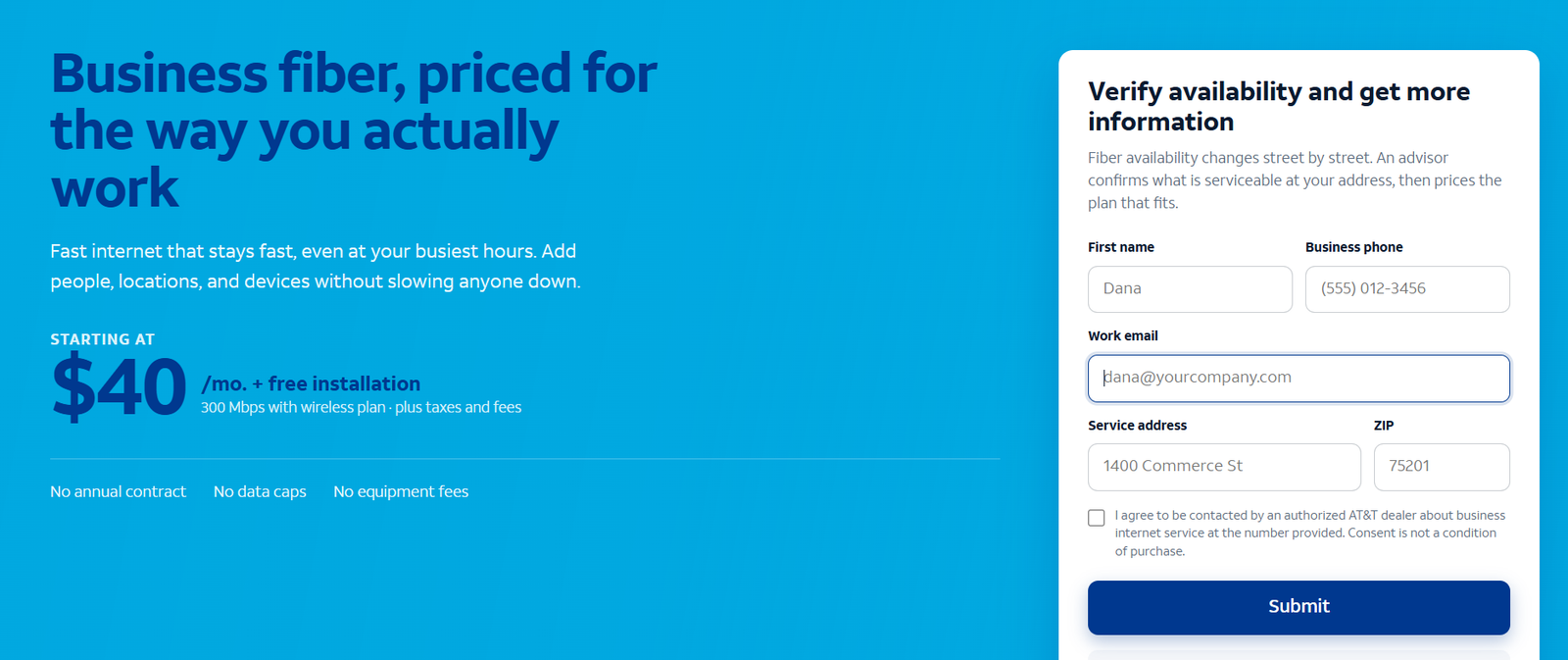
AT&T Business Fiber offers five symmetrical tiers, making it a strong candidate for the best internet for small business users with upload-heavy workflows. Published pricing is $60/mo for 300 Mbps, $100/mo for 500 Mbps, $140/mo for 1 GIG, $185/mo for 2 GIG, and $285/mo for 5 GIG — with bundle discounts to $40, $60, $90, $135, and $235/mo respectively when paired with an eligible AT&T Business wireless plan plus AutoPay and paperless billing.
| AT&T Business Fiber plan | Download / upload | List price | With eligible AT&T wireless + AutoPay |
|---|---|---|---|
| 300 Mbps | 300 / 300 Mbps | $60/mo | $40/mo |
| 500 Mbps | 500 / 500 Mbps | $100/mo | $60/mo |
| 1 GIG | 1,000 / 1,000 Mbps | $140/mo | $90/mo |
| 2 GIG | 2,000 / 2,000 Mbps | $185/mo | $135/mo |
| 5 GIG | 5,000 / 5,000 Mbps | $285/mo | $235/mo |
Pricing checked October 2026 — confirm at checkout. Bundled rates require an eligible AT&T Business wireless plan plus AutoPay and paperless billing; pricing varies by address and promotions.
Every tier includes symmetrical speeds, no data caps, ActiveArmor security features, and a Wi-Fi gateway — no modem rental fees stacking onto the bill. Promotional offers have included $300–$500 reward cards depending on tier and promo period. For a small business comparing the best internet for small business options, the standout figure is the bundled 1 GIG at $90/mo: full gigabit symmetrical for less than Spectrum’s $95/mo Ultra cable plan, which offers only 35 Mbps uploads.
Check AT&T Business Fiber availability and bundle pricing for your business address
AT&T Fiber Strengths: Symmetrical vs Asymmetrical Speeds
The symmetrical vs asymmetrical speeds difference is AT&T’s entire case in this comparison. On AT&T Business Fiber, a 500 Mbps plan uploads at 500 Mbps; on Spectrum’s $65/mo Premier plan, a nominally similar 500 Mbps download comes with just 10 Mbps upload — a 50-to-1 gap. For any business that video conferences, backs up to the cloud, syncs POS data, or sends large files, that gap is the difference between workflows that fly and workflows that stall.
Beyond raw speed, AT&T Business Fiber includes business-grade extras: no data caps, ActiveArmor security, and an included Wi-Fi gateway. The 5 GIG tier also gives growing businesses enormous headroom without switching providers — Spectrum’s cable lineup tops out at 1,000 Mbps down / 35 Mbps up, so a business that outgrows cable uploads has nowhere to go within Spectrum’s plans.
AT&T Fiber Limits: Where Fiber vs Cable Internet Trade-offs Appear
AT&T Business Fiber’s trade-offs are about availability and price structure, not performance. Fiber does not reach every commercial address — some buildings in AT&T territory are served only by older technologies — so the fiber vs cable internet choice is moot where fiber is not built out. Always verify serviceability at your exact address.
The bundle discount is the other caveat: the aggressive $40–$235/mo bundled rates require an eligible AT&T Business wireless plan plus AutoPay and paperless billing. At pure list price, AT&T’s 500 Mbps plan ($100/mo) costs $35/mo more than Spectrum’s $65/mo Premier — though the upload comparison (500 Mbps vs 10 Mbps) still favors fiber heavily. Promotional reward cards ($300–$500 on recent promos) also rotate and should be treated as a bonus rather than the deciding factor.
Spectrum Business Internet Plans: Spectrum Business Pricing and Tiers
Spectrum Business Internet plans are straightforward cable offerings with no contracts. Published spectrum business pricing is $65/mo for Premier (500 Mbps down / 10 Mbps up), $95/mo for Ultra (750 Mbps down / 35 Mbps up), and $115/mo for Gig (1,000 Mbps down / 35 Mbps up). Every plan includes a free modem, free desktop security software, and a 30-day money-back guarantee, and Ultra and Gig plans carry a 3-year price guarantee — a genuinely useful protection against the annual rate creep cable bills are known for.
| Spectrum Business plan | Download / upload | Monthly price | Key terms |
|---|---|---|---|
| Premier | 500 / 10 Mbps | $65/mo | No contract, free modem |
| Ultra | 750 / 35 Mbps | $95/mo | No contract, 3-yr price guarantee |
| Gig | 1,000 / 35 Mbps | $115/mo | No contract, 3-yr price guarantee |
Pricing checked October 2026 — confirm at checkout. Pricing varies by address and current promotions.
The appeal of spectrum business pricing is its simplicity: no contracts to sign, no bundle requirements, no AutoPay conditions to unlock the advertised rate. The $65/mo Premier plan is one of the cheapest ways to get 500 Mbps downloads for a business, and the 3-year price guarantee on Ultra and Gig means the $95 or $115/mo rate is locked — a meaningful commitment in an industry where promo rates often expire after 12 months.
Fiber vs Cable Internet: Where Spectrum Business Internet Plans Shine
In the fiber vs cable internet comparison, Spectrum Business Internet plans shine on flexibility and simplicity. No contracts means a business can leave anytime — valuable for startups on short leases, seasonal businesses, or anyone who wants to try the service without a term commitment. The free modem removes the equipment-rental line item, and free desktop security software adds value for very small businesses without IT staff.
Spectrum’s download speeds are legitimately fast for the price. The $115/mo Gig plan’s 1,000 Mbps downloads beat AT&T’s $140/mo list-price 1 GIG on downloads alone — and match AT&T’s $90/mo bundled 1 GIG on downloads while costing $25/mo more. For a business whose internet use is overwhelmingly downloads — web browsing, streaming, software downloads, cloud apps that pull far more than they push — Spectrum delivers plenty of speed per dollar with zero commitment.
Spectrum Business Internet Plans: The Upload Problem With Business Cable Uploads
Business cable uploads are Spectrum’s Achilles’ heel, and it is not close. The Premier plan’s 10 Mbps upload is shared across the entire business — every video call, cloud backup, POS sync, and file upload competes for the same 10 Mbps. A single HD video call needs roughly 3–5 Mbps of upload; two simultaneous calls can saturate a Premier connection’s upstream, causing frozen video and robotic audio for everyone else.
Even the top Gig plan’s 35 Mbps upload pales next to fiber: AT&T’s entry 300 Mbps fiber plan offers 300 Mbps uploads — nearly 9 times Spectrum’s best upload — for $5/mo less at list price ($60 vs $65). At the $95–$115/mo price points where Spectrum sells Ultra and Gig, AT&T’s bundled 1 GIG fiber at $90/mo delivers 1,000 Mbps uploads, roughly 29 times Spectrum Gig’s 35 Mbps. Any business that backs up data to the cloud nightly, uploads security camera footage, hosts video meetings all day, or sends large design and media files will hit the business cable uploads ceiling constantly.
Fiber vs Cable Internet Compared: The Full Business Internet Table
The table below puts the full fiber vs cable internet comparison side by side: every tier, uploads, terms, and business features.
| Comparison point | AT&T Business Fiber | Spectrum Business Internet |
|---|---|---|
| Technology | Fiber to the premises | Cable (DOCSIS) |
| Entry plan | 300/300 Mbps — $60/mo ($40 bundled) | Premier 500/10 Mbps — $65/mo |
| Mid plan | 500/500 Mbps — $100/mo ($60 bundled) | Ultra 750/35 Mbps — $95/mo |
| Top plan | 5 GIG 5,000/5,000 — $285/mo ($235 bundled) | Gig 1,000/35 Mbps — $115/mo |
| Upload speed range | 300–5,000 Mbps (symmetrical) | 10–35 Mbps (asymmetrical) |
| Data caps | None | No caps stated on business plans |
| Contracts | Terms vary by plan and promo | No contracts |
| Equipment | Wi-Fi gateway included | Free modem included |
| Security | ActiveArmor included | Free desktop security included |
| Price guarantee | Promo-dependent | 3-year price guarantee (Ultra/Gig) |
| Money-back | Promo-dependent | 30-day money-back guarantee |
| Current promos | $300–$500 reward cards (select promos) | Promos vary by market |
| Best for | Video calls, cloud backups, big uploads | No-contract simplicity, download-heavy use |
Pricing checked October 2026 — confirm at checkout. All prices vary by address and current promotions.
Disclaimer: This article contains affiliate links to AT&T Business services. We may earn a commission if you purchase through them, at no extra cost to you. Ortelcom.com is an independent publisher and is not affiliated with or endorsed by AT&T. Pricing, speeds, and availability are not guaranteed, were checked in October 2026, and vary by address and promotions — please confirm all details before ordering. AT&T and all related marks are trademarks of their respective owners.
Business Cable Uploads vs Fiber: Why Uploads Decide This Matchup
To understand why business cable uploads vs fiber is the deciding factor, put concrete numbers on common business tasks. Uploading a 1 GB video file to a client portal takes about 27 seconds on AT&T’s 300 Mbps fiber uploads — and roughly 14 minutes on Spectrum Premier’s 10 Mbps upload. A nightly 50 GB cloud backup finishes in about 22 minutes on 300 Mbps fiber uploads versus over 11 hours on 10 Mbps cable uploads — meaning the backup may still be running when staff arrive in the morning.
Video conferencing tells the same story. A 10-person office with everyone on HD video calls needs roughly 30–50 Mbps of sustained upload. AT&T’s entry 300 Mbps fiber plan covers that six times over; Spectrum’s Gig plan at 35 Mbps is right at the edge, and the Premier plan at 10 Mbps cannot support it at all. As remote and hybrid work keeps video calls central to business operations, the upload gap is not a theoretical spec — it is the daily quality of every meeting.
Security cameras compound the problem. A single 4K camera uploading continuously can consume 8–15 Mbps; four cameras can saturate Spectrum Premier’s entire 10 Mbps upstream before a single employee joins a video call. On fiber, camera uploads are a rounding error. For retail shops, restaurants, and offices with camera systems, business cable uploads are often the hidden reason the internet “feels slow” despite fast download speed tests.
Spectrum Business Pricing vs AT&T Fiber: Tier-by-Tier Cost Math
On headline monthly price, spectrum business pricing looks competitive — until uploads enter the math. Spectrum Premier at $65/mo undercuts AT&T’s $100/mo list-price 500 Mbps plan by $35/mo, but compares 10 Mbps uploads against 500 Mbps uploads. Against AT&T’s $60/mo bundled 500 Mbps plan (with eligible wireless), Spectrum Premier is both $5/mo more expensive and 50x slower on uploads — the rare case where the cheaper-feeling option loses on both price and performance.
At the mid tier, Spectrum Ultra at $95/mo (750/35) versus AT&T’s $90/mo bundled 1 GIG (1,000/1,000) is the starkest value gap in this comparison: AT&T costs $5/mo less while delivering 33% faster downloads and roughly 29x faster uploads. At list price without the wireless bundle, AT&T’s $140/mo 1 GIG costs $45/mo more than Spectrum Ultra — a real premium, but one that buys 1,000 Mbps uploads instead of 35 Mbps.
At the top, Spectrum Gig at $115/mo (1,000/35) has no fiber equivalent at that price — AT&T’s 1 GIG starts at $140/mo list — but the comparison is lopsided: Spectrum matches downloads and surrenders uploads 29-to-1. Two-year totals sharpen the picture: Spectrum Gig costs $2,760 over two years; AT&T’s bundled 1 GIG costs $2,160 — $600 less for vastly more upload. The honest summary: spectrum business pricing wins only when uploads do not matter to the business; the moment they do, fiber’s value is overwhelming.
Best Internet for Small Business: Three Real-World Scenarios
The best internet for small business is not a single plan — it is the right match for how the business actually uses the connection. Here is how the fiber vs cable internet choice plays out in three typical scenarios.
Best Internet for Small Business Retail: POS and Guest Wi-Fi
A boutique retail shop with cloud POS terminals, four security cameras, and guest Wi-Fi needs reliable uploads more than huge downloads. On Spectrum Premier ($65/mo), the cameras alone can consume the 10 Mbps upload, leaving POS syncs and card transactions competing for scraps during busy hours. AT&T’s 300 Mbps fiber at $60/mo list ($40/mo bundled) gives the cameras, POS, and guest network 300 Mbps of headroom each way. For retail, fiber is the best internet for small business use — the monthly cost is essentially identical, and the reliability difference is dramatic.
Best Internet for Small Business Offices: Video Calls and Cloud Backups
A 20-person professional office on video calls all day with nightly cloud backups is the textbook fiber customer. Spectrum Ultra or Gig ($95–$115/mo) can handle the downloads, but 35 Mbps of shared upload will bottleneck simultaneous calls and stretch backups for hours. AT&T’s bundled 1 GIG at $90/mo costs less than either Spectrum plan while delivering 1,000 Mbps uploads — backups finish in minutes, and every call gets all the upstream it needs. For offices, the fiber vs cable internet decision is the clearest: fiber wins on both price (bundled) and performance.
Best Internet for Small Business Growth: Multi-Location Plans
A growing business adding locations should think about standardization. Spectrum’s no-contract plans make it easy to spin up a new site quickly, and the 3-year price guarantee on Ultra/Gig keeps multi-site budgeting predictable. But every Spectrum location inherits the upload ceiling — fine for a download-heavy branch, painful for one that video conferences heavily. AT&T Business Fiber standardizes better for upload-heavy operations, and the wireless bundle discount compounds across every location on AT&T wireless. Mixed approach is legitimate: fiber where uploads matter, cable where they do not — but confirm fiber availability at each address first.
Who Should Pick Fiber vs Cable Internet for Their Business?
Pick AT&T Business Fiber if your business does video calls daily, backs up to the cloud, uploads camera footage or large files, runs VoIP phones, or syncs POS data constantly — in other words, if uploads matter at all. The symmetrical speeds (300 to 5,000 Mbps up) eliminate the bottleneck that defines cable, and at bundled pricing ($40–$235/mo) fiber often costs the same or less than Spectrum’s cable plans.
Pick Spectrum Business Internet if your internet use is overwhelmingly downloads, you want zero contract commitment, and you value simplicity: no bundles, no AutoPay conditions, free modem, 3-year price lock on Ultra/Gig. A small office that mostly browses, emails, and streams — with light video-call use — can be perfectly happy on Spectrum Premier at $65/mo.
The tiebreaker question is simple: count your daily uploads. If video meetings, backups, cameras, or file sends are part of every workday, fiber vs cable internet is not really a contest — fiber wins. If your business genuinely lives downstream, Spectrum’s no-contract simplicity is a fair deal.
Fiber vs Cable Internet FAQs: Business Internet Questions Answered
Is Spectrum Business Pricing Really Cheaper Than AT&T Fiber?
Sometimes on the sticker, rarely on value. Spectrum Business pricing starts at $65/mo for 500/10 Mbps versus AT&T’s $60/mo list for 300/300 Mbps — Spectrum gives more download for $5/mo more, but 30x less upload. With AT&T’s wireless bundle, 500 Mbps symmetrical costs $60/mo — $5/mo less than Spectrum Premier with 50x the upload. Spectrum is cheaper only at pure list price for download-heavy users who do not need uploads.
What Are Business Cable Uploads Good Enough For?
Business cable uploads (10–35 Mbps) are fine for email, web browsing, light cloud-app use, and the occasional video call. They struggle with simultaneous HD video calls, nightly cloud backups of any real size, continuous security-camera uploads, and sending large files. A good rule: if more than two people video conference at once or you back up more than a few gigabytes nightly, business cable uploads will feel slow.
Do Spectrum Business Internet Plans Include Symmetrical Speeds?
No. Spectrum Business Internet plans are cable-based and asymmetrical on every tier: 500/10, 750/35, and 1,000/35 Mbps. There is no symmetrical option in the published Spectrum Business lineup used for this comparison. Businesses that need symmetrical speeds must choose fiber — from AT&T or another fiber provider serving the address.
Symmetrical vs Asymmetrical Speeds: Which Matters More for Small Business?
It depends on direction of traffic. Symmetrical vs asymmetrical speeds only matter when a business pushes data upstream — and modern small businesses increasingly do: video calls, cloud backups, VoIP, camera uploads, and file sharing are all upload-intensive. Download-heavy businesses (browsing, streaming, downloading) will not notice the difference. Audit your uploads for a week; the answer is usually obvious.
Is Fiber vs Cable Internet a Real Choice, or Is Fiber Always Better?
Fiber is technically superior — symmetrical speeds, lower latency, no shared-node congestion — but the fiber vs cable internet choice is real because of availability, contracts, and price. Where AT&T fiber is not built out, Spectrum cable is the practical choice. Where a business needs no-contract flexibility and barely uploads, Spectrum is the rational pick. Fiber wins on performance; cable can win on simplicity and availability.
Best Internet for Small Business Verdict: Our Fiber vs Cable Internet Pick
For most small businesses in 2026, AT&T Business Fiber is the better pick in this fiber vs cable internet matchup. The symmetrical uploads (300 Mbps and up) solve the bottleneck that limits every cable plan, and at bundled pricing — $60/mo for 500 Mbps symmetrical, $90/mo for 1 GIG — fiber matches or beats spectrum business pricing while delivering 15–50x the upload speed. Add no data caps, ActiveArmor security, and an included gateway, and the value case is decisive for any business that video conferences, backs up to the cloud, or uploads files daily.
Spectrum Business Internet earns its place for download-heavy businesses that prize no-contract simplicity: $65/mo for 500 Mbps downloads with a free modem and a 3-year price lock on higher tiers is a fair, flexible deal — provided uploads stay light. Before deciding, verify which technology actually reaches your address, since availability often makes this choice for you.
Ready for symmetrical fiber at your business? Check AT&T Business Fiber plans, bundle discounts, and current promos — pricing checked October 2026; confirm all details at checkout.

