
Choosing between AT&T Business Fiber and Comcast Business Internet is one of the most common decisions facing US small and medium businesses in 2026. Both are major national providers, both advertise gigabit-class speeds, and both court the same customers — offices, retail shops, restaurants, clinics, and professional firms that cannot afford downtime. But under the hood they are very different products: AT&T Business Fiber runs on fiber-optic lines with identical upload and download speeds, while Comcast Business runs primarily on cable infrastructure with much faster downloads than uploads.
The short answer: if AT&T fiber is available at your business address, it is usually the better value. Symmetrical speeds up to 5 GIG, no data caps, and bundle discounts that drop the entry price to $40 per month make it hard to beat for offices that upload large files, run video calls all day, or back up to the cloud. If AT&T fiber has not reached your street yet, Comcast Business is a strong fallback — its cable footprint covers far more addresses, it offers a 5-year price-lock option on select plans, and its entry tier sits in the same $60–$70 range.
This guide gives you an honest, tier-by-tier business internet price comparison of AT&T Business Fiber vs Comcast Business Internet for 2026. Every price below was checked in October 2026, and where sources disagree — as they do on Comcast pricing — we say so openly and show you the range instead of picking the number that suits a narrative.
A quick note on how pricing works for both providers: advertised rates are almost always “with AutoPay and paperless billing” prices, and the lowest AT&T prices require bundling with an eligible AT&T Business wireless plan. Your exact quote will vary by address, current promotions, and contract terms, so always confirm at checkout before ordering.
And if you want the wider field compared before you decide, see our guide to the best business internet for small business.
Below you will find the full plan lineups, an honest look at the conflicting Comcast Business pricing range reports, upload-speed comparisons that matter more than most businesses expect, contract and feature differences, real-world use cases, and answers to the questions buyers ask most. Let us start with the verdict in more detail.
Looking for the fiber-first option?
Check whether AT&T Business Fiber serves your office and compare the 300 Mbps to 5 GIG speed tiers.
AT&T Business Fiber vs Comcast Business Internet: The Short Answer
For a closer look at the plans themselves, see our AT&T Business Fiber overview.
For most offices that can get it, AT&T Business Fiber wins this matchup on the merits that affect daily work: symmetrical upload and download speeds on every tier, no data caps, a security suite (ActiveArmor) included, and aggressive bundle pricing. The 300 Mbps tier lists at $60 per month but drops to $40 per month when bundled with an eligible AT&T Business wireless plan, which undercuts Comcast’s entry tier while delivering five to ten times the upload speed.
Comcast Business wins on two things AT&T cannot match everywhere: availability and price certainty. Comcast’s cable network reaches millions of business addresses where fiber has not been built yet, including many suburban strip malls, older office parks, and rural-adjacent corridors. And its 5-year price-lock option gives finance-minded owners something AT&T does not offer in the same form — a guaranteed rate for half a decade.
We break down the broader technology matchup in our AT&T Business Fiber vs cable comparison.
On raw download speed, the two are closer than marketing suggests. Comcast’s top cable tiers reach 1.25 Gbps and 2 Gbps downloads, comparable to AT&T’s 1 GIG and 2 GIG fiber tiers. The gap opens on uploads: AT&T’s fiber tiers are symmetrical (300/300, 500/500, 1000/1000, and so on), while Comcast’s cable uploads are a fraction of download speed. If your team lives on Zoom, uploads design files, or syncs to cloud backups, that gap is the single most important number in this comparison.
Price-wise, the business internet price comparison is genuinely close at the entry level and diverges as you climb. AT&T’s bundled prices ($40–$235 across five tiers) are consistently lower than Comcast’s reported ranges at equivalent download tiers, but Comcast frequently runs promotions and its Choice Bundles packaging can include equipment in the quoted price. Neither provider charges data-cap overages on these business plans, which removes one of the classic cable gotchas.
Bottom line for the busy owner: check AT&T fiber availability at your address first. If it is there, take the fiber — the symmetrical speeds and bundle pricing are the best business internet provider value in this matchup. If it is not, Comcast Business is a legitimate, widely available alternative with its own strengths, especially the price-lock option. The rest of this article shows you exactly why, tier by tier.
Check AT&T Business Fiber availability at your address →
AT&T Business Fiber Plans and Symmetrical Fiber Speeds
AT&T Business Fiber is a true fiber-to-the-premises product: a fiber-optic line runs all the way to your building, and every tier delivers the same speed in both directions. That is what “symmetrical fiber speeds” means in practice — a 1 GIG plan gives you roughly 1,000 Mbps down and 1,000 Mbps up, not 1,000 down and 35 up. For businesses, uploads are where fiber earns its keep, and we will quantify that below.
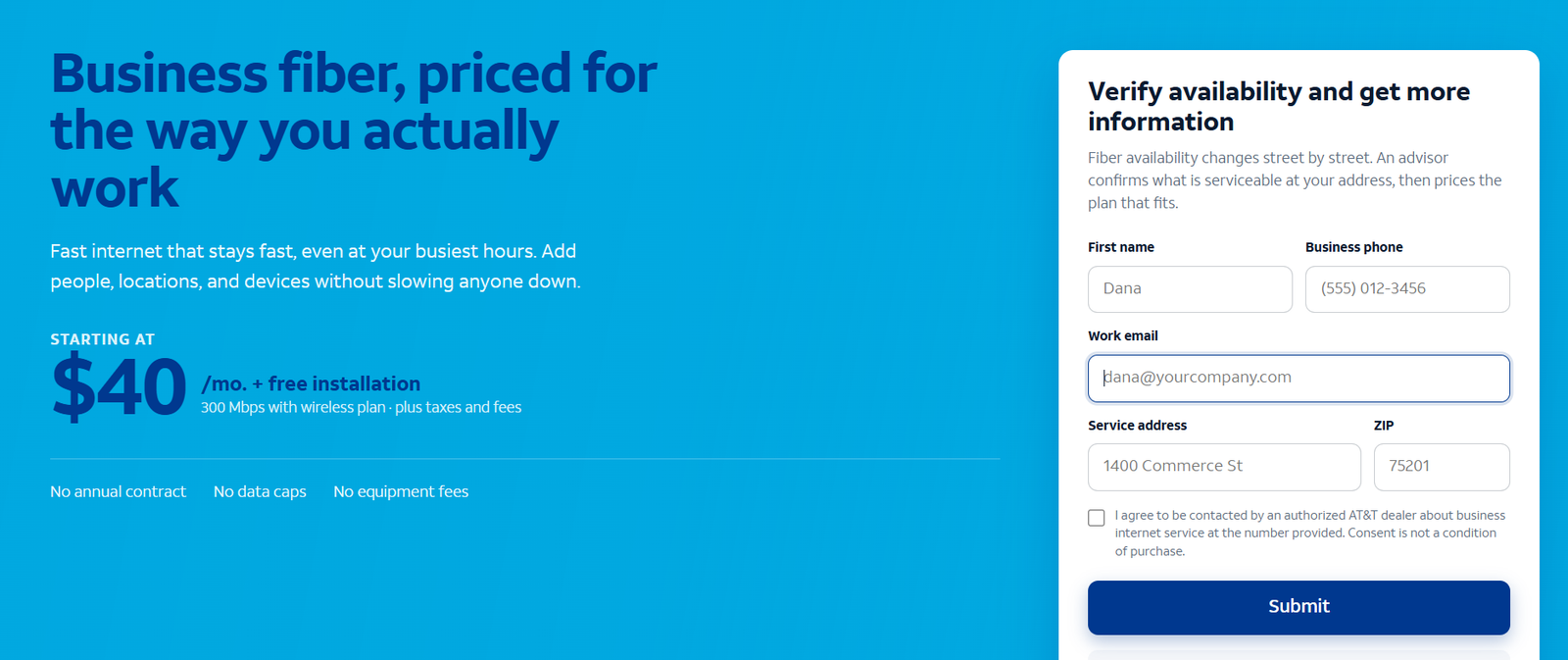
The 2026 AT&T Business Fiber lineup has five tiers. List prices (with AutoPay and paperless billing) are: 300 Mbps at $60 per month, 500 Mbps at $100 per month, 1 GIG at $140 per month, 2 GIG at $185 per month, and 5 GIG at $285 per month. Each tier drops significantly when bundled with an eligible AT&T Business wireless plan: $40, $60, $90, $135, and $235 per month respectively. The bundle discount is the single biggest lever on AT&T’s side of the business internet price comparison — a 300 Mbps fiber line at $40 per month is priced like budget cable but performs like enterprise fiber on uploads.
Every AT&T Business Fiber tier includes unlimited data with no caps and no overage fees, which matters for offices with security-camera uploads, large cloud backups, or point-of-sale systems syncing constantly. AT&T ActiveArmor security is included, adding network-level threat protection without a separate subscription. The Wi-Fi gateway is included as well, so there is no monthly equipment rental stacking up on the bill the way it sometimes does with cable providers.
Contract terms on AT&T Business Fiber are straightforward: the advertised prices assume a term agreement with AutoPay and paperless billing, and the bundle prices additionally require an eligible AT&T Business wireless plan on the same account. If you do not have AT&T wireless, you pay the list price — still competitive, but the comparison with Comcast tightens. Installation is professional, and because fiber requires a physical line to the premises, availability is the main constraint: AT&T’s fiber footprint is large and growing, but it does not cover every commercial address.
One more strength worth naming: consistency. Fiber does not share neighborhood bandwidth the way cable nodes do, so speeds hold steadier during peak hours. For a 20-person office where everyone jumps on video calls at 10 a.m., that consistency is felt in fewer frozen screens and dropped calls. It is also why fiber is the default recommendation for businesses running VoIP phone systems, which are sensitive to jitter and latency spikes.
The honest limitations: AT&T fiber simply may not be available at your address, and AT&T does not publish a single national availability map precise enough to settle it — you have to check the address. The bundle discounts that make the pricing so attractive require the wireless plan, so single-service buyers should compare using list prices. And while the gateway is included, businesses with complex networking needs (VLANs, multiple SSIDs, site-to-site VPN) will still want their own router or firewall behind it.
Fiber vs Comcast Business Upload Speeds: Why Symmetry Matters
Upload speed is the most underrated number in business internet shopping, and it is where the fiber vs Comcast Business gap is widest. AT&T’s 300 Mbps tier uploads at 300 Mbps. A comparable Comcast cable tier downloading at 300 Mbps typically uploads at a small fraction of that — cable technology allocates most of the line to downloads. For a business that only browses and streams, that is fine. For a business that creates, it is not.
Consider concrete workloads. A 2 GB video file — a training recording, a marketing asset, a batch of high-res product photos — uploads in under a minute on a 300 Mbps symmetrical fiber line. On a 35 Mbps cable upload, the same file takes nearly eight minutes, during which the connection feels sluggish for everyone else. Multiply that by a design team pushing files all day, and the “same speed” plans are not the same product at all.
Cloud backup is the second killer workload. A 500 GB initial backup to a cloud service finishes in under four hours on a 300 Mbps symmetrical connection; on a 35 Mbps upload it takes more than 31 hours — over a full day of saturating your upstream. Businesses subject to data-retention rules, or anyone who has ever waited on a restore, feel this difference in real money.
Video conferencing is the third. A single HD Zoom or Teams call needs roughly 3–5 Mbps of stable upload per participant, and 4K or multi-participant gallery views need more. Ten simultaneous calls can saturate a 35 Mbps cable upload entirely, while a symmetrical 300 Mbps line handles it with room to spare. If your office runs on video, symmetrical fiber speeds are not a luxury — they are the correct tool.
Bundle Discounts and the Business Internet Price Comparison
The AT&T wireless bundle discount deserves its own section because it moves AT&T’s prices from “competitive” to “clearly ahead” in the business internet price comparison. With an eligible AT&T Business wireless plan plus AutoPay and paperless billing, the effective prices become $40 (300 Mbps), $60 (500 Mbps), $90 (1 GIG), $135 (2 GIG), and $235 (5 GIG) per month. That is a $20–$50 monthly saving per tier, or $240–$600 per year, before any promotional pricing.
For businesses already using AT&T for company phones or tablets, the bundle is nearly automatic — the wireless plan you already pay for unlocks the cheaper internet tier. For businesses on another carrier, the math is worth doing: compare your current mobile spend against AT&T Business wireless plans, because the combined saving can exceed the cost difference of switching carriers. Many small businesses find the bundle pays for itself.
Two caveats keep this honest. First, the discount requires maintaining the eligible wireless plan; drop the wireless line and the internet price reverts toward list. Second, “eligible” plans exclude some of the cheapest prepaid-style options, so verify the specific wireless plan qualifies before counting on the $40 price. Both are standard bundle mechanics, not hidden traps, but they belong in any serious business internet price comparison.
Without the bundle, AT&T’s list prices ($60–$285) still compare well against Comcast’s ranges on a per-megabit basis, especially once uploads are weighted. But the bundle is what makes the 300 Mbps tier the standout value in this entire matchup — $40 per month for symmetrical 300 Mbps with no caps is a price Comcast’s cable tiers cannot structurally match, because cable’s upload economics are different.
See current AT&T Business Fiber bundle pricing →
Comcast Business Internet Plans: Pricing Range and Features
Comcast Business Internet is the cable-based challenger in this matchup, and its greatest asset is reach. Comcast’s business cable network passes millions of commercial addresses across the US, including many locations where fiber providers have not built yet. For a business opening in a suburban retail plaza or an older light-industrial park, Comcast is often the only gigabit-class option on the street — and a good cable connection beats a slow DSL or fixed-wireless fallback by a wide margin.
The 2026 Comcast Business lineup centers on four speed tiers: 300 Mbps, 500 Mbps, 1.25 Gbps, and 2 Gbps (download speeds). Reported pricing, however, depends on which source you read — and this is where honesty matters. Third-party reviewers (Business.org, data current as of October 2026) list the tiers at $60, $90, $140, and $170 per month. Comcast’s own Choice Bundles page, checked the same week, shows $70, $100, $150, and $180 per month with equipment included. Rather than pretend one number is “the” price, this guide presents the Comcast Business pricing range for each tier: $60–$70 for 300 Mbps, $90–$100 for 500 Mbps, $140–$150 for 1.25 Gbps, and $170–$180 for 2 Gbps.
On features, Comcast Business Internet plans include several business-grade touches. SecurityEdge is included — Comcast’s network-level security that helps block malware, phishing, and botnet threats before they reach your devices. There are no data caps on these business tiers and no overage fees, matching AT&T on the policy that matters most for heavy users. Comcast also offers a 30-day money-back guarantee, which lowers the risk of trying the service, and a 5-year price-lock option on select plans — the longest rate guarantee in this comparison.
In March 2026, Comcast announced its Total Solutions Advantage program, which simplifies its business internet packaging with plans starting from $60 per month and bundles connectivity with security and support features. The practical effect for shoppers is a cleaner lineup and a stated $60 entry point — consistent with the bottom of the reported pricing range. As with all provider announcements, the details that matter (which speeds, which contract terms, which addresses) are confirmed at the address level during ordering.
The technology underneath is hybrid fiber-coax cable. Downloads are fast and the headline numbers are real, but uploads are asymmetric — a small fraction of download speed. Comcast has been upgrading upload capacity across its footprint, so the exact upload figure varies by market and tier, but no cable tier matches fiber’s symmetrical uploads. Businesses should ask for the upload number on their specific tier during the quote, not just the download headline.
Comcast’s honest limitations mirror AT&T’s in reverse. Where AT&T’s weakness is fiber availability, Comcast’s is upload performance and, in some markets, the shared nature of cable nodes — speeds can dip during neighborhood peak hours, though Comcast’s business tiers get priority handling over residential traffic. Pricing complexity is the other limitation: between Choice Bundles, Total Solutions Advantage, promotional rates, and the third-party vs. direct price discrepancy, getting a clean apples-to-apples quote takes more work than it should.
The Comcast Business Pricing Range, Explained Honestly
Let us dwell on the pricing discrepancy, because it is exactly the kind of thing that erodes trust when reviewers gloss over it. Business.org’s October 2026 data shows $60 / $90 / $140 / $170 across the four tiers. Comcast’s own Choice Bundles page, viewed the same week, shows $70 / $100 / $150 / $180. Both can be “true” simultaneously: third-party reviewers typically quote base internet pricing while Comcast’s bundles page prices include equipment, and promotional vs. standard rates shift constantly.
What this means for you: treat $60–$70, $90–$100, $140–$150, and $170–$180 as the realistic Comcast Business pricing range per tier, and re-check at order time. The range presentation is more useful than a single number that will be wrong for half of all readers. When you request a quote, ask specifically whether the number includes the equipment fee, whether it is a promotional rate (and for how many months), and what the rate becomes afterward.
For comparison against AT&T, the fairest approach is range-to-range: AT&T’s bundled prices ($40–$235) sit below Comcast’s ranges at every comparable download tier, while AT&T’s list prices ($60–$285) overlap Comcast’s ranges at the low end and pull ahead at higher tiers. But remember that AT&T’s lowest numbers require the wireless bundle, while Comcast’s numbers are for internet alone — a business already on AT&T wireless gets the bundle math; a business with no interest in switching carriers should compare AT&T list vs. Comcast range.
One more pricing note: Comcast’s 5-year price lock, where available, has real value that does not show up in a monthly-price table. If your business values budget predictability — multi-year leases, franchise operations, tight-margin retail — locking a rate for five years can outweigh a $10–$20 monthly difference. AT&T’s bundle discounts are larger, but they depend on maintaining the wireless plan; Comcast’s lock depends only on the internet contract itself.
Comcast Business Internet Plans vs Fiber on Everyday Reliability
Reliability comparisons between cable and fiber often get exaggerated in both directions, so here is the measured version. Fiber has a structural advantage: a dedicated optical line is less susceptible to neighborhood congestion and weather-related degradation than shared coaxial cable runs. In practice, modern Comcast Business cable tiers are reliable for typical office work — email, browsing, cloud apps, and even video calls — and Comcast prioritizes business traffic on its network.
Where the difference shows is at the margins that matter to specific businesses. A medical office running a cloud-based EHR with constant syncing, a creative studio pushing 4K footage, or a call center on softphones will notice fiber’s lower jitter and steadier uploads. A boutique retailer processing card transactions and running a couple of registers will notice no difference at all — both connections are far more than sufficient.
Support and SLAs are the other half of reliability. Both providers offer business-class support with faster response targets than residential service. Comcast’s business support includes 24/7 priority access, and its 30-day money-back guarantee means you can validate performance at your specific address with an exit ramp. AT&T’s business fiber support is similarly structured. Neither provider’s standard small-business tier includes a hard uptime SLA with credits in the way enterprise contracts do — if you need contractual uptime guarantees, that is a conversation for the enterprise sales teams on both sides.
The practical takeaway: do not choose cable over fiber (or vice versa) on reliability folklore. Choose on the workloads you actually run. If your uploads are heavy or your phones are VoIP, fiber’s technical edge is real and worth paying for. If your usage is download-heavy and conventional, Comcast’s cable tiers deliver the headline speeds reliably, and the 5-year price lock may matter more to your planning than symmetrical uploads.
Business Internet Price Comparison: The Main Table
Here is the full side-by-side business internet price comparison, with AT&T’s bundled prices (requiring an eligible AT&T Business wireless plan) shown alongside list prices, and Comcast shown as the honest range reported in October 2026. Prices assume AutoPay and paperless billing; confirm at checkout, as rates vary by address and promotion.
| Tier (download) | AT&T Business Fiber (list) | AT&T Business Fiber (w/ wireless bundle) | Comcast Business (reported range) | Uploads | Data caps | Best for |
|---|---|---|---|---|---|---|
| 300 Mbps | $60/mo | $40/mo | $60–$70/mo | AT&T: 300 Mbps symmetrical; Comcast: cable (fraction of download) | None on either | Small offices, retail, clinics |
| 500 Mbps | $100/mo | $60/mo | $90–$100/mo | AT&T: 500 Mbps symmetrical; Comcast: cable (fraction of download) | None on either | Growing teams, heavy video use |
| 1 Gig class | $140/mo (1 GIG) | $90/mo (1 GIG) | $140–$150/mo (1.25 Gbps) | AT&T: 1 Gbps symmetrical; Comcast: cable (fraction of download) | None on either | Creative, dev, and data-heavy offices |
| 2 Gig class | $185/mo (2 GIG) | $135/mo (2 GIG) | $170–$180/mo (2 Gbps) | AT&T: 2 Gbps symmetrical; Comcast: cable (fraction of download) | None on either | Large offices, multi-site HQ |
| Top tier | $285/mo (5 GIG) | $235/mo (5 GIG) | — (2 Gbps max listed) | AT&T: 5 Gbps symmetrical | None | Power users; no Comcast equivalent tier |
Two patterns jump out of the business internet price comparison. First, AT&T’s bundled column is the lowest number in every row — the wireless bundle is doing heavy lifting, and businesses already on AT&T wireless should treat those as their real prices. Second, Comcast holds its own at list-price parity on the 300 Mbps and 1-gig rows, especially once you factor the equipment-included Choice Bundles pricing; the gap widens in AT&T’s favor as speeds climb and at the very top, where Comcast simply has no 5-gig cable tier to offer.
The column that matters more than price for many buyers is uploads. Every AT&T row is symmetrical; every Comcast row is a fraction of the download speed. If your shortlist is down to two plans at similar monthly prices, choose by upload need: heavy uploaders take fiber, download-centric users can take either.
Disclaimer: This article contains affiliate links to AT&T Business services. We may earn a commission if you purchase through them, at no extra cost to you. Ortelcom.com is an independent publisher and is not affiliated with or endorsed by AT&T. Pricing, speeds, and availability are not guaranteed, were checked in October 2026, and vary by address and promotions — please confirm all details before ordering. AT&T and all related marks are trademarks of their respective owners.
Symmetrical Fiber Speeds vs Cable Uploads in Daily Work
Beyond the table, it helps to translate “symmetrical fiber speeds” into the rhythm of a workday. On AT&T fiber, uploading never becomes the bottleneck: screen-sharing in 4K while a colleague pushes a build to the cloud while the security cameras upload footage — all of it fits inside a symmetrical 500 Mbps or 1 GIG pipe without anyone throttling anyone else. The connection behaves the same in both directions, which is exactly what multi-user offices need.
On Comcast cable, the workday needs a little more awareness. Downloads will feel identical or even faster — web pages snap open, downloads fly, streaming is flawless. It is the upstream moments that reveal the technology: the all-hands video call where remote participants say you are freezing, the end-of-day backup that is still running at midnight, the designer who schedules big uploads overnight. None of these are dealbreakers for typical offices, but they are the texture of life on asymmetric cable.
There is also a latency and jitter dimension. Fiber’s light-based transmission tends to deliver lower, more consistent latency than cable’s shared medium, which shows up in VoIP call quality and real-time applications like remote desktop or cloud-hosted point-of-sale. Comcast’s network is well-engineered and business traffic is prioritized, so most users will not perceive a difference — but latency-sensitive operations (trading-adjacent work, live broadcast contribution, telehealth video) should weight fiber’s edge seriously.
The fair summary: symmetrical fiber speeds are the technically superior product for business workloads, full stop. Cable’s uploads are its permanent compromise. Whether that compromise matters to you depends entirely on what your business uploads — and many businesses upload far more than they realize once cameras, backups, and video calls are counted.
Contracts, Data Caps, and Support: Picking the Best Business Internet Provider
Choosing the best business internet provider is not only a speed decision; the contract and policy terms shape your costs for years. Start with the good news both sides share: neither AT&T Business Fiber nor Comcast Business Internet imposes data caps or overage fees on these tiers. For businesses that lived through residential-style cap anxiety, this is a genuine relief — back up, sync, and stream without metering math.
On price certainty, Comcast’s 5-year price lock is the standout term in this matchup. A guaranteed rate for five years is rare in business telecom and valuable for anyone signing a multi-year office lease or building a franchise budget. AT&T counters with bundle discounts rather than a long lock: the savings are larger month-to-month but contingent on keeping the eligible wireless plan. Decide which kind of certainty you prefer — a locked rate, or a bigger discount tied to a bundle.
Installation and equipment differ modestly. AT&T includes the Wi-Fi gateway with its fiber tiers and installs the fiber line professionally; where fiber construction to the building is needed, lead times can stretch. Comcast’s Choice Bundles pricing includes equipment, and cable installs are typically faster where the drop already exists — a real advantage for businesses opening on a deadline. Both offer professional installation and business-grade support with 24/7 availability.
Guarantees also favor the buyer on both sides: Comcast offers a 30-day money-back guarantee, and AT&T’s business fiber terms include standard satisfaction provisions. Use them. Order the service, run your actual workloads for two weeks — video calls at peak hours, a full backup cycle, your VoIP phones — and measure. The best business internet provider for your address is the one that performs at your address, and both providers give you a low-risk window to verify.
Fiber vs Comcast Business Availability: Check Your Address First
Every comparison like this one carries the same asterisk: none of it matters if the service does not reach your building. In the fiber vs Comcast Business availability contest, Comcast usually wins on raw footprint — its cable plant passes a huge number of US commercial addresses, including many where no fiber provider has built. If your business is in a suburban commercial corridor, a strip center, or an exurban industrial park, there is a good chance Comcast is available and AT&T fiber is not.
AT&T’s fiber footprint is substantial and still expanding, with strong coverage in its traditional service regions across the South, Midwest, and West, plus growing metro builds elsewhere. Multi-tenant office buildings in AT&T markets are increasingly fiber-lit. But fiber construction is expensive and slow, and plenty of addresses — even in major metros — remain unserved. The only reliable check is the address lookup during ordering.
This creates a practical decision tree. Step one: check AT&T Business Fiber availability at your address. If it is available, the symmetrical speeds and bundle pricing make it the default choice for most offices, and you can stop comparing. Step two: if fiber is not available, price Comcast Business against whatever else reaches you — and in many locations, Comcast’s cable tiers will be the fastest option available by a wide margin.
One more availability nuance: “available” can mean different lead times. An on-net building (fiber already in the riser, cable drop already on the wall) can be installed in days. An off-net address needing construction can take weeks or months on either technology. If you are opening a new location, start the connectivity check the same week you sign the lease — it is the most commonly underestimated timeline in small-business openings.
Best Business Internet Provider by Use Case
The 5-person professional office (accounting, legal, insurance): AT&T’s 300 Mbps fiber at the $40 bundled price is the value pick — symmetrical uploads handle video calls and cloud practice-management software with ease. If fiber is unavailable, Comcast’s 300 Mbps tier ($60–$70) covers the same workloads on downloads; just keep an eye on upstream during all-hands calls.
The retail store or restaurant: Point-of-sale, guest Wi-Fi, and a few cameras need reliability more than raw speed. Either provider’s 300 Mbps tier works. Comcast’s wider footprint often decides this one by default, and the 5-year price lock suits franchise budgeting. Where AT&T fiber is available, its included gateway and ActiveArmor simplify the setup.
The creative or software team (design, video, development): This is fiber’s showcase. Large file transfers, cloud renders, and continuous deployment pipelines punish slow uploads. AT&T’s 1 GIG or 2 GIG symmetrical tiers ($90/$135 bundled) are the right tool; Comcast’s matching download tiers will feel throttled on every push. If the team is on Comcast-only premises, budget for the highest tier to maximize the upstream allocation.
The medical or dental practice: Cloud EHR systems, imaging uploads, and telehealth video reward symmetrical, low-jitter connections — AT&T fiber where available. Compliance-conscious practices should also weigh included security features (ActiveArmor vs. SecurityEdge) and confirm HIPAA-relevant configurations with their IT provider regardless of carrier.
The multi-site or growing company: Standardize where you can, but stay pragmatic: take AT&T fiber at sites where it is available and Comcast cable where it is not, rather than forcing one provider everywhere. Both offer business support structures that multi-site IT can work with, and the per-site decision should follow the availability tree above.
The budget-focused startup: AT&T’s $40 bundled 300 Mbps tier is the cheapest genuinely business-grade symmetrical option in this comparison. Without the wireless bundle, Comcast’s $60–$70 entry tier and AT&T’s $60 list price are neck and neck — pick by availability and upload needs, and re-check promotions at order time.
Who Should Choose Which in the Fiber vs Comcast Business Decision
Choose AT&T Business Fiber if: fiber is available at your address; your team uploads large files, runs frequent video calls, or uses cloud backup; you already have (or will get) AT&T Business wireless and can unlock bundle pricing; you run VoIP phones or latency-sensitive apps; or you want the highest available tier (5 GIG), which Comcast cannot match on cable.
Choose Comcast Business if: AT&T fiber has not reached your address; you want the 5-year price lock for budget certainty; your workload is download-heavy and conventional (browsing, streaming, card processing); you need fast installation on a new location where cable drops already exist; or Comcast’s current promotion at your address beats AT&T’s list price and you do not want the wireless bundle.
Either is fine if: you are a small office with modest, download-centric usage and both are available — in that case, take the better quoted price at your address, confirm the contract terms, and use the 30-day guarantee window to validate real-world performance. There is no wrong answer between two uncapped, business-grade connections for light workloads.
A final honest note: the “winner” framing in most comparisons oversells the difference for typical users and undersells it for heavy uploaders. For a ten-person office doing email, web apps, and a few video calls, both providers will feel fast and reliable. The fiber advantage is real, but it concentrates in uploads, consistency under load, and the top speed tiers — exactly where the businesses that need it know who they are.
Business Internet Price Comparison FAQs
Quick answers to the questions buyers ask most about this business internet price comparison, with the October 2026 numbers as checked.
Which Is Cheaper in the Business Internet Price Comparison: AT&T Fiber or Comcast?
AT&T Business Fiber is cheaper at every comparable tier when the wireless bundle discount applies: $40 vs. $60–$70 (300 Mbps), $60 vs. $90–$100 (500 Mbps), $90 vs. $140–$150 (1-gig class), and $135 vs. $170–$180 (2-gig class). Without the bundle, AT&T’s list prices ($60/$100/$140/$185) land at or just above the bottom of Comcast’s reported ranges. Your address-specific quote is the final word — promotions move these numbers.
What Is the Real Comcast Business Pricing Range Right Now?
As of October 2026, the honest range is $60–$70 for 300 Mbps, $90–$100 for 500 Mbps, $140–$150 for 1.25 Gbps, and $170–$180 for 2 Gbps. The spread exists because third-party reviewers report base internet pricing while Comcast’s own bundles page shows equipment-included bundle pricing. Always ask whether a quote includes equipment, whether it is promotional, and what the post-promo rate is.
Do AT&T Business Fiber and Comcast Business Internet Plans Have Data Caps?
No. Neither AT&T Business Fiber nor the Comcast Business Internet plans compared here impose data caps or overage fees. This is one of the genuine advantages of business-class service on both sides — heavy backup, camera, and sync workloads will not trigger surcharges. (Residential plans from the same companies are a different story; do not assume the policies transfer.)
Is AT&T’s Symmetrical Fiber Speeds Advantage Worth Switching Providers?
It depends on your uploads. If your business regularly pushes large files to the cloud, runs all-day video conferencing, backs up hundreds of gigabytes, or uses VoIP heavily, symmetrical fiber speeds are worth real money — the productivity difference versus cable uploads is measured in hours per week for heavy users. If your usage is mostly downloading and browsing, the advantage is theoretical and price or availability should decide.
Which Is the Best Business Internet Provider for a New Office Location?
Check availability first, then decide by timeline and workload. If AT&T fiber is already in the building, it is the best business internet provider choice for most new offices on speed and value. If only Comcast cable reaches the suite, its faster typical install and 5-year price lock make it a strong, low-risk choice. Either way, start the connectivity check the week you sign the lease — construction lead times are the most underestimated part of opening a new location.
Final Verdict: AT&T Business Fiber vs Comcast Business Internet
After the full tier-by-tier business internet price comparison, the verdict is refreshingly simple. AT&T Business Fiber is the better product where you can get it: symmetrical fiber speeds on every tier, no data caps, included security and gateway, and bundle pricing that starts at $40 per month. For upload-heavy offices, it is not close. Comcast Business is the better fallback and, in many addresses, the only gigabit-class game in town: wider availability, honest mid-range pricing in the $60–$180 band, a 5-year price lock for planners, and cable speeds that handle conventional office work without complaint.
The decision tree fits in one paragraph: check AT&T fiber at your address. Available? Take it — especially with the wireless bundle. Not available? Get a Comcast quote, ask about the price lock and the post-promo rate, and validate with the 30-day guarantee. Either way you end up with an uncapped, business-grade connection, which is the outcome that actually matters.
Pricing was checked in October 2026 and both providers run address-specific promotions, so treat every number here as a verified snapshot and confirm your quote before ordering. If AT&T fiber reaches your business, it is worth the two minutes to check.
Check AT&T Business Fiber availability and current pricing →

