
Fixed 5G wireless has quietly become one of the most practical ways for a US small business to get online in 2026 — no technician visit, no drilling, just a self-installed gateway that connects over the carrier’s 5G network. The two biggest names in the space are AT&T Internet Air for Business and Verizon 5G Business Internet, and choosing between them comes down to pricing structure, data policies, and which carrier’s signal is stronger at your address.
The short answer: Verizon’s headline number is hard to ignore — with a qualifying Verizon Business smartphone plan, its 100 Mbps tier drops to an effective $35 per month, backed by a 10-year price guarantee. But AT&T Internet Air for Business counters with a cleaner no-cap structure: no speed caps, no data caps, no overage fees on either plan, a $40-per-month bundled Standard price, and a Premium tier with 250 GB of priority Turbo data for businesses that need guaranteed performance during busy hours. If you want the lowest possible bundled price and a decade-long rate lock, Verizon leads. If you want unlimited data without overage anxiety and priority data when the network is congested, AT&T leads.
This comparison breaks down AT&T Internet Air vs Verizon 5G Business Internet honestly for 2026: real pricing with and without carrier bundles, what “priority data” actually means, the fine print on price guarantees, setup and address restrictions both services share, and which business types fit each option. All prices were checked in October 2026 — confirm at checkout, since wireless promotions change frequently.
New to the category? Start with our explainer on what 5G business internet is.
One framing note before we start: 5G fixed wireless is a different product category from fiber or cable. Speeds depend on signal strength at your specific address, both services must be used at the qualified business address (they are not mobile hotspots), and neither will match fiber’s consistency. For many businesses — retail, pop-ups, offices in buildings without fiber — that tradeoff is worth it for the simplicity and price. For upload-heavy or latency-sensitive operations, keep fiber in the conversation.
Need business internet without the wait?
Check whether AT&T Internet Air for Business is available at your address and compare the Standard and Premium plans.
AT&T Internet Air vs Verizon 5G Business Internet: The Short Answer
For a closer look at the plans themselves, see our AT&T Internet Air for Business guide.
Strip away the marketing and these are the numbers that decide the matchup. AT&T Internet Air for Business offers two plans: Standard at $65 per month list ($40 with an eligible AT&T wireless plan after AutoPay and wireless discounts) and Premium at $105 per month list ($80 bundled). Both include unlimited data with no caps, no speed caps, and no overage fees. The Premium plan adds 250 GB of AT&T Turbo for Business priority data per bill cycle — after that, speeds may slow when the network is busy, but there are no hard cutoffs or fees.
Verizon 5G Business Internet offers three speed tiers: 100 Mbps at $69 per month, 200 Mbps at $99 per month, and 400 Mbps at $199 per month. With a qualifying Verizon Business smartphone plan, credits of $30 (mobility) plus $4 (internet) bring the 100 Mbps tier to an effective $35 per month — the sharpest bundled number in this comparison. Verizon also offers a 10-year price guarantee for eligible new customers in select areas, plus a 30-day satisfaction guarantee.
And if T-Mobile is on your shortlist too, see our AT&T Internet Air vs T-Mobile Business Internet comparison.
So who wins? On pure bundled price, Verizon’s $35 effective rate beats AT&T’s $40 — by five dollars, with the caveat that you need the qualifying smartphone plan and eligible address for the full guarantee. On data policy, AT&T wins clearly: unlimited everything with no overages versus Verizon’s tiered speed structure. On flexibility for growing bandwidth needs, Verizon’s three tiers (100/200/400 Mbps) give you a cleaner upgrade path than AT&T’s two-plan lineup.
The honest answer most buyers need: check both carriers’ 5G coverage at your address first, because the “better” plan on paper is worthless if the signal is weak at your location. Where both are strong, choose by priority — lowest bundled cost and long rate lock (Verizon), or unlimited-data simplicity with priority data on demand (AT&T). The rest of this guide gives you every number you need to make that call.
Check AT&T Internet Air availability at your business address →
AT&T Internet Air for Business: 5G Fixed Wireless for Business Plans and Pricing
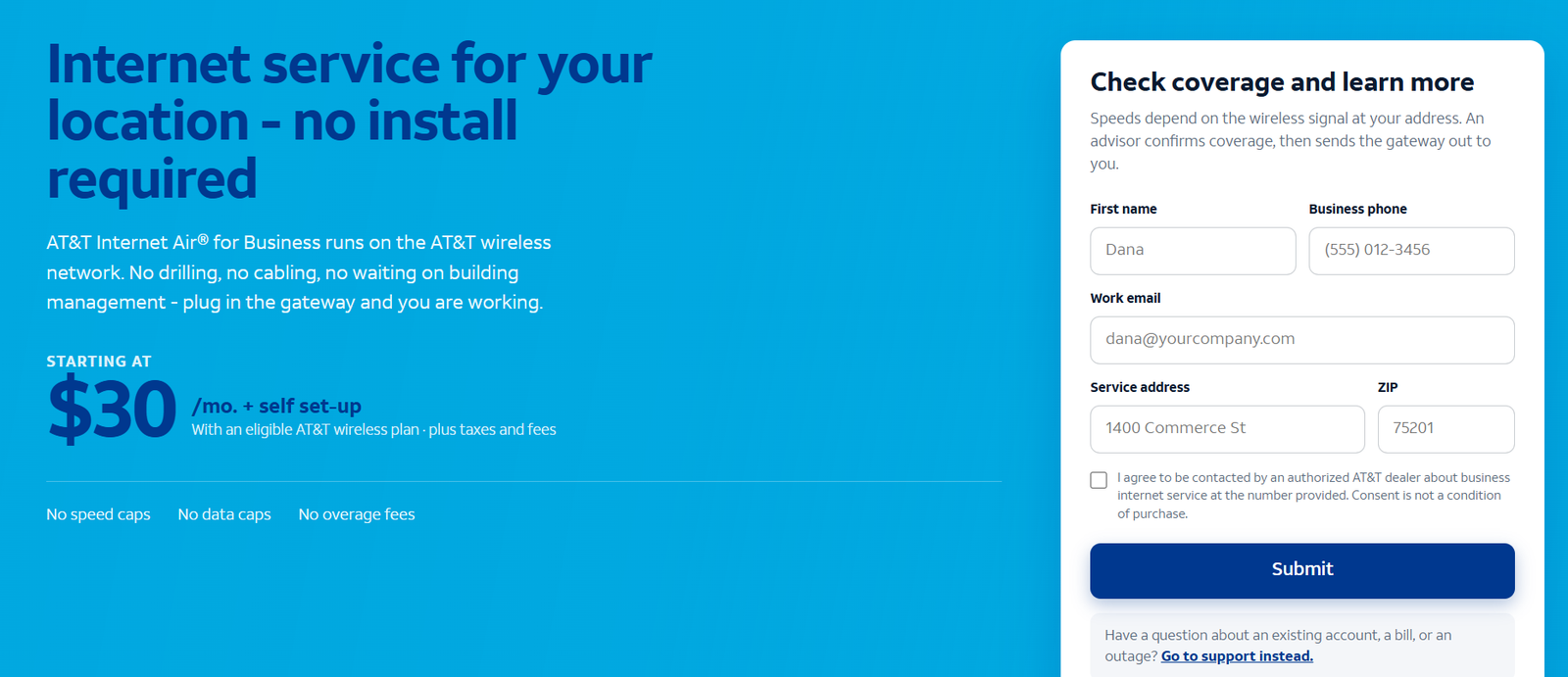
AT&T Internet Air for Business is AT&T’s 5G fixed-wireless business product: a compact gateway you plug in at your business location, self-install in minutes, and connect your office through over AT&T’s 5G network. There is no wired line to install and no technician appointment — which makes it one of the fastest ways to get a business online, especially in locations where wired options are slow or unavailable.
The lineup is simple — two plans. Standard lists at $65 per month and drops to $40 per month with an eligible AT&T wireless plan (the $25 reduction comes from a $5 AutoPay discount plus a $20 wireless discount). Premium lists at $105 per month and drops to $80 per month with the same eligible wireless bundle. Both prices assume AutoPay and paperless billing, and the bundled rates require maintaining the eligible AT&T Business wireless plan on the account.
The defining feature of both AT&T Internet Air plans is what they do not have: no speed caps, no data caps, and no overage fees. Your bill does not change because you used more data, and there is no meter running in the background. For businesses coming from capped plans — or from mobile hotspots where every gigabyte is priced — this is the single most liberating part of the product.
The difference between the two plans is priority. Premium includes 250 GB of AT&T Turbo for Business priority data per bill cycle: during times when the network is congested, your traffic is prioritized ahead of non-priority users for that 250 GB. After the 250 GB is used, your data may slow when the network is busy — but it is never cut off, never capped, and never billed extra. Standard has no priority allocation, so it is the first to feel congestion during peak hours.
Which plan fits whom? Standard at $40 bundled suits light-to-moderate offices: email, web apps, card processing, a few video calls. Premium at $80 bundled suits busier environments where consistent performance during peak hours matters — the priority data acts as insurance for your most important 250 GB each month. The $40 monthly gap between them is worth paying if your business cannot tolerate slowdowns at 2 p.m. on a Tuesday.
Two restrictions to know. First, AT&T Internet Air must be used at the qualified business address — it is fixed wireless, not a mobile hotspot you can carry between sites. Move it to an unqualified address and it will not work as intended. Second, speeds are “no speed cap” but not guaranteed: actual throughput depends on 5G signal strength, network congestion, and gateway placement at your location. A 30-day money-back guarantee gives you a risk-free window to test real performance where you work.
Internet Air vs Verizon 5G Bundled Pricing: With and Without a Wireless Plan
The AT&T Internet Air pricing story has two versions, and you should know both before comparing against Verizon. Without any wireless bundle, Standard is $65 per month and Premium is $105 per month (with AutoPay/paperless). These are the prices for a business that wants internet only and has no interest in AT&T mobile service — still reasonable for unlimited 5G business internet, but not the headline numbers.
With an eligible AT&T Business wireless plan, the math improves substantially: Standard falls to $40 per month and Premium to $80 per month. The discount stack is transparent — $5 for AutoPay plus $20 for the wireless bundle — and it applies every month you maintain both services. For businesses already running AT&T company phones, this is effectively free money: the wireless plan you already pay for unlocks $300 per year in internet savings on Standard.
One pricing nuance worth an honest mention: authorized AT&T dealers occasionally advertise Internet Air promos as low as $30 per month during sales events. Those are dealer-specific, time-limited promotions — not the standard offer — so treat them as a possible bonus rather than the expected price. The $40/$80 bundled rates are the numbers to plan around.
When you compare this against Verizon below, keep the bundle conditions symmetric: both carriers’ best prices require their own mobile plans. A business already on AT&T wireless will find AT&T’s bundle natural; a business on Verizon wireless will find Verizon’s credits natural. The switching math — what your mobile lines cost on each carrier — belongs in the comparison just as much as the internet prices.
How 5G Fixed Wireless for Business Works at Your Address
Understanding the technology prevents disappointment. 5G fixed wireless for business works by placing a gateway (a small router with a built-in 5G modem) at your location, ideally near a window facing the nearest tower. The gateway converts the 5G signal into Wi-Fi and Ethernet for your office network. Setup genuinely takes minutes — plug in power, position the device, connect your devices — and there is no drilling, no wall jacks, no waiting for a technician.
Performance, however, is location-dependent in a way wired internet is not. The same plan can deliver dramatically different speeds two blocks apart depending on tower distance, building materials (concrete and Low-E glass attenuate signal), and network load. This is why both AT&T and Verizon qualify addresses before selling: they check predicted signal strength at your location, and the 30-day guarantees exist so you can validate reality against the prediction.
Gateway placement matters more than most buyers expect. A gateway tucked in a back closet behind a metal filing cabinet will underperform the same gateway on a window sill facing the tower. During your trial period, test two or three placements and run speed tests at different times of day — morning, lunch rush, and evening — to see your real range before committing. A $30 stand or shelf near the right window can be worth more than a plan upgrade.
Finally, set expectations honestly: 5G fixed wireless for business is a superb solution for typical office workloads, but it is a shared, radio-based medium. It will not match fiber’s latency consistency or symmetrical uploads, and heavy uploaders (video production, large cloud backups) should keep that in mind. For everyone else — retail, professional offices, pop-ups, temporary sites — the combination of fast setup, no wiring, and unlimited data is genuinely compelling.
See current AT&T Internet Air plans and bundle pricing →
Verizon 5G Business Internet Plans and Pricing
Verizon 5G Business Internet is Verizon’s fixed-wireless business product and the most direct rival to AT&T Internet Air. Like AT&T’s offering, it is a self-installed 5G gateway for a fixed business address — no technician, no wiring — running over Verizon’s 5G network. Verizon’s differentiators are its tiered speed structure, its aggressive bundled pricing, and the longest price guarantee in the fixed-wireless category.
The lineup has three tiers with clearly stated speed targets: 100 Mbps at $69 per month, 200 Mbps at $99 per month, and 400 Mbps at $199 per month. Unlike AT&T’s two-plan structure (which differentiates on priority rather than speed), Verizon sells you a speed tier — you know roughly what throughput to expect, and you can step up a tier when the business outgrows the current one. That upgrade path is cleaner than anything in AT&T’s lineup for bandwidth-hungry offices.
The headline deal is the bundle: with a qualifying Verizon Business smartphone plan, a $30-per-month mobility credit plus a $4-per-month internet credit bring the 100 Mbps tier to an effective $35 per month. That is the lowest bundled price in this entire comparison — five dollars under AT&T’s $40 Standard bundle — and it is the number Verizon leads with for good reason. The credits require maintaining the qualifying smartphone plan, and the exact credit structure should be confirmed at order time since wireless promos rotate.
Verizon’s other standout term is the 10-year price guarantee, available to eligible new customers in select areas. Ten years of rate certainty is unmatched in this matchup — AT&T’s bundle discounts are larger in some configurations but depend on keeping the wireless plan, while Verizon’s guarantee locks the internet rate itself. For businesses signing long leases or building multi-year budgets, that guarantee has tangible financial-planning value.
A 30-day satisfaction guarantee backs the purchase, giving you a month to validate speeds at your address with an exit ramp. As with AT&T, the service must be used at the qualified business address, and actual speeds vary with signal strength, congestion, and gateway placement. Verizon qualifies addresses before sale, so the eligibility check doubles as a signal-strength sanity check.
Verizon’s honest limitations: the speed tiers are download targets on a shared wireless medium — real-world throughput varies, and uploads are a fraction of downloads (typical for fixed wireless). The $35 effective price requires the smartphone bundle; internet-only buyers pay $69 and up. And the 10-year guarantee’s fine print matters — “eligible new customers in select areas” means you must confirm your address qualifies during ordering rather than assuming it.
Verizon Business Internet Price Tiers Explained
Let us put the Verizon business internet price tiers under the microscope, because the three-tier structure invites a different kind of comparison than AT&T’s two plans. At $69 for 100 Mbps, Verizon’s entry tier is priced $4 above AT&T’s $65 Standard list — but $29 above AT&T’s $40 bundled Standard. The bundle is where Verizon claws it back: $35 effective with the smartphone credits versus AT&T’s $40 with the wireless discount. Net: Verizon wins the entry-level bundle comparison by $5 per month, or $60 per year.
The middle tier — 200 Mbps at $99 — has no direct AT&T equivalent. AT&T differentiates its plans by priority data rather than speed, so a business that specifically needs ~200 Mbps of throughput has a cleaner buying decision on Verizon: pick the tier, get the speed target. Whether that speed target holds at your address during peak hours is what the 30-day trial is for.
The top tier — 400 Mbps at $199 — is the fastest fixed-wireless option in this matchup and suits bandwidth-heavy small offices: think 20+ connected devices, constant video conferencing, and large downloads. AT&T’s Premium plan at $105 list ($80 bundled) undercuts it substantially on price but does not promise a speed tier — it promises priority data instead. These are genuinely different philosophies: Verizon sells speed, AT&T sells unlimited data with priority insurance.
The pricing takeaway: Verizon’s tiered structure rewards businesses that know their bandwidth needs and want a defined upgrade path, while its bundle credits make the entry tier the cheapest in the comparison. But every tier’s real-world value still depends on signal at your address — a 400 Mbps plan delivering 150 Mbps at a weak-signal location is worse value than a cheaper plan delivering its full target at a strong one. Test before you commit.
Verizon 5G Business Internet Plans vs AT&T on Price Guarantees
Price guarantees deserve a dedicated comparison because they are the fine-print feature that affects your costs for years. Verizon’s 10-year price guarantee — for eligible new customers in select areas — is the longest commitment to rate stability either provider offers in fixed wireless. If your address qualifies, your rate is locked for a decade, insulating you from the annual price creep that affects nearly every other telecom product.
AT&T’s answer to price certainty is structural rather than contractual: the bundle discount. At $40/$80 bundled, AT&T’s ongoing prices are low because the wireless discount renews monthly — but the discount depends on maintaining the eligible wireless plan, and list prices ($65/$105) are what you pay without it. There is no 10-year lock; there is a persistently low bundled rate. Different mechanism, similar practical effect for bundle-eligible buyers, weaker protection for internet-only buyers.
Which matters more depends on your planning horizon and carrier situation. A business already committed to Verizon mobile for the long term gets the best of both: the $35 effective entry price and the decade-long lock. A business on AT&T wireless gets AT&T’s low bundled rates with no long-term guarantee but also no long-term exposure beyond the bundle requirement. A business on neither carrier should price both bundles including the mobile lines — the “internet price” is only half the equation.
One caution that applies to every price guarantee in telecom: read the eligibility terms at order time. “Eligible new customers in select areas” is doing real work in Verizon’s offer — confirm your address qualifies, confirm what happens if you move, and confirm whether plan changes void the guarantee. A guarantee you do not qualify for is marketing; a guarantee you do qualify for is money.
Internet Air vs Verizon 5G: The Main Comparison Table
Here is the full internet air vs Verizon 5G side-by-side, with list and bundled prices, data policies, and the terms that matter. Prices checked October 2026; bundled rates require each carrier’s eligible mobile plan plus AutoPay/paperless — confirm at checkout.
| Dimension | AT&T Internet Air for Business | Verizon 5G Business Internet |
|---|---|---|
| Entry plan (list) | Standard $65/mo | 100 Mbps $69/mo |
| Entry plan (bundled) | Standard $40/mo | 100 Mbps $35/mo effective |
| Mid option | Premium $105/mo list, $80/mo bundled | 200 Mbps $99/mo |
| Top option | — (2 plans total) | 400 Mbps $199/mo |
| Data caps / overages | None — no caps, no overage fees | Tiered speeds; check plan terms at order |
| Priority data | Premium: 250 GB Turbo priority/bill cycle, then may slow when busy | Speed-tier based; no separate priority allocation advertised |
| Speed caps | None | Tier targets (100/200/400 Mbps) |
| Price guarantee | Ongoing bundle discount (requires wireless plan) | 10-year price guarantee (eligible new customers, select areas) |
| Trial period | 30-day money-back | 30-day satisfaction guarantee |
| Setup | Self-install gateway, fixed business address | Self-install gateway, fixed business address |
| Best for | Unlimited-data simplicity; priority during congestion | Lowest bundled price; defined speed tiers; long rate lock |
Three patterns emerge from the internet air vs Verizon 5G table. First, Verizon wins the entry-level bundle math ($35 vs. $40) and offers the only defined upgrade path to 400 Mbps. Second, AT&T wins data-policy simplicity — unlimited everything, no overages, with priority data as a paid upgrade rather than a speed tier as the product. Third, the guarantees reflect different philosophies: Verizon locks the rate for a decade where eligible; AT&T keeps the rate low through the bundle.
The row most buyers underweight is priority data. On a congested tower at peak hours, AT&T Premium’s 250 GB of Turbo priority is the difference between usable and frustrating — it is effectively congestion insurance. Verizon’s answer is the speed tier itself: buy 200 or 400 Mbps and your headroom absorbs congestion. Both approaches work; they just price the insurance differently.
Disclaimer: This article contains affiliate links to AT&T Business services. We may earn a commission if you purchase through them, at no extra cost to you. Ortelcom.com is an independent publisher and is not affiliated with or endorsed by AT&T. Pricing, speeds, and availability are not guaranteed, were checked in October 2026, and vary by address and promotions — please confirm all details before ordering. AT&T and all related marks are trademarks of their respective owners.
5G Fixed Wireless for Business: Speed and Reliability Compared
Speed comparisons in 5G fixed wireless for business need more nuance than wired comparisons, because the medium is shared radio spectrum. Verizon’s tier targets (100/200/400 Mbps) describe what the plan is provisioned for under good conditions; AT&T’s “no speed cap” describes the absence of an artificial limit rather than a promised speed. In practice, both deliver tens to hundreds of megabits depending on signal, and both slow during congestion — AT&T Premium’s priority data being the exception for its first 250 GB.
Reliability has two components: the connection staying up, and performance staying consistent. On uptime, both are solid — 5G gateways with battery backup options can even ride through short power outages, a genuine advantage over wired modems for retail point-of-sale continuity. On consistency, expect more variance than fiber or cable: a tower serving a packed stadium district at 7 p.m. will deliver less than the same tower at 7 a.m., and weather or new construction can shift signal over time.
For typical business workloads — email, cloud apps, card processing, video calls, guest Wi-Fi — both services are reliable enough that most offices will not think about the connection. The workloads that expose fixed wireless are the demanding ones: sustained multi-hundred-megabit uploads, ultra-low-latency trading or telehealth video, and 50+ concurrent heavy users. Those workloads belong on fiber; fixed wireless is the wrong tool regardless of which carrier sells it.
The practical reliability test is the one both carriers invite: use the 30-day guarantee as a measurement period. Run your actual peak-hour workloads, test video calls when the network is busiest, and try the gateway in two or three placements. A fixed-wireless connection that passes a two-week real-world trial at your address is a known quantity — and that is worth more than any advertised speed.
Data, Priority, and Overage Policies: Finding the Best 5G Business Internet
Data policy is where the best 5G business internet decision often gets made, because it determines whether your bill can surprise you. AT&T’s policy is the simplest in the category: no data caps, no speed caps, no overage fees on either plan. Use 50 GB or 5 TB — the bill is the same. For businesses with security cameras uploading 24/7, that simplicity is not just convenient; it is the difference between a predictable $40–$80 and a metered nightmare.
AT&T Premium’s 250 GB of Turbo priority data deserves a clear explanation, because “priority” is often misunderstood. It does not make your connection faster than the network allows — it moves your traffic ahead of non-priority traffic when the tower is congested. Think of it as a fast-pass lane that works only when there is a line. For the first 250 GB each bill cycle, your video calls and cloud apps get first dibs on tower capacity during busy hours; after that, you join the regular queue. Nothing is cut off and nothing is billed extra.
Verizon structures the tradeoff differently: instead of priority allocations, you buy speed tiers. A 400 Mbps tier has more headroom to absorb congestion than a 100 Mbps tier, so the “insurance” is built into the tier price. This is simpler to understand — bigger number, more headroom — but it means congestion protection costs $199 instead of $105/$80. Businesses should compare AT&T Premium ($80 bundled with priority) against Verizon’s 200 Mbps ($99) as the realistic mid-range congestion answer.
Neither provider in this matchup is reported to charge classic per-gigabyte overages on these business fixed-wireless plans, which is a meaningful consumer protection versus older mobile-broadband products. Still, “unlimited” in wireless always comes with network-management language — deprioritization thresholds, video optimization, and the like — so skim the plan’s network management disclosure during ordering. The headline is honest (no overage fees), and the fine print is worth ten minutes.
Internet Air vs Verizon 5G Availability and Setup
In the internet air vs Verizon 5G availability contest, there is no national winner — only a winner at your address. Both carriers have spent billions densifying 5G, but coverage quality varies block by block: tower placement, spectrum holdings, building density, and terrain all matter. A business in a strong-AT&T corridor may get superb Internet Air performance where Verizon is mediocre, and vice versa two miles away.
The buying process is identical on both sides and refreshingly simple: enter your business address, the carrier checks predicted 5G signal strength, and if you qualify, they ship the gateway. Self-installation takes minutes — power, placement near a window facing the tower, connect your network. No technician, no appointment window, no drilling. For new locations opening on tight timelines, this is fixed wireless’s killer feature against wired installs that can take weeks.
Both services share the fixed-address restriction: the gateway must be used at the qualified business address. This surprises some buyers who assume “wireless” means “mobile” — it does not. These are not hotspot devices for the road; they are address-qualified home-internet replacements. Multi-site businesses need one subscription per site, and moving locations means re-qualifying the new address.
Setup tip that applies equally to both: treat gateway placement as part of installation, not an afterthought. Test the gateway near different windows, ideally on the side of the building facing the nearest tower, and run speed tests at several times of day during your trial month. Signal bars on the gateway are a rough guide; sustained speed tests under your real workload are the truth. Fifteen minutes of placement testing routinely beats paying for a higher tier.
Best 5G Business Internet by Use Case
The retail shop or café: Card processing, a couple of cameras, guest Wi-Fi. Either service’s entry tier handles this easily. Pick by bundled price and signal: Verizon’s $35 effective entry is the cheapest credible option in the comparison; AT&T’s $40 Standard is five dollars more with unlimited-data simplicity. Test both signals if you can — the stronger tower wins.
The professional office (10–20 people): Email, cloud apps, all-day video calls. This is where AT&T Premium’s 250 GB of priority data earns its keep — $80 bundled buys congestion insurance for the hours when everyone is on camera simultaneously. Verizon’s 200 Mbps tier at $99 is the alternative for offices that prefer a defined speed target over a priority allocation.
The pop-up, seasonal, or temporary site: Fixed wireless was made for this. No wiring, no construction lead time, gateway ships to the address. Either provider works; choose by who qualifies the address with stronger predicted signal, and favor the 30-day guarantee as your exit ramp when the season ends.
The camera-heavy location (warehouse, lot, multi-camera retail): Continuous upstream video is the hardest workload for fixed wireless, and unlimited data is non-negotiable. AT&T’s no-cap, no-overage structure (either plan) is the safer pick here — camera uploads running 24/7 will not trigger surprise fees. Validate upstream throughput during the trial, and keep fiber on the wishlist if uploads saturate.
The budget-focused startup: Verizon’s $35 effective 100 Mbps tier (with the qualifying smartphone plan) is the lowest price in this matchup and hard to argue with for light workloads. Without a Verizon mobile plan, AT&T’s $40 bundled Standard (with AT&T wireless) or $65 list are the alternatives — run the full mobile-plus-internet math on both carriers before deciding.
The long-lease, planning-oriented business: If your address qualifies, Verizon’s 10-year price guarantee is genuinely unique — a decade of rate certainty has real budgeting value for franchises and multi-year leases. AT&T counters with lower ongoing bundled rates but no equivalent lock. Decide whether you value the lowest monthly number or the longest guaranteed number.
Who Should Choose Which in the Internet Air vs Verizon 5G Decision
Choose AT&T Internet Air for Business if: you want unlimited data with zero overage risk; your office needs consistent peak-hour performance (Premium’s 250 GB Turbo priority); you already have AT&T Business wireless and the $40/$80 bundle pricing is available to you; your workloads are upload-meaningful (cameras, cloud backup) and benefit from no-cap simplicity; or AT&T’s 5G signal is stronger at your address.
Choose Verizon 5G Business Internet if: you want the lowest bundled entry price ($35 effective with the smartphone plan); you prefer defined speed tiers with a clear 100 → 200 → 400 Mbps upgrade path; your address qualifies for the 10-year price guarantee and long-term rate certainty matters; you already have Verizon Business mobile; or Verizon’s 5G signal is stronger at your address.
Either is fine if: you run a light, download-centric office and both carriers show strong signal — in that case take the better bundled quote, confirm the trial terms, and validate with two weeks of real-world use. Both are self-installed, both carry 30-day guarantees, and both beat the old fallback of slow DSL or overpriced mobile hotspots by a wide margin.
The honest bottom line neither marketing page will give you: signal at your address outweighs every other factor in this decision. A $35 plan on a weak tower loses to a $40 plan on a strong one every time. Check both, trial the winner, and let your speed tests — not the brochures — make the final call.
5G Fixed Wireless for Business FAQs
Answers to the most common questions about 5G fixed wireless for business, with October 2026 pricing as checked.
What Is the Cheapest Way to Get the Best 5G Business Internet Price?
Bundle with the carrier’s mobile plan. Verizon’s 100 Mbps tier drops to an effective $35 per month with a qualifying Verizon Business smartphone plan ($30 mobility credit + $4 internet credit), and AT&T Internet Air Standard drops to $40 per month with an eligible AT&T wireless plan ($5 AutoPay + $20 wireless discount). Without bundles, expect $65–$69 at entry level. Always confirm current credits at order time — wireless promos rotate.
How Does Internet Air vs Verizon 5G Pricing Compare Tier by Tier?
AT&T sells two plans differentiated by priority: Standard $65 list ($40 bundled) and Premium $105 list ($80 bundled, with 250 GB Turbo priority data). Verizon sells three speed tiers: 100 Mbps $69, 200 Mbps $99, 400 Mbps $199 (before bundle credits). AT&T’s bundled prices undercut Verizon’s list prices, but Verizon’s $35 effective entry beats AT&T’s $40. Compare bundle-to-bundle if you will carry the carrier’s mobile lines, list-to-list if you will not.
Can I Take 5G Fixed Wireless for Business to Another Location?
No — and this is the most misunderstood restriction in the category. Both AT&T Internet Air and Verizon 5G Business Internet must be used at the qualified business address; they are fixed wireless, not mobile hotspots. Moving the gateway to a new address requires re-qualifying that address with the carrier. Multi-site businesses need a subscription per site.
Is 250 GB of Priority Data Enough on the Best 5G Business Internet Plans?
For most small offices, yes. The 250 GB of Turbo priority data covers the traffic most sensitive to congestion — video calls, cloud apps, VoIP — during busy hours, and typical office use rarely pushes 250 GB of priority-sensitive traffic in a month. Heavy bulk transfers (backups, large downloads) can run on the deprioritized remainder without issue since they are not latency-sensitive. Only exceptionally heavy real-time workloads would exhaust it.
Which Has the Better Guarantee: Internet Air vs Verizon 5G?
They guarantee different things. Verizon’s 10-year price guarantee (eligible new customers, select areas) is the strongest rate protection in fixed wireless — your price is locked for a decade where you qualify. AT&T’s protection is the 30-day money-back guarantee plus persistently low bundled rates, but no multi-year lock. If long-term budget certainty is your top criterion and your address qualifies, Verizon’s guarantee is unmatched; if lowest ongoing bundled cost matters more, AT&T’s $40/$80 rates lead.
Final Verdict: AT&T Internet Air vs Verizon 5G Business Internet
The AT&T Internet Air vs Verizon 5G Business Internet decision comes down to what you value most. Verizon brings the sharpest bundled price ($35 effective), the cleanest speed-tier upgrade path (100 → 200 → 400 Mbps), and a 10-year price guarantee no competitor matches. AT&T brings unlimited-data simplicity with no caps and no overages, a $40 bundled entry price, and Premium’s 250 GB of Turbo priority data for businesses that need guaranteed performance when the network is busy.
For most small offices choosing on value and simplicity, AT&T Internet Air for Business is the pick — especially the Premium tier at $80 bundled for teams that live on video calls. For buyers optimizing for the absolute lowest bundled price, a defined speed tier, or decade-long rate certainty at a qualifying address, Verizon 5G Business Internet earns the nod. Both are honest products with 30-day trials; neither will punish you for testing.
Whichever way you lean, do the two things that matter more than any comparison article: check both carriers’ 5G signal at your exact business address, and run a real two-week trial under your actual workload before committing. The best 5G business internet is the one that performs where you work — and now you have every number you need to choose it.

