
If you are choosing between AT&T Internet Air vs T-Mobile business internet for your company in 2026, the short answer is this: pick AT&T Internet Air for Business if you want no data caps, no overage fees, and priority data on the Premium tier — and pick T-Mobile 5G Business Internet if you want a five-year price guarantee and a genuinely portable option for teams on the move. Neither one is the “right” answer for every business, which is why the rest of this guide digs into the plans, pricing, data policies, and fine print that actually determine which one fits your operation.
Both services are 5G fixed wireless business internet: instead of a cable or fiber line being trenched to your building, a self-installed gateway connects to the carrier’s cellular network and broadcasts Wi-Fi to your office. That makes both fast to deploy, easy to relocate within a service area, and a real alternative for locations where wired business internet is slow, expensive, or simply unavailable. But the two carriers package the idea very differently — from how they price the plans to what happens when you hit heavy data use.
For the full three-carrier picture, see our best 5G business internet comparison.
In this 5G business internet comparison, we break down AT&T Internet Air pricing side by side with T-Mobile 5G business internet plans, explain the list-versus-bundled prices honestly, and show where each service wins on paper and where each one has real limitations. Everything below reflects pricing and plan details checked in October 2026 — confirm current offers at checkout, because promotions and address-level availability change.
For every rate in one place, see our AT&T Internet Air for Business pricing breakdown.
Before the deep dive, here is the head-to-head in one glance: AT&T Internet Air lists at $65/month (Standard) or $105/month (Premium), dropping to $40 or $80 with an eligible AT&T wireless plan, with no data caps and no overage fees on either tier. T-Mobile 5G Business Internet runs $35–$55/month with AutoPay and a voice line ($60–$80 without discounts) across its Rely, Amplified, and All-in tiers, plus portable AWAY plans starting at $110/month. T-Mobile locks your rate for five years; AT&T’s edge is Turbo priority data on Premium and zero overage risk.
For a closer look at the plans themselves, see our AT&T Internet Air for Business guide.
Below, we start with a full look at AT&T Internet Air for Business, then T-Mobile’s lineup, then the detailed side-by-side table, the key differences that matter in daily use, real-world scenarios, and answers to the questions business owners ask most.
Need business internet without the wait?
Check whether AT&T Internet Air for Business is available at your address and compare the Standard and Premium plans.
Check Internet Air Availability
<
AT&T Internet Air Pricing and Plans Explained
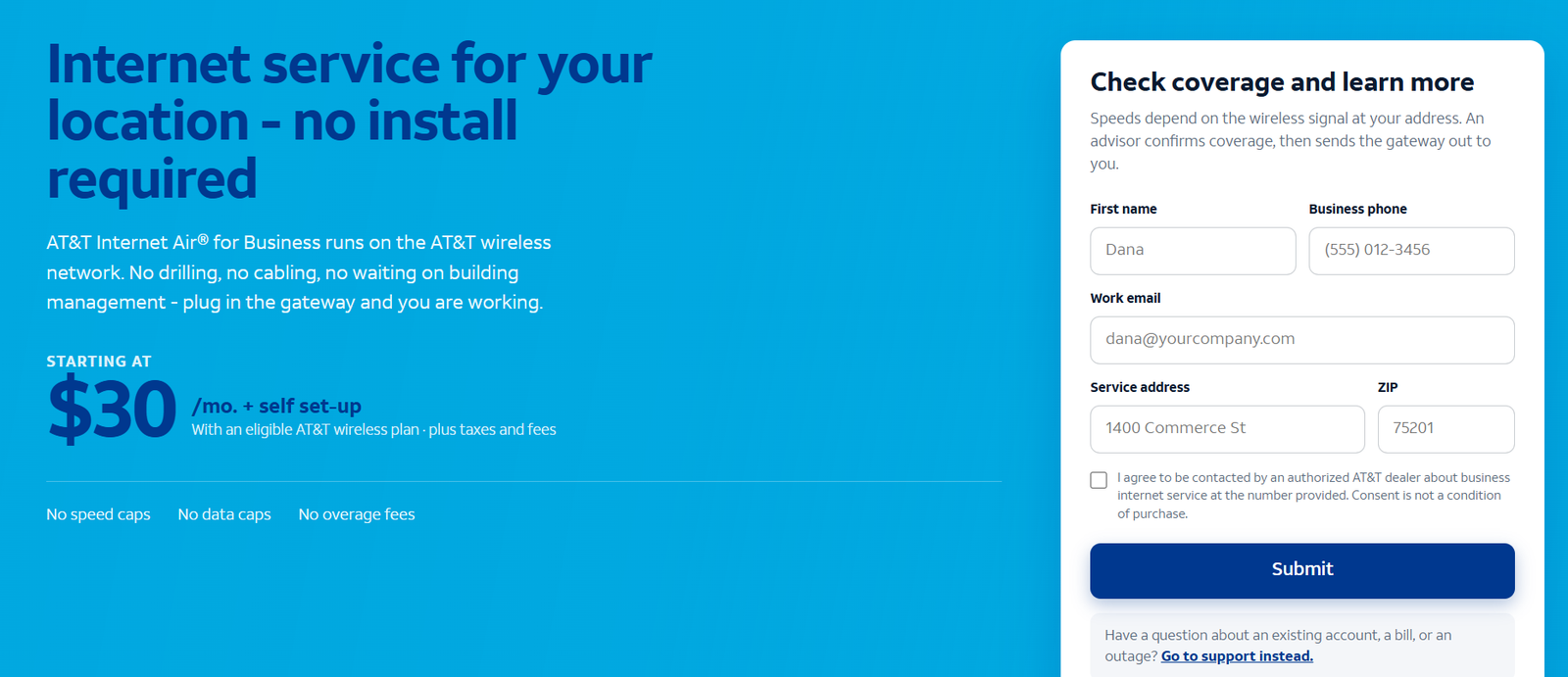
AT&T Internet Air for Business is AT&T’s fixed wireless internet product for business locations. It runs on AT&T’s cellular network, arrives as a self-setup gateway you plug in at your qualified business address, and is designed as a primary or backup connection for offices, retail spaces, and temporary sites. Unlike a mobile hotspot, it is provisioned for a fixed address — you do not get to carry it to job sites or take it on the road.
The lineup is simple: two tiers, Standard and Premium. The headline difference between them is priority data. Premium includes AT&T Turbo for Business priority — 250GB of priority data per bill cycle — which matters most in congested areas or during peak hours, when standard traffic can be slowed but priority traffic keeps moving. After that 250GB, Premium data may be slowed when the network is busy.
| AT&T Internet Air Plan | List Price | With Eligible AT&T Wireless Plan | Data Policy |
|---|---|---|---|
| Internet Air Standard | $65/month | $40/month | No data caps, no speed caps, no overage fees |
| Internet Air Premium | $105/month | $80/month | 250GB Turbo priority per bill cycle; no data caps or overage fees; may slow when network is busy after 250GB |
Pricing checked October 2026 — confirm at checkout. Bundled rates require an eligible AT&T wireless plan and AutoPay; availability varies by address.
Understanding the AT&T Internet Air pricing structure is important because the “list” and “bundled” prices are $25 apart. Standard lists at $65/month, but businesses that already carry an eligible AT&T wireless plan pay $40/month after a $5 AutoPay discount and a $20 wireless-bundle discount. Premium lists at $105/month and drops to $80/month with the same bundle. If your company already runs AT&T business wireless lines — which many small businesses do — the effective price is dramatically lower than the headline number.
What you do not pay for is almost as notable as what you do. Neither tier has a data cap, a speed cap, or overage fees. That is a genuine differentiator in the fixed wireless market, where “unlimited” plans often come with deprioritization thresholds buried in the fine print. With Internet Air, heavy months cost the same as light months. For businesses that move a lot of data — cloud backups, video conferencing all day, point-of-sale systems syncing constantly — that predictability is worth real money.
Setup is designed to be fast. The gateway ships to you, you plug it in and follow the guided setup, and you are online without a technician appointment. AT&T backs the service with a 30-day money-back guarantee, which lowers the risk of trying fixed wireless at your location: if the signal at your address does not deliver what your business needs, you have a month to find out.
Strengths of AT&T Internet Air for Business, summarized: no data caps and no overage fees on either tier; 250GB of Turbo priority data on Premium for congested-area performance; steep bundled discounts ($25/month off) for existing AT&T wireless customers; self-installation with no technician visit; and a 30-day money-back guarantee that makes the first month a low-risk trial.
The limitations are equally worth knowing before you order. First, the service is fixed to your qualified business address — it is not a mobile product, so it cannot follow crews to job sites or serve a food truck on the move. Second, AT&T does not publish fixed speed tiers or guaranteed speed ranges for Internet Air; your actual speeds depend on signal strength and network conditions at your address, so the 30-day guarantee is doing real work here — test at your actual location. Third, the Turbo priority benefit only applies to the first 250GB per bill cycle on Premium; after that, data may be slowed when the network is busy. Fourth, the best prices require an eligible AT&T wireless plan plus AutoPay — at list price, the plans are meaningfully more expensive. Finally, as with any fixed wireless service, availability is address-specific: enter your exact business address before you plan around it.
Check AT&T Internet Air availability and current pricing for your business address
T-Mobile 5G Business Internet Plans and Prices
T-Mobile 5G Business Internet is T-Mobile’s fixed wireless offering for companies, built on its 5G network and shipped as a gateway with built-in Wi-Fi. Like AT&T’s product, it is self-installed and provisioned for a business address — with one big exception that we will get to: the AWAY plans, which are designed for genuine portability.
The current T-Mobile 5G business internet plans come in three tiers. Rely is $35/month with AutoPay and any voice line ($60/month without discounts). Amplified is $45/month with AutoPay and a voice line ($70/month without discounts) and steps up to a Wi-Fi 7 gateway. All-in is $55/month with AutoPay and a voice line ($80/month without discounts), also with a Wi-Fi 7 gateway. All three tiers include unlimited data and carry T-Mobile’s 5-year price guarantee on talk, text, and data. (T-Mobile previously sold business internet under names such as Small Business Internet “Grow” and Unlimited 5G Business Internet — the lineup above reflects the current tier names.) T-Mobile has published typical speeds of 91–361 Mbps down and 21–38 Mbps up for its 5G business internet service.
| T-Mobile Plan | Monthly Price | Notes |
|---|---|---|
| Rely | $35/mo with AutoPay + any voice line ($60/mo without discounts) | Entry tier; unlimited data |
| Amplified | $45/mo with AutoPay + voice line ($70/mo without discounts) | Unlimited data; Wi-Fi 7 gateway |
| All-in | $55/mo with AutoPay + voice line ($80/mo without discounts) | Unlimited data; Wi-Fi 7 gateway |
| AWAY 200GB | $110 | Portable — true mobile use |
| AWAY Unlimited | $160 | Portable — true mobile use |
Pricing checked October 2026 — confirm at checkout. Prices without discounts apply without AutoPay and a qualifying voice line; availability varies by address.
The T-Mobile business internet price story has two halves: the plan price and the price promise. On price, the bundled tiers are aggressive — $35 to $55 a month with AutoPay and a voice line is the cheapest entry point among the major carriers’ business fixed wireless lineups. But notice the without-discounts column: without AutoPay and a qualifying voice line, those same tiers run $60 to $80, which reframes the comparison. If your business does not use T-Mobile voice service, budget on the $60–$80 numbers, not the bundled ones.
On the price promise, T-Mobile offers a five-year price guarantee on talk, text, and data with its business internet, which is the longest fixed price lock among the mainstream options and a genuine budgeting advantage for multi-year planning. There is also no annual contract on the fixed plans, so you are not trading flexibility for the rate lock — you can leave, but while you stay, the rate is protected.
The AWAY plans deserve special attention because nothing in AT&T’s Internet Air lineup matches them. AWAY is T-Mobile’s portable business internet: 200GB for $110/month or unlimited data for $160/month, designed to travel with mobile teams, temporary sites, and vehicles. If your business model includes work outside a fixed address — field crews, pop-up retail, event teams, mobile services — AWAY is a capability AT&T Internet Air simply does not offer, since Internet Air is provisioned to a single qualified address.
Strengths of T-Mobile 5G Business Internet, summarized: the five-year price guarantee on talk, text, and data is the strongest rate protection in this comparison; bundled tiers start at just $35/month with AutoPay and a voice line; published typical speed ranges (91–361 Mbps down) give you honest expectations; Wi-Fi 7 gateways on the Amplified and All-in tiers; no annual contract on fixed plans; and AWAY plans deliver true portability that fixed-only competitors cannot match.
The limitations matter too. The typical speeds are ranges, not guarantees — 91 Mbps and 361 Mbps are very different workdays, and your address determines where you land. The attractive bundled prices require AutoPay plus a qualifying voice line; without those discounts, pricing is $25/month higher per tier ($60–$80). The fixed plans are still address-tied — only AWAY travels, and AWAY is priced like a premium mobile product ($110–$160/month), not like home internet. And as with any cellular-based service, congestion management during peak hours is part of the deal, so businesses with latency-sensitive work should test during their actual busy periods.
5G Business Internet Comparison: AT&T vs T-Mobile Side by Side
The table below puts the AT&T Internet Air vs T-Mobile business internet decision into a single view. Use it to match each service against what your business actually needs — price certainty, data policy, portability, or raw speed.
| Factor | AT&T Internet Air for Business | T-Mobile 5G Business Internet |
|---|---|---|
| Entry price (bundled) | $40/month (Standard, with eligible wireless plan) | $35/month (Rely, with AutoPay + voice line) |
| Entry price (standalone) | $65/month (Standard list) | $60/month (Rely, without discounts) |
| Top fixed tier | $105/month list, $80 bundled (Premium) | $80/month (All-in, without discounts) |
| Data caps | None on either tier | No hard caps on unlimited fixed tiers |
| Overage fees | None | None on unlimited tiers |
| Priority data | 250GB Turbo priority per bill cycle (Premium only) | Not published as a separate priority bucket |
| Typical speeds published | Not published; varies by address | 91–361 Mbps down, 21–38 Mbps up |
| Portability | Fixed address only | Fixed plans address-tied; AWAY plans portable ($110–$160) |
| Price guarantee | Not a headline feature | 5-year price guarantee (talk/text/data) |
| Annual contract | 30-day money-back guarantee offered | No annual contract on fixed plans |
| Setup | Self-install gateway | Self-install gateway (Wi-Fi 7 on All-in) |
| Best for | Heavy data users; existing AT&T wireless customers | Price certainty; mobile/portable use via AWAY |
Comparison based on pricing and plan details checked October 2026 — confirm at checkout, as promotions, speeds, and address-level availability change.
Read the table as a decision tool, not a scoreboard. If your deciding factor is the lowest possible monthly cost with a voice bundle, T-Mobile’s Rely at $35/month undercuts AT&T’s $40 bundled Standard. If your deciding factor is never worrying about data limits or overage charges, AT&T’s explicit no-caps-no-overages policy on both tiers is the cleaner promise. If your team works from vans, job sites, or pop-up locations, T-Mobile’s AWAY plans are the only option of the two that follows you — and that single difference can settle the whole comparison for mobile businesses.
Disclaimer: This article contains affiliate links to AT&T Business services. We may earn a commission if you purchase through them, at no extra cost to you. Ortelcom.com is an independent publisher and is not affiliated with or endorsed by AT&T. Pricing, speeds, and availability are not guaranteed, were checked in October 2026, and vary by address and promotions — please confirm all details before ordering. AT&T and all related marks are trademarks of their respective owners.
Internet Air vs T-Mobile: Key Differences That Matter Daily
The side-by-side table tells you what each plan costs and includes. The sections below explain what those differences feel like in day-to-day business use — because the plan you pick has to survive your busiest week, not just look good on a spec sheet.
Internet Air vs T-Mobile on Data Caps and Overage Fees
AT&T Internet Air’s clearest advantage is its data policy: no data caps, no speed caps, and no overage fees on either tier. You can run cloud backups overnight, host all-day video calls, and stream training content without watching a meter. T-Mobile’s unlimited fixed tiers also avoid hard caps and overage fees, so in practice both services are “unlimited” — but AT&T states the no-caps-no-overages policy as a headline feature, while T-Mobile’s unlimited tiers operate under typical cellular network management. For data-heavy operations like design studios pushing large files or medical offices syncing imaging, AT&T’s explicit policy is the safer bet.
The nuance is priority. AT&T’s Premium tier gives you 250GB of Turbo priority data per bill cycle — traffic that gets preferential treatment when the network is congested. After 250GB, Premium data may slow during busy periods. T-Mobile does not market a separate priority bucket on its fixed plans. If your office sits in a dense area where evening congestion is real, that Turbo priority is worth weighing seriously, especially for latency-sensitive work like VoIP phone systems.
T-Mobile Business Internet Price Guarantee vs AT&T Internet Air Pricing
Here the advantage flips. T-Mobile’s five-year price guarantee means the rate you sign up for is the rate you keep — a powerful tool for multi-year budgeting, and something no other carrier in this 5G business internet comparison matches on fixed wireless. AT&T Internet Air pricing is competitive, especially bundled ($40/$80 with an eligible wireless plan), but AT&T does not headline a multi-year price lock, so long-term cost planning involves more uncertainty.
Do the bundle math carefully either way. AT&T’s discounts require an eligible AT&T wireless plan plus AutoPay — a $25/month swing per tier. T-Mobile’s cheapest tiers require AutoPay plus a qualifying voice line — also roughly a $25/month swing between bundled and without-discounts pricing. Businesses already consolidated on one carrier’s wireless service get the best of both worlds; businesses on the other carrier’s wireless (or on no business wireless at all) should compare using the standalone prices, where the gap between the two services narrows considerably.
Internet Air vs T-Mobile for Portable and Multi-Location Businesses
This is the most decisive difference in the whole comparison, and for some businesses it ends the debate immediately. AT&T Internet Air is provisioned to a single qualified business address. You cannot take it to a second location, a job site, or a vehicle. T-Mobile’s fixed plans are also address-tied — but the AWAY lineup (200GB for $110/month, unlimited for $160/month) is built for exactly that mobile use case. A contractor running a site office for three months, a retailer doing a seasonal pop-up, or an event company working weekends all get a native solution from T-Mobile and none from AT&T’s Internet Air.
For multi-location businesses with fixed sites, the calculus is different: you would order a separate fixed plan per address from either carrier. The question then becomes which carrier has better coverage at each of your addresses — and that is genuinely address-specific. Run both carriers’ availability checks for every location before committing, because a great plan on a weak signal is a bad plan.
T-Mobile Internet for Small Business Speeds: Reading the Ranges Honestly
T-Mobile publishes typical speeds of 91–361 Mbps download and 21–38 Mbps upload for its small-business fixed tiers. That transparency is useful — but read it as a range, not a promise. 91 Mbps down handles a small office comfortably (video calls, cloud apps, POS); 361 Mbps down handles a busy one. Where your address falls in that range depends on distance to the tower, building materials, and local congestion. AT&T does not publish equivalent typical speeds for Internet Air, which makes T-Mobile easier to plan around — but also means AT&T’s 30-day money-back guarantee is your practical substitute for a speed spec: test at your address during your actual working hours.
For most small-business workloads — email, cloud software, video conferencing, card payments, web browsing — anything above roughly 50 Mbps down and 10 Mbps up is comfortable, and both services clear that bar at most addresses. The businesses that should scrutinize speeds hardest are the ones with unusual demands: 4K video production uploads, large CAD file transfers, or dozens of simultaneous video streams. Those businesses should test before they commit, regardless of which carrier they lean toward.
T-Mobile Internet for Small Business: Real-World Scenarios
Specs only go so far. Here is how the AT&T Internet Air vs T-Mobile business internet choice plays out in five common small-business situations.
Scenario 1: The professional office (10–25 people). An accounting firm, law office, or agency running cloud software and video calls all day. Data use is heavy but the address is fixed. This is AT&T Internet Air Premium territory: no data caps or overage fees remove the billing anxiety, and 250GB of Turbo priority keeps VoIP calls clean during congested hours. T-Mobile’s Unlimited at $70/month is a strong alternative, especially with the five-year price guarantee — choose it if long-term rate certainty matters more to your budgeting than priority data.
Scenario 2: The retail store or restaurant. POS terminals, guest Wi-Fi, security cameras, and music streaming — steady, moderate use, and downtime directly costs revenue. Either service works as a primary connection where wired options are weak, and both work well as a backup to cable or fiber. T-Mobile’s lower bundled entry price ($35–$45/month with AutoPay + a voice line) is attractive for a backup role; AT&T’s no-overage policy is attractive if the connection becomes the primary during an outage and data spikes.
Scenario 3: The mobile or seasonal business. Food trucks, contractors, event companies, pop-up retail. AT&T Internet Air cannot serve this use case — it is fixed to one address. T-Mobile AWAY (200GB at $110/month or unlimited at $160/month) is purpose-built for it. This scenario is not close: if portability is a requirement, T-Mobile is the only answer in this comparison.
Scenario 4: The business with terrible wired options. Rural offices, older buildings, or areas where the only wired choice is slow DSL or overpriced cable. Both fixed wireless services can be transformative here — self-installed, no construction, online in days. Check both carriers’ coverage at the exact address, test during the money-back or trial window, and pick whichever delivers the stronger, more consistent signal. Price differences are secondary to actually working.
Scenario 5: The backup connection. A business with decent primary internet that needs failover for outages. Both services suit this role, and the math favors the cheapest reliable option. T-Mobile’s bundled Rely or Amplified tiers ($35–$45/month with a voice line) are hard to beat on price for a standby connection. AT&T Internet Air Standard at $40/month bundled is equally compelling if you already carry AT&T wireless lines — and its no-caps policy means a week-long primary outage will not generate a surprise bill.
Who Should Choose AT&T Internet Air vs T-Mobile Business Internet
Pulling the scenarios and specs together, here is the decision in plain terms. Choose AT&T Internet Air for Business if: your monthly data use is heavy or unpredictable and you want zero overage risk; your office is in a congested area where Premium’s 250GB of Turbo priority data will protect call and meeting quality; your company already uses AT&T business wireless (unlocking the $40/$80 bundled rates); or you want a fixed-location connection with a 30-day money-back guarantee as your risk hedge.
Choose T-Mobile 5G Business Internet if: multi-year price certainty is a priority (the five-year price guarantee is unmatched); any part of your operation is mobile, seasonal, or temporary (AWAY is the only portable option here); you want published typical speed ranges to plan around; you already use T-Mobile voice lines (unlocking $35–$55/month bundled tiers, with a Wi-Fi 7 gateway on Amplified and All-in); or you prefer no annual contract with your rate still protected.
Choose based on address, not brand loyalty, if: you are in an area where one carrier’s 5G coverage clearly beats the other’s at your specific location. Run both availability checks, and if possible, test during the trial or money-back window at your busiest hours. The best plan on paper is worthless on a weak signal — and both carriers’ fixed wireless lives or dies on the signal at your door.
See current AT&T Internet Air offers and check your business address
AT&T Internet Air vs T-Mobile Business Internet: FAQs
Does AT&T Internet Air pricing change if I don’t have an AT&T wireless plan?
Yes. The advertised $40/month (Standard) and $80/month (Premium) rates require an eligible AT&T wireless plan plus AutoPay — the $5 AutoPay discount and $20 wireless-bundle discount together take $25 off the list prices of $65 and $105. Without an eligible wireless plan, you pay the list price. If your business already runs AT&T wireless lines, the bundled rate is the real price; if it does not, compare using $65/$105 against T-Mobile’s standalone tiers.
Which T-Mobile 5G business internet plans include a portable option for teams on the move?
The standard T-Mobile 5G business internet plans (Rely, Amplified, All-in) are provisioned for a fixed business address. Portability comes from the separate AWAY lineup: 200GB for $110/month or unlimited data for $160/month, designed for mobile teams, temporary sites, and vehicles. AWAY is the answer if your internet needs to travel; the fixed plans are not.
Is the T-Mobile business internet price really guaranteed for five years?
T-Mobile advertises a five-year price guarantee on talk, text, and data with its business internet plans, meaning your rate is protected from increases for five years. It is the longest price lock among the major carriers’ business fixed wireless offers and a legitimate budgeting advantage. As with any carrier promise, confirm the guarantee’s exact terms for your specific plan at checkout, since promotions and plan structures can change.
Can I move Internet Air vs T-Mobile fixed equipment to a second office?
Neither carrier’s standard fixed wireless plan is designed for that. AT&T Internet Air is provisioned to a single qualified business address, and T-Mobile’s fixed 5G business internet plans are likewise address-tied. Moving the gateway to another location may violate the service terms and will likely perform poorly if the new address was never qualified. For a second fixed site, order a separate plan for that address; for mobile use, T-Mobile’s AWAY plans are the purpose-built option.
Which 5G business internet comparison factor matters most for video calls and VoIP?
Consistency beats peak speed. Look for priority data and congestion behavior first: AT&T Internet Air Premium’s 250GB of Turbo priority data per bill cycle is specifically designed to protect performance when the network is busy, which is exactly when VoIP calls and video meetings suffer most. Also consider testing during your actual peak hours — a connection that is fast at midnight but congested at 2 PM will frustrate a call-heavy team regardless of the plan’s headline features.
Is T-Mobile internet for small business good enough as a primary connection?
For many small businesses, yes — with the usual fixed wireless caveat that it depends on the signal at your address. T-Mobile’s published typical speeds of 91–361 Mbps down and 21–38 Mbps up comfortably cover email, cloud apps, video conferencing, POS systems, and guest Wi-Fi for a small team. Businesses with extreme upload needs or dozens of concurrent heavy users should test first, and any business where an outage stops revenue should consider keeping a backup connection regardless of which carrier is primary.
Internet Air vs T-Mobile: Final Verdict for 2026
There is no universal winner in the AT&T Internet Air vs T-Mobile business internet matchup — there is only the right pick for your situation. Choose AT&T Internet Air for Business if you want the cleanest data policy in fixed wireless (no caps, no overages), Turbo priority data on Premium for congested areas, and the steep $25/month bundled discount as an existing AT&T wireless customer. Choose T-Mobile 5G Business Internet if you value the five-year price guarantee, need a portable AWAY option for mobile work, or want the lowest bundled entry price with a modern Wi-Fi 7 gateway on the All-in tier.
Whichever way you lean, do two things before ordering: check address-level availability with both carriers, and test during your real working hours inside the trial or money-back window. Fixed wireless is a location product — the signal at your door decides everything. Get those two steps right, and either service can be an excellent, contract-light foundation for your business internet in 2026.
Check AT&T Internet Air for Business pricing and availability at your address

