
Shopping for the best 5G business internet in 2026? The three major carriers — AT&T, Verizon, and T-Mobile — all sell 5G fixed wireless internet for businesses, and on the surface the pitches sound identical: fast setup, no technician visit, a gateway that turns a cellular signal into office Wi-Fi. But the plans, prices, data policies, and price guarantees underneath are genuinely different, and the right choice depends on what your business values most. Here is the honest short answer: choose AT&T Internet Air if you want no data caps and no overage fees with Turbo priority data on the Premium tier; choose Verizon 5G Business Internet if you want the longest price guarantee in the industry (10 years) with clearly tiered speeds; and choose T-Mobile 5G Business Internet if you want a five-year price guarantee plus a truly portable AWAY option for mobile teams. There is no single “best overall” winner — only the best fit for your situation.
New to the category? Start with our explainer on what 5G business internet is.
5G fixed wireless business internet has matured into a legitimate alternative to wired connections. For offices, retail stores, restaurants, and temporary sites, it offers something cable and fiber often cannot: deployment in days instead of weeks, no construction, and easy relocation. It is also the answer to the growing “business internet without cable” search — companies that are done with coaxial price hikes, long contracts, and installation windows.
For a closer look at the AT&T plans themselves, see our AT&T Internet Air for Business guide.
This guide compares all three carriers head to head: AT&T Internet Air for Business, Verizon 5G Business Internet, and T-Mobile 5G Business Internet. You will find per-carrier plan breakdowns, a full 5G business internet price comparison table, the key differences that matter in daily use, real-world scenarios, best-for-X verdicts, and answers to common questions. Pricing and plan details were checked in October 2026 — confirm everything at checkout, since promotions and address-level availability change.
Need business internet without the wait?
Check whether AT&T Internet Air for Business is available at your address and compare the Standard and Premium plans.
AT&T’s 5G Fixed Wireless Business Option: Internet Air Plans and Pricing
 For the direct AT&T-versus-Verizon matchup, see our AT&T Internet Air vs Verizon 5G Business Internet comparison.
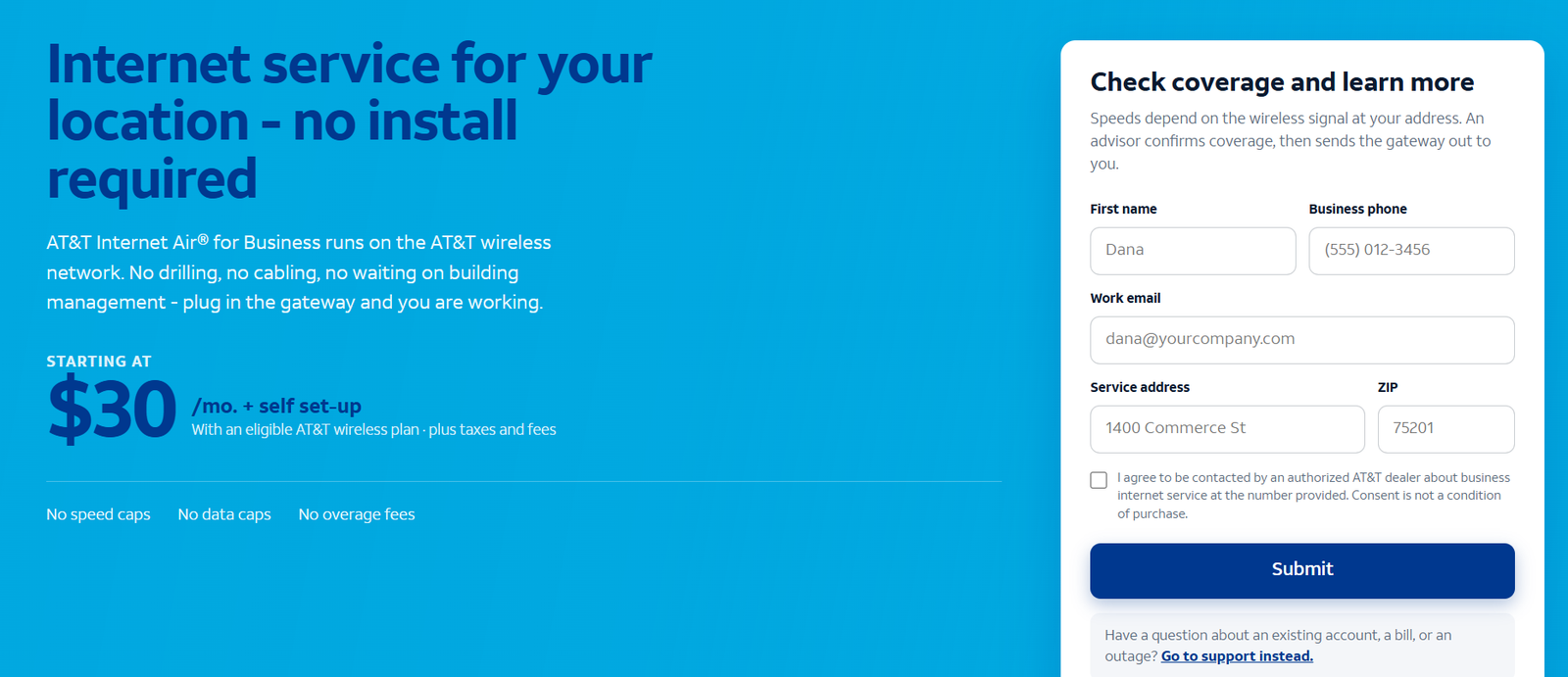
AT&T Internet Air for Business is AT&T’s fixed wireless entry: a self-installed gateway that connects to AT&T’s cellular network at your qualified business address. Two tiers, one clear differentiator — priority data on Premium.
| AT&T Internet Air Plan | List Price | With Eligible AT&T Wireless Plan | Data Policy |
|---|---|---|---|
| Standard | $65/month | $40/month | No data caps, no speed caps, no overage fees |
| Premium | $105/month | $80/month | 250GB Turbo for Business priority per bill cycle; no caps or overages; may slow when network is busy after 250GB |
Pricing checked October 2026 — confirm at checkout. Bundled rates require an eligible AT&T wireless plan and AutoPay; availability varies by address.
The bundled discount is the story here: $25/month off each tier ($5 AutoPay + $20 wireless discount) for businesses already on AT&T business wireless. At $40/month bundled, Standard is the cheapest entry point among the three carriers’ headline business tiers for existing wireless customers — and it carries the cleanest data policy in this entire comparison, with no caps and no overages on either tier.
Premium’s 250GB of Turbo priority data per bill cycle is AT&T’s answer to congestion. In busy areas or peak hours, priority traffic keeps moving while standard traffic may slow. After the 250GB, Premium data may be slowed when the network is busy — so the priority benefit is real but finite. Neither tier publishes fixed speed tiers, so actual performance depends on signal strength at your address; the 30-day money-back guarantee is your practical safety net for testing.
Limitations to weigh: the service is fixed to your qualified business address — no portable use. The best prices require the wireless bundle. And without published speed ranges, you are buying based on the data policy and the trial period rather than a speed spec, which suits heavy-data businesses more than speed-sensitive ones.
Check AT&T Internet Air availability and current business pricing
Verizon 5G Fixed Wireless Business Internet: Tiers and Prices
Verizon 5G Business Internet takes a different approach from its rivals: clearly tiered, speed-named plans. Instead of “standard” and “premium” labels, you pick the speed tier your business needs — 100, 200, or 400 Mbps — which makes capacity planning unusually straightforward for a fixed wireless product.
| Verizon 5G Business Internet Plan | Monthly Price | Advertised Speed |
|---|---|---|
| 100 Mbps | $69/month | Up to 100 Mbps |
| 200 Mbps | $99/month | Up to 200 Mbps |
| 400 Mbps | $199/month | Up to 400 Mbps |
Pricing checked October 2026 — confirm at checkout. Effective pricing can drop to $35/month with a qualifying Verizon smartphone plan; availability varies by address.
Two headline features set Verizon apart in this 5G business internet price comparison. First, the price guarantee: 10 years for eligible new customers in select areas — double T-Mobile’s five-year guarantee and the longest rate lock any major carrier offers on business fixed wireless. For businesses that plan infrastructure on decade-long horizons, that certainty is unmatched. Second, the bundle math: with a qualifying Verizon smartphone plan, the effective price can fall to $35/month, which undercuts every rival’s entry tier.
The tiered structure is itself a strength. A 10-person office that needs a reliable 100 Mbps can buy exactly that; a busier operation can step to 200 or 400 Mbps without guessing what “premium” means. Verizon also offers a 30-day satisfaction guarantee, giving you a trial window to validate performance at your address.
Limitations to weigh: the 10-year price guarantee applies to eligible new customers in select areas — confirm your address and eligibility rather than assuming it. The $35 effective price requires the qualifying smartphone plan; without it, you pay the tier list prices of $69–$199. And as with all fixed wireless, “up to” speeds depend on signal and congestion at your location, so the satisfaction-guarantee window is the time to test during your actual busy hours.
T-Mobile 5G Fixed Wireless Business Internet: Plans and Prices
T-Mobile 5G Business Internet fields the broadest lineup of the three carriers: multiple fixed tiers, aggressive bundled pricing, and the only truly portable option in this comparison — the AWAY plans.
The current fixed tiers are Rely at $35/month with AutoPay and any voice line ($60/month without discounts), Amplified at $45/month with AutoPay and a voice line ($70/month without discounts) with a Wi-Fi 7 gateway, and All-in at $55/month with AutoPay and a voice line ($80/month without discounts), also with a Wi-Fi 7 gateway. All three include unlimited data and carry a 5-year price guarantee on talk, text, and data. (T-Mobile previously sold business internet under names such as Small Business Internet “Grow” and Unlimited 5G Business Internet.)
| T-Mobile Plan | Monthly Price | Notes |
|---|---|---|
| Rely | $35/mo with AutoPay + any voice line ($60/mo without discounts) | Entry tier; unlimited data |
| Amplified | $45/mo with AutoPay + voice line ($70/mo without discounts) | Unlimited data; Wi-Fi 7 gateway |
| All-in | $55/mo with AutoPay + voice line ($80/mo without discounts) | Unlimited data; Wi-Fi 7 gateway |
| AWAY 200GB | $110 | Portable — true mobile use |
| AWAY Unlimited | $160 | Portable — true mobile use |
Pricing checked October 2026 — confirm at checkout. Prices without discounts apply without AutoPay and a qualifying voice line; availability varies by address.
T-Mobile’s headline advantages: a five-year price guarantee on talk, text, and data (second only to Verizon’s ten), no annual contract on fixed plans, published typical speed ranges for honest expectations, and bundled entry pricing as low as $35/month with AutoPay and a voice line. Wi-Fi 7 gateways on the Amplified and All-in tiers are the most modern equipment in this comparison — relevant if you are connecting many devices or want the latest Wi-Fi standard without buying your own hardware.
The AWAY plans are T-Mobile’s unique card: 200GB for $110/month or unlimited for $160/month, built for mobile teams, temporary sites, and vehicles. Neither AT&T Internet Air nor Verizon’s 5G business internet offers a native portable equivalent — their fixed plans are address-tied. If portability is a requirement, T-Mobile wins this category by default.
Limitations to weigh: the cheapest prices require AutoPay and a qualifying voice line — without those discounts, the tiers run $60–$80, a $25/month swing. Typical speeds are ranges (91–361 Mbps down), not guarantees, so your address determines your reality. And AWAY’s portability comes at a premium price; it is a mobile product priced like one, not a cheap second line.
5G Business Internet Price Comparison: All Three Carriers Side by Side
This is the core of the AT&T vs Verizon vs T-Mobile decision. The table below compares every factor that actually changes your monthly bill or your daily experience — not just the headline price, but the data policy, the price lock, portability, and what happens when the network gets busy.
| Factor | AT&T Internet Air | Verizon 5G Business Internet | T-Mobile 5G Business Internet |
|---|---|---|---|
| Entry price (bundled) | $40/mo (Standard, w/ eligible wireless plan) | $35/mo effective (w/ qualifying smartphone plan) | $35/mo (Rely, w/ AutoPay + voice line) |
| Entry price (standalone) | $65/mo (Standard list) | $69/mo (100 Mbps) | $60/mo (Rely, without discounts) |
| Mid tier | $105/mo list, $80 bundled (Premium) | $99/mo (200 Mbps) | $70/mo (Amplified, without discounts) |
| Top tier | — (two-tier lineup) | $199/mo (400 Mbps) | $80/mo (All-in, without discounts; Wi-Fi 7 gateway) |
| Data caps / overages | None on either tier | No overage-style caps advertised on tiers | No hard caps on unlimited tiers |
| Priority data | 250GB Turbo priority/bill cycle (Premium) | Not marketed as a separate bucket | Not marketed as a separate bucket |
| Speed transparency | No published speed tiers; varies by address | Speed-named tiers: 100 / 200 / 400 Mbps | Typical 91–361 down, 21–38 up |
| Price guarantee | Not a headline feature | 10 years (eligible new customers, select areas) | 5 years (talk/text/data) |
| Annual contract | 30-day money-back guarantee | 30-day satisfaction guarantee | No annual contract |
| Portability | Fixed address only | Fixed plans address-tied; AWAY portable ($110–$160) | |
| Setup | Self-install gateway | Self-install gateway | Self-install gateway (Wi-Fi 7 on All-in) |
| Standout strength | No caps/overages; Turbo priority | 10-year price lock; tiered speeds | 5-year lock; AWAY portability |
Comparison based on pricing and plan details checked October 2026 — confirm at checkout. Every “bundled” price above requires the carrier’s qualifying wireless or voice plan; standalone prices apply otherwise. Availability varies by address for all three.
Three patterns jump out of the 5G business internet price comparison. First, bundled pricing is where the value lives: all three carriers cut roughly $25–$35/month for businesses already on their wireless service, so your existing carrier relationship should heavily influence the math. Second, no carrier wins every row — AT&T leads on data policy, Verizon on price-lock length and speed clarity, T-Mobile on portability and equipment. Third, the standalone column is the honest comparison for businesses not bundled with any carrier, and there the three are closer than the marketing suggests: $60–$69 at entry.
Disclaimer: This article contains affiliate links to AT&T Business services. We may earn a commission if you purchase through them, at no extra cost to you. Ortelcom.com is an independent publisher and is not affiliated with or endorsed by AT&T. Pricing, speeds, and availability are not guaranteed, were checked in October 2026, and vary by address and promotions — please confirm all details before ordering. AT&T and all related marks are trademarks of their respective owners.
AT&T vs Verizon vs T-Mobile: Key Differences Explained
The table gives you the numbers. These sections explain what the differences mean when the internet has to work — during your busiest hours, your heaviest data months, and your longest budget cycles.
AT&T vs Verizon vs T-Mobile on Price Guarantees
Price guarantees are the most underrated factor in business internet, because a cheap plan that rises 20% in year two is not a cheap plan. Verizon’s 10-year price guarantee (for eligible new customers in select areas) is the longest in the industry — it effectively removes price risk from a decade of planning. T-Mobile’s five-year guarantee is the next best and applies broadly to its business internet lineup. AT&T does not headline a multi-year price lock for Internet Air, which makes its long-term cost the least predictable of the three — though its bundled $40/month Standard rate is low enough that many businesses accept the tradeoff.
Read the fine print on eligibility either way. Verizon’s guarantee is tied to eligible new customers and select areas; T-Mobile’s to its business internet plans as currently structured. And remember that all three carriers’ best prices assume you bundle with their wireless service — a business switching carriers to chase a guarantee should price the whole relationship, not just the internet line.
AT&T vs Verizon vs T-Mobile on Data Policies and Overage Risk
AT&T Internet Air has the cleanest data story: no data caps, no speed caps, no overage fees, stated outright for both tiers. For businesses with heavy or spiky data use — video production, cloud backups, all-day video conferencing — that explicit policy eliminates an entire category of billing risk. T-Mobile’s unlimited fixed tiers likewise avoid hard caps and overage fees, operating under standard network management. Verizon’s speed-tiered plans do not advertise overage-style caps either, but the tiered structure means you buy the capacity you need upfront rather than relying on an unlimited policy.
AT&T’s additional edge is the only marketed priority-data bucket in this comparison: 250GB of Turbo priority per bill cycle on Premium. None of the three carriers publish a comparable priority allowance on their standard fixed tiers. If your office is in a congested area and your work is latency-sensitive (VoIP, video meetings, remote desktop), that priority data is a tangible, differentiating feature — finite at 250GB, but real.
AT&T vs Verizon vs T-Mobile on Portability and Multi-Site Use
Two of the three carriers sell fixed-address service only. AT&T Internet Air and Verizon 5G Business Internet are provisioned to a qualified business address — they do not travel to job sites, second locations, or vehicles. T-Mobile breaks the tie with AWAY: 200GB for $110/month or unlimited for $160/month, purpose-built for mobile teams, temporary sites, and seasonal operations.
For multi-location businesses with fixed sites, the answer from all three carriers is the same: one plan per address, each qualified separately. The practical advice is to run all three carriers’ availability checks at every address, because coverage — not brand — determines performance. A carrier that is excellent at your headquarters may be mediocre at your warehouse, and fixed wireless lives or dies on the signal at each door.
5G Internet for Small Business Speeds: How to Read the Fine Print
The three carriers describe speed very differently, and knowing how to read each one prevents disappointment. Verizon names its tiers by speed (100/200/400 Mbps) — the clearest capacity signal, though “up to” still depends on signal and congestion. T-Mobile publishes typical ranges (91–361 Mbps down, 21–38 Mbps up) — honest about variability, but your address decides where you land in a wide band. AT&T publishes no speed figures for Internet Air at all — you are buying the data policy and the 30-day money-back guarantee, then validating at your address.
For most small-business workloads (email, cloud apps, video calls, POS, guest Wi-Fi), anything consistently above ~50 Mbps down and ~10 Mbps up is comfortable, and all three services clear that at most well-covered addresses. The businesses that must test hardest: those with heavy uploads (video production, CAD, large file sync), dozens of concurrent users, or latency-critical applications. Test during peak hours inside the trial or guarantee window — midnight speed tests tell you nothing about 2 PM performance.
5G Internet for Small Business: Five Real-World Scenarios
Here is how the three-way choice plays out in the situations small businesses actually face.
Scenario 1: The professional office (10–30 people). Cloud software, video meetings, VoIP phones. Data use is heavy and uptime matters. AT&T Internet Air Premium fits well: no caps or overages plus 250GB of Turbo priority to protect call quality during congestion. Verizon’s 200 Mbps tier ($99/month) is the alternative for offices that want a defined capacity number, and its 10-year price guarantee suits firms that hate renegotiating. T-Mobile’s Unlimited at $70/month with the five-year lock is the budget-conscious pick.
Scenario 2: Retail, restaurant, or hospitality. POS terminals, guest Wi-Fi, cameras, streaming — and every outage costs revenue. Any of the three works as a primary where wired options are poor, and all three work as backup failover. For a backup role, buy on bundled price: T-Mobile Rely ($35/month with AutoPay + a voice line), Verizon at $35 effective with a qualifying smartphone plan, or AT&T Standard at $40/month with an eligible wireless plan are all strong. Match the backup to whichever carrier you already use for wireless.
Scenario 3: Construction, field services, events, pop-ups. The internet has to move. Only T-Mobile AWAY ($110–$160/month) is built for this. AT&T Internet Air and Verizon 5G Business Internet are fixed-address products and cannot serve mobile use cases. If portability is a requirement, this scenario is decided before price even enters the conversation.
Scenario 4: The location with bad wired options. Rural offices, old buildings, areas stuck on slow DSL or overpriced cable — the classic business internet without cable opportunity. All three fixed wireless services can be transformative: self-installed, online in days, no construction. Check all three carriers’ coverage at the exact address and test during the trial window. Here, signal quality outranks every other factor — pick whichever carrier is strongest at your door.
Scenario 5: The cost-focused small business. A lean team that needs reliable internet at the lowest sustainable price. Bundled entry tiers are the play: $35/month (T-Mobile Rely with AutoPay + voice line or Verizon effective with smartphone plan) or $40/month (AT&T Standard with wireless plan). Without any carrier bundle, T-Mobile’s $60 standalone entry is the lowest list price of the three. Add the price guarantees into multi-year math: Verizon’s 10-year and T-Mobile’s 5-year locks protect lean budgets from creeping increases.
Best 5G Business Internet: Honest Best-for-X Verdicts
No single carrier wins “best 5G business internet” outright — the honest answer is best-for-X. The table below assigns each crown only where the evidence supports it, then the sections underneath explain the reasoning.
| If you want… | The best 5G business internet pick | Why |
|---|---|---|
| No data caps or overage fees, ever | AT&T Internet Air | Explicit no-caps, no-overages policy on both tiers |
| Priority data during congestion | AT&T Internet Air Premium | 250GB Turbo priority per bill cycle — the only marketed priority bucket here |
| The longest price guarantee | Verizon 5G Business Internet | 10-year price lock (eligible new customers, select areas) |
| Clearly tiered, plannable speeds | Verizon 5G Business Internet | 100 / 200 / 400 Mbps tiers make capacity planning simple |
| A 5-year guarantee plus low bundled entry | T-Mobile 5G Business Internet | 5-year lock on talk/text/data; Rely from $35/month with AutoPay + a voice line |
| Portable internet for mobile teams | T-Mobile AWAY | The only portable option among the three ($110–$160/month) |
| The most modern gateway hardware | T-Mobile All-in | Wi-Fi 7 gateway included on Amplified and All-in tiers |
| Lowest standalone entry price | T-Mobile (Rely) | $60/month standalone undercuts AT&T $65 and Verizon $69 |
No Data Caps or Overage Fees: the Best 5G Fixed Wireless Business Choice for Heavy Data
AT&T Internet Air takes this category without real competition. “No data caps, no speed caps, no overage fees” is a headline feature on both the $65/$40 Standard and $105/$80 Premium tiers — not a footnote. Businesses with unpredictable or heavy data months (backups, video, large file transfers) get complete billing predictability. T-Mobile’s unlimited tiers are also cap-free in practice, but AT&T states it as the product’s defining promise, which matters when you are choosing based on policy rather than testing.
Long-Term Price Certainty: AT&T vs Verizon vs T-Mobile Guarantees Compared
Verizon wins on the longest horizon: a 10-year price guarantee for eligible new customers in select areas is double anything else in this comparison. T-Mobile’s five-year guarantee is the runner-up and the safer bet for businesses that do not meet Verizon’s eligibility criteria or are outside its select areas. AT&T trades the multi-year lock for the lowest bundled entry price and the strongest data policy — a reasonable trade if your planning horizon is 2–3 years rather than ten.
Portable and Seasonal Work: 5G Internet for Small Business on the Move
T-Mobile AWAY is the only answer in this comparison — 200GB for $110/month or unlimited for $160/month, designed to travel with crews, pop-ups, and temporary sites. Neither AT&T Internet Air nor Verizon 5G Business Internet offers a portable equivalent; both are fixed to a qualified address. Price AWAY against the cost of the problem it solves (site offices, event connectivity, mobile teams) rather than against fixed home-style internet — it is a business mobility product, and it is priced like one.
Business Internet Without Cable: When Fixed Wireless Beats a Wired Line
The “business internet without cable” decision is not just about carriers — it is about whether fixed wireless suits your location at all. Fixed wireless wins when: wired installation is slow or expensive, your building cannot get fiber, you need connectivity in days, or you want a contract-light backup to a wired primary. Wired still wins when: you need guaranteed symmetric gigabit speeds, your uploads are massive and constant, or your address has weak cellular coverage from all three carriers. Many businesses end up with both — fiber or cable primary, 5G fixed wireless as automatic failover — which is arguably the most resilient setup of all.
See if AT&T Internet Air is available at your business address
Best 5G Business Internet FAQs
Is 5G fixed wireless business internet reliable enough as a primary connection?
For most small and mid-sized businesses, yes — provided the signal at your address is strong. Thousands of businesses run primarily on 5G fixed wireless for cloud apps, video conferencing, POS, and guest Wi-Fi. The keys are address-level qualification and peak-hour testing during the trial or money-back window. Businesses where any outage stops revenue should keep a backup connection (a second carrier’s fixed wireless or a wired line) regardless of how reliable the primary proves in testing.
How does the 5G business internet price comparison change with bundled wireless plans?
Dramatically — bundling is the single biggest lever in this 5G business internet price comparison. AT&T Internet Air drops $25/month per tier with an eligible wireless plan ($65→$40, $105→$80). T-Mobile’s Rely, Amplified, and All-in tiers drop roughly $25/month with AutoPay and a qualifying voice line ($60→$35, $70→$45, $80→$55). Verizon’s effective price can fall to $35/month with a qualifying smartphone plan. If your business already consolidates wireless with one carrier, that carrier’s internet pricing is almost certainly your best value — price the whole relationship, not just the internet line.
Can AT&T vs Verizon vs T-Mobile gateways move between office locations?
The standard fixed plans from all three carriers are provisioned for a single qualified business address and are not designed to move. Relocating the gateway without requalifying the new address can violate service terms and usually performs poorly. For a second fixed site, order a separate plan for that address. For genuinely mobile use, T-Mobile’s AWAY plans are the purpose-built option in this AT&T vs Verizon vs T-Mobile lineup.
Which 5G internet for small business option works for temporary job sites?
T-Mobile AWAY is designed exactly for this: portable business internet at 200GB for $110/month or unlimited for $160/month, usable at temporary sites, in vehicles, and across locations. AT&T Internet Air and Verizon 5G Business Internet are fixed-address services and do not cover temporary or mobile sites. For a construction firm running sequential site offices, AWAY is the only fit among the three.
Do I still need business internet without cable if fiber is available at my address?
Not necessarily as your primary — fiber remains the gold standard for speed and consistency where available. But 5G fixed wireless still earns a role as automatic failover: a $35–$40/month bundled plan from any of the three carriers is cheap insurance against a fiber outage that would otherwise halt your business. And if your fiber quotes come with long contracts, installation fees, or months of lead time, fixed wireless may win on total cost and time-to-online even where fiber exists.
Best 5G Business Internet in 2026: Final Take
The best 5G business internet for your company is the one that matches your priorities — and this comparison gives you an honest map. Choose AT&T Internet Air if you want no data caps and no overage fees with Turbo priority data on Premium. Choose Verizon 5G Business Internet if you want the industry’s longest price guarantee and clearly tiered speeds you can plan around. Choose T-Mobile 5G Business Internet if you want the five-year price guarantee, the lowest bundled entry prices, and the only portable AWAY option for mobile work.
Before you order from any of the three: check address-level availability with each carrier, confirm the bundled-versus-standalone price that applies to your wireless situation, and test during your real working hours inside the trial or guarantee window. Do those three things and whichever carrier you pick will be an informed choice — not a gamble.
Check AT&T Internet Air for Business pricing and availability at your address

