
If you are choosing business internet from AT&T, the decision usually comes down to AT&T Business Fiber versus AT&T Internet Air for Business. Here is the verdict up front: if your business operates from a permanent location and AT&T fiber is available at your address, Business Fiber is the better choice — you get symmetrical speeds up to 5 GIG, no data caps, and the kind of rock-steady consistency that video calls, cloud apps, and large uploads demand. If you need internet running this week, operate a temporary or seasonal location, want a backup connection, or fiber simply has not reached your address, Internet Air for Business is the practical pick — it sets up in minutes with no installation appointment and includes a 30-day money-back guarantee.
For a closer look at the plans themselves, see our AT&T Business Fiber overview.
This is a decision guide between two AT&T products, not a contest between carriers. Both run on AT&T’s networks, both are built for businesses, and both can be the right answer depending on your situation. This guide compares fiber vs Internet Air for business across the dimensions that actually matter: monthly pricing, speed consistency, installation time, address availability, data policies, and the real-world scenarios where each one wins. Pricing below was checked in October 2026 and reflects AT&T’s published business rates, including the wireless-bundle discounts available when you pair service with an eligible AT&T wireless line.
And for the wireless option in depth, see our AT&T Internet Air for Business guide.
One note before we dig in: prices are shown two ways — the standard monthly rate, and the lower rate available when bundled with eligible AT&T wireless service. If your business already uses AT&T for mobile lines, the bundle pricing below is what you will likely pay. Either way, confirm final pricing at checkout, because promotions and availability vary by address.
Looking for the fiber-first option?
Check whether AT&T Business Fiber serves your office and compare the 300 Mbps to 5 GIG speed tiers.
AT&T Business Fiber Plans: Tiers, Pricing, and Symmetrical Speeds
We break down the broader technology matchup in our AT&T Business Fiber vs cable comparison.
AT&T Business Fiber plans are dedicated fiber-optic connections built for offices that need guaranteed, symmetrical bandwidth. “Symmetrical” is the key word: unlike cable or fixed wireless, where uploads are a fraction of download speed, fiber gives you the same speed in both directions. A 1 GIG fiber plan delivers up to 1 Gbps down and up. For businesses that live on cloud backups, video conferencing, large file transfers, and hosted applications, that symmetry is the single biggest performance advantage fiber holds.
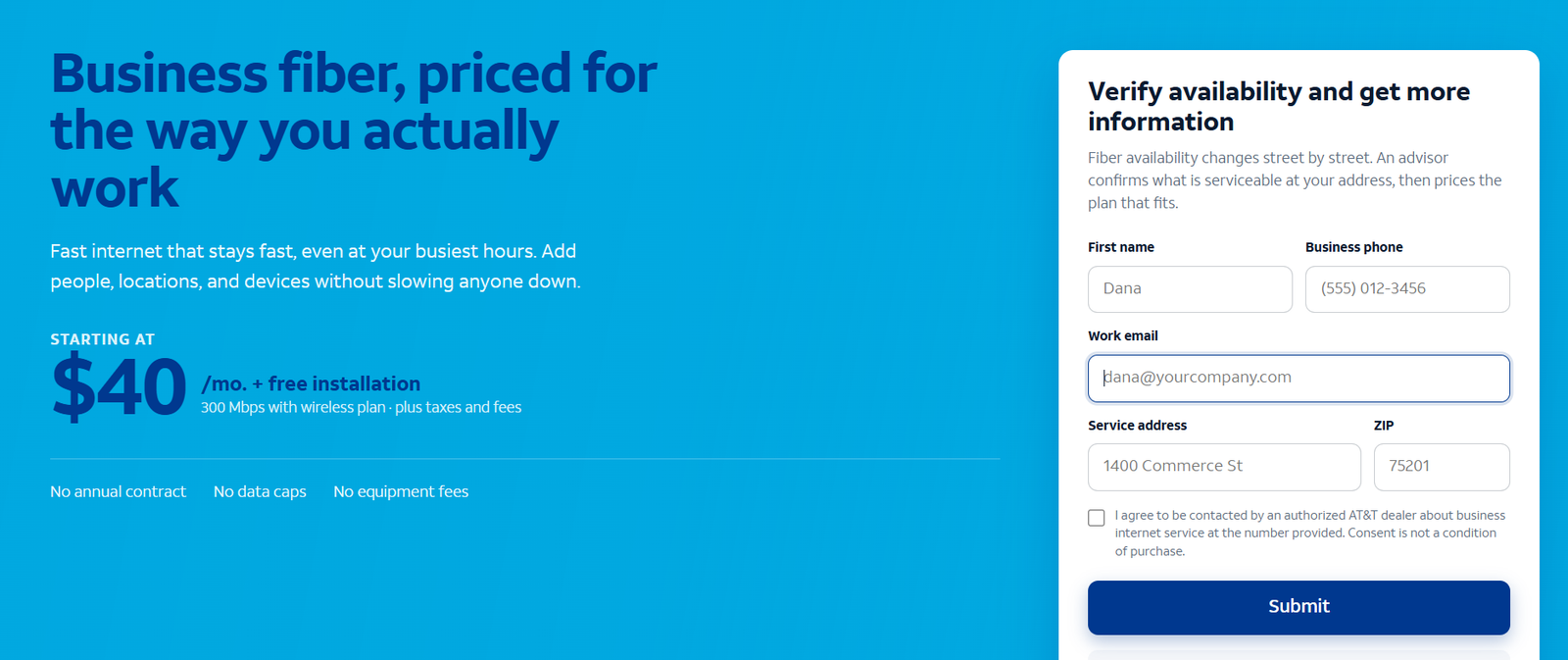
Here is the current AT&T Business Fiber lineup, with October 2026 pricing:
| Plan | Speeds (down/up) | Monthly price | With eligible wireless |
|---|---|---|---|
| 300 Mbps | 300 Mbps symmetrical | $60/mo | $40/mo |
| 500 Mbps | 500 Mbps symmetrical | $100/mo | $60/mo |
| 1 GIG | 1 Gbps symmetrical | $140/mo | $90/mo |
| 2 GIG | 2 Gbps symmetrical | $185/mo | $135/mo |
| 5 GIG | 5 Gbps symmetrical | $285/mo | $235/mo |
Every tier includes unlimited data with no data caps, AT&T ActiveArmor security features, and the Wi-Fi gateway included — no separate equipment rental line item to watch for on the bill. Installation is professional: an AT&T technician handles the fiber drop and gateway setup at your location. The one hard requirement is address eligibility — Business Fiber requires fiber to be available at your specific business address, and not every commercial building is lit yet. That availability limit is the main reason Internet Air for Business exists as an alternative.
Which AT&T Business Fiber Plans Suit a 10-Person Office
For a typical 10-person office running cloud apps, VoIP phones, and daily video meetings, the 300 Mbps or 500 Mbps AT&T Business Fiber plans are usually plenty — $60 or $100 per month, dropping to $40 or $60 with an eligible wireless line. Offices with in-house media production, constant large uploads, or 25+ heavy users should look at 1 GIG. The 2 GIG and 5 GIG tiers are aimed at larger operations, multi-tenant buildings, and businesses running on-premises servers or point-of-sale systems across many lanes. Because speeds are symmetrical, even the entry 300 Mbps tier uploads faster than most cable business plans download.
AT&T Business Fiber Plans: Wireless Bundle Savings Explained
The wireless-bundle discount is worth understanding because it is substantial — $20 to $50 per month depending on tier. Pairing your fiber plan with an eligible AT&T wireless line drops 300 Mbps from $60 to $40, 500 Mbps from $100 to $60, 1 GIG from $140 to $90, 2 GIG from $185 to $135, and 5 GIG from $285 to $235. If your business already runs AT&T mobile lines for staff, you are likely already eligible; if not, adding even a single business wireless line can pay for itself through the fiber discount alone. Confirm eligibility details when you check availability, since qualifying wireless plans can change with promotions.
Business Fiber Installation: What to Expect at Your Office
Business fiber installation is a professional, technician-led process — this is not a self-install product. After you order, AT&T schedules an installation visit to bring the fiber connection into your building and set up the included Wi-Fi gateway. For buildings already wired for fiber, the visit is straightforward. For buildings that need new fiber construction to the premises, the timeline is longer and depends on your building, local permits, and crew scheduling. The honest expectation: plan for a scheduled appointment measured in days to weeks, not minutes.
That lead time is the main trade-off of fiber. If your business needs connectivity by Friday and fiber is not already at your address, Business Fiber cannot help you this week — which is exactly the gap Internet Air for Business fills. But once fiber is installed, it is installed: a permanent, dedicated line that does not share bandwidth with your neighbors the way cable does, and does not depend on wireless signal conditions the way fixed wireless does.
Business Fiber Installation and Address Qualification
Before anything else, your address has to qualify. AT&T Business Fiber requires fiber infrastructure at your specific business address, and availability varies street by street — one side of a commercial park can be lit while the other is not. The qualification check takes a minute and is the first step of any order. If your address does not qualify, AT&T will tell you so rather than sell you something that cannot be delivered, and that is your signal to evaluate Internet Air for Business instead.
Business Fiber Installation Equipment: The Included Gateway
The Wi-Fi gateway is included with AT&T Business Fiber plans — there is no separate monthly equipment rental fee in the published pricing. The technician configures it during the installation visit, including your business network name and security settings. If you run your own networking gear (a business-grade router, firewall, or mesh system), the gateway can typically be configured to work alongside it; discuss your setup with the installer or confirm the configuration options when you order.
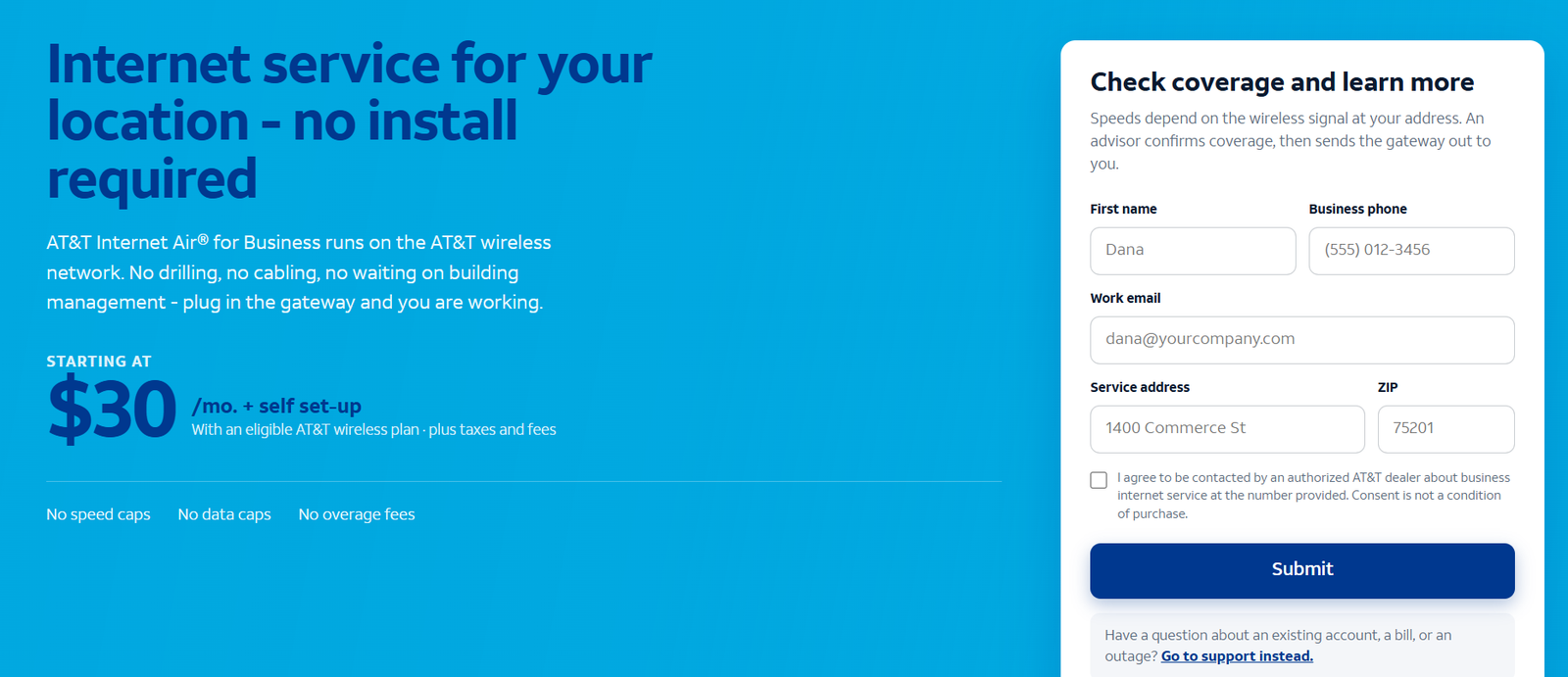
Internet Air for Business Pricing: Standard vs Premium
AT&T Internet Air for Business is a fixed-wireless internet service that runs over AT&T’s wireless network instead of a wired line. There are two plans, and the difference between them comes down to one thing: network priority.
| Plan | Monthly price | With eligible wireless | Priority data |
|---|---|---|---|
| Standard | $65/mo | $40/mo | Standard network priority |
| Premium | $105/mo | $80/mo | 250GB of Turbo for Business priority per billing cycle, then speeds may slow when the network is busy |
The Standard plan at $65 per month ($40 with an eligible wireless line) is the budget-friendly way to get a business online fast. It carries no speed caps, no data caps, and no overages — you pay the flat monthly rate and use the connection as your business needs. The trade-off is network priority: during busy periods on the local wireless network, Standard traffic can be deprioritized behind higher-priority users, which means speeds may dip at peak times.
The Premium plan at $105 per month ($80 with eligible wireless) adds 250GB of Turbo for Business priority data per billing cycle. That priority data gets preferential treatment on the network — pages load faster, video calls stay smooth, and uploads move quickly even when the local tower is busy. Once you use the 250GB in a cycle, the connection may slow when the network is busy, though it keeps working without caps or overage charges. For a small office, 250GB of priority data covers a great deal of prioritized video conferencing, cloud work, and browsing before the standard-priority experience kicks in.
Both plans share the same practical advantages: self-setup in minutes with the included equipment, no professional installation appointment, no data caps, no overage fees, and a 30-day money-back guarantee that lets you test the service at your location with a real exit ramp. The main constraint is the address rule — Internet Air is fixed to a qualified business address. It is designed to stay at the location it was qualified for, not to travel between sites. And like fiber, it requires qualification: your business address must be in an eligible coverage area.
Internet Air for Business Pricing With an Eligible Wireless Line
The wireless-bundle discount applies to Internet Air just as it does to fiber: Standard drops from $65 to $40 per month and Premium from $105 to $80 when paired with an eligible AT&T wireless line. At $40 per month, Internet Air Standard with the bundle is the lowest-cost way to get an AT&T business connection running — cheaper than the entry fiber tier at the same $40 bundle price, though without fiber’s symmetrical speeds or dedicated-line consistency. If your business already carries AT&T mobile lines, ask about bundle eligibility when you check Internet Air availability for your address.
What Internet Air for Business Pricing Includes (and What It Doesn’t)
The monthly price covers the service and the self-setup equipment — there is no separate equipment rental fee and no installation charge because there is no installation visit. What the price does not include is a guarantee of specific speeds: AT&T does not publish fixed speed tiers for Internet Air the way it does for fiber, because fixed-wireless speeds depend on your location’s signal conditions and network load. The 30-day money-back guarantee is the practical answer to that uncertainty — it lets you measure real-world performance at your address before committing. Pricing was checked in October 2026; confirm current rates and terms before ordering.
Fiber vs Internet Air for Business: Side-by-Side Comparison
With both products explained, here is the head-to-head comparison across the dimensions that decide the choice for most businesses:
| Dimension | AT&T Business Fiber | AT&T Internet Air for Business |
|---|---|---|
| Monthly price range | $60–$285 ($40–$235 w/ wireless) | $65–$105 ($40–$80 w/ wireless) |
| Speeds | 300 Mbps–5 Gbps, symmetrical | Varies by location and network conditions; no published fixed tiers |
| Upload speeds | Equal to download (symmetrical) | Lower than download; varies with signal |
| Data policy | No data caps | No data caps, no overages; Premium includes 250GB priority data per cycle |
| Installation | Professional technician visit; scheduled appointment | Self-setup in minutes; no appointment |
| Equipment | Wi-Fi gateway included | Self-setup equipment included |
| Availability requirement | Fiber must be available at your address | Qualified business address in eligible coverage area |
| Speed consistency | Dedicated line; consistent at peak hours | Shared wireless; may slow when network is busy (especially after priority data is used) |
| Money-back / trial | Standard order terms; confirm at checkout | 30-day money-back guarantee |
| Best for | Permanent offices, heavy uploads, video-heavy teams | Fast setup, temporary sites, backup connections, no-fiber addresses |
The price comparison has a nuance worth spelling out. At the entry level with wireless-bundle pricing, both start at $40 per month — Fiber 300 Mbps and Internet Air Standard cost the same. That makes the decision purely about performance and practicality, not price: for $40, would you rather have a dedicated 300 Mbps symmetrical line (if your address qualifies and you can wait for installation) or a self-installed wireless connection running today? At the top end, the products diverge completely — Fiber scales to 5 GIG for $285 ($235 bundled) while Internet Air tops out at the $105 Premium plan, because Air is not trying to be a high-capacity office backbone.
Speed consistency is where fiber earns its reputation. A dedicated fiber line does not slow down because the business next door is streaming, and it does not care about tower congestion at 2 p.m. Internet Air, as a wireless product, shares local network capacity — the 250GB of Turbo priority on the Premium plan buys you preferential treatment, but it is still a shared medium. For email, browsing, and typical cloud apps, Air’s real-world performance is fine. For all-day video production uploads or a 30-person office on simultaneous calls, fiber’s consistency is the safer bet.
Setup time cuts the other way. Fiber requires a scheduled technician visit and, in some buildings, construction lead time. Internet Air ships you equipment you plug in yourself — businesses have gone from order to online in days rather than weeks. If your lease starts Monday, that difference decides the purchase by itself.
Disclaimer: This article contains affiliate links to AT&T Business services. We may earn a commission if you purchase through them, at no extra cost to you. Ortelcom.com is an independent publisher and is not affiliated with or endorsed by AT&T. Pricing, speeds, and availability are not guaranteed, were checked in October 2026, and vary by address and promotions — please confirm all details before ordering. AT&T and all related marks are trademarks of their respective owners.
Fiber vs 5G Internet: Speed Consistency Compared
The fiber vs 5G internet debate for businesses really comes down to one technical difference: dedicated versus shared capacity. Fiber gives your business a dedicated line — the bandwidth you pay for is yours around the clock. Fixed 5G internet like Internet Air rides on a wireless network shared with every other user on the local tower, including consumer mobile traffic. AT&T manages that sharing with priority tiers (which is what the Premium plan’s Turbo data buys), but the underlying physics do not change: wireless capacity fluctuates with demand, distance, building materials, and weather.
In practice, that means fiber’s advertised speed is a floor you can plan around, while fixed wireless speed is a range that moves through the day. A fiber connection rated at 500 Mbps delivers 500 Mbps at 9 a.m. and at 3 p.m. An Internet Air connection might be fast in the morning and noticeably slower during the evening congestion window — or perfectly steady all day if your local tower has headroom. The 30-day money-back guarantee exists precisely so you can find out which reality applies at your address before committing.
None of this makes Internet Air a bad product — it makes it a different product. For a retail pop-up, a construction trailer, or a second location that needs connectivity next week, “speeds vary” beats “no internet for a month” every time. The mistake is treating them as interchangeable: buy fiber for performance you can guarantee, buy Air for speed of deployment and flexibility.
Why Fiber vs 5G Internet Comparisons Matter for Video Conferencing
Video conferencing is the workload where the fiber vs 5G internet difference shows up first, because calls punish inconsistency more than low averages. A steady 50 Mbps connection holds a flawless Teams call; a connection swinging between 200 Mbps and 15 Mbps produces frozen frames and robotic audio at the worst moments. Fiber’s dedicated, symmetrical bandwidth keeps calls smooth even when the whole office is on video. Internet Air handles video calls well in good signal conditions — the Premium plan’s priority data helps most here — but businesses running back-to-back client-facing calls all day should weigh that peak-hour variability honestly.
Fiber vs 5G Internet for Cloud Backups and Large Uploads
Uploads are fiber’s biggest structural advantage. A 1 GIG fiber plan uploads at up to 1 Gbps; fixed wireless uploads are a fraction of download speeds by design. If your business pushes nightly cloud backups, syncs large design files, uploads video content, or runs security cameras to cloud storage, fiber’s symmetrical speeds can turn an overnight backup window into a lunch-break task. On Internet Air, large uploads work — there are no data caps stopping you — but they take longer and compete with everything else the connection is doing. For upload-heavy workflows, this single dimension often settles the fiber vs Internet Air for business question on its own.
Internet Air Coverage Business Address Eligibility: What to Check
Internet Air for Business is available only at qualified business addresses within AT&T’s eligible coverage areas. “Qualified” does two jobs here: it confirms the wireless network at your location can support the service, and it locks the service to that address — Internet Air is designed as a fixed-location connection, not a mobile hotspot you carry between sites. When you check availability, AT&T verifies your specific address rather than just your ZIP code, because wireless performance is hyper-local.
This address-qualification step is worth doing early even if you are leaning toward fiber. Many businesses discover that fiber is not available at their address but Internet Air is — and that single check resolves the whole decision. Run both availability checks with the same address, compare what comes back, and let eligibility narrow the field before you compare prices. Check AT&T Business availability for your address here to see which options your location qualifies for.
How Internet Air Coverage Business Checks Work Before You Order
The coverage check for a business address looks at the AT&T wireless footprint serving that specific location — signal strength, tower capacity, and whether the address falls inside the Internet Air service area. Because the service is fixed to the qualified address, you should run the check with the exact street address where the connection will be used, not a mailing address or a nearby location. If you later move offices, the service does not automatically move with you; the new address needs its own qualification. For multi-location businesses, that means checking each site individually rather than assuming one approval covers all of them.
Internet Air for Business Pricing vs Fiber: Two-Year Cost Picture
Monthly pricing tells most of the story, but it helps to see the two-year math. Take the entry point: Fiber 300 Mbps at $60 per month versus Internet Air Standard at $65 — over 24 months that is $1,440 versus $1,560, a $120 difference in fiber’s favor, before bundle discounts. With an eligible wireless line, both drop to $40 per month, or $960 over two years — identical. The mid-range comparison is Fiber 500 Mbps at $100 ($60 bundled) against Internet Air Premium at $105 ($80 bundled): $2,400 versus $2,520 over two years, or $1,440 versus $1,920 with the bundle. Neither product carries a separate equipment rental fee — the gateway is included with fiber and the self-setup equipment with Air — so there are no hidden monthly add-ons in the published pricing to adjust for.
The value question is not “which is cheaper” but “what does the money buy.” Fiber’s dollars buy guaranteed symmetrical speed and peak-hour consistency. Air’s dollars buy deployment speed and flexibility — no installation appointment, no waiting on construction, and a 30-day money-back guarantee that removes the risk of trying it. A business paying $105 per month for Internet Air Premium is not overpaying relative to $60 fiber if fiber is not available at their address or cannot be installed before their opening date; it is paying for the only AT&T option that meets its timeline.
One more cost factor: the wireless-bundle discount compounds over time. Saving $20 to $50 per month on fiber, or $25 per month on Internet Air, adds up to hundreds per year — enough that a business considering AT&T internet should price its mobile lines in the same conversation. All pricing in this guide was checked in October 2026; promotions change, so confirm the current rates and bundle terms before ordering. Check current AT&T Business pricing and availability for your address.
Fiber vs Internet Air: Business Use-Case Scenarios
The permanent office. A law firm, agency, clinic, or any business settled into a long-term lease should default to fiber if the address qualifies. The symmetrical speeds, consistency, and scalability (up to 5 GIG) match a fixed location’s needs for years, and the professional installation is a one-time event. This is fiber’s home turf and the scenario where it wins most decisively.
The pop-up, seasonal, or short-term location. Holiday retail, event venues, farmers-market operations with a back office, and any site operating for weeks or months rather than years — Internet Air is built for exactly this. Self-setup means no waiting on a technician for a location you will vacate in ninety days, and there is no installation investment to amortize over a short stay.
The construction site or field office. Temporary offices at job sites need connectivity before the permanent building — sometimes before the permanent building exists. Internet Air’s address qualification covers the site location, the equipment sets up in minutes, and when the project wraps, there is no fiber line left behind to cancel.
The backup connection. Businesses that cannot afford downtime — retailers with cloud point-of-sale, clinics with hosted records, any office where an outage stops revenue — increasingly run Internet Air as a failover behind their primary fiber line. Because Air runs on the wireless network, it stays up through the kinds of incidents (cut fiber lines, construction accidents) that take down wired connections, and vice versa. Two independent paths in is the cheapest business-continuity insurance most small businesses can buy.
The fiber-not-available address. The most common scenario of all: you want fiber, your street does not have it. Internet Air turns “no AT&T options” into a working business connection with no data caps and a money-back trial. Check back on fiber availability periodically — build-outs expand — but do not leave a business offline waiting for construction that has no date.
Fiber vs Internet Air for Business Offices With 15+ Employees
Once an office passes roughly 15 simultaneous users, the comparison tilts hard toward fiber. Fifteen people on video calls, cloud file sync, and VoIP will saturate a shared wireless connection’s practical capacity far sooner than a dedicated 500 Mbps or 1 GIG fiber line. Internet Air can serve a 15-person office in good conditions — especially the Premium plan with its priority data — but it becomes the constraint sooner, and the constraint appears exactly when everyone is busiest. For larger offices, the honest guidance is: fiber first, Air as backup, not Air as primary.
Fiber vs 5G Internet for Temporary Business Locations
Temporary locations invert the normal advice. When the location itself is the variable — a three-month project office, a seasonal storefront, a disaster-recovery site — installation lead time and commitment length matter more than peak throughput. Fiber’s professional installation and address-tied infrastructure assume permanence; Internet Air’s self-setup and 30-day money-back guarantee assume change. Match the product’s assumptions to the location’s lifespan and the choice makes itself.
Fiber vs Internet Air for Business: Frequently Asked Questions
Does Internet Air for Business Pricing Include the Equipment?
Yes. Internet Air for Business pricing covers the self-setup equipment — there is no separate monthly equipment rental fee and no professional installation charge. You receive the device, plug it in at your qualified business address, and complete the guided setup yourself. If the equipment fails under normal use, support and replacement terms are handled through AT&T Business support; confirm the specifics when you order.
Is Business Fiber Installation Available at Every Address?
No. Business fiber installation requires AT&T fiber infrastructure at your specific business address, and availability varies by street and building. The address qualification check is free and takes about a minute — run it before planning around fiber. If your address does not qualify, Internet Air for Business is the AT&T alternative designed for exactly that situation, provided your address falls in its eligible coverage area.
Internet Air Coverage Business Speeds: Will They Slow During Busy Hours?
It can. Internet Air runs on a shared wireless network, so speeds vary with local demand. The Premium plan’s 250GB of Turbo for Business priority data per billing cycle gives your traffic preferential treatment, which protects performance during busy periods until the 250GB is used; after that, speeds may slow when the network is busy. The Standard plan does not include priority data. Neither plan has data caps or overage charges. The 30-day money-back guarantee lets you test peak-hour performance at your address with a real exit option.
Internet Air Coverage Business Rules: Can I Move Between Locations?
Internet Air for Business is fixed to the qualified business address — it is not designed to travel between sites like a mobile hotspot. If your business relocates, the new address needs its own eligibility check. Businesses with multiple locations should qualify each address individually rather than assuming coverage transfers.
Does Fiber vs 5G Internet Matter for Upload-Heavy Work?
Yes — this is the single biggest technical difference. AT&T Business Fiber is symmetrical, so a 1 GIG plan uploads at up to 1 Gbps. Fixed 5G services like Internet Air are asymmetrical by nature, with uploads substantially slower than downloads. Businesses doing nightly cloud backups, syncing large media files, uploading video, or streaming security footage to the cloud will feel this difference daily. If uploads are central to your workflow, fiber is the clear answer.
Fiber vs Internet Air: What Should Business Buyers Confirm Before Ordering?
Three things: address eligibility for the specific location, the current monthly price including any wireless-bundle discount you qualify for, and the installation or setup timeline. Pricing and promotions were checked in October 2026 and change over time, and availability is genuinely address-specific for both products. Confirm all three at checkout so there are no surprises on the first bill or the go-live date.
Fiber vs Internet Air for Business: Which Should You Get?
Choose AT&T Business Fiber if your business operates from a permanent location, your address qualifies for fiber, and you want guaranteed symmetrical speeds — for video-heavy teams, upload-intensive workflows, offices with 15+ people, or anyone who needs the connection to perform identically at 9 a.m. and 3 p.m. Starting at $60 per month ($40 with eligible wireless), it is also price-competitive with Air at the entry level while delivering far more consistency.
Choose AT&T Internet Air for Business if you need connectivity fast, your location is temporary or seasonal, you want a backup connection independent of wired infrastructure, or fiber is not available at your address. Standard at $65 per month ($40 bundled) gets you online quickly; Premium at $105 ($80 bundled) adds 250GB of priority data for busier offices. The 30-day money-back guarantee makes it a low-risk trial.
Many businesses will sensibly end up with both: fiber as the primary connection and Internet Air as the failover. But if you are picking one, let your address and your timeline decide — check eligibility first, then match the product to the reality of your location. Check AT&T Business availability for your address to see whether fiber, Internet Air, or both are available at your business location, and confirm current October 2026 pricing before you order.

