
The best business internet providers in Greenville, South Carolina are not the ones with the biggest national advertising budgets, and the first fact to get right is the one that changes the whole shortlist: AT&T Fiber is a real, leading option in Greenville. AT&T Southeast, the former BellSouth territory, is the legacy telephone company here, and the federal business data puts AT&T Business Fiber at about 74 percent of locations in downtown ZIP 29601, about 72 percent in ZIP 29605, about 76 percent in ZIP 29607, about 66 percent in ZIP 29609, about 59 percent in ZIP 29611, about 73 percent in ZIP 29615 and about 65 percent in ZIP 29617, with symmetrical speeds up to 5 Gbps. That is a genuine, majority footprint — roughly three in five to three in four Greenville business locations — but it is not citywide, and about a quarter to two-fifths of Greenville businesses will not find AT&T Fiber at their address. A Greenville business that starts its search with AT&T Fiber is starting in the right place, because where it reaches it is a strong product with published national business prices — but the address check still comes first, because about a quarter to two-fifths of Greenville businesses will not find AT&T Fiber at their address, and the weeks spent chasing it are weeks lost. The honest picture is that the Greenville market is led by AT&T Fiber and Spectrum Business, with Spectrum Business cable reaching almost every building in the city as the near-universal fallback.
The short answer is that AT&T Fiber is the best all-round choice for most Greenville businesses that can get it, with the deepest fiber footprint in the city and published business pricing that can be compared honestly against the alternatives. Spectrum Business is the strongest challenger, and Spectrum Business cable is the option that almost certainly reaches the building, with published business pricing from $65 to $70 a month for an entry-level tier. Which of the three fits a particular business depends on the exact address, because Greenville coverage is street by street, with some neighbourhoods reporting fiber coverage near 100 percent while others report far less, all on the same federal data. The same street-by-street pattern shows up in other cities we have covered — our guide to the best business internet providers in Anderson, South Carolina works through the same address-first method on a different legacy-telco market, and the lesson is the same there as it is here.
That street-by-street reality is the thread running through this whole guide. Citywide, fiber from some provider reaches about 62 to 85 percent of homes depending on the ZIP code, which sounds generous until a business discovers that its own street is in the other share, or that the fiber reaching its street belongs to a provider whose business pricing is by quote only. This guide uses the facilities-based federal figures and says so where sources disagree, because a business that plans around an aggregator’s citywide average and then finds its building is not served has wasted weeks. The practical rule is simple: check the exact business address first, compare the providers that genuinely reach that building, and only then decide on speed and price. Prices in this guide are starting prices before taxes and fees, checked in November 2026, and every provider that does not publish a business price is marked by quote rather than given an invented figure. Our companion guide to best business internet providers in Atlanta, Georgia applies the same provider-by-provider comparison to another city, and the pattern holds there too: check the address, then compare the written quotes.
Check AT&T Business Fiber Availability for Your Greenville, South Carolina Address
Symmetrical fiber speeds from 300 Mbps to 5 GIG, with no data caps and a gateway included.
Best Business Internet Providers in Greenville at a Glance
Greenville is a much larger and more competitive business internet market than the smaller South Carolina cities covered earlier in this series — about 75,000 residents in the city proper and about 583,000 in Greenville County — with four fiber networks overlapping in parts of the city. Fiber from some provider reaches about 62 to 85 percent of homes depending on the ZIP code, which sounds generous until a business discovers that its own street is in the other share, or that the fiber reaching its street belongs to a provider whose business pricing is by quote only. Coverage in this guide is reported ZIP by ZIP, because a single citywide percentage would hide the real story. The table below summarises the main business options as checked in November 2026, with every price a starting price before taxes and fees.
| Provider | Type | Coverage in Greenville | Business pricing |
|---|---|---|---|
| AT&T Business Fiber | Fiber | 59.0% to 76.2% by ZIP | National list $60 to $285 a month |
| Spectrum Business | Cable | 93.0% to 99.9% by ZIP | $65 to $165 a month for 500 Mbps to 2 Gig |
| WOW! Business | Fiber | 8.8% in ZIP 29607 only | From $49.99 a month for 300 Mbps |
| Lumos business fiber | Fiber | 10.6% to 13.2% in two ZIPs | $50 to $300 a month promotional |
| T-Mobile 5G Business | Fixed wireless | 93.3% to 99.9% by ZIP | $35 a month with a voice line, $60 standalone |
| Verizon 5G Business | Fixed wireless | 51.5% to 79.7% by ZIP | 100 to 400 Mbps from $69 a month |
| AT&T Internet Air | Fixed wireless | 66.8% to 85.9% by ZIP | $65 to $105 a month list |
Get A Free AT&T Business Fiber Quote
Symmetrical fiber speeds from 300 Mbps to 5 GIG, with no data caps and a gateway included.
The table tells the Greenville story in one glance: AT&T Fiber is the leading fiber option with the deepest footprint in the city, Spectrum cable is the near-universal fallback, and two smaller fiber challengers — WOW! and Lumos — offer real multi-gig fiber at a small number of addresses. A Greenville business that starts with the top two rows and checks its exact address against both will have a real choice in most of the city, and the rest of the table is for special cases: an Eastside address where WOW! fiber reaches, a north-side address where Lumos fiber reaches, or a site that needs a 5G backup alongside a wired line.
AT&T Business Fiber Pricing in Greenville, South Carolina

AT&T Fiber is a real, leading option in Greenville. AT&T Southeast, the former BellSouth territory, is the legacy telephone company here, and the federal business data puts AT&T Business Fiber at about 74 percent of locations in downtown ZIP 29601, about 72 percent in ZIP 29605, about 76 percent in ZIP 29607, about 66 percent in ZIP 29609, about 59 percent in ZIP 29611, about 73 percent in ZIP 29615 and about 65 percent in ZIP 29617, with symmetrical speeds up to 5 Gbps. That is a genuine, majority footprint — roughly three in five to three in four Greenville business locations — but it is not citywide, and about a quarter to two-fifths of Greenville businesses will not find AT&T Fiber at their address. AT&T’s own Greenville pages confirm the position without quantifying it: they say AT&T Business Fiber delivers speeds up to 5 GIGs in Greenville where available, with no coverage percentage and no neighbourhood list. No single reliable citywide percentage exists — residential aggregators say 51 to 53 percent, while the federal business data says 59.0 to 76.2 percent by ZIP — and this guide uses the ZIP-level federal business figures because they are the most trustworthy and the most useful for a business checking its own address.
AT&T Business Fiber is sold nationally in five symmetrical tiers: 300 Mbps at $60 a month, 500 Mbps at $100, 1 Gig at $140, 2 Gig at $185 and 5 Gig at $285, with no data caps, a gateway included and no annual contract on the shared plans. With an eligible AT&T business wireless plan those list prices fall to $40, $60, $90, $135 and $235 a month. Secondary sources put the regular post-promotion rates at $70, $110 and $160 a month for the 300 Mbps, 500 Mbps and 1 Gig tiers. Those are national list prices, checked in November 2026, and they apply only where AT&T Fiber actually reaches an address. In Greenville those national prices apply where AT&T Fiber reaches, which is roughly three in five to three in four business locations depending on the ZIP code. The 5G backup built into the 1 Gig tier and above needs the specified gateway, does not work during a power loss, and does not carry static IP addresses or voice-over-IP traffic over to the backup connection, so a business that depends on a hosted phone system should plan its failover separately. Residential promotional prices for AT&T Fiber in Greenville — advertised for the first year on residential plans — are not business prices and are not quoted here as business prices; a business should compare the business list prices above, not a residential promotion.
AT&T’s legacy DSL still covers most of Greenville — about 75 to 98 percent of homes — at speeds up to 100 Mbps, but DSL is a legacy fallback, not a serious business option where fiber or cable exists, and this guide does not present it as one. AT&T Internet Air for Business, the fixed-wireless product, is priced nationally at $65 a month for the Standard plan and $105 a month for Premium, or $60 and $100 with AutoPay and paperless billing, and $40 and $80 with an eligible business wireless plan. AT&T fixed wireless reaches about 67 to 86 percent of homes depending on the ZIP code, so Internet Air is genuinely available to most Greenville businesses as the fallback where fiber does not reach. For larger Greenville sites, AT&T also sells Dedicated Internet up to 1 Tbps and Switched Ethernet on Demand up to 100 Gbps by quote.
Spectrum Business Cable Internet Pricing in Greenville
Spectrum Business cable is the near-universal wired fallback in Greenville, reaching 99.8 percent of locations in downtown ZIP 29601, 99.9 percent in ZIP 29605, 98.6 percent in ZIP 29607, 99.5 percent in ZIP 29609, 99.8 percent in ZIP 29611, 99.8 percent in ZIP 29615 and 93.0 percent in ZIP 29617, and it is the option that almost certainly reaches the building. Published small-business pricing from Spectrum’s own pages is $65 a month for 500 Mbps, $95 for 750 Mbps, $115 for 1 Gig and $165 for 2 Gig on 12-month promotional pricing, with no contract on internet-only plans, a modem included and no data caps, and $40 a month for 500 Mbps when bundled with two other services. Spectrum’s own pages also show a $50 a month online-only price for 500 Mbps alongside the $65 figure; this guide uses the $65 standalone figure and notes the $50 online-only figure appears on the same pages, and older tier names — 300 and 600 Mbps — are superseded by the current 500 and 750 Mbps tiers.
The post-promotion price is the part of the Spectrum quote that needs the most attention in Greenville. Standard rates rise after 12 months, with secondary sources reporting standard rates around $99.99 and above for 500 Mbps, about $120 to $150 for 750 Mbps and about $150 to $170 for 1 Gig, but Spectrum does not prominently disclose its standard rates, so this guide says confirm the post-promo rate in writing rather than quoting a single figure as settled. A static IP is $14.99 a month, there is a $5 a month payment-processing charge if the business is not on AutoPay, and a $10 a month Advanced WiFi add-on is reported. Uploads on cable are far below downloads — 10 to 20 Mbps up on the 500 Mbps tier and 35 to 50 Mbps up on the 1 Gig tier — and there is no formal uptime service level agreement on the standard plans, though enterprise and dedicated fiber gets 99.9 to 100 percent guarantees. Spectrum’s fiber filing of 13.9 to 39.0 percent is its fiber-powered hybrid network, not fiber to the premises, and this guide calls Spectrum cable, not fiber, following the federal split. A three-year price guarantee is offered on the 750 Mbps and 1 Gig plans when bundled with two other services.
WOW! and Lumos Business Fiber in Greenville, South Carolina
WOW!, short for WideOpenWest, is Greenville’s homegrown fiber challenger: it entered Greenville County in March 2023, switched on a brand-new fiber network, signed its first Mauldin customers in December 2023, and is building fiber to the home across Greenville, Five Forks, Fountain Inn and Simpsonville. In May 2026 it announced fiber for 10,000 additional homes, businesses and offices, targeting more than 20,000 passings by fall 2026. But the federal business data keeps the scale honest: WOW! fiber reaches only 8.8 percent of business locations in ZIP 29607 and does not appear in the other six Greenville city ZIPs. It is a real but still small, new-build footprint inside the city limits, concentrated in new subdivisions and the Eastside, not a citywide option. Published business starting prices are 300 Mbps from $49.99 a month and 600 Mbps from $65.99 a month, with 1 Gig and dedicated tiers by custom quote; those are national WOW! Business starting prices, not Greenville-specific, and this guide presents them as published starting prices and says confirm in writing for a Greenville address. The residential Fiber 500 price of $40 a month is not a business price and is not presented as one.
Lumos is the second fiber challenger in Greenville, a Southeast fiber overbuilder now owned 50 percent by T-Mobile through a joint venture that closed in April 2025, with T-Mobile as anchor tenant as Lumos transitions to a wholesale model. The federal business data puts Lumos fiber at 13.2 percent of business locations in ZIP 29609 and 10.6 percent in ZIP 29615, and it does not appear in the other five Greenville city ZIPs — roughly one in ten business locations in two ZIPs only. Published business pricing from Lumos’s South Carolina business page is promotional: 100 Mbps $50 a month against a $95 list price, 500 Mbps $75 against $130, 1 Gig $85 against $180, 2 Gig $125 against $280, 5 Gig $200 against $430 and 8 Gig $300 against $580, with no contract, no data caps and business Wi-Fi included, available in select locations. This guide quotes the promotional prices with the list prices alongside them, labels the lower figures as promotional and select-location offers, and says confirm in writing. Enterprise and dedicated fiber is by custom quote. For a Greenville business on the north side where Lumos reaches, it is a genuine multi-gig fiber option at competitive prices; for a business anywhere else in the city, it is not an option at all.
Two names that appear on Greenville provider lists deserve a short, honest note. WCTEL and Upcountry Fiber — the local cooperative fiber network — serve Greenville County, but they have no federal business filing in any of the seven Greenville city ZIPs, so they are a northern-county option, not a downtown-Greenville option, and this guide does not present them as one. Skyrunner Internet, a fixed-wireless provider, reaches 21 to 78 percent of locations by ZIP at up to 25 Mbps, with residential pricing from $45 a month and business pricing not published — a minor fixed-wireless option for addresses without fiber or cable, named here only as such. XNET WiFi and Open Broadband appear on one aggregator’s Greenville business page but in no federal business filing, so their business availability in Greenville is unverified and this guide does not quote their speeds or prices as business figures.
How to Choose a Business Internet Provider in Greenville, South Carolina
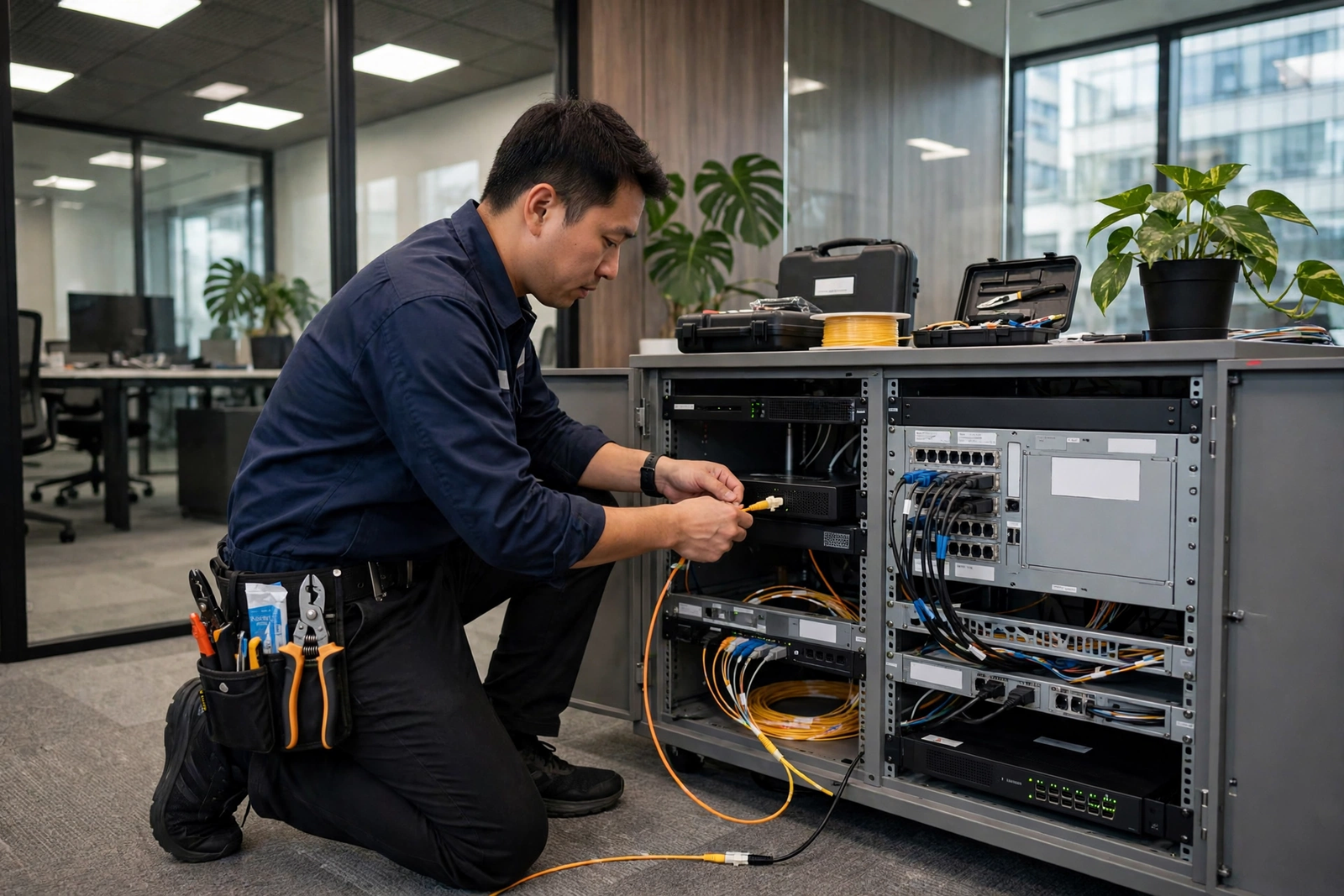
The choice in Greenville follows a simple order, and the ZIP code is the first filter. First, check the exact business address against AT&T Fiber, because where it reaches it is a strong product with published national business prices, and the address check takes minutes — but check the ZIP code too, because a business in ZIP 29611 has only about a three-in-five chance of finding it while a business in ZIP 29607 has about a three-in-four chance. Second, check Spectrum Business cable, because it reaches almost every building and its published pricing gives a firm fallback number. Third, if the business is on the Eastside or the north side, check WOW! and Lumos, because one of them may be the fiber option at that address even though neither is a citywide choice. Fourth, check the 5G options as a backup or as a primary where no wired option reaches, and test them at the real address before relying on them.
When the quotes are in, compare them on five things: the speed in both directions, the total cost over two years including the post-promotion step-up, the contract term and the early-termination fee, the installation charge and the go-live date, and what happens when the connection fails. A Greenville business that compares only the first-month price will almost always choose wrong, because the cheapest first month is usually a promotional cable tier that rises in year two, while the best two-year value is usually a fiber tier with a published price and no step-up. The comparison table above is the starting point; the written quotes for the specific address are the decision.
For a comparison with another legacy-telco market, our guide to best business internet providers in Detroit, Michigan works through the same provider-by-provider comparison on a different city’s networks, and the contrast shows how much of the Greenville shortlist is driven by which networks were built here first.
The same address-first method works in every market we cover, and our guide to best business internet providers in Cleveland, Ohio applies it to a larger metro where the cable incumbent and the fiber incumbent split the city differently from Greenville, with the same lesson: check the address, then compare the written quotes.
Speed is the number every Greenville business asks about first, and it is also the number most often bought wrong. The right speed is set by what the business actually does at its busiest hour, not by the fastest tier on the page. A useful way to think about it is in concurrent use: a video call needs roughly 3 to 5 Mbps per participant in each direction, a cloud point-of-sale terminal needs very little, a large file upload to a cloud drive needs as much upload as the business can get, and a nightly cloud backup of a few hundred gigabytes needs either a very fast upload or a very long night. The upload speed matters more than the download speed for most modern offices, which is why symmetrical fiber is worth real money and why cable’s much slower uploads are the first thing to check on a cable quote.
As a planning guide for a Greenville business: a one-to-five-person office doing email, browsing, card payments and occasional video calls is usually well served by 300 Mbps symmetrical fiber, or by 300 Mbps cable where fiber does not reach. A five-to-twenty-person office with constant video calls, cloud applications and a shared drive should look at 500 Mbps to 1 Gig. A twenty-plus-person office, a business with a guest network, or one that uploads large files daily should look at 1 Gig to 2 Gig. Above 2 Gig is for specialised uses — media production, large design files, a server room — and a business that is quoted 5 Gig should ask what its current connection actually delivers at peak before paying for it.
Two cautions apply to every speed claim in Greenville. First, the speed on the page is the maximum the plan can deliver, not a guaranteed speed; shared cable and fixed wireless slow down at busy times, and only dedicated access carries a speed guarantee. Second, the Wi-Fi inside the building is often the real bottleneck: a 1 Gig connection behind an old router or a single access point in a large office will feel like a 100 Mbps connection. Before paying for a faster tier, a Greenville business should check that its router, its cabling and its access points can actually pass the speed it is buying — otherwise the upgrade buys nothing but a larger bill.
Installation is where Greenville business internet projects most often slip, and the slip is almost always about the building rather than the provider. The first question is whether the building is already wired for the provider chosen: a building with fiber in the riser can often be connected in days, while a building that needs a new fiber run, a landlord permission or a street works permit can take weeks or months. The second question is the internal wiring: the point where the provider’s line enters the building, the path to the router, and the state of the cabling to each desk. A provider quote that assumes the entry point is beside the server room and a building where it is at the opposite end of the floor are two different jobs with two different prices.
Before signing, a Greenville business should get four things in writing: the installation charge and what it covers, the date the service goes live, whether the price quoted is the price for the full term or a promotional price that rises, and what happens if the installation cannot be completed — who pays for the aborted work and whether the contract can be cancelled without penalty. Construction charges are the least transparent part of business internet pricing in Greenville: no published price was found for AT&T or rival installation and construction charges in this batch’s research, and this guide gives no invented figure. The only safe approach is a written quote for the specific address, including any construction, before the contract is signed.
On the day itself, the practical checklist is short: confirm the appointment window and who needs to be on site, make sure the router location has power and ventilation, have the business’s network details ready — how many devices, whether there is a guest network, whether card readers or printers need fixed addresses — and test the connection at the busiest time on the first day, not the quietest. A static IP address, where the business needs one for a server, a camera system or remote access, is sold in blocks by most providers and is by quote only in this batch’s research; Spectrum’s published static IP figure is $14.99 a month, and for other providers the guide says confirm in writing rather than guessing.
Business Internet Reliability and Uptime in Greenville, South Carolina
Reliability is the quality a Greenville business notices only when it fails, and it is the hardest quality to compare from a provider’s page, because every provider claims high reliability and almost none publishes a service level agreement on its standard small-business tiers. Fiber is the most reliable standard connection in Greenville: it is not affected by weather in the way fixed wireless is, it does not slow down at busy times in the way shared cable can, and its symmetrical speeds stay consistent through the working day. Cable is next, with a mature network and a long record in the city, but with the shared-network slowdowns that come with it. Fixed wireless is the least consistent, because its speed depends on the tower, the weather and the number of users sharing it at the time — which is why it is best used as a backup or as a primary only where nothing wired reaches.
Disclaimer: This article contains affiliate links to AT&T Business services; we may earn a commission at no extra cost to you. Ortelcom.com is an independent publisher not affiliated with or endorsed by AT&T. Pricing, speeds and availability are not guaranteed, were checked 15 November 2026, and vary by address and promotions. Confirm all details before ordering. AT&T trademarks belong to their owner.
On the standard tiers in this guide, WOW! claims 99.99 percent network reliability, and the dedicated-access products carry contractual uptime agreements of 99.9 to 100 percent, priced by quote. For the standard tiers, the practical questions to ask are simpler and more useful than any percentage: how quickly does the provider respond when the connection fails, is there a local technician or a remote call centre, and what compensation applies if the service is down for a day. A business should also ask whether the provider’s network in Greenville has a single point of failure at the building — one cable into the premises — and, if it does, whether a second connection on a different network is worth the cost. Two connections from different networks, with automatic failover, is the cheapest real reliability a small business can buy, and it costs far less than a day of lost trading.
The other half of reliability is inside the building. A business that loses internet because its own router failed has not had a provider outage, and the fix is a spare router, a battery backup for the network equipment and a written note of who to call and what to restart. Power cuts deserve the same attention: AT&T’s 5G backup does not work during a power loss, and neither does a fixed-wireless gateway without power, so a business in a building with unreliable power should budget for an uninterruptible power supply for its router and its point-of-sale terminals. Reliability in Greenville is a system — the provider’s network, the building’s wiring and the business’s own equipment — and the weakest part of that system is the one that will fail first.
Fixed wireless — 5G business internet — is the fastest-growing part of the Greenville business market, and it deserves a serious look for three kinds of business: one that cannot get fiber or cable at its address, one that needs a backup connection alongside a wired line, and one that values a quick install over the fastest possible speeds. The technology has real limits that the marketing rarely leads with. Speeds vary by tower, by time of day and by how many devices share the connection, and the federal filings for Greenville show typical fixed-wireless speeds far below the headline figures on the providers’ pages. A business that runs point-of-sale terminals, card readers and a handful of laptops will usually be fine; a business that moves large files, runs video production or backs up to the cloud all day will usually not be.
T-Mobile Business Internet is the widest fixed-wireless option in all four of this batch’s cities. Its current tiers are Rely at $35 a month with a business voice line or $60 a month standalone, Amplified at $45 with a voice line or $70 standalone, and All-In at $55 with a voice line or $80 standalone, with a five-year price guarantee, a free Wi-Fi 7 gateway, no annual contract and a 15-day trial. Older tier names — Small Business Grow, Business Advanced and 5G Business Internet at $70 — still appear in articles from May 2026, but they are superseded by the current Rely, Amplified and All-In names, and this guide uses the current figures. SuperBroadband, which pairs 5G with Starlink backup, starts at $250 a month with a 36-month commitment and is a different product for businesses that cannot tolerate an outage.
Verizon 5G Business Internet comes in 100, 200 and 400 Mbps tiers. The 100 Mbps tier is $69 a month regular, $65 on offer, and $35 a month when bundled with a qualifying business smartphone plan; the 200 Mbps tier is $99 regular, $85 on offer and $55 bundled; the 400 Mbps tier exists but is not priced on Verizon’s page and is by quote. Verizon offers a 10-year price guarantee, includes the router on a monthly payment plan and offers up to $1,500 in switching credits, with current offers ending 31 December 2026 and some running to 10 January 2027. Older summaries that quote $39 a month bundled for the 100 Mbps tier are superseded by the current $35 figure, and this guide uses the current figure.
Used as a backup, fixed wireless is genuinely useful in Greenville: a fiber or cable primary with a 5G backup on a different network survives a cut cable or a provider outage, and the monthly cost of a $35 or $60 backup line is small against a day of lost trading. Used as the only connection, it needs a trial at the real address — the 15-day T-Mobile trial exists for exactly this reason — and the business should test it at its busiest hour, with its real devices, before cancelling anything else. A fixed-wireless connection that is fast at 9 in the morning and slow at 3 in the afternoon is not a business-grade primary connection.
Most Greenville businesses will never need dedicated internet access, and this guide says so plainly, because the standard shared tiers from the providers above cover the great majority of offices. Dedicated internet access is the enterprise product for businesses that cannot share bandwidth with anyone else: a data centre, a call centre, a medical imaging practice, a design studio moving very large files, or a business with a contractual uptime requirement. It is sold by quote at equipped buildings, with a service level agreement that guarantees symmetrical speeds and uptime, and the price depends on the building, the construction needed to reach it and the speed ordered.
Dedicated internet access, the enterprise product sold by quote at equipped buildings, runs nationally at roughly $300 to $700 a month for 100 Mbps and roughly $700 to $2,000 a month for 1 Gig. Those are national broker ranges for 2026, not prices for any named provider in this city, and a real quote depends on the building, the construction needed and the service level agreement. In Greenville the dedicated providers are the enterprise arms of the same networks — AT&T Dedicated Internet, the cable incumbent’s enterprise fiber, Verizon Internet Dedicated, Zayo and Lumen — plus regional enterprise fiber where it exists. None of them publishes a Greenville price, and any article that quotes a single dedicated-access price for Greenville is inventing it. The right approach is to get two or three quotes for the same speed and the same service level agreement, and to compare the installation charge, the term and the early-termination terms as carefully as the monthly price, because the construction charge is often the largest number in the first year.
A cheaper middle step exists for many Greenville businesses: two shared connections from different networks — for example fiber from one provider and cable or 5G from another — with automatic failover between them. That costs far less than dedicated access, it survives a single provider outage, and it can be installed in days rather than the weeks or months a dedicated build can take. It does not give the guaranteed speeds or the uptime contract of dedicated access, so it is not a substitute for a business that has a contractual uptime obligation, but for a retail shop, a restaurant group or a professional office it is usually the better spend.
Frequently Asked Questions About Business Internet in Greenville, South Carolina
Which business internet provider is best in Greenville, South Carolina?
There is no single best provider in Greenville, because the answer depends on the exact address. AT&T Fiber and Spectrum Business lead the market, with Spectrum Business cable as the near-universal fallback, and the best choice is the provider that reaches the specific building with the speed the business needs at a price that does not rise without warning. A business should check its address against the top two or three providers, get written quotes, and compare the two-year total cost rather than the first-month price.
How much does business internet cost in Greenville, South Carolina?
Published starting prices in Greenville run from about $35 a month for fixed wireless with a voice line to about $65 to $70 a month for entry-level fiber or cable, and up to $149 to $285 a month for 1 Gig and above depending on the provider. The real cost is the two-year total, including the post-promotion step-up, equipment, installation and fees, and this guide works through that total in the cost sections above. Every price in this guide is a starting price before taxes and fees, checked in November 2026.
Is AT&T Business Fiber available in Greenville, South Carolina?
AT&T Fiber is a real, leading option in Greenville. AT&T Southeast, the former BellSouth territory, is the legacy telephone company here, and the federal business data puts AT&T Business Fiber at about 74 percent of locations in downtown ZIP 29601, about 72 percent in ZIP 29605, about 76 percent in ZIP 29607, about 66 percent in ZIP 29609, about 59 percent in ZIP 29611, about 73 percent in ZIP 29615 and about 65 percent in ZIP 29617, with symmetrical speeds up to 5 Gbps. That is a genuine, majority footprint — roughly three in five to three in four Greenville business locations — but it is not citywide, and about a quarter to two-fifths of Greenville businesses will not find AT&T Fiber at their address. AT&T’s genuinely available product for most Greenville addresses is Internet Air for Business, its fixed-wireless service, priced nationally at $65 a month for Standard and $105 for Premium, or $60 and $100 with AutoPay and paperless billing, and $40 and $80 with an eligible business wireless plan. A Greenville business should check its exact address rather than assuming AT&T Fiber is available.
How long does business fiber installation take in Greenville, South Carolina?
It depends on the building. A building with fiber already in the riser can often be connected in days, while a building that needs a new fiber run, a landlord permission or a street works permit can take weeks or months. Before signing, get the installation charge, the go-live date and the cancellation terms in writing for the specific address, and confirm what happens if the installation cannot be completed.
Do I need a static IP address for my Greenville business?
Most small businesses do not. A static IP is needed mainly for a server, a camera system, remote access or a hosted phone system that requires a fixed address. Where it is needed, it is sold in blocks by most providers and is by quote only in this batch’s research, except that Spectrum’s published static IP figure is $14.99 a month, and for other providers the guide says confirm in writing rather than guessing.
Choosing Business Internet in Greenville, South Carolina: The Short Version
The short version of this guide is a five-step checklist. First, check the exact business address against AT&T Fiber and Spectrum Business, because the best connection in Greenville is the one that reaches the building. Second, check Spectrum Business cable as the fallback, because it reaches almost every building and gives a firm price to compare against. Third, check the 5G options as a backup or as a primary where no wired option reaches, and test them at the real address. Fourth, get written quotes for the same speed from two or three providers, and compare the two-year total cost — including the post-promotion step-up, the equipment, the installation and the fees — rather than the first-month price. Fifth, confirm the installation date, the contract term and the early-termination terms in writing before signing anything.
A Greenville business that follows those five steps will end up with a connection that fits its real needs, at a price it can budget for, from a provider that serves its address — and it will not have wasted weeks chasing a provider that does not. The market in Greenville is genuinely competitive, with fiber, cable and fixed wireless all available at most addresses, and the businesses that get the best result are the ones that check their address first, compare written quotes second, and sign third. Prices in this guide were checked in November 2026, and they will change, so the written quote for the specific address is always the final word.
If AT&T Fiber reaches your Greenville address, it is worth a direct check: check AT&T Business Fiber availability for your Greenville, South Carolina business address and compare the quote against the providers below before you sign anything.
Once the provider is chosen, the next step is the order itself, and our how to order and install AT&T Business Fiber guide walks through the ordering and installation process step by step, including what to have ready on the day and what to check before the installer leaves.

