
Business fiber internet in Salt Lake City, Utah is faster and more competitive than most businesses expect, and more uneven than any citywide map suggests. Downtown offices can often choose between three or four fiber networks in the same building, while a business a few miles away may have only one fiber option, or none at all, and must choose between cable and 5G instead. The city has four genuine fiber networks, a municipal open-access network, a strong local enterprise carrier and near-universal cable coverage, which means the right question is not whether fiber exists in Salt Lake City, Utah, but which fiber networks reach your building, what speeds they offer there, and what installation will cost.
The short answer is that AT&T Business Fiber is the best starting point for most Salt Lake City, Utah businesses that can get it, with symmetrical speeds from 300 Mbps to 5 GIG, no data caps, no annual contract and a gateway included, at list prices from $60 a month. Its footprint covers parts of the city rather than every address, and it grew substantially in February 2026 when AT&T acquired the former Quantum Fiber network, which named Salt Lake City, Utah as one of its new metro areas. Where AT&T Business Fiber is unavailable, Quantum Fiber, Google Fiber and UTOPIA Fiber cover different parts of the city, and Comcast Business provides cable and dedicated fiber almost everywhere. This guide maps business fiber internet in Salt Lake City, Utah by neighborhood, compares speeds and prices, and walks through installation step by step so you can order with confidence.
Check AT&T Business Fiber Availability for Your Salt Lake City, Utah Address
Symmetrical fiber speeds from 300 Mbps to 5 GIG, with no data caps and a gateway included.
Business Fiber Internet in Salt Lake City, Utah at a Glance
Salt Lake City, Utah is a fiber city with gaps. Independent coverage data compiled from provider filings to the Federal Communications Commission puts fiber availability at about 80 percent of homes citywide, with 1 Gig download available to about 99 percent of homes through some technology, but those citywide figures hide the variation that matters to a business. In the 84101 downtown ZIP code, UTOPIA Fiber reaches about 64 percent of homes, Google Fiber about 51 percent and Quantum Fiber about 49 percent. In Wasatch Hollow, Quantum Fiber reaches about 98 percent of locations and Comcast Business cable reaches 100 percent. In the People’s Freeway neighborhood, Google Fiber reaches about 57 percent of locations. A business should read those figures as a guide to which networks are strong in its part of town, not as a promise for its own building, because coverage changes block by block and a fiber line that passes the street does not always enter the building.
The fiber networks in the city fall into three groups. The first is the national and acquired fiber: AT&T Business Fiber, which now includes the former Quantum Fiber footprint following the February 2026 acquisition, and Google Fiber, which has served the city since it was one of Google Fiber’s early expansion markets. The second is the municipal open-access network, UTOPIA Fiber, which reaches parts of downtown and lets a business choose from many small providers over one shared fiber line. The third is enterprise and dedicated fiber from Lumen, FirstDigital and Comcast Business, which serves fiber-lit buildings downtown, in the Gateway and Granary districts, and around Research Park, with guaranteed bandwidth and strong service-level agreements. Cable from Comcast Business and 5G fixed wireless from T-Mobile and Verizon fill the gaps where fiber has not yet been built.
Speeds on business fiber in Salt Lake City, Utah run from 300 Mbps to 8 Gbps on shared broadband fiber, and to 100 Gbps on dedicated enterprise circuits. Most small offices need 300 Mbps to 1 Gig symmetrical, and only video production, large file transfer or multi-site work needs more. Installation is included on most shared fiber plans, and construction is the exception rather than the rule, although older buildings in the Avenues, Sugar House and Capitol Hill are more likely to need a new fiber drop. Prices are starting prices before taxes and fees, checked 19 November 2026, and the final quote depends on the address, the term and any promotion running at the time.
AT&T Business Fiber Availability in Salt Lake City, Utah
AT&T Business Fiber is available in parts of Salt Lake City, Utah, and the history of how it got there matters, because older coverage maps tell a different story. AT&T was not the legacy telephone company in Utah, and for years its fiber footprint was concentrated in the South and Southeast and in Texas. That changed on 2 February 2026, when AT&T closed its $5.75 billion acquisition of Lumen Technologies’ Mass Markets fiber business, sold under the Quantum Fiber brand. AT&T’s own announcement named Salt Lake City, Utah as one of the new major metro areas in the deal, adding more than 1 million fiber subscribers and more than 4 million fiber locations across 11 states. The small-business fiber that Salt Lake City, Utah businesses used to buy as Quantum Fiber is now part of AT&T, and AT&T’s own Salt Lake City, Utah pages now say that AT&T Fiber is available in parts of the city and in many neighborhoods, with availability depending on the specific address.
There is a genuine conflict in the public data, and it should be stated plainly. Older coverage data compiled from provider filings to the Federal Communications Commission shows AT&T fiber at or near zero percent in some Salt Lake City, Utah neighborhoods, including Wasatch Hollow, where AT&T appears only as a fixed wireless provider. That data predates the February 2026 acquisition and describes the old AT&T footprint, not the network AT&T acquired. The acquired Quantum Fiber footprint is far larger, reaching about 49 percent of homes in the 84101 downtown ZIP code and about 98 percent in Wasatch Hollow, with speeds up to 8 Gbps. The practical reading is that AT&T Business Fiber is now a real option across large parts of Salt Lake City, Utah, but it is not citywide, and any coverage map that still carries the AT&T name without the acquired footprint will understate it. The only availability answer that matters is the one for your street address.
AT&T Business Fiber offers symmetrical speeds from 300 Mbps to 5 GIG, with no data caps, no annual contract, a gateway included and free installation on eligible online orders. List prices in November 2026 are $60 a month for 300 Mbps, $100 for 500 Mbps, $140 for 1 Gig, $185 for 2 Gig and $285 for 5 Gig, or $40, $60, $90, $135 and $235 a month with an eligible AT&T business wireless plan. Secondary sources report regular post-promotion rates of $70, $110 and $160 a month for the first three tiers, so ask what the price becomes when any introductory period ends. Plans at 1 Gig and above include built-in 5G backup at no extra cost, which keeps card payments and bookings running during a fiber outage. If your building is on the acquired fiber footprint, check AT&T Business Fiber availability for your Salt Lake City, Utah address before comparing anything else, because the combination of symmetrical gigabit speeds, published pricing and no annual contract is hard to beat in this market.
Fiber Availability and Coverage in Salt Lake City, Utah by Neighborhood
Downtown Salt Lake City, Utah has the densest business fiber coverage in the city. The central business district, the Gateway and the Granary District have several fiber networks overlapping in the same buildings, including AT&T Business Fiber through the acquired footprint, Google Fiber, UTOPIA Fiber in parts of the 84101 ZIP code, and dedicated fiber from Lumen, FirstDigital and Comcast Business. Newer office towers downtown are often pre-wired for fiber and can be switched on quickly, and dedicated circuits are available for businesses that need guaranteed bandwidth. A downtown business should check at least three fiber providers at its address, because the price and speed differences between them are large, and a building that has one fiber network often has two or three.
Sugar House, the Avenues and Capitol Hill have good but patchier fiber. Quantum Fiber is strong in these older neighborhoods, reaching about 98 percent of locations in Wasatch Hollow, while Google Fiber is thinner, at about 16 percent in Wasatch Hollow. Older brick buildings and mature tree canopies can complicate installation, because a technician may need to route an overhead drop carefully into the building, and a new fiber drop may be needed where the fiber reaches the street but not the building. A business in these neighborhoods should check Quantum Fiber first, then AT&T Business Fiber and Google Fiber, and should budget extra time for installation if construction is needed.
The University of Utah and Research Park on the east bench have strong enterprise fiber, with dedicated circuits available from Lumen and FirstDigital and shared fiber from the national providers. Industrial and logistics space west toward the airport has more variable coverage: Comcast Business cable reaches most commercial addresses there, and dedicated fiber is available in lit buildings, but shared fiber may not have been built to every warehouse yet, so a business should check early in the site selection process rather than after signing a lease. South Salt Lake, West Valley City, North Salt Lake, Midvale and Bountiful, just outside the city limits, are also served by Google Fiber and by the acquired AT&T footprint, and a business on the city boundary should check providers for its exact address rather than assuming the citywide picture applies. Businesses in other cities face the same neighborhood-by-neighborhood variation, as our guide to business fiber internet in Cleveland, Ohio shows, where the fiber footprint also changes from one district to the next.
Quantum Fiber Internet in Salt Lake City, Utah
Quantum Fiber is the deepest fiber footprint in Salt Lake City, Utah, and it is the network most likely to serve an address that AT&T Business Fiber does not yet list. Independent coverage data puts Quantum Fiber at about 51 percent of homes citywide, about 49 percent in the 84101 downtown ZIP code and about 98 percent in Wasatch Hollow, with speeds up to 8 Gbps. Because AT&T acquired the Quantum Fiber business in February 2026, the two now describe the same underlying fiber in much of the city, and a business may see Quantum Fiber business pages and pricing alongside AT&T Business Fiber. Confirm which network a quote runs on and whether service, support and billing are AT&T or the legacy Quantum Fiber operation, so there are no surprises later.
Quantum Fiber publishes its small-business pricing, and it is among the cheapest gigabit fiber in the country. As checked in late September 2026, the business tiers are 500 Mbps at $50 a month, 1 Gig at $50 a month after a $25 new-customer discount and a $5 AutoPay discount from a $75 list price, 2 Gig at $70 a month and 3 Gig at $70 a month, with 2 and 3 Gig in select markets, and 8 Gig at $165 a month. All tiers have no annual contract, require paperless billing, include 360 WiFi equipment and technician installation at no extra cost, and Quantum Fiber covers the first $1,500 of any construction charge. That construction allowance matters in Salt Lake City, Utah, where an older building may need a new fiber drop. Business plans add a service-level agreement with priority repair, static IP options, commercial-use terms and business support.
The trade-off is that Quantum Fiber is shared broadband fiber, not a dedicated circuit, so speeds are advertised as up to, and the 1 Gig tier delivers up to 940 Mbps in practice. That is more than enough for most offices, but a business that needs guaranteed bandwidth should look at dedicated fiber instead. The $50 price for 1 Gig depends on a new-customer discount and an AutoPay discount paid from a bank account, so ask how long the discount lasts and get it in writing. For a small or mid-sized business that wants the lowest price for a symmetrical gigabit connection, Quantum Fiber is the value pick in the neighborhoods it serves.
Google Fiber Internet in Salt Lake City, Utah
Google Fiber, sold as GFiber, has a special place in Salt Lake City, Utah. The city was one of Google Fiber’s early flagship expansion cities, and the network now serves Salt Lake City, Utah itself plus nearby communities including West Valley City, North Salt Lake, Midvale, Woods Cross and Bountiful. Coverage is strong but not universal: about 51 percent of homes in the 84101 downtown ZIP code, about 57 percent in the People’s Freeway neighborhood and about 16 percent in Wasatch Hollow, with speeds up to 2 Gbps for business and up to 8 Gbps for residential service in some markets. Google Fiber is the best-rated provider in the 84101 ZIP code in independent customer satisfaction data, and its real-world median speeds in the city, measured in the second half of 2025, were about 468 Mbps down and 333 Mbps up with 7 ms latency, the fastest median performance of any provider measured in Salt Lake City, Utah.
Google Fiber Business is deliberately simple, with two tiers, both symmetrical fiber and no data caps: Business 1 Gig starting at $100 a month and Business 2 Gig starting at $250 a month, both starting prices plus taxes and fees. Business plans include a 99.9 percent uptime service-level agreement, static IP addresses, a WiFi 6 router and dedicated business support, and there is no annual contract. Installation is included, equipment is included, and prices have been notably stable, with the residential 1 Gig price unchanged at $70 a month since 2012. The $30 premium over the residential 1 Gig plan buys the uptime service-level agreement and the business support, which a business that depends on its connection should not do without.
The limitation is the two-tier ladder. There is no 300 Mbps or 500 Mbps business tier, so a very small shop pays $100 a month for a gigabit it may not use, and there is no tier above 2 Gig for a business that needs more. For a professional office, a clinic, a design studio or a growing shop in a Google Fiber neighborhood, the $100 Business 1 Gig plan is one of the best-value business fiber offers in the city, and it is the provider to beat on reliability and customer satisfaction where it is available.
Disclaimer: This article contains affiliate links to AT&T Business services; we may earn a commission at no extra cost to you. Ortelcom.com is an independent publisher not affiliated with or endorsed by AT&T. Pricing, speeds and availability are not guaranteed, were checked 19 November 2026, and vary by address and promotions. Confirm all details before ordering. AT&T trademarks belong to their owner.
UTOPIA Fiber Internet in Salt Lake City, Utah
UTOPIA Fiber is the most unusual network in Salt Lake City, Utah. UTOPIA stands for Utah Telecommunication Open Infrastructure Agency, and it is a municipal open-access fiber network owned by a group of Utah cities. Instead of selling internet itself, UTOPIA builds the fiber and leases it to many independent internet providers, more than 19 residential providers and more than 25 business providers, so a business picks its provider and its price while the fiber underneath stays the same. Speeds run to 10 Gbps for residential service and far higher for business, with the network advertising up to 100 Gbps for businesses in its older materials and up to 400 Gbps in its 2026 updates. It is the largest open-access network in the United States, with more than 260,000 available locations across its projects, and it has passed 67,000 subscribers.
The important detail for Salt Lake City, Utah is that the city itself is not one of UTOPIA’s founding member cities. The member and partner cities are places such as Brigham City, Centerville, Layton, Lindon, Midvale, Murray, Orem, Payson, Perry, Tremonton, West Valley City, Bountiful, Clearfield, Pleasant Grove, Syracuse and Santa Clara. Even so, UTOPIA Fiber reaches parts of Salt Lake City, Utah itself, mainly downtown, where independent coverage data puts it at about 64 percent of homes in the 84101 ZIP code and about 20 to 25 percent across the city as a whole, with speeds up to 10 Gbps. UTOPIA also says it provides business-class service in 50 communities, which is wider than its residential city list. The honest position is that a downtown Salt Lake City, Utah business should check UTOPIA Fiber at its address, because it may be available, while a business in Sugar House, the Avenues or the west side should not count on it and should check the other fiber networks first.
UTOPIA Fiber pricing works differently from other providers, because there is a network access fee, reported at about $30 a month for residential service, plus the internet provider’s own monthly fee, which can be as low as about $44 a month for 1 Gig on the residential side. Business pricing is quoted by the provider chosen on the network and varies with speed, service level and static IP needs, so there is no single published business price to quote here, and any figure should be confirmed in writing. The advantage is choice: if one provider on the network raises prices or disappoints, a business can switch providers without a new fiber installation, because the fiber stays in place. The disadvantage is complexity, because support is split between UTOPIA, which owns the fiber, and the chosen provider, which sells the service. For a downtown business that values competition and very high speeds, UTOPIA Fiber is worth a check.
Comcast Business Fiber and Dedicated Fiber in Salt Lake City, Utah
Comcast Business plays two roles in Salt Lake City, Utah. Over its cable network, which reaches close to every commercial address in the city, it sells shared business internet at 300 Mbps starting at $70 a month, 500 Mbps at $100, 1.25 Gig at $150 and 2 Gig at $180 on 1-year pricing, with a 5-year price lock option at $110, $140, $190 and $220 a month. Cable is not fiber, and its uploads are slower than its downloads, sometimes much slower on older parts of the network, but it is the fallback that almost always works, and it can connect a business quickly where fiber installation would take weeks.
Comcast Business also sells dedicated internet over fiber with speeds up to 10 Gbps, priced by quote, which is a different product from the shared cable tiers. Dedicated fiber gives a business bandwidth that no other tenant shares, backed by a service-level agreement, and it competes directly with enterprise fiber from Lumen and FirstDigital. Lumen’s enterprise network, which it kept after selling its Mass Markets fiber business to AT&T, offers dedicated internet access, Ethernet, wavelengths and dark fiber, with third-party guides putting dedicated internet from Lumen at roughly $300 a month and up for lower speeds. FirstDigital, the Utah-based carrier with more than 2,000 fiber miles and 10,000 lit buildings, offers dedicated fiber up to 100 Gbps, also by quote, with a locally based support team and a franchise from Salt Lake City, Utah itself. A business that needs guaranteed bandwidth, a strong uptime service-level agreement and a direct connection to cloud providers should get quotes from all three and compare them on the service-level agreement, the repair response time and the install date rather than on headline speed alone. For most small businesses, shared fiber is the right product, and dedicated fiber is the upgrade to consider when downtime starts costing more than the circuit.
Fiber Speeds and Plans in Salt Lake City, Utah
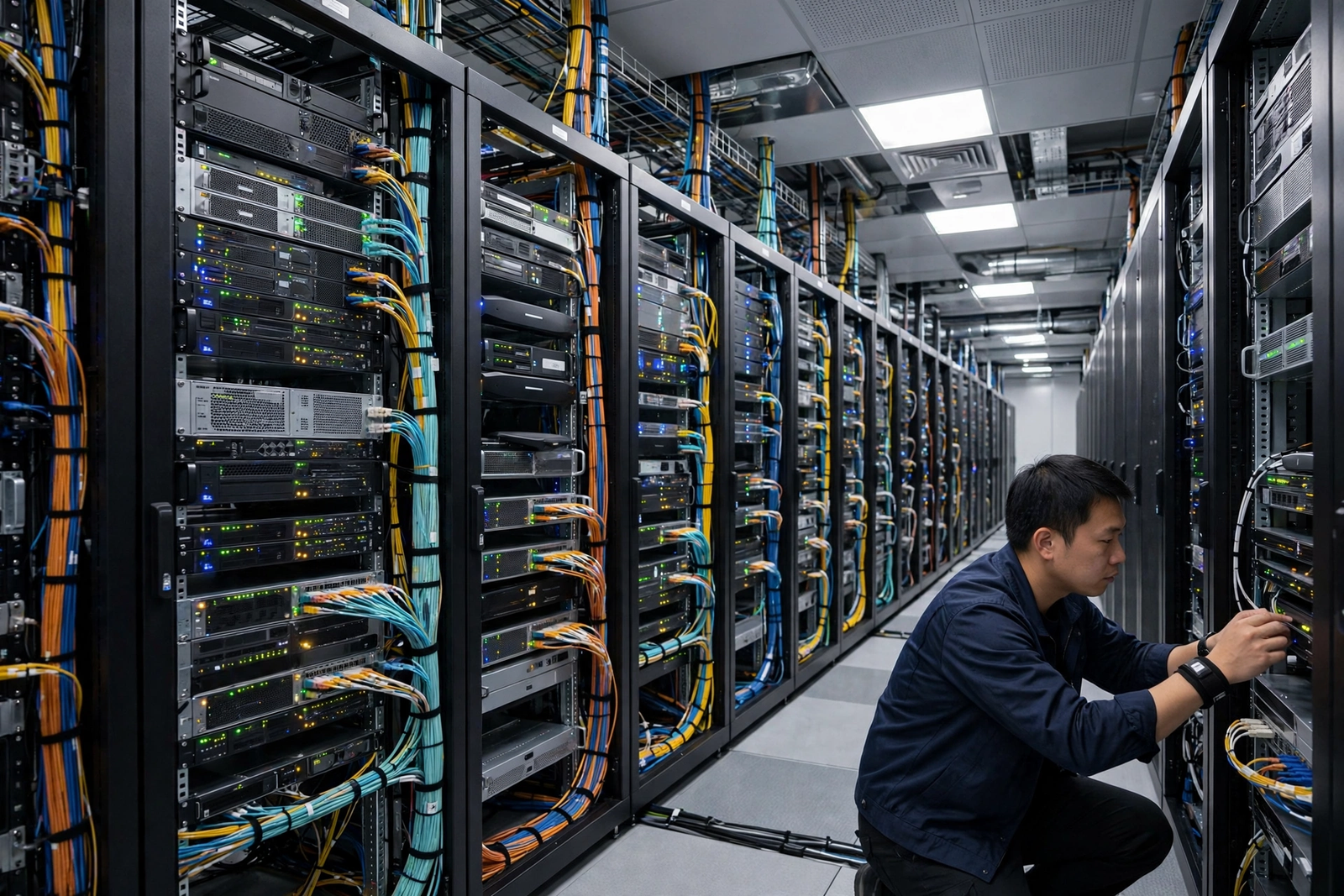
The table below summarises business fiber internet speeds and prices in Salt Lake City, Utah as checked in November 2026. Treat every price as a starting price before taxes and fees, and expect the final quote to depend on the address, the term and any promotion running at the time.
| Provider | Speeds | Uploads | Starting price | Contract |
|---|---|---|---|---|
| AT&T Business Fiber | 300 Mbps to 5 Gig | Symmetrical | From $60 a month list | No annual contract |
| Quantum Fiber business | 500 Mbps to 8 Gig | Symmetrical | From $50 a month | No annual contract |
| Google Fiber Business | 1 Gig to 2 Gig | Symmetrical | From $100 a month | No annual contract |
| UTOPIA Fiber | Up to 10 Gig and above | Symmetrical | By quote | Varies by provider |
| Comcast Business cable | 300 Mbps to 2 Gig | Asymmetrical, slower | From $70 a month | 1-year agreement |
| Comcast dedicated fiber | To 10 Gig | Symmetrical | By quote | By quote |
| Lumen dedicated fiber | To 100 Gig | Symmetrical | By quote | By quote |
| FirstDigital dedicated fiber | To 100 Gig | Symmetrical | By quote | By quote |
Choosing a speed is a matter of counting users and uses. A useful rule is 25 to 50 Mbps of download per heavy user and at least 10 Mbps of upload per person who is on video or uploading files, and then round up to the next tier. A five-person office with cloud tools and daily video calls will be comfortable on 300 to 500 Mbps symmetrical fiber, while a 20-person office with design files or video production should be looking at 1 Gig. The symmetrical upload is the reason fiber beats cable at the same download speed: a 300 Mbps symmetrical fiber connection uploads at 300 Mbps, while a 300 Mbps cable connection may upload at a fraction of that, and the difference shows up every time the team backs up to the cloud or joins a video call. Businesses that want a fuller speed comparison should read our guide to AT&T Business Fiber versus cable, which explains the upload gap in detail.
Fiber Installation in Salt Lake City, Utah: Steps, Timelines and Construction
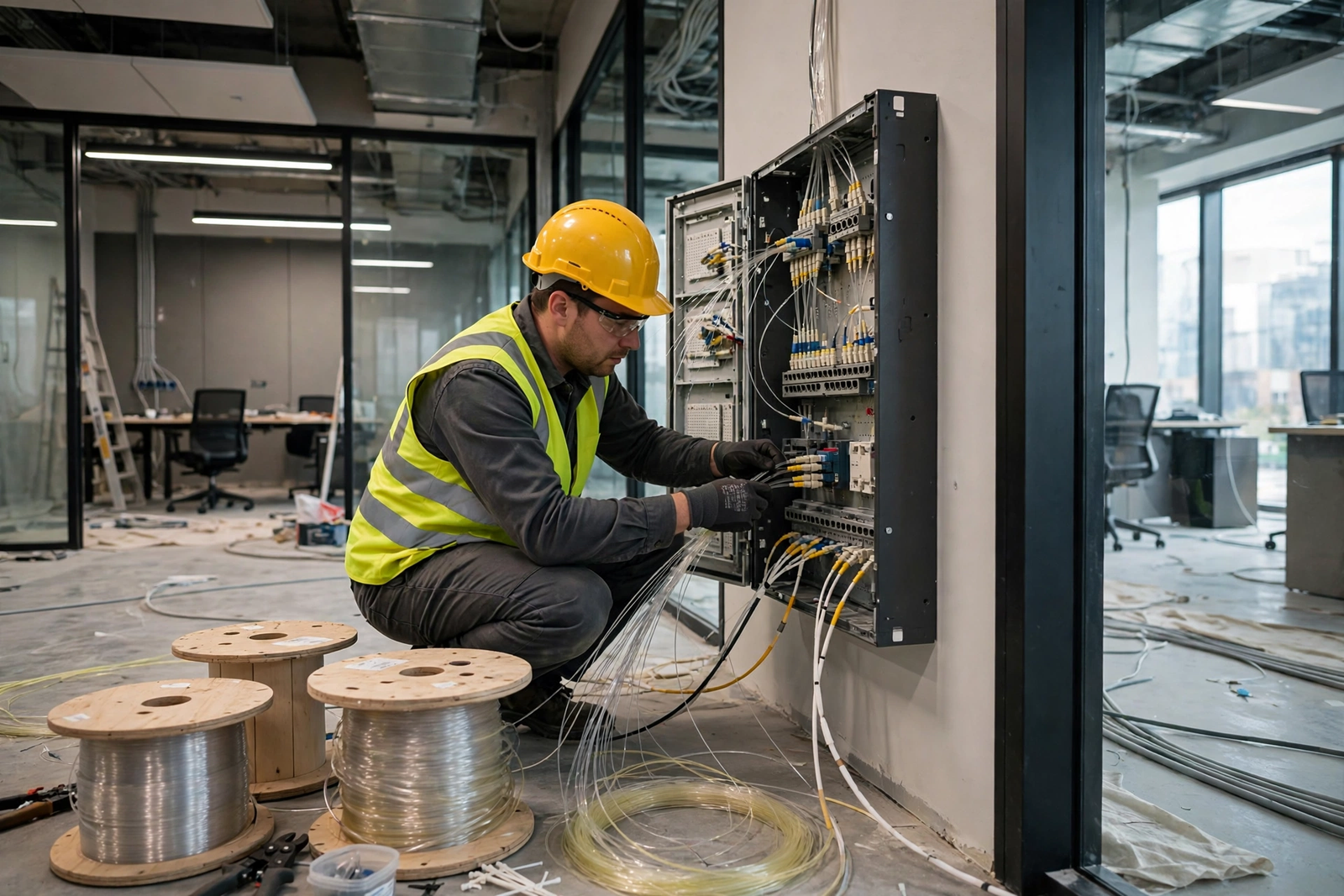
Installing business fiber internet in Salt Lake City, Utah follows the same steps whatever the provider, and knowing them in advance avoids the delays that catch businesses out. The first step is the address check, which takes minutes online and tells the business which providers and speeds are available at its building. The second is the quote, which should be in writing and should state the monthly price, the price after any introductory period, the installation charge, the equipment charge, the static IP charge, the taxes and fees, the term and the early termination fee. The third is the site survey, where the provider confirms how the fiber will enter the building, whether construction is needed, and where the gateway and any internal wiring will go. The fourth is the installation appointment, where a technician runs the fiber, installs the gateway and tests the connection. The fifth is the handover, where the business should run a speed test on a wired connection, test the WiFi in every room, and confirm that point-of-sale, printers and cameras all work before the technician leaves.
Timelines vary by building. A standard installation in a pre-wired downtown tower can take days, while an installation that needs construction can take weeks, because the provider must survey the route, get any permits, and schedule the build. Older buildings in the Avenues, Sugar House and Capitol Hill are the most likely to need construction, because the fiber may reach the street but not the building, and a new drop, conduit or riser may be needed. Quantum Fiber covers the first $1,500 of any construction charge on its business plans, which is the most generous published allowance in this market, and a business should ask every other provider what construction allowance it offers. AT&T Business Fiber offers free installation on eligible online orders, Quantum Fiber includes technician installation at no extra cost, and Google Fiber includes installation with no fee, so a standard install should cost nothing beyond the monthly price.
Three practical points deserve attention. The first is landlord permission: a business in a leased building should confirm in writing that the landlord allows the fiber installation, including any drilling, conduit or external work, before the survey, because a landlord objection discovered on installation day can delay the project by weeks. The second is internal wiring: the provider’s responsibility usually ends at the point where the fiber enters the building, and running Ethernet to desks, meeting rooms and point-of-sale terminals is the business’s cost, either through its own IT support or a cabling contractor. The third is the cutover: a business switching providers should keep the old connection live until the new fiber is tested and working, and should schedule the cutover outside trading hours, because a failed cutover during the working day costs more than a week of overlapping bills. Our guide to how to order and install AT&T Business Fiber walks through each step and the checks to run before the technician arrives.
Business Fiber Internet Costs in Salt Lake City, Utah
Business fiber internet costs in Salt Lake City, Utah start at $50 a month for Quantum Fiber at 500 Mbps or 1 Gig after discounts, $60 a month list for AT&T Business Fiber at 300 Mbps or $40 with an eligible business wireless plan, and $100 a month for Google Fiber Business at 1 Gig. UTOPIA Fiber business pricing is by quote, and dedicated fiber from Lumen, FirstDigital and Comcast Business is also by quote, with third-party guides putting dedicated internet at roughly $300 a month and up for lower speeds. Two-year totals before taxes and fees run from about $1,200 for Quantum Fiber 1 Gig at the discounted price to about $3,360 for AT&T Business Fiber 1 Gig at list, and about $2,400 for Google Fiber Business 1 Gig. Taxes and fees add roughly $5 to $15 a month, and a static IP address may cost extra where it is not included in the plan.
The cost that catches businesses out is the post-promotion rise. AT&T Business Fiber’s regular post-promotion rates are reported at $70, $110 and $160 a month for the first three tiers, against list prices of $60, $100 and $140, and Comcast Business Essential rises from $60 to $100 in month 13 and $140 in month 25. Quantum Fiber’s $50 price for 1 Gig depends on a $25 new-customer discount that may end, returning the price to $75. Google Fiber Business has no introductory discount, so its $100 price is the price in year two as well. A business should compare two-year totals rather than first-month prices, and should diary the date any discount ends. For a full fee-by-fee breakdown, our guide to the business internet cost in Chicago, Illinois works through the same comparison in another major city.
Business Fiber Internet Backup and Reliability in Salt Lake City, Utah
Fiber is reliable, but no single connection is reliable enough for a business that takes payments or bookings online. Salt Lake City, Utah businesses should plan for a second connection from the start, on a different network from the primary, so that a fiber cut, a construction accident or a provider outage does not take the business offline. The simplest backup is 5G fixed wireless: T-Mobile Small Business Internet starts at $35 a month with discounts, and Verizon 5G Business Internet starts at $65 a month on offer or $35 bundled, and both install in days with a self-installed gateway. AT&T Business Fiber includes built-in 5G backup on its 1 Gig and faster plans at no extra cost, which is the neatest version of this setup, because the failover is automatic and there is no second bill.
Reliability also depends on the service-level agreement. Google Fiber Business includes a 99.9 percent uptime service-level agreement, Quantum Fiber business plans include priority repair, and dedicated fiber from Lumen, FirstDigital and Comcast Business carries stronger service-level agreements with guaranteed uptime and faster repair response. A business should ask each provider what the service-level agreement promises, what happens when the provider misses it, and how fast the repair response is, and should get the answers in writing. Test the failover before it is needed, keep the backup gateway powered and updated, and keep the provider’s support number and the account number where the team can find them, because a backup that has not been tested is a hope rather than a plan. A business that runs two connections from different networks, one fiber and one 5G or cable, will stay trading through almost any single failure.
Salt Lake City, Utah Business Fiber Frequently Asked Questions
Is business fiber internet available in Salt Lake City, Utah?
Yes, in large parts of the city, but not everywhere. AT&T Business Fiber, Quantum Fiber, Google Fiber and UTOPIA Fiber all offer fiber in parts of Salt Lake City, Utah, and Comcast Business, Lumen and FirstDigital offer dedicated fiber to lit buildings. Coverage changes block by block, so check your exact address with each provider rather than trusting a citywide map.
How much does business fiber internet cost in Salt Lake City, Utah?
Shared business fiber starts at $50 a month for Quantum Fiber, $60 a month list for AT&T Business Fiber at 300 Mbps, and $100 a month for Google Fiber Business at 1 Gig, all starting prices before taxes and fees. Dedicated fiber is by quote, typically several hundred dollars a month and up. Two-year totals for shared gigabit fiber run from about $1,200 to about $3,840 before taxes and fees, depending on the provider and the price after any discount ends.
How long does business fiber installation take in Salt Lake City, Utah?
A standard installation in a pre-wired building can take days, while an installation that needs construction can take weeks. Older buildings in the Avenues, Sugar House and Capitol Hill are more likely to need a new fiber drop. Confirm the timeline and whether construction is needed in writing before signing, and keep the old connection live until the new fiber is tested.
Which business fiber provider is fastest in Salt Lake City, Utah?
Quantum Fiber offers speeds up to 8 Gbps, AT&T Business Fiber up to 5 Gig, Google Fiber Business up to 2 Gig, and UTOPIA Fiber up to 10 Gbps and above. In real-world measurements, Google Fiber had the fastest median speeds in the city in the second half of 2025, at about 468 Mbps down and 333 Mbps up. For most offices the difference between providers at the same tier is small, and availability and upload speed matter more than the maximum advertised speed.
Do I need a backup connection with business fiber in Salt Lake City, Utah?
Any business that takes payments, bookings or patient data online should have one. A 5G backup from T-Mobile or Verizon costs from $35 a month with discounts and runs on a separate network from fiber, and AT&T Business Fiber includes built-in 5G backup on its 1 Gig and faster plans. Test the failover before it is needed.
Salt Lake City, Utah Fiber Installation Checklist
Use this checklist before ordering business fiber internet in Salt Lake City, Utah. First, check availability at your exact address with AT&T Business Fiber, Quantum Fiber, Google Fiber and Comcast Business, and with UTOPIA Fiber if you are downtown. Second, size the connection for the busiest hour, favouring symmetrical upload speeds for cloud work and video calls. Third, get every quote in writing with the monthly price, the post-promotion price, installation, equipment, static IP, taxes and fees, the term and the early termination fee. Fourth, confirm whether construction is needed, who pays for it, and how long installation will take. Fifth, confirm landlord permission for any drilling or external work. Sixth, confirm the uptime service-level agreement and the repair response time. Seventh, arrange a backup connection on a different network and test the failover. Eighth, keep the old connection live until the new fiber is tested and working. A business that works through that list will get fiber installed on time, at the quoted price, and with a backup in place for the day it is needed. If you want to compare fiber providers in another city before you commit, our guide to the best business internet providers in Nashville, Tennessee shows how the same availability and installation questions play out elsewhere.

