
In today’s fast-paced business environment, communication is everything. Whether you are a small local business or a large enterprise, how you manage customer interactions can define your reputation, sales success, and operational efficiency. An answering service handles calls for businesses, capturing messages and providing basic customer support, often after hours. A call center manages high-volume calls, offering comprehensive customer service, sales, and technical support. Choosing between them depends on your business needs, call volume, and level of personalized customer interaction required.
Answering Service vs Call Center: The Ultimate Guide for Businesses
Two major solutions dominate the market for phone-based customer management: answering services and call centers. While both serve as intermediaries between businesses and clients, their roles, capabilities, and operational models differ significantly. Choosing the right option can streamline workflows, reduce costs, and improve customer satisfaction.
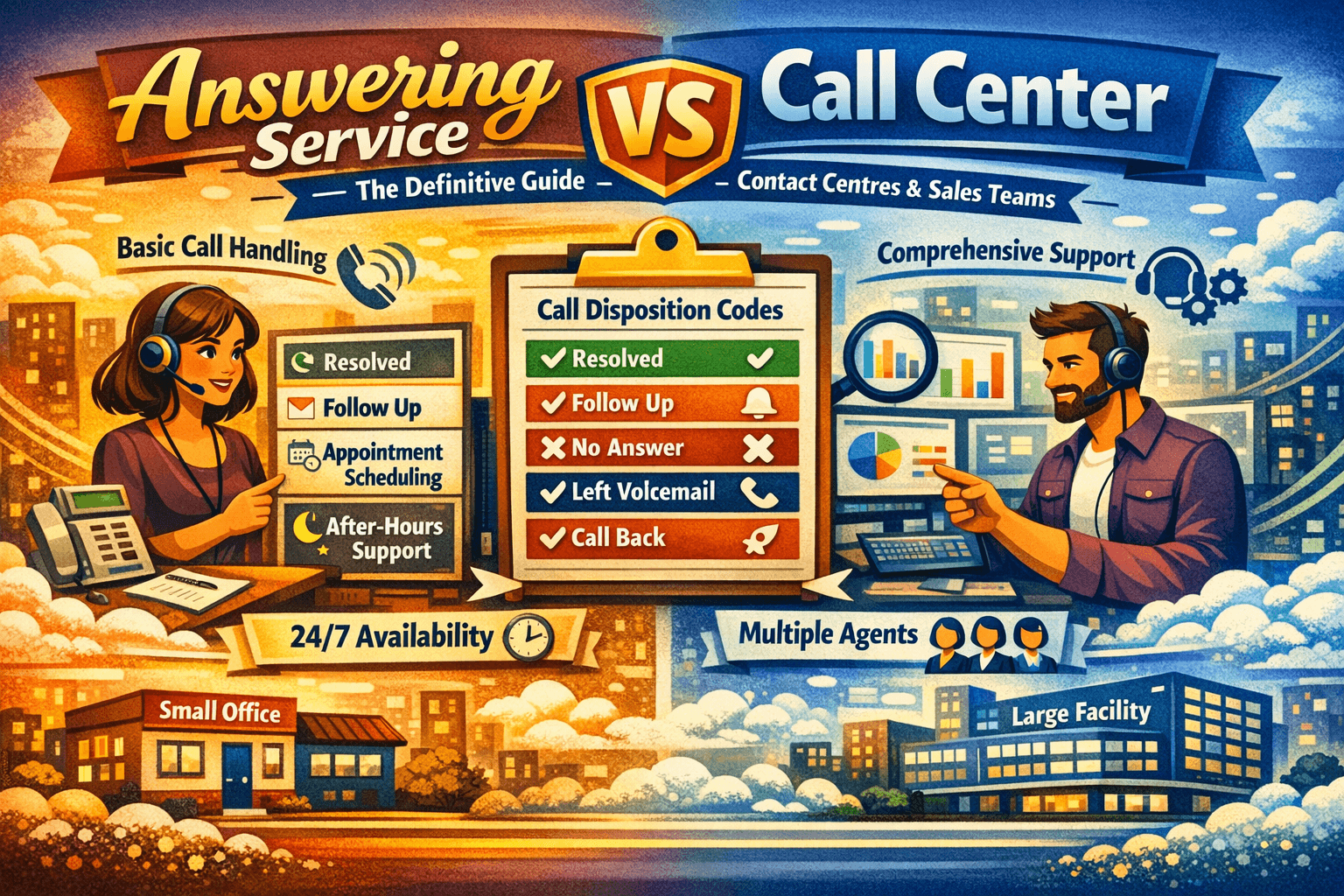
The history of telephone support dates back to the early 20th century when businesses relied on in-house switchboard operators to manage calls. As companies grew, the need for outsourced phone management became clear. Answering services emerged to handle after-hours calls, schedule appointments, and take messages. By contrast, call centers evolved in the 1960s and 1970s as high-volume operations capable of handling customer inquiries, technical support, and even telemarketing campaigns.
Today, the distinction is more important than ever. Small businesses often lean toward answering services to ensure they never miss a call, while large enterprises depend on call centers to manage thousands of interactions daily. Understanding which solution fits your business model, budget, and customer expectations is crucial.
What is an Answering Service?
An answering service is a professional third-party operation that handles incoming calls on behalf of a business. Its primary goal is to capture messages, relay information, and ensure clients receive timely responses, especially outside normal business hours.
Key Features of Answering Services
- Message-Taking and Call Routing: Agents take accurate messages and route urgent calls to the right person.
- Appointment Scheduling: Integrates with calendars to book or confirm appointments.
- Basic Customer Support: Provides simple information about services, products, or policies.
- After-Hours Coverage: Many answering services operate 24/7 to ensure businesses are always reachable.
Who Benefits Most from Answering Services?
- Small businesses with low call volumes
- Professionals such as doctors, lawyers, and consultants
- Companies needing personal, accurate, and human-centric call handling
Example Scenario: A local law firm receives calls after office hours. An answering service takes messages and schedules consultations. Clients never feel ignored, and lawyers can focus on case preparation without being interrupted by every call.
What is a Call Center?
Call centers are centralized operations designed to manage high-volume inbound and outbound calls. Unlike answering services, call centers provide comprehensive support, including sales, technical assistance, and customer service.
Key Features of Call Centers
- High-Volume Handling: Designed to manage hundreds or thousands of calls daily.
- Inbound and Outbound Capabilities: Can handle customer inquiries and actively reach out for sales or marketing.
- Specialized Agent Training: Agents are trained for customer service, problem-solving, or technical support.
- Multi-Channel Support: Some call centers integrate voice, email, chat, and social media.
- Advanced Technology Integration: CRMs, analytics tools, and reporting dashboards help track performance and customer behavior.
Read More: is it illegal to record a conversation in jamaica
Who Benefits Most from Call Centers?
- Large companies with high call volumes
- E-commerce and tech companies needing detailed support
- Businesses requiring multilingual or global customer service
Example Scenario: A multinational software company handles customer issues via a call center. Agents troubleshoot technical problems, process orders, and provide product education. The company maintains high customer satisfaction, even during peak periods, thanks to trained staff and scalable infrastructure.
Step-by-Step Guide: Choosing the Right Solution
Choosing between an answering service and a call center requires careful evaluation of your business needs. Here’s a detailed guide:
Step 1: Assess Call Volume
- Low to Moderate: Answering service is sufficient
- High Volume: Call center is more appropriate
Step 2: Understand Customer Needs
- Simple inquiries or appointment scheduling: Answering service
- Technical support, order processing, or multi-channel queries: Call center
Step 3: Evaluate Costs
- Answering services generally cost less, ideal for small businesses
- Call centers are more expensive due to infrastructure, software, and trained personnel
Step 4: Consider Hours of Operation
- After-hours support or part-time coverage → Answering service
- 24/7 multi-functional support → Call center
Step 5: Integration with Business Tools
- Answering services often sync with calendars and basic messaging tools
- Call centers integrate with CRMs, reporting software, and advanced analytics
Step 6: Test and Measure
- Conduct a 2–4 week trial to evaluate response times, accuracy, and customer satisfaction
- Review metrics like missed calls, first-call resolution, and follow-up efficiency
Comparison Table: Answering Service vs Call Center
| Feature | Answering Service | Call Center |
|---|---|---|
| Call Volume | Low to moderate | High |
| Functionality | Messages, scheduling, basic support | Customer support, technical support, sales |
| Costs | Lower | Higher |
| Agent Training | Basic | Specialized and advanced |
| Availability | After-hours or peak periods | 24/7 |
| Technology Integration | Calendar, voicemail | CRM, analytics, multi-channel support |
| Ideal for | Small businesses, professionals | Medium to large businesses, global companies |
Benefits of Answering Services
- Cost-Efficient: Saves money compared to hiring full-time receptionists
- Ensures No Missed Calls: Every call is recorded or routed appropriately
- Improved Customer Experience: Timely, professional responses improve satisfaction
- Flexibility: Scale the service based on call volume
- Focus on Core Tasks: Internal staff focus on critical business operations
Benefits of Call Centers
- Comprehensive Customer Support: Handles complex queries and technical issues
- Scalability: Easily manage seasonal spikes or business growth
- Data and Analytics: Provides insights into customer behavior and call trends
- Professional Representation: Trained agents maintain brand reputation
- Multilingual & Global Support: Reach international customers efficiently
Real-World Scenario: Putting It into Perspective
Scenario 1: Small Business Using Answering Service
A boutique dental clinic has 15 patients calling daily. An answering service schedules appointments and answers basic questions. No calls are missed, and dentists focus on treatments rather than phone calls.
Scenario 2: Large Enterprise Using Call Center
An e-commerce retailer receives thousands of calls daily. A call center manages order tracking, product queries, and returns. Multilingual agents and CRM integration ensure high customer satisfaction, even during Black Friday or holiday rush periods.
Unique Value: How to Decide
- Answering services excel in personal, low-cost, and flexible solutions for smaller operations.
- Call centers shine in high-volume, multi-channel, and technically complex scenarios.
Businesses must consider ROI, customer satisfaction, operational efficiency, and scalability before choosing the right model.
FAQs: Answering Service vs Call Center
Q1: Can small businesses use call centers?
Yes, but they might be cost-prohibitive. Many small businesses benefit more from answering services until call volume grows.
Q2: Are answering services available 24/7?
Most offer after-hours coverage, but full-time 24/7 coverage is usually provided by call centers.
Q3: What is the difference between inbound and outbound call centers?
Inbound handles incoming customer queries; outbound focuses on sales, marketing, and outreach campaigns.
Q4: How do costs compare?
Answering services are less expensive, ideal for basic tasks. Call centers are costlier due to staff training, software, and scale.
Q5: Which integrates better with CRMs?
Call centers typically have robust CRM and analytics integrations, while answering services offer basic tools for scheduling and messaging.
Q6: Can answering services handle multiple languages?
Some do, but call centers usually have broader multilingual support for global operations.
Q7: How to measure success?
Track KPIs such as response times, missed calls, first-call resolution, and customer satisfaction scores.
Conclusion
Choosing between an answering service and a call center is not just about cost — it’s about matching your business needs, call volume, customer expectations, and operational goals. Small businesses or professionals seeking flexible, personal call management often benefit from an answering service. Enterprises needing high-volume, multi-channel, or technical support rely on call centers to deliver consistent, high-quality customer interactions.
By understanding the distinctions, evaluating your requirements, and testing options, businesses can make informed decisions that enhance productivity, improve customer satisfaction, and maximize ROI.

