
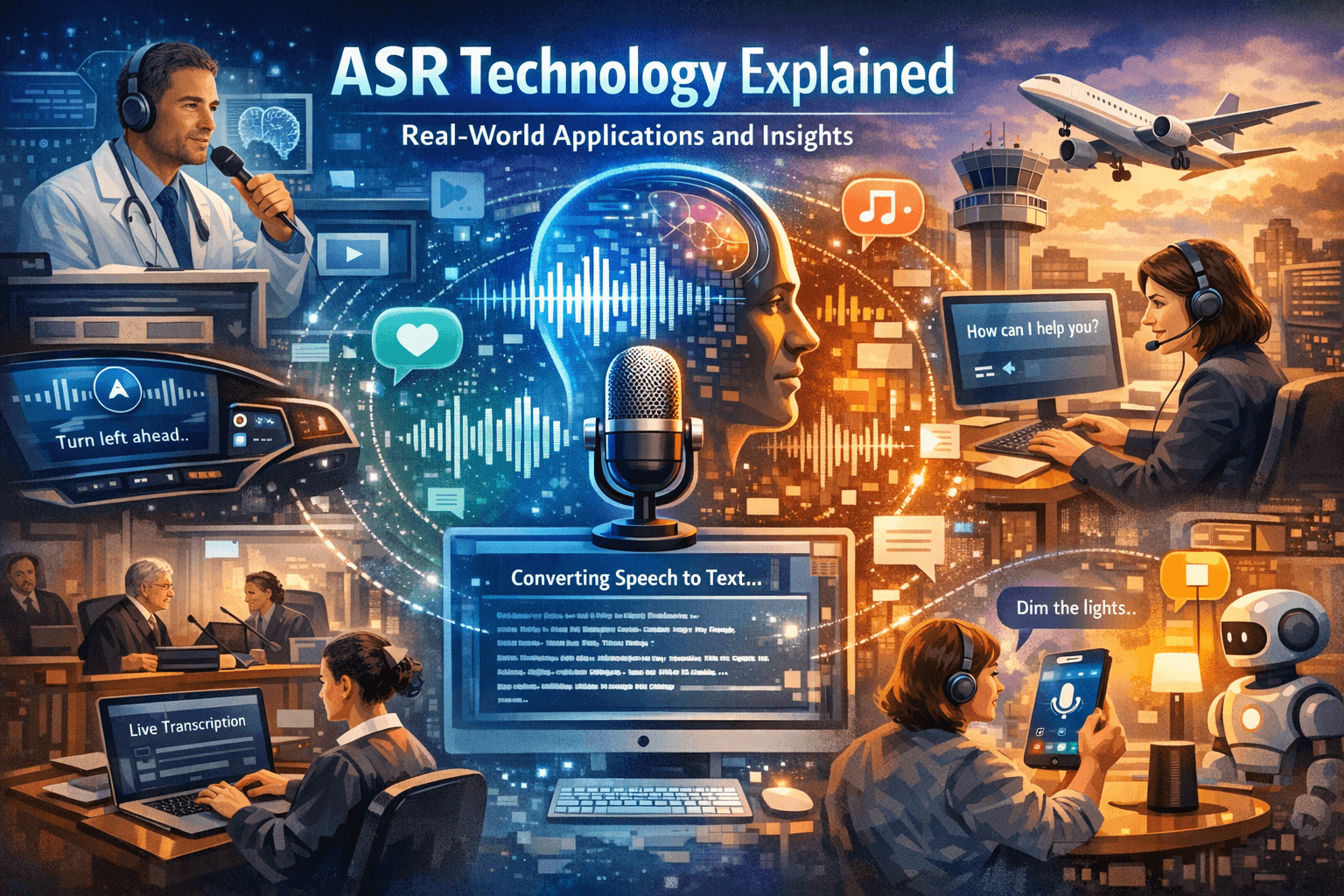
Automatic Speech Recognition (ASR) converts spoken language into written text by analyzing audio signals with advanced algorithms. It identifies phonemes, matches them to linguistic models, and predicts words in real-time. Modern ASR systems leverage AI and deep learning, making them accurate for transcription, voice assistants, and real-time communication applications across industries.
How Does ASR Work? A Complete Guide
Automatic Speech Recognition (ASR) has become a cornerstone of modern communication technology. From voice assistants like Siri and Alexa to real-time transcription tools used in conferences and customer support, ASR is everywhere. But how exactly does this technology work, and why has it become so accurate and widely adopted? In this guide, we’ll explore the underlying mechanics, applications, comparisons, and common questions about ASR systems.
1. The Basics of Speech Recognition
Speech is a complex signal. It consists of vibrations, intonations, and patterns that convey not just words but meaning. ASR systems take these audio signals and convert them into text.
At a high level, the process involves:
-
Audio Input: Capturing the spoken voice via a microphone.
-
Preprocessing: Cleaning the signal to remove noise and normalize volume.
-
Feature Extraction: Breaking down the audio into measurable features like frequency, amplitude, and phonemes.
-
Acoustic Modeling: Comparing features to a library of known sounds in the language.
-
Language Modeling: Using grammar and vocabulary to predict the most likely sequence of words.
-
Decoding: Combining acoustic and language models to produce the final text output.
This process happens in milliseconds in modern systems, allowing almost real-time transcription.
2. How ASR Interprets Human Speech
Humans speak in varied accents, speeds, and tones, making speech recognition a challenging task. ASR addresses this through machine learning models that “learn” from thousands of hours of audio.
Key Steps in Interpretation:
-
Segmentation: Dividing speech into small units, like phonemes, which are the smallest sound units in a language.
-
Pattern Matching: Comparing these units to a trained dataset of sounds.
-
Prediction: Using statistical models to predict words based on context.
For example, when you say “I need a coffee,” the ASR system doesn’t just recognize individual sounds; it predicts the most probable word sequence based on context, even if the pronunciation varies slightly.
3. Modern ASR: AI and Deep Learning
The shift from rule-based models to AI-driven deep learning has revolutionized ASR. Modern systems use neural networks to model complex relationships between sounds and words.
Benefits of AI in ASR:
-
Handles diverse accents and languages more accurately.
-
Learns from new data continuously, improving over time.
-
Reduces transcription errors in noisy environments.
Real-world scenario: A multinational company uses ASR to transcribe meetings. Before AI-based ASR, errors were frequent for non-native English speakers. After adopting deep learning ASR, transcription accuracy improved dramatically, reducing manual correction efforts.
Comparison Table: Traditional vs AI-Powered ASR
| Feature | Traditional ASR | AI/Deep Learning ASR |
|---|---|---|
| Accuracy | Moderate, struggles with accents | High, handles accents and dialects |
| Noise Handling | Poor, background noise affects output | Robust, filters noise effectively |
| Learning | Static, limited updates | Continuous learning from data |
| Application | Dictation, simple commands | Voice assistants, transcription, call centers |
| Adaptability | Limited | Highly adaptable across languages and contexts |
This table highlights why modern businesses prefer AI-powered ASR over traditional rule-based systems.
Real-Life Applications of ASR
ASR isn’t limited to transcription. It powers many aspects of our daily lives:
-
Voice Assistants: Alexa, Siri, Google Assistant.
-
Customer Support: Automatic call routing and transcription.
-
Healthcare: Doctors dictate patient notes for EMR systems.
-
Education: Real-time lecture transcription for accessibility.
-
Media & Entertainment: Subtitle generation for videos.
A personal scenario: While traveling in a noisy airport, I dictated a text message using ASR. Despite the background announcements and chatter, the system accurately captured my message, demonstrating the technology’s robustness in real-world conditions.
Read More: is it illegal to record a conversation in jamaica
Challenges in ASR
Even with modern advancements, ASR faces challenges:
-
Accents & Dialects: Some regional pronunciations can still be misinterpreted.
-
Background Noise: Extreme environments can affect recognition.
-
Homophones: Words that sound alike may confuse the system without proper context.
-
Privacy Concerns: Audio data must be processed securely, especially in sensitive industries like healthcare.
Continuous research focuses on improving context recognition, noise reduction, and multilingual support.
Future of ASR
The future of ASR is intertwined with AI advancements:
-
Multilingual Support: Systems capable of recognizing and switching between multiple languages seamlessly.
-
Emotion Recognition: Understanding tone and sentiment for better responses.
-
Edge Computing: Processing speech locally on devices to reduce latency and improve privacy.
For instance, AI-powered earphones may soon transcribe meetings and provide real-time translation without relying on cloud processing, making ASR even more versatile.
FAQ
Q1: Can ASR work in noisy environments?
Yes, modern AI-powered ASR systems use noise-cancellation algorithms and deep learning models to accurately transcribe speech even in noisy settings.
Q2: Is ASR accurate for all languages?
Accuracy varies by language. Popular languages like English, Spanish, and Mandarin have higher accuracy due to larger datasets. Emerging languages are being integrated progressively.
Q3: What is the difference between ASR and voice recognition?
ASR converts speech to text. Voice recognition identifies the speaker. Some systems combine both for personalized experiences.
Q4: Can ASR be used for live translation?
Yes, real-time ASR combined with translation models can transcribe and translate speech almost instantly, enabling live multilingual communication.
Q5: How secure is ASR data?
Security depends on implementation. Cloud-based ASR systems should comply with privacy regulations like GDPR and HIPAA to protect user data.
Q6: Do accents affect ASR accuracy?
Accents can impact accuracy, but modern systems trained on diverse datasets can handle multiple accents with high reliability.
Q7: What industries benefit the most from ASR?
Healthcare, education, media, telecommunications, and customer support industries see significant efficiency gains from ASR technology.

