
If you run a business in Denver, Colorado, the short answer to the question of whether fiber internet is the right choice is this: yes, for most offices, shops, clinics, and studios, because fiber gives you symmetrical upload and download speeds, no data caps, and the most consistent performance of any business connection, and Denver has more fiber choice than most American cities. Quantum Fiber, the fiber brand of Lumen, is the largest fiber provider in the city, covering roughly 90 percent or more of premises in many central neighborhoods with speeds up to 8 Gbps. AT&T Business Fiber is also worth checking, with symmetrical speeds from 300 Mbps to 5 GIG, no data caps, and a gateway included, although its Denver footprint is limited and address-specific. This guide explains business fiber internet in Denver, Colorado in practical terms: which providers sell it, what speeds and prices to expect, where it is available, how installation works, and when cable or fixed wireless is the better choice.
Denver, Colorado is a strong fiber city, but it is not a uniform one. Fiber is densest in Downtown, LoDo, RiNo, Cherry Creek, and the Denver Tech Center, where new office towers and business parks were built with fiber in mind, while outer neighborhoods and older buildings may have no fiber at all and rely on cable or fixed wireless. That patchwork means the fiber question is always an address question: the provider, the speed, the price, and the installation time all depend on your exact suite, not just your neighborhood. Every speed and price in this guide is drawn from comparison sources and 2026 broker data, and every one should be tested against an address-specific quote before you decide. Treat this guide as a map of the market, and the address check as the moment the map becomes your answer.
Check AT&T Business Fiber Availability for Your Denver Address
Symmetrical fiber speeds from 300 Mbps to 5 GIG, with no data caps and a gateway included.
Business Fiber Internet in Denver, Colorado at a Glance
The table below summarizes the business fiber internet providers in Denver, Colorado, the speeds comparison sources report, and the type of business each one suits best. Shared fiber plans are the right choice for most businesses, because they are fast, symmetrical, and far cheaper than dedicated lines. Dedicated fiber, sold as Dedicated Internet Access, is a separate product for larger offices that need guaranteed bandwidth and a service level agreement, and it is priced accordingly.
| Provider | Technology | Speeds reported | Typical business pricing | Best for |
|---|---|---|---|---|
| Quantum Fiber | Shared fiber | Up to 8 Gbps | From around $50 per month | Widest fiber coverage in Denver |
| AT&T Business Fiber | Shared fiber | 300 Mbps to 5 GIG symmetrical | Business plans from $40 per month nationally | Offices where AT&T fiber is available |
| CenturyLink (Lumen) | Shared and dedicated fiber | Fiber up to 1 Gbps | Varies by address and speed | Existing Lumen buildings |
| Zayo | Dedicated fiber | Up to 10 Gbps and above | Quoted per address | Large offices and data users |
| Crown Castle Fiber | Dedicated fiber | Quoted per address | Quoted per address | Commercial cores and campuses |
| Cogent | Dedicated fiber | Quoted per address | Quoted per address | Businesses needing low-cost dedicated bandwidth |
Get A Free AT&T Business Fiber Quote
Symmetrical fiber speeds from 300 Mbps to 5 GIG, with no data caps and a gateway included.
Two patterns stand out in that table. First, shared fiber is the value choice: Quantum Fiber and AT&T Business Fiber both offer gigabit-plus speeds at prices that sit inside the roughly $100 to $350 per month range that broker data reports for shared plans up to 1 Gbps, while dedicated fiber from Zayo, Crown Castle Fiber, and Cogent costs several times more for the same speed, because you are paying for a guarantee rather than just bandwidth. Second, no single provider covers all of Denver, Colorado, so the fiber provider that serves your building matters more than the provider with the fastest advertised speed. A 1 Gbps fiber plan that reaches your suite beats a 5 Gbps plan that stops at the end of your street.
Quantum Fiber: Denver Business Fiber Internet Providers With the Widest Coverage
Quantum Fiber is the fiber brand of Lumen, the company that operates the former CenturyLink network in Denver, Colorado, and it is the largest fiber provider in the city by coverage. Comparison sources report Quantum Fiber offering speeds up to 8 Gbps, with plans starting at around $50 per month, and covering roughly 90 percent or more of premises in many central neighborhoods. That coverage is unusually high for a fiber network, and it reflects how much of central Denver has been built or rebuilt in the fiber era, with new office towers, apartment buildings, and business parks wired for fiber from the start. Speeds are symmetrical on fiber plans, so uploads match downloads, which matters for cloud backups, video conferencing, and point-of-sale systems that send as much data as they receive.
Quantum Fiber’s main limitation is that coverage is not universal, even in a fiber-dense city. Outside Downtown, LoDo, RiNo, Cherry Creek, and the Denver Tech Center, availability falls away, and some business parks, older buildings, and outer neighborhoods may have no Quantum Fiber at all. Prices also vary by speed tier and by whether the address qualifies for a promotional rate, so the starting price of around $50 per month is a floor for the slowest tier rather than a promise for gigabit service. When you get a Quantum Fiber quote, ask whether the price includes the gateway and installation, whether it rises after an introductory period, and what the contract term is, because those details decide the real first-year cost.
If Quantum Fiber reaches your building, it should be the first quote you compare, and the second quote should be AT&T Business Fiber where available, because the two providers compete directly on symmetrical speeds and no data caps. Compare them at the same speed tier, on total first-year and second-year cost, and on installation time, because the cheaper monthly price is not always the cheaper two-year price once installation and equipment are counted. If Quantum Fiber does not reach your building, ask the provider whether a build is planned for your street or your building, and check Comcast Business cable and fixed wireless as interim options while you wait, rather than signing a long cable contract that locks you out of fiber when it arrives.
AT&T Business Fiber: Denver Business Fiber Internet Speeds and Availability
AT&T Business Fiber is the product these Denver guides lead to, and it deserves an honest description in a fiber guide. Nationally, AT&T Business Fiber offers symmetrical speeds from 300 Mbps to 5 GIG, no data caps, a gateway included, and no annual contract on shared plans, with business plans from $40 per month on AT&T’s own city pages. Those are strong specifications: symmetrical speeds matter because video calls, cloud backups, and point-of-sale systems all upload as much as they download, and no data caps means a busy month never triggers overage charges. For a Denver business that qualifies, AT&T Business Fiber is competitive with any fiber provider in the city on speed, symmetry, and simplicity.
The honest limitation is availability. AT&T is not the incumbent telephone provider in Denver, Colorado, and Federal Communications Commission data shows AT&T mainly reaching Denver neighborhoods at up to 100 Mbps through older DSL and fixed wireless technology, not through a citywide fiber network. That means AT&T Business Fiber availability in Denver is genuinely address-limited, and many Denver businesses will find that the fiber product is not available at their building even though AT&T advertises it nationally. The right response is to check rather than assume: you can check AT&T Business Fiber availability for your Denver address and get a straight answer for your building in minutes, at no cost, before spending time comparing other providers.
If the answer is yes, compare the quoted speed and price against Quantum Fiber at the same address and choose on the numbers, including installation time and the price after any introductory period. If the answer is no, AT&T Internet Air for Business, the fixed wireless product, is the realistic AT&T fallback in Denver, and it can serve as a primary connection for a small office or as a backup connection alongside a wired provider. For a step-by-step walkthrough of what happens after you order fiber, see our guide on how to order and install AT&T Business Fiber, which covers the address survey, the install appointment, and the equipment you should expect on the day.
Denver Business Fiber Internet Speeds: Symmetrical Speeds Explained

Symmetrical speeds are the single biggest reason to choose fiber over cable, and they are worth understanding before you buy. On a symmetrical fiber plan, the upload speed matches the download speed: a 500 Mbps plan gives you 500 Mbps in both directions, and a 1 Gbps plan gives you 1 Gbps in both directions. On cable, the upload speed is a fraction of the download speed: a plan advertised at 1 Gbps download may only offer 35 to 100 Mbps upload. That difference is invisible when you are browsing or streaming, but it decides whether video calls freeze, cloud backups finish overnight or run into the next working day, and large files upload before a client meeting or after it.
| Business type | People online at once | Download speed to look for | Upload speed to look for |
|---|---|---|---|
| Solo office or small shop | 1 to 3 | 100 to 300 Mbps | 100 to 300 Mbps symmetrical |
| Small office or cafe | 4 to 10 | 300 to 500 Mbps | 300 to 500 Mbps symmetrical |
| Mid-sized office or clinic | 11 to 25 | 500 Mbps to 1 Gbps | 500 Mbps to 1 Gbps symmetrical |
| Large office or call center | 26 or more | 1 Gbps or higher | 1 Gbps symmetrical |
| Design studio or media team | 5 to 15 | 1 Gbps | 1 Gbps symmetrical |
Speed needs also change with the number of connected devices, not just the number of people. A Denver restaurant with ten staff, twenty smart devices, a point-of-sale system, security cameras, and guest Wi-Fi for fifty diners can have more devices online than a twenty-person office, and each camera and terminal takes a slice of bandwidth. Before choosing a speed tier, count the devices that will be connected during your busiest hour, including cameras, printers, card readers, smart thermostats, and guest phones, and add a margin of at least 25 percent for growth. If the count surprises you, step up a tier rather than buying the cheapest plan and discovering the shortfall during a lunch rush. For a comparison of how the same fiber speeds and prices look in another large city, see our guide to business fiber internet in Los Angeles, California, which covers the same symmetrical-speed decision at a larger scale.
Business Fiber Internet Installation in Denver, Colorado
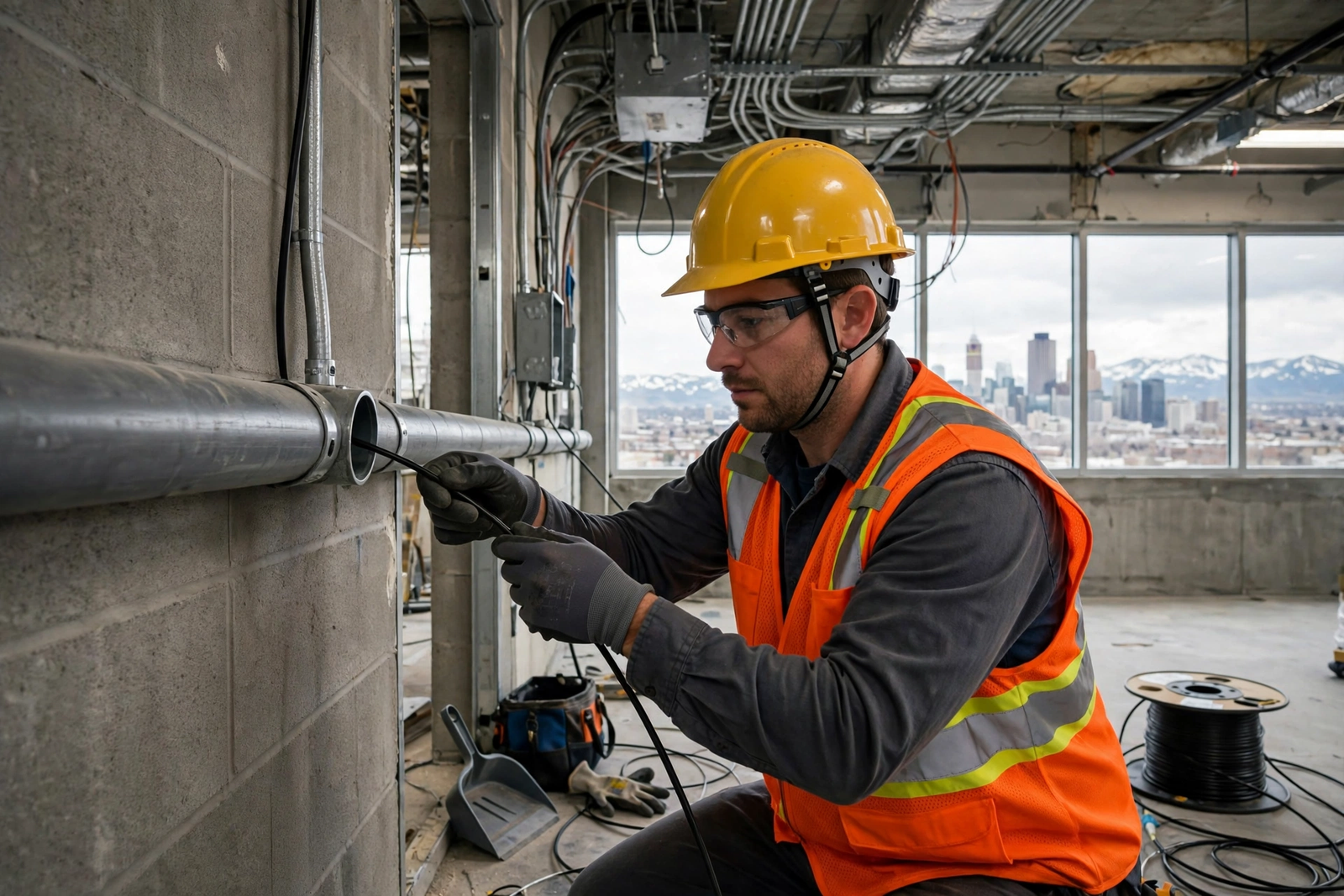
Business fiber internet installation in Denver, Colorado usually follows four steps: an address check, a site survey, the physical install, and activation and testing. The address check is the fastest step and can be done online in minutes: the provider confirms whether fiber already reaches your building and which speeds are available at your suite. The site survey comes next, and it is the step that decides the timeline. A technician or engineer visits your premises, confirms where the fiber will enter the building, where the gateway will sit, and whether any internal wiring is needed, and they will tell you whether landlord permission is required and whether a construction charge applies.
The physical install is where fiber differs most from cable. If fiber is already in your suite, the install can take a few hours: the technician connects the fiber to an optical network terminal, sets up the gateway, and tests the connection. If fiber has never been run into your building, the install can take weeks, because the provider may need to run fiber from the street, drill an entry point, and wire it to your suite, and the building owner may need to approve the work. That is why installation time is a question to ask up front, not a detail to discover after you have signed: a business that needs service this week should not order a fiber build that takes six weeks, and a business that can wait should not settle for cable when fiber is coming. Ask for the install date in writing, ask what happens if the survey finds extra work, and ask whether a temporary fixed wireless gateway can keep you online while the fiber build is underway.
On install day, prepare the site before the technician arrives. Clear access to the point where fiber will enter the building and to the room where the gateway will sit, confirm that someone with authority to approve the work will be on site, and have your Wi-Fi network name and password decided in advance so the technician can set up the gateway and test your devices before they leave. Test the connection yourself before the technician leaves: run a speed test on a wired connection, join a video call, process a card payment, and check that your printers and point-of-sale terminals are online. If anything does not work, it is far easier to fix while the technician is still in the building than after they have gone. Keep the install paperwork, including the quoted speed, the price after any introductory period, and the support number, in one place, because you will need it at renewal time.
Denver Business Fiber Internet Availability by Neighborhood
Denver business fiber internet availability varies by neighborhood in ways that surprise business owners who move across town. Fiber is densest in Downtown, LoDo, RiNo, Cherry Creek, and the Denver Tech Center, where Quantum Fiber covers roughly 90 percent or more of premises in many central neighborhoods according to comparison sources, and where dedicated fiber providers such as Zayo and Crown Castle Fiber also serve commercial cores. In those areas a business can often choose between two fiber providers, and prices are more competitive because providers compete for the same buildings. Comparison sources also report Comcast Business cable covering close to 99 percent of premises in many neighborhoods, so even in fiber-dense areas, cable is available as a fast alternative or a backup.
Outside the core, the picture changes. Neighborhoods such as Montbello, Green Valley Ranch, and parts of southeast Denver have good cable coverage but thinner fiber, and some business parks on the city edge rely on a single provider or on fixed wireless. Older commercial buildings can also be a problem even in central neighborhoods: a building constructed before fiber was standard may need a wiring run, landlord permission, and a construction survey before fiber can be installed, which adds weeks and sometimes a construction charge. That is why two businesses on the same street can get very different answers, and why an address check matters more than any coverage map. If you are signing a lease, check fiber availability before you sign, not after, and ask the landlord which providers already serve the building. Businesses comparing other cities can see the same pattern in our guide to the best business internet providers in San Diego, California, where fiber is also concentrated in central neighborhoods and cable fills the gaps.
Disclaimer: This article contains affiliate links to AT&T Business services; we may earn a commission at no extra cost to you. Ortelcom.com is an independent publisher not affiliated with or endorsed by AT&T. Pricing, speeds and availability are not guaranteed, were checked 6 November 2026, and vary by address and promotions. Confirm all details before ordering. AT&T trademarks belong to their owner.
Business Fiber Internet vs Cable in Denver, Colorado
The fiber-versus-cable decision in Denver, Colorado comes down to upload speed, consistency, and price at your address. Fiber wins on upload speed, because it is symmetrical, and on consistency, because a fiber connection does not slow down at peak hours the way a shared cable connection can in a busy commercial area. Fiber plans also have no data caps, which matters for businesses that back up large amounts of data to the cloud every night. Cable wins on availability and installation speed: Comcast Business reaches close to 99 percent of premises in many neighborhoods, and a cable install can often be done within days, while a fiber build can take weeks if your building has never been wired.
Price is the tiebreaker, and it depends on your address. Entry-level fiber from Quantum Fiber starts at around $50 per month, and AT&T Business Fiber business plans start from $40 per month nationally, while cable plans for similar download speeds often start higher, so fiber can be cheaper as well as faster where it is available. At gigabit speeds, fiber and cable prices overlap, and the choice should be made on upload speed and on the price after the introductory period, not on the advertised download speed. A business that mostly browses, emails, and takes card payments can be happy on cable, and a business that runs video calls, cloud backups, and large file uploads should choose fiber if it reaches the building. The worst choice is to pay for a fast cable plan whose upload speed chokes your team, when a slower fiber plan would have served you better for the same money.
How Much Does Business Fiber Internet Installation Cost in Denver, Colorado
Business fiber internet installation cost in Denver, Colorado depends on whether fiber already reaches your suite. If it does, installation is usually free or low cost, often under $100, and sometimes waived entirely for a 12-month or longer term. If fiber has never been run into your building, the provider may charge a construction fee of hundreds or thousands of dollars, or waive it in exchange for a longer contract. Ask whether the quote includes installation, whether a construction survey is needed, and what happens to the price if the survey finds extra work, because those answers decide whether the first-year cost is the monthly price times twelve or that figure plus a large one-time charge.
Equipment is the other installation cost to check. AT&T Business Fiber includes the gateway, which saves the $10 to $15 per month that some providers charge to rent one, adding up to $360 to $540 over three years. Other providers may include the gateway, rent it, or sell it outright, and the difference should be in the quote. Also ask about the cost of extra Wi-Fi access points if your premises are large or spread across floors, because a single gateway rarely covers a warehouse or a multi-floor office well, and each extra access point adds to the install cost. Compare providers on total first-year cost, including installation and equipment, rather than on the monthly price alone, and keep the written quote so you can check the first bill against it. For a sense of how the same installation costs look in another market, see our breakdown of business internet cost in Sacramento, California, which uses the same total-cost method.
Frequently Asked Questions About Business Fiber Internet in Denver, Colorado
Is business fiber internet available in Denver, Colorado?
Yes, business fiber internet is available for many Denver businesses, and it is densest in Downtown, LoDo, RiNo, Cherry Creek, and the Denver Tech Center, where Quantum Fiber covers roughly 90 percent or more of premises in many central neighborhoods according to comparison sources. Availability falls away in outer neighborhoods and in older buildings that have never been wired for fiber, so the only reliable answer is an address check for your exact suite. If fiber is not available at your building, cable from Comcast Business or fixed wireless from T-Mobile or AT&T Internet Air for Business are the usual alternatives.
How fast is business fiber internet in Denver, Colorado?
Quantum Fiber offers speeds up to 8 Gbps in Denver, Colorado, and AT&T Business Fiber offers symmetrical speeds from 300 Mbps to 5 GIG nationally. Most Denver businesses buy between 300 Mbps and 1 Gbps, which is more than enough for video calls, cloud backups, and point-of-sale systems for a small or mid-sized team. Speeds are symmetrical on fiber plans, so the upload speed matches the download speed, which is the main advantage fiber has over cable.
How much does business fiber internet cost in Denver, Colorado?
Entry-level fiber plans in Denver start at around $40 to $50 per month, with AT&T Business Fiber business plans from $40 per month nationally and Quantum Fiber plans starting at around $50 per month locally. Shared fiber plans up to 1 Gbps typically run roughly $100 to $350 per month according to 2026 broker data, while Dedicated Internet Access costs about $300 to $700 per month for 100 Mbps symmetrical and about $700 to $2,000 per month for 1 Gbps. Compare total first-year and second-year cost including installation and equipment, not just the first month’s price.
How long does business fiber internet installation take in Denver, Colorado?
If fiber already reaches your suite, installation can take a few hours on a single visit. If fiber has never been run into your building, installation can take weeks, because the provider may need to run fiber from the street, drill an entry point, and wire it to your suite, and the building owner may need to approve the work. Ask for the install date in writing before you sign, and ask whether a temporary fixed wireless gateway can keep you online while the fiber build is underway.
Is AT&T Business Fiber available in Denver, Colorado?
AT&T Business Fiber availability in Denver, Colorado is limited and address-specific. AT&T is not the incumbent telephone provider in Denver, and Federal Communications Commission data shows AT&T mainly reaching Denver neighborhoods at up to 100 Mbps through older DSL and fixed wireless technology, not through a citywide fiber network. Check your exact address before assuming AT&T fiber is available, and consider AT&T Internet Air for Business as the fallback where fiber does not reach your building.
Final Word on Business Fiber Internet in Denver, Colorado
Business fiber internet in Denver, Colorado is a strong choice for most businesses, and the city is lucky to have a fiber leader in Quantum Fiber, with AT&T Business Fiber competing wherever its limited footprint reaches a building. The symmetrical speeds, the absence of data caps, and the consistency of fiber make it the best connection for any business that runs video calls, backs up to the cloud, or sends large files, and the entry-level prices make it affordable for even a small shop. Start with address checks at Quantum Fiber and AT&T Business Fiber, compare symmetrical speeds and total two-year costs rather than advertised download speeds, and ask about installation time and construction charges before you sign.
If fiber does not reach your building yet, do not settle for a long cable contract without asking when fiber is planned for your street, and consider fixed wireless as a bridge rather than a permanent compromise. And if fiber does reach your building, take the time to choose the right speed tier and the right contract term, because a fiber connection chosen well will serve your business for years without needing to be revisited. The provider you choose should be the one whose network reaches your suite, whose upload speed matches your work, and whose price stays honest after the first year, and in Denver, Colorado that provider is usually a fiber provider.

