
Business fiber internet in Houston, Texas is the best connection most offices can buy, and the only honest question is whether it reaches your building. Fiber delivers symmetrical speeds, so a 1 Gig plan uploads at 1 Gig, with low latency, no data caps and a reliability that cable and fixed wireless cannot match. Houston has more fiber choice than almost any other city in Texas, with AT&T Business Fiber reaching roughly three quarters of addresses and local fiber providers serving the fast-growing suburbs, but the coverage is uneven, and a business that assumes fiber is available everywhere in Houston will waste weeks. This guide covers which fiber providers serve Houston, what their speeds and prices really are, how long installation takes, and what to do when fiber does not reach your address yet.
The short answer is that AT&T Business Fiber is the best fiber choice for most Houston businesses that can get it, with symmetrical speeds from 300 Mbps to 5 Gig, no data caps, no annual contract and a gateway included. List prices are $60 per month for 300 Mbps, $100 for 500 Mbps, $140 for 1 Gig, $185 for 2 Gig and $285 for 5 Gig, or $40, $60, $90, $135 and $235 with an eligible business wireless plan, and the 1 Gig tier and above add built-in 5G backup. Tachus Fiber, Frontier Fiber and Ezee Fiber are local alternatives worth a quote in the suburbs they serve, with symmetrical speeds up to 10 Gig, while Comcast Business and Spectrum Business offer fiber-based service at some Houston addresses, priced by quote. Where no fiber reaches, cable or 5G business internet is the bridge, not the destination, and the address check should be repeated at every renewal.
Check AT&T Business Fiber Availability for Your Houston, Texas Address
Symmetrical fiber speeds from 300 Mbps to 5 GIG, with no data caps and a gateway included.
Business Fiber Internet in Houston, Texas at a Glance
The table below summarises the main business fiber options in Houston, Texas as checked in November 2026. Treat every price as a starting price before taxes and fees, and expect the final quote to depend on the address, the term and any promotion running at the time. Coverage figures come from federal coverage data and third-party comparisons, and they are labelled with their basis where the sources differ, because a citywide average is not a promise about any single building.
| Business Fiber Provider | Top Speed | Starting Price | Contract | Houston Coverage |
|---|---|---|---|---|
| AT&T Business Fiber | 5 Gig symmetrical | From $60 per month list | No annual contract | About three quarters of addresses |
| Tachus Fiber | 10 Gig symmetrical | Business by quote | No contract | Northwest suburbs, about 7 percent |
| Frontier Business Fiber | 5 Gig symmetrical | From $49.99 per month for 500 Mbps | 24-month contract for bundle price | Select neighborhoods, about 2 percent |
| Ezee Fiber | 8 Gig symmetrical | Business by quote | No contract | Expanding suburbs |
| Spectrum Business Fiber | 1 Gig and above by market | By market; cable from $50 per month | No contract on internet-only | Limited; mostly cable |
| Comcast Business Fiber | Multi-gig by quote | By quote; cable from $60 per month | 1-year agreement | Select commercial addresses |
| LOGIX, Lumen, Zayo | 100 Mbps to 10 Gig and higher | By quote | Term by quote | Commercial buildings and data centers |
Two facts in that table decide most Houston fiber choices. First, AT&T Business Fiber is the only fiber provider with both wide coverage and published pricing, which makes it the benchmark. Every other fiber name is either narrow, like Tachus and Frontier, or quoted, like Ezee and the enterprise providers, which means a business has to do more work to compare them. Second, the coverage percentages are not additive. A building served by AT&T, Tachus and Frontier has three fiber choices, while a building served by none of them has no fiber choice at all, and the citywide percentages say nothing about which of those two situations applies to any given address. The address check is the whole test, and it should be run with every provider before any price is compared.
The same pattern holds across Texas. Our guide to business fiber internet in Dallas, Texas shows a market where AT&T Fiber and Spectrum Business split the city differently, and the comparison underlines how much of the Houston picture is driven by which networks were built in which neighborhoods.
AT&T Business Fiber in Houston, Texas: Coverage, Fiber Speeds and Fiber Pricing
AT&T Business Fiber is the leading fiber choice for Houston businesses, and it leads on all three measures that matter: coverage, speed and price transparency. AT&T has the largest fiber network in Houston, and recent comparison data puts its fiber at roughly three quarters of Houston addresses. That is a strong footprint, but it is not citywide, and the gaps are concentrated in older industrial pockets, newly built commercial parks on the fringe, and some parts of the suburbs where the fiber build has not yet reached. A business in the Galleria, Midtown, Downtown or the Energy Corridor is very likely to be served, while a business elsewhere should check before assuming anything.
List pricing in November 2026 is $60 per month for 300 Mbps, $100 for 500 Mbps, $140 for 1 Gig, $185 for 2 Gig and $285 for 5 Gig, all symmetrical, with no data caps, no annual contract, a gateway included and free installation on eligible online orders. Businesses that bundle an eligible AT&T business wireless plan pay $40, $60, $90, $135 and $235 per month for the same five tiers. The 1 Gig tier and above add built-in 5G backup at no extra cost, which means the connection fails over to a wireless link if the fiber is cut. Secondary sources report regular post-promotion rates of $70, $110 and $160 per month for the 300 Mbps, 500 Mbps and 1 Gig tiers, so a business should ask what the price becomes when any introductory period ends rather than budgeting on the first-year figure alone.
The speeds are symmetrical on every tier, which is the point of buying fiber rather than cable. A 300 Mbps plan uploads at 300 Mbps, a 1 Gig plan uploads at 1 Gig, and the difference shows up the moment a team uploads large files, runs cloud backups or hosts video calls all day. Latency is low, typically single-digit milliseconds in the metro, and the connection does not slow down in the evening the way a shared cable node can. For a Houston office, the practical tiers are 300 Mbps for a small shop, 500 Mbps for a busy professional office, 1 Gig for a cloud-heavy team or a business that wants the built-in 5G backup, and 2 Gig or 5 Gig for multi-site offices, data-heavy operations and businesses running their own servers. AT&T also sells DSL and fixed wireless under its business internet umbrella in Houston, so confirm the quote is for fiber, not copper or wireless, and confirm whether the Monthly State Cost Recovery Charge, which AT&T’s residential footnote says applies in Texas, is included in the business quote, because no published dollar figure for that charge on business orders was found.
Business Fiber Internet Coverage in Houston, Texas by Neighborhood

Houston’s fiber map follows its commercial geography, and the differences between neighborhoods are large enough to change the shortlist completely. Downtown Houston, Midtown, the Galleria and Uptown, the Texas Medical Center and the Energy Corridor have the most developed infrastructure and the greatest competition, and a business in one of those districts can usually get fiber to the building in a few days, with several providers to choose from. Downtown high-rises in particular have multiple fiber providers already in the building risers, and the question is usually which provider offers the best price for the speed, not whether fiber exists at all. The Texas Medical Center adds a requirement that other districts do not have: medical practices and imaging centers need symmetrical uploads for picture archiving and telehealth, which makes fiber the default and cable a poor fit.
Moving out to Sugar Land, Pearland, Katy and The Woodlands, the situation is more complex. Fiber has been extended to new commercial developments, but the availability of providers at neighboring addresses can be very different, and a business park built in 2024 may have Tachus or Ezee Fiber while the office park across the road has only cable. The Woodlands and Spring are Tachus territory, Katy and Cypress are shared between Frontier, Ezee and Tachus, and Sugar Land and Pearland are largely AT&T Fiber and Comcast Business with pockets of local fiber. Moving further out to the edges of Harris County and beyond, it is possible that no fiber is available at all, and cable and fixed wireless are the only two choices. A business in that position should take the best cable or 5G option available and re-check fiber availability every six months, because build-outs do reach new streets, and the economics of the choice change completely when fiber arrives.
Google Fiber is the one name Houston businesses should not plan around. Google Fiber’s own Texas page lists Austin and San Antonio only, and Houston is not listed, although some third-party sources claim limited availability in select Houston neighborhoods and new developments. The sources disagree, and the drafts present the conflict honestly: check the address on Google Fiber’s own checker and treat a negative result as final, rather than delaying an order for a provider whose own website does not list the city. If Google Fiber does reach the building, its symmetrical gigabit fiber with no data caps and no annual contract would be a strong option. But no Houston business should wait for it while a connection it can buy today is available.
Business Fiber Internet Speeds in Houston, Texas: Which Tier Fits Your Office
Fiber speeds are symmetrical, so the tier a business buys decides both its download and its upload, and the right tier depends on what the business actually does rather than on what sounds impressive. The 300 Mbps tier at $60 a month suits a small office of up to ten people doing email, browsing, cloud applications and occasional video calls, and it suits a retail shop running point of sale, a card reader and a handful of staff devices. It is a genuine small-office plan, not a teaser, and it is the cheapest published fiber entry point in Houston from a national provider. The 500 Mbps tier at $100 a month suits a busier professional office, a team on video calls all day, a business with regular cloud file transfers, and an office with twenty or more connected devices. For most Houston offices, 500 Mbps is the sweet spot, because it gives a team symmetrical speed for everything it does in a working day without paying for gigabit capacity it will not use.
The 1 Gig tier at $140 a month suits a cloud-heavy team, a design studio moving large files, a medical imaging practice, a business running its own servers or hosting, and any office that wants the built-in 5G backup that comes with the 1 Gig tier and above. The 2 Gig tier at $185 a month suits a multi-site office, a business with heavy data transfer needs, and an office with a large number of simultaneous users. The 5 Gig tier at $285 a month suits data-heavy operations, businesses with genuine multi-gigabit workloads, and offices that aggregate traffic from several locations. Tachus Fiber reaches 10 Gig and Ezee Fiber reaches 8 Gig inside their smaller suburban footprints, and those tiers suit the same workloads where they are available. The mistake to avoid is buying speed for its own sake. A ten-person office on 5 Gig pays $285 a month for capacity it will never use, while a design studio on 300 Mbps will feel the bottleneck every time it uploads a project. Match the tier to the workload, and re-check the tier at every renewal, because a business that grows from ten people to thirty will outgrow 300 Mbps faster than it expects.
Speed is not the only performance measure. Latency matters for voice calls, video conferencing and real-time applications, and fiber’s low latency is one of its real advantages over cable and fixed wireless. Houston’s fixed broadband median, measured by Speedtest Intelligence in the second half of 2025, was 325.84 Mbps download and 116.44 Mbps upload with 9 ms latency, which is a strong baseline for a metro of this size, and a fiber connection at the same address will typically beat that median on upload and latency. A business that runs latency-sensitive applications, such as a trading desk, a call center or a remote desktop environment, should ask the provider for the latency to its key destinations and for the service level agreement, because those figures matter more than the headline speed.
Business Fiber Internet Pricing in Houston, Texas: AT&T and the Local Fiber Rivals
AT&T Business Fiber sets the price level for fiber in Houston, and the local providers are measured against it. AT&T list pricing in November 2026 is $60 per month for 300 Mbps, $100 for 500 Mbps, $140 for 1 Gig, $185 for 2 Gig and $285 for 5 Gig, or $40, $60, $90, $135 and $235 with an eligible business wireless plan. The two-year totals are $1,440 at list for 300 Mbps, or $960 bundled; $3,360 at list for 1 Gig, or $2,160 bundled; and $6,840 at list for 5 Gig, or $5,640 bundled. Those totals assume the list price holds, and the honest range uses the reported regular post-promotion rates of $70, $110 and $160 for the 300 Mbps, 500 Mbps and 1 Gig tiers for the second year, which would put the two-year totals at $1,560, $2,520 and $3,600. A business should ask what the price becomes after any introductory period and get the answer in writing.
Frontier Business Fiber is the cheapest published business fiber in Houston where it serves, at $49.99 a month for 500 Mbps as part of a bundle with a voice line and a 24-month contract, and $69.99 a month for 1 Gig, with a 99.9 percent network uptime guarantee. Its two-year totals are about $1,200 for 500 Mbps and about $1,680 for 1 Gig, which undercuts AT&T on both tiers for the businesses in the neighborhoods it serves, including the Heights, Montrose, Bellaire, Galena Park, South Houston, Alief and North Houston, plus Kingwood. The catch is coverage: federal data puts Frontier business availability in Houston at about 2.14 percent, so most Houston businesses cannot buy it, and the ones that can should check it first.
Tachus Fiber and Ezee Fiber do not publish business prices, so no business figure is asserted for either of them here. Tachus publishes residential tiers of 1 Gig at $65 a month, 2.5 Gig at $85, 5 Gig at $99 to $125 depending on the source and date, and 10 Gig at $250, with no contracts and no data caps, and Ezee Fiber residential pricing is reported from $69 a month for multi-gig symmetrical fiber with no contracts. Those residential figures are labelled as such because business pricing is quoted by address, and a business in a Tachus or Ezee suburb should get the written business quote and compare it against the AT&T list for the same speed. What the residential figures establish is the shape of the offer: symmetrical fiber at a lower price per megabit than any national provider. Our guide to business fiber internet in Austin, Texas works through the same price comparison in a market where Google Fiber is a real competitor, which shows how much of the Houston price picture is driven by AT&T’s position as the benchmark.
Disclaimer: This article contains affiliate links to AT&T Business services; we may earn a commission at no extra cost to you. Ortelcom.com is an independent publisher not affiliated with or endorsed by AT&T. Pricing, speeds and availability are not guaranteed, were checked 19 November 2026, and vary by address and promotions. Confirm all details before ordering. AT&T trademarks belong to their owner.
Tachus Fiber, Frontier Fiber and Ezee Fiber in Houston, Texas
The local fiber providers are where the fastest and cheapest fiber in Houston is found, and where the most care is needed about coverage, because each of them serves a small, specific part of the metro. Tachus Fiber is the local overbuilder for the northwest suburbs, founded in 2019 in The Woodlands and built on a purpose-built fiber-to-the-home network using XGS-PON and 25G-PON technology. It serves The Woodlands, Spring, Conroe, Tomball, Katy, Sugar Land, Cypress and Pearland, and federal coverage data puts it at about 7.43 percent of Houston addresses. Its published residential tiers run from 1 Gig at $65 a month to 10 Gig at $250, with 2.5 Gig at $85 and 5 Gig at $99 to $125 depending on the source and date, all symmetrical, with no contracts and no data caps. Business pricing is by quote, and a business in a Tachus suburb should get the written quote and compare it against the AT&T list for the same speed, because the local provider’s advantage is usually price and service rather than headline speed.
Frontier Business Fiber serves select Houston neighborhoods, including the Heights, Montrose, Bellaire, Galena Park, South Houston, Alief and North Houston, plus Kingwood, with business pricing reported at $49.99 a month for 500 Mbps as part of a bundle with a voice line and a 24-month contract, and $69.99 a month for 1 Gig, with a 99.9 percent network uptime guarantee and fiber speeds up to 5 Gig symmetrical. Federal coverage data puts Frontier business availability in Houston at about 2.14 percent, which is a small footprint, but inside it Frontier is the cheapest business fiber in the city. One check matters more than any other with Frontier: confirm the quote is for fiber, not for Frontier’s legacy DSL, which still exists in parts of Houston and should never be bought at a fiber price.
Ezee Fiber is the newest name on the Houston fiber map, expanding across the Houston and Dallas-Fort Worth markets with symmetrical multi-gig fiber up to 8 Gig, no contracts, transparent lifetime pricing and included Wi-Fi hardware, with residential pricing reported from $69 a month and a confirmed presence in Cypress, Tomball and Katy. Business pricing is by quote, and no published business price list was found. For a small business in one of those growth corridors, Ezee Fiber is worth an address check even though it is less well known than the national providers, because its offer is modern fiber without the contract and pricing games. The limitation for all three local providers is the same: coverage is address-specific and concentrated in newer developments and specific suburbs, so a business inside the Loop is unlikely to be served, and the address checker is the whole test.
Business Fiber Internet Installation in Houston, Texas: Timelines, Construction and What to Expect
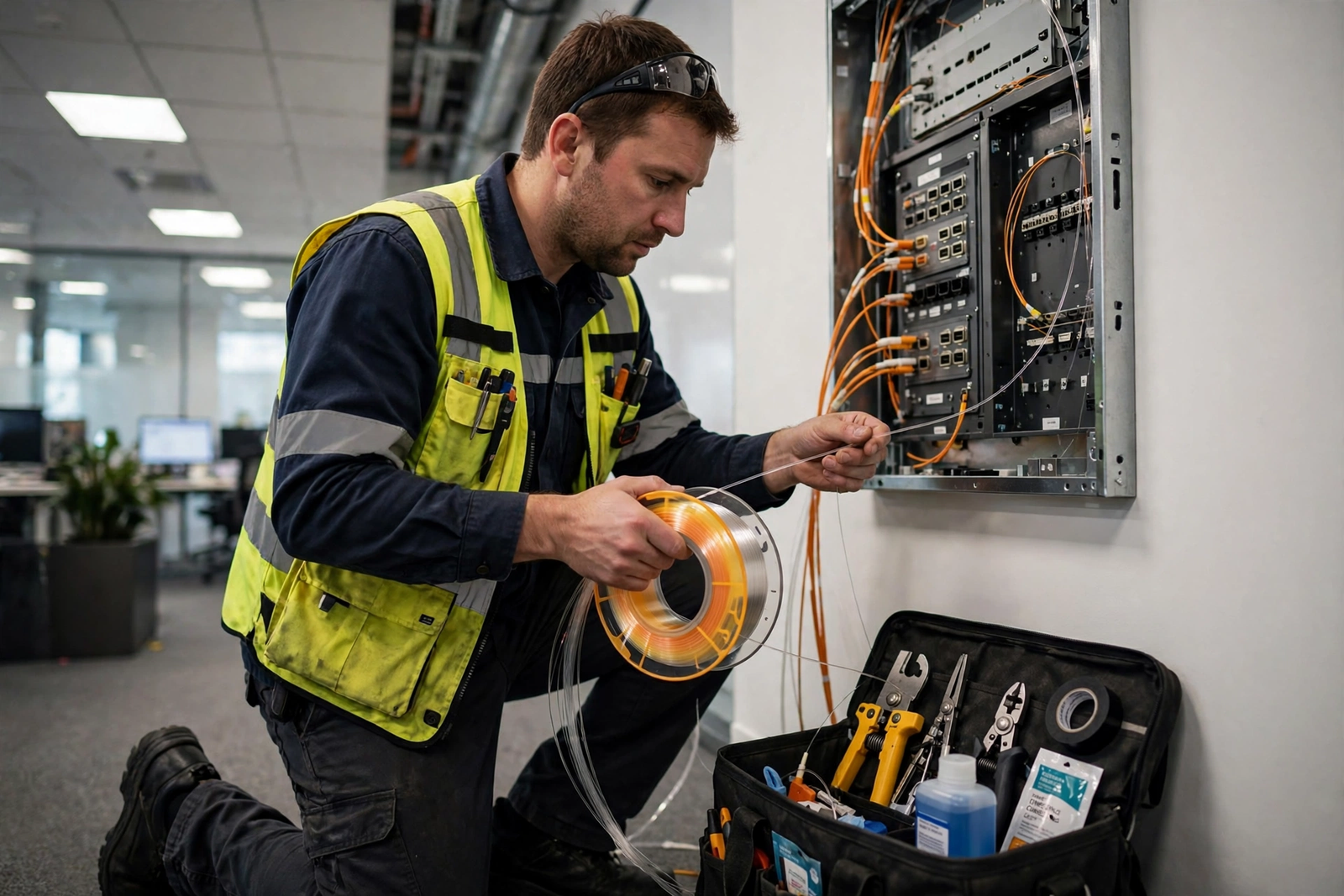
Fiber installation takes longer than cable installation, and a Houston business should plan for it rather than discovering the lead time after signing. Cable can usually be installed in days, because the cable is already in the ground. Fiber requires physical cable runs and permitting, so plan for two to six weeks from order to live service where the building is already wired for fiber, and longer where construction is needed. 5G fixed wireless installs the same week, sometimes the same day, which is why it is the right bridge while a business waits for fiber. If a business is moving or launching, the lead time matters as much as the price, and the fiber order should be placed as soon as the lease is signed, not the week before opening.
The installation itself follows a standard sequence. First, the address check confirms fiber is available and which tiers are offered. Second, the order is placed and a site survey is scheduled if the building has not had fiber before, to confirm the route the fiber will take into the building and where the optical network terminal will sit. Third, the fiber is run to the building, which may involve a street cut, a conduit pull or a riser run in a high-rise, and this is the step that can extend the timeline, particularly in Downtown high-rises where building management approval and riser access have to be arranged. Fourth, the technician installs the optical network terminal and the gateway, tests the connection, and confirms the speed at the wall. AT&T Business Fiber offers free installation on eligible online orders, which covers the standard installation, but construction charges for a building that is not already wired are by quote and can be substantial, so a business should confirm whether the quote includes construction or whether that is charged separately.
Three practical points make the difference between a smooth installation and a delayed one. First, confirm the building is already wired for fiber before signing the lease or the order, because a building with fiber in the risers installs in days and a building without it installs in weeks or months. Second, get the building manager’s approval for the fiber run before the installation date, particularly in a multi-tenant building, because the technician cannot run cable through common areas without it. Third, plan the cutover: keep the old connection live until the fiber is tested, run the new gateway in parallel for a day, and only cancel the old service once the new one is confirmed working, because a business that cancels first and installs second will spend the gap offline. Our guide on how to order and install AT&T Business Fiber walks through the address check, the order, the installation appointment and the first-week checks in detail.
Business Fiber Internet vs Cable in Houston, Texas
Fiber and cable are different technologies, and the difference shows up in upload speed, latency and reliability rather than in the download figure on the marketing page. Fiber delivers symmetrical speeds, so a 1 Gig fiber plan uploads at 1 Gig, while cable delivers fast downloads and slow uploads, typically 20 to 35 Mbps on Comcast Business and Spectrum Business, regardless of the download tier. For a business that mostly downloads, browses and holds video meetings, cable is adequate. For a business that uploads large files, runs cloud backups, hosts video calls all day or moves data to the cloud, cable’s upload cap is a daily bottleneck, and fiber is the better technical fit. Our comparison of AT&T Business Fiber versus cable explains the upload, latency and reliability trade-offs in detail, and it is worth reading before choosing between the two.
Price is the second difference, and it cuts both ways. Cable entry tiers are cheaper than fiber in the first year: Spectrum Business 500 Mbps at $50 a month on a one-year online offer undercuts AT&T Business Fiber 500 Mbps at $100 a month, and Comcast Business 300 Mbps at $60 to $70 a month is close to AT&T Business Fiber 300 Mbps at $60. But cable prices rise after twelve months, by $20 to $35 a month on Spectrum and by $20 or more on Comcast, while AT&T Business Fiber list pricing has no scheduled year-two increase, so the two-year totals converge and fiber often ends up cheaper. Cable also carries an installation fee on Comcast Business of $129.95 and a one-year agreement with an early termination fee of 75 percent of the remaining contract value, while AT&T Business Fiber has free installation on eligible online orders and no annual contract. The cheapest adequate connection is cheaper than the fastest inadequate one, and a business should compare the two-year total on the upload it needs rather than the download it wants.
Reliability is the third difference, and it matters in Houston specifically. Fiber is a dedicated glass connection to the building, it does not slow down in the evening the way a shared cable node can, and it is less affected by weather and electrical interference. Cable is a shared connection, and its performance can vary with the number of users on the node. That does not make cable unreliable, and most Houston businesses run well on it, but it does make fiber the better choice for a business where consistent performance matters, such as a medical practice, a trading desk or a business running real-time applications. Comcast is deploying DOCSIS 4.0 X-Class upgrades in select markets that push cable uploads to 300 Mbps and beyond, which narrows the gap where those upgrades are live, but availability is market-specific and should be confirmed for the address rather than assumed.
Business Fiber Internet Backup in Houston, Texas: 5G Failover and Dual Connections
Fiber is reliable, but it is not invulnerable, and a Houston business that loses money when the internet goes down needs a backup. The cheapest effective backup is a 5G business internet gateway on a different network from the primary line, and it is the right choice for most small and medium offices. AT&T Business Fiber at 1 Gig and above includes built-in 5G backup at no extra cost, which means the connection fails over to a wireless link automatically if the fiber is cut, and that feature alone is worth the step up from 500 Mbps to 1 Gig for a business that cannot afford downtime. A business on a lower AT&T tier, or on another provider’s fiber, can add a separate 5G line: T-Mobile 5G Business Internet at $60 a month standalone or $35 with a voice line, Verizon 5G Business Internet from $65 a month for 100 Mbps, or AT&T Internet Air for Business at $65 a month for the Standard plan and $105 for the Premium plan, with the Premium plan adding 250 GB of priority-treated Turbo data.
A second wired line from a different provider is stronger than a 5G backup but costs more, and it is the right choice for businesses that cannot tolerate any outage, such as a medical practice, a financial services office or a logistics business running real-time dispatch. The key is that the second line must be on a different network path from the first, because two connections that share the same street cut will fail together. A fiber primary with a cable backup, or a fiber primary with a 5G backup, gives the business two failure domains. A fiber primary with a second fiber line from the same provider in the same conduit does not. Houston’s hurricane history makes this concrete: when storms hit Houston, some networks go down while others stay up, and LOGIX, the Texas-based enterprise fiber provider, notes that its network stayed up during hurricanes that took other Houston telecoms down. A business should ask its provider what happens when the street is cut, what the repair response time is, and whether the service level agreement carries financial penalties, because those answers matter more than the headline speed when the connection fails.
The practical setup is a dual-WAN router that monitors both connections and fails over automatically, with the backup line tested monthly rather than discovered broken on the day it is needed. A business that buys a backup and never tests it has bought a false sense of security. Test the failover, confirm the point of sale and the phones still work on the backup, and diarise the test for the same day every month. The cost of a 5G backup line is $35 to $65 a month, which is less than the cost of a single hour of downtime for most Houston businesses.
How to Order Business Fiber Internet in Houston, Texas
Ordering business fiber internet in Houston is a short process if it is done in the right order. First, decide what the business needs: the speed tier that matches the workload, whether a backup is required, and whether a static IP is needed. A ten-person office on cloud applications runs well on 500 Mbps, a cloud-heavy team needs 1 Gig, and a business that hosts its own services needs a static IP. Second, check availability at the exact address with every provider on the shortlist, and keep a note of which tiers each one offers there, because a provider that does not serve the building is out of the running regardless of its price. Third, compare the two-year total, not the first bill, and get the post-promotion rate, the installation or construction charge, the equipment fee, the static IP fee and the early termination fee in writing for every quote.
Fourth, ask about the service level agreement, the repair response time and whether the provider offers a backup path, because a cheap connection that takes three days to repair is more expensive than a dearer one fixed in four hours. Fifth, confirm the installation timeline and the building access requirements before signing, particularly in a multi-tenant building where the building manager’s approval is needed for the fiber run. Sixth, place the order as soon as the lease is signed, because fiber installation takes two to six weeks where the building is already wired and longer where construction is needed, and the order should not wait until the week before opening. Seventh, keep the old connection live until the fiber is tested, run the new gateway in parallel for a day, and only cancel the old service once the new one is confirmed working.
For most Houston offices the decision comes down to a simple rule. If AT&T Business Fiber reaches the address, take it, at the tier that matches the workload, and add the built-in 5G backup by choosing the 1 Gig tier if downtime costs money. If it does not reach the address, check whether Tachus, Frontier or Ezee Fiber serves the building, and take the best local fiber quote. If no fiber reaches, take cable or 5G as the bridge and re-check fiber availability at every renewal. To confirm what AT&T Business Fiber costs at your address, which tiers are available there, and whether the 1 Gig tier with built-in 5G backup is offered, check AT&T Business Fiber availability for your Houston, Texas address before signing with any other provider, and compare the written quote against the local fiber options before committing.
Frequently Asked Questions About Business Fiber Internet in Houston, Texas
How fast is business fiber internet in Houston, Texas?
AT&T Business Fiber reaches 5 Gig symmetrical, Tachus Fiber reaches 10 Gig and Ezee Fiber reaches 8 Gig inside their smaller footprints, and Frontier Business Fiber reaches 5 Gig. For most offices the practical tiers are 300 Mbps to 1 Gig, with 500 Mbps suiting a busy professional office and 1 Gig suiting a cloud-heavy team. The fastest plan that does not serve the building is worth nothing, so check the address before comparing speeds.
How long does business fiber internet installation take in Houston, Texas?
Plan for two to six weeks from order to live service where the building is already wired for fiber, and longer where construction is needed. Cable installs in days, and 5G fixed wireless installs the same week, sometimes the same day, which is why 5G is the right bridge while a business waits for fiber. Order as soon as the lease is signed, and keep the old connection live until the fiber is tested.
Is business fiber internet available at my Houston, Texas address?
It depends on the address. AT&T Business Fiber reaches roughly three quarters of Houston addresses, Tachus Fiber about 7 percent, concentrated in the northwest suburbs, and Frontier Business Fiber about 2 percent, concentrated in select neighborhoods. Downtown, the Galleria, the Texas Medical Center and the Energy Corridor have the best coverage, while the outer suburbs are more variable. Run every provider’s address checker with the exact business address.
What does business fiber internet cost in Houston, Texas?
AT&T Business Fiber list pricing is $60 a month for 300 Mbps, $100 for 500 Mbps, $140 for 1 Gig, $185 for 2 Gig and $285 for 5 Gig, or $40, $60, $90, $135 and $235 with an eligible business wireless plan. Frontier Business Fiber is $49.99 a month for 500 Mbps and $69.99 for 1 Gig where it serves. Tachus and Ezee Fiber business pricing is by quote. Installation is free on eligible AT&T online orders, and construction charges for buildings not already wired are by quote.
Do I still need backup internet with business fiber in Houston, Texas?
Yes, if downtime costs the business money. AT&T Business Fiber at 1 Gig and above includes built-in 5G backup at no extra cost. A business on a lower tier, or on another provider’s fiber, should add a 5G business internet line at $35 to $65 a month, or a second wired line on a different network path for businesses that cannot tolerate any outage. Test the failover monthly, because a backup that has never been tested is a guess, not a plan.
Business fiber internet in Houston, Texas rewards the business that checks its address first and compares the two-year total second. AT&T Business Fiber is the best default where it reaches, the local fiber providers are worth a quote in the suburbs they serve, and cable or 5G is the bridge where fiber has not arrived yet. Check the address, match the tier to the workload, get the post-promotion rate and any construction charge in writing, and buy the connection the business needs rather than the fastest tier on the page.

