
If you run a business in Miami, Florida, the short answer to the question of whether fiber internet is the right choice is this: yes, for most offices, shops, clinics, and studios, because fiber gives you symmetrical upload and download speeds, no data caps, and the most consistent performance of any business connection, and Miami has more fiber choice than most American cities in its commercial cores. AT&T Business Fiber is the incumbent fiber leader, with symmetrical speeds from 300 Mbps to 5 GIG where available, and Brickell, Downtown Miami, Doral, and the airport corridor have the heaviest fiber investment and the strongest carrier density in South Florida. This guide explains business fiber internet in Miami, Florida in practical terms: which providers sell it, what speeds and prices to expect, where it is available, how installation works, and when cable or fixed wireless is the better choice.
Miami is also a city where fiber availability is building by building rather than neighborhood by neighborhood. A Miami broker states that two towers on the same Brickell block can quote very differently, because the providers, the speeds, and the prices all depend on whether fiber already reaches your suite, whether your landlord has a bulk or exclusive agreement with a provider, and whether a construction build is needed to bring fiber into the building. That patchwork means the fiber question is always an address question: the provider, the speed, the price, and the installation time all depend on your exact suite, not just your neighborhood. Every speed and price in this guide was checked in November 2026 against official provider sites and comparison sources, and every one should be tested against an address-specific quote before you decide. Treat this guide as a map of the Miami fiber market, and the address check as the moment the map becomes your answer.
Check AT&T Business Fiber Availability for Your Miami Address
Symmetrical fiber speeds from 300 Mbps to 5 GIG, with no data caps and a gateway included.
Business Fiber Internet in Miami, Florida at a Glance
The table below summarizes business fiber internet in Miami, Florida, the providers that sell it, the speeds comparison sources report, and the type of business each one suits best. Shared fiber plans are the right choice for most businesses, because they are fast, symmetrical, and far cheaper than dedicated lines. Dedicated fiber, sold as Dedicated Internet Access, is a separate product for larger offices that need guaranteed bandwidth and a service level agreement, and it is priced accordingly. Building-specific fiber from Hotwire Communications is a third category, relevant to condos, apartments, and managed communities rather than to a standalone office.
| Provider | Technology | Speeds reported | Typical business pricing | Best for |
|---|---|---|---|---|
| AT&T Business Fiber | Shared fiber | 300 Mbps to 5 GIG symmetrical | From $40 per month with eligible wireless plan | Offices where AT&T fiber is available |
| Xfinity Comcast Business | Fiber in select locations | Up to 2 Gbps download | From $60 to $70 per month | Buildings with Xfinity fiber |
| Hotwire Communications | Building fiber | Up to 8 Gbps on eligible service | Quoted per building or community | Condos, apartments, and managed communities |
| Enterprise fiber carriers | Dedicated fiber | Quoted per address | Quoted per address | Large offices and data users |
| AT&T Dedicated Internet | Dedicated fiber | Up to 1 Tbps | Quoted per address | Businesses needing guaranteed bandwidth |
Get A Free AT&T Business Fiber Quote
Symmetrical fiber speeds from 300 Mbps to 5 GIG, with no data caps and a gateway included.
Two patterns stand out in that table. First, shared fiber is the value choice: AT&T Business Fiber offers gigabit-plus symmetrical speeds at prices that sit inside the roughly $150 to $400 per month range that Miami broker data reports for shared plans up to 1 Gbps, while dedicated fiber costs several times more for the same speed, because you are paying for a guarantee rather than just bandwidth. Second, no single fiber provider covers all of Miami, Florida, so the fiber provider that serves your building matters more than the provider with the fastest advertised speed. A 1 Gbps fiber plan that reaches your suite beats a 5 Gbps plan that stops at the end of your street, and a 300 Mbps fiber plan with symmetrical upload beats a 2 Gbps cable plan whose upload speed chokes your team. Speedtest data for the second half of 2025 underlines the gap: AT&T recorded the fastest median download in Miami at 366.19 Mbps, with median upload of 303.28 Mbps and 9 ms latency, against Xfinity cable at 282.64 Mbps download, 60.44 Mbps upload, and 22 ms latency.
AT&T Business Fiber: Miami Business Fiber Internet Speeds and Pricing
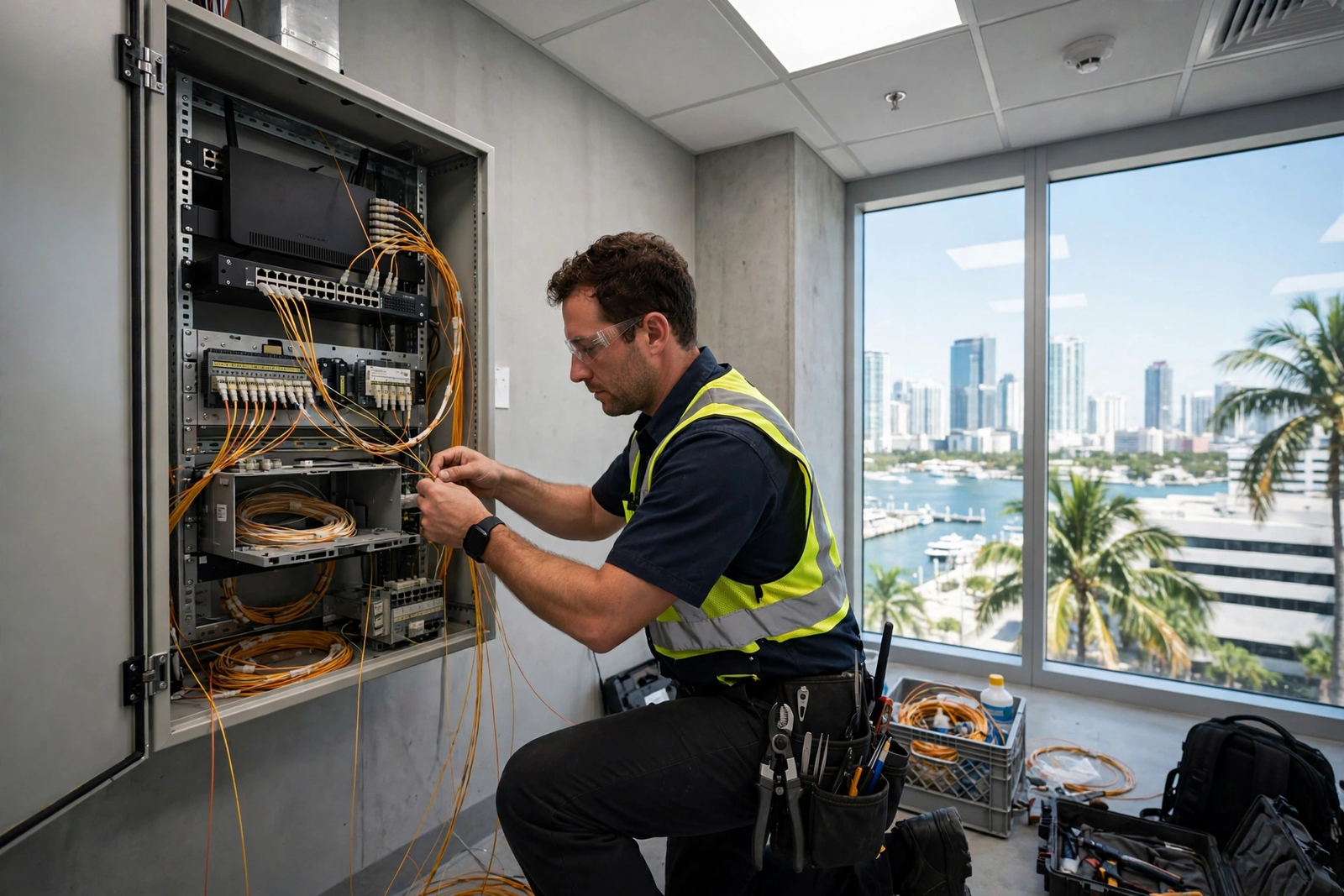
AT&T Business Fiber is the product these Miami guides lead to, and it deserves an honest description in a fiber guide. Nationally, AT&T Business Fiber offers symmetrical speeds from 300 Mbps to 5 GIG, no data caps, a Wi-Fi gateway included, and no annual contract on shared Fiber plans. Business prices per month plus taxes and fees, with the lower figure applying when you have an eligible AT&T Business wireless plan, are 300 Mbps at $60 or $40, 500 Mbps at $100 or $60, 1 GIG at $140 or $90, 2 GIG at $185 or $135, and 5 GIG at $285 or $235. New customers ordering 300 Mbps or higher can receive waived installation, a $99 value, and reward-card offers of $100 to $300 by tier for new customers only. The 2 GIG business tier is still listed in November 2026, and it should not be deleted from a comparison on the basis of a secondary source about the residential lineup. Those are strong specifications: symmetrical speeds matter because video calls, cloud backups, and point-of-sale systems all upload as much as they download, and no data caps means a busy month never triggers overage charges.
The honest limitation is availability, and in Miami that limitation is an address question rather than a city question. AT&T Business Fiber reaches up to 5 GIG where available, but fiber does not reach every Miami building, and the only reliable answer for your business is an address check for your exact suite. You can check AT&T Business Fiber availability for your Miami address and get a straight answer for your building in minutes, at no cost, before spending time comparing other providers. If the answer is yes, compare the quoted speed and price against Xfinity fiber or cable at the same address and choose on the numbers, including installation time and the price after any introductory period. AT&T also offers Dedicated Internet up to 1 Tbps for larger businesses that need guaranteed bandwidth, plus Switched Ethernet on Demand up to 100 Gbps.
One feature that matters more in Miami than in most American cities is backup. South Florida hurricane exposure makes redundancy more important here than in most metros, and finance, healthcare, and logistics businesses routinely pair fiber with fixed wireless or a diverse-path backup. AT&T includes 5G backup on Fiber plans of 1 GIG and above, although it requires a specified gateway and does not work during a power loss, so it is a network backup rather than a power backup, and a business that needs to stay online through an outage should still plan for backup power. The 5 GIG tier also carries a technical note worth knowing before you pay for it: the single-device wired maximum is 4.7 Gbps, so the full 5 GIG speed is only reachable across multiple devices or with the right equipment. For most Miami businesses the value tier is 500 Mbps or 1 GIG, where the price per megabit is lowest and the backup is included on the 1 GIG plan.
Xfinity Business Fiber Options in Miami, Florida
Xfinity Comcast Business is best known in Miami for cable, but it also offers fiber in select locations, and a business in a building with Xfinity fiber should compare it directly against AT&T Business Fiber. Xfinity cable reaches up to 2 Gbps download across the Miami area, with fiber in select locations, and its official site in November 2026 lists one-year pricing with equipment and SecurityEdge included, a $10 per month paperless and AutoPay discount included, and taxes and fees extra: 300 Mbps from $70 per month, 500 Mbps at $100 per month, 1.25 Gbps at $150 per month, and 2 Gbps at $180 per month. Review sites list a lower promotional entry of $60 per month for the Essential 300 Mbps tier on a one-year agreement, and $170 per month for the 2 Gigabit tier, so a fair description is $60 to $70 per month at the entry tier and $170 to $180 per month at the top tier.
The difference between Xfinity fiber and Xfinity cable is upload speed, and it is the difference that decides whether a plan suits business use. Review sources report cable upload speeds of 20 Mbps on the 300 and 500 Mbps tiers, 100 Mbps on the 1 Gig tier, and 200 Mbps on the 2 Gig tier, with some older areas as low as 35 Mbps, while a fiber connection is symmetrical, with upload matching download. A business that is offered Xfinity fiber should ask in writing whether the quoted plan is fiber or cable, what the upload speed is, and whether the price is for a fiber tier or a cable tier, because the same download number can hide a very different upload number. Xfinity also sells Dedicated Internet over fiber up to 10 Gbps, priced by quote only, for larger Miami businesses that need symmetrical speeds and a service level agreement.
If Xfinity fiber reaches your building, it should be the first quote you compare, and the second quote should be AT&T Business Fiber where available, because the two providers compete directly on symmetrical speeds and no data caps. Compare them at the same speed tier, on total first-year and second-year cost, and on installation time, because the cheaper monthly price is not always the cheaper two-year price once installation and equipment are counted. If Xfinity fiber does not reach your building, ask the provider whether a build is planned for your street or your building, and check cable and fixed wireless as interim options while you wait, rather than signing a long cable contract that locks you out of fiber when it arrives.
Hotwire Business Fiber in Miami, Florida Buildings and Communities
Hotwire Communications, sold under the Fision brand, is a building-specific fiber provider in Miami, Florida, and it is relevant to a different kind of business premises from the providers above. Hotwire serves particular buildings and managed communities, and it matters to condos, apartments, homeowners associations, and managed communities rather than to a standalone office on a random street. Named Miami properties include Icon Brickell and Legacy at 19th Street, and Hotwire offers up to 8 Gbps on eligible service. Federal Communications Commission derived listings put Hotwire at roughly 0.7 percent of Miami city, which sounds tiny until you understand that the meaningful figure is per building or community, not citywide: if your building has a Hotwire agreement, Hotwire may be your fastest option, and if it does not, Hotwire is not an option at all. The same listings put Hotwire at roughly 15 percent of the Miami Springs postal area, which again reflects community coverage rather than a citywide network.
Pricing for Hotwire in Miami needs careful handling, because the published figures conflict and none of them is a business price for Miami. Hotwire’s official retail rate sheet for the first quarter of 2026, for residential use only, lists 300 Mbps at $169.99, 500 Mbps at $199.99, 1 Gig at $299.99, 2 Gig at $399.99, and 5 Gig at $599.99 per month, while third-party review estimates put the same tiers at $59.99, $74.99, $99.99, and $129.99 per month. No published Hotwire business-specific Miami pricing was found, so this guide does not publish either figure as a Hotwire business price. In many buildings Hotwire runs through community or homeowners association wide agreements, which may be bulk or exclusive provider arrangements, so the first question for a business in a Hotwire building is what the building agreement already covers and what it costs, and the second is whether the business can order its own service or must use the community arrangement. For a comparison of how the same fiber options look in another Florida city, see our guide to business fiber internet in Fort Lauderdale, Florida, where building-specific fiber also shapes the choice.
Business Fiber Internet Installation in Miami, Florida

Business fiber internet installation in Miami, Florida usually follows four steps: an address check, a site survey, the physical install, and activation and testing. The address check is the fastest step and can be done online in minutes: the provider confirms whether fiber already reaches your building and which speeds are available at your suite. The site survey comes next, and it is the step that decides the timeline. A technician or engineer visits your premises, confirms where the fiber will enter the building, where the gateway will sit, and whether any internal wiring is needed, and they will tell you whether landlord permission is required and whether a construction charge applies. In Miami, the survey also matters because older commercial buildings and buildings in managed communities may have existing provider agreements that affect where fiber can enter and who can install it.
The physical install is where fiber differs most from cable. If fiber is already in your suite, the install can take a few hours: the technician connects the fiber to an optical network terminal, sets up the gateway, and tests the connection. If fiber has never been run into your building, the install can take weeks, because the provider may need to run fiber from the street, drill an entry point, and wire it to your suite, and the building owner may need to approve the work. Dedicated Internet Access quotes depend heavily on whether fiber already reaches the building, and off-net construction can add large one-off costs, so ask for build costs in writing before you sign. That is why installation time is a question to ask up front, not a detail to discover after you have signed: a business that needs service this week should not order a fiber build that takes six weeks, and a business that can wait should not settle for cable when fiber is coming. Ask for the install date in writing, ask what happens if the survey finds extra work, and ask whether a temporary fixed wireless gateway can keep you online while the fiber build is underway.
On install day, prepare the site before the technician arrives. Clear access to the point where fiber will enter the building and to the room where the gateway will sit, confirm that someone with authority to approve the work will be on site, and have your Wi-Fi network name and password decided in advance so the technician can set up the gateway and test your devices before they leave. Test the connection yourself before the technician leaves: run a speed test on a wired connection, join a video call, process a card payment, and check that your printers and point-of-sale terminals are online. If anything does not work, it is far easier to fix while the technician is still in the building than after they have gone. Keep the install paperwork, including the quoted speed, the price after any introductory period, and the support number, in one place, because you will need it at renewal time. For a step-by-step walkthrough of what happens after you order fiber, see our guide on how to order and install AT&T Business Fiber, which covers the address survey, the install appointment, and the equipment you should expect on the day.
Miami Business Fiber Internet Availability by Neighborhood
Miami business fiber internet availability varies by neighborhood in ways that surprise business owners who move across town. Fiber is densest in Brickell, Downtown Miami, Doral, and the airport corridor, where the heaviest fiber investment and the strongest carrier density in South Florida are concentrated. Brickell and Downtown Miami are home to the Network Access Point of the Americas and the CoreSite MI1 data center downtown, with CoreSite MI2 in Doral built to Category 5 hurricane standards, with a roof rated for 185-mile-per-hour gusts and lit fiber between MI1 and MI2 at up to 100 Gbps. That infrastructure reflects Miami’s role as a Latin American business hub, and it means a business in Brickell or Doral can often choose between two or more fiber providers, while a business a few miles away may have only one wired option.
Outside the core, the picture changes. Fiber is widely available in Brickell, Downtown Miami, and Coral Gables, while parts of Miami Beach and some northern suburbs remain cable and fixed wireless concentrated, with Breezeline as the Miami Beach cable leader and fixed wireless filling the gaps. Miami Beach and wider Miami-Dade County are separate markets, and figures for one should not be read as figures for the other: Breezeline cable coverage in Miami Beach is listed at 91.2 percent by BroadbandNow and 99 percent by Allconnect, with fiber at roughly 28.9 percent in the South of Fifth area of Miami Beach. No Wynwood-specific coverage percentage was found, so this guide does not state one, and a Wynwood business should check its address rather than relying on a neighborhood average. Coverage percentages in this guide come from Federal Communications Commission Broadband Data Collection figures, using December 2025 data published in October 2026 as republished by comparison sites, and BroadbandMap warns that those figures are likely overestimates, so treat every percentage as approximate and address-dependent, never as a guarantee.
Older commercial buildings can also be a problem even in central neighborhoods: a building constructed before fiber was standard may need a wiring run, landlord permission, and a construction survey before fiber can be installed, which adds weeks and sometimes a construction charge. That is why two businesses on the same street can get very different answers, and why an address check matters more than any coverage map. If you are signing a lease, check fiber availability before you sign, not after, and ask the landlord which providers already serve the building and whether any bulk or exclusive agreement limits your choice. A business in a Hotwire building, for example, may already be covered by a community agreement, while a business in a new Brickell tower may have a choice of AT&T fiber and an enterprise carrier. Businesses comparing other cities can see the same pattern in our guide to business fiber internet in Los Angeles, California, where fiber is also concentrated in central neighborhoods and cable fills the gaps.
Miami Business Fiber Internet Speeds: Symmetrical Speeds Explained
Symmetrical speeds are the single biggest reason to choose fiber over cable, and they are worth understanding before you buy. On a symmetrical fiber plan, the upload speed matches the download speed: a 500 Mbps plan gives you 500 Mbps in both directions, and a 1 Gbps plan gives you 1 Gbps in both directions. On cable, the upload speed is a fraction of the download speed: a plan advertised at 1 Gbps download may only offer 35 to 100 Mbps upload. That difference is invisible when you are browsing or streaming, but it decides whether video calls freeze, cloud backups finish overnight or run into the next working day, and large files upload before a client meeting or after it. In Miami the gap is visible in the Speedtest figures for the second half of 2025: AT&T fiber at a median upload of 303.28 Mbps against Xfinity cable at 60.44 Mbps, even though the download figures are far closer at 366.19 Mbps and 282.64 Mbps.
| Business type | People online at once | Download speed to look for | Upload speed to look for |
|---|---|---|---|
| Solo office or small shop | 1 to 3 | 100 to 300 Mbps | 100 to 300 Mbps symmetrical |
| Small office or cafe | 4 to 10 | 300 to 500 Mbps | 300 to 500 Mbps symmetrical |
| Mid-sized office or clinic | 11 to 25 | 500 Mbps to 1 Gbps | 500 Mbps to 1 Gbps symmetrical |
| Large office or call center | 26 or more | 1 Gbps or higher | 1 Gbps symmetrical |
| Design studio or media team | 5 to 15 | 1 Gbps | 1 Gbps symmetrical |
Speed needs also change with the number of connected devices, not just the number of people. A Miami restaurant with ten staff, twenty smart devices, a point-of-sale system, security cameras, and guest Wi-Fi for fifty diners can have more devices online than a twenty-person office, and each camera and terminal takes a slice of bandwidth. Before choosing a speed tier, count the devices that will be connected during your busiest hour, including cameras, printers, card readers, smart thermostats, and guest phones, and add a margin of at least 25 percent for growth. If the count surprises you, step up a tier rather than buying the cheapest plan and discovering the shortfall during a lunch rush. For most Miami businesses the value tier is 500 Mbps or 1 GIG, where the price per megabit is lowest and the backup is included on the AT&T 1 GIG plan.
Disclaimer: This article contains affiliate links to AT&T Business services; we may earn a commission at no extra cost to you. Ortelcom.com is an independent publisher not affiliated with or endorsed by AT&T. Pricing, speeds and availability are not guaranteed, were checked 7 November 2026, and vary by address and promotions. Confirm all details before ordering. AT&T trademarks belong to their owner.
Business Fiber Internet vs Cable and Fixed Wireless in Miami, Florida
The fiber-versus-cable decision in Miami, Florida comes down to upload speed, consistency, and price at your address. Fiber wins on upload speed, because it is symmetrical, and on consistency, because a fiber connection does not slow down at peak hours the way a shared cable connection can in a busy commercial area. Fiber plans also have no data caps, which matters for businesses that back up large amounts of data to the cloud every night. Cable wins on availability and installation speed: Xfinity Comcast Business reaches far more Miami buildings than any fiber provider, and a cable install can often be done within days, while a fiber build can take weeks if your building has never been wired. Fixed wireless from T-Mobile, Verizon, and AT&T Internet Air for Business wins on flexibility and speed of setup, with no wired install at all, but its speeds vary with signal strength, tower capacity, and the time of day, so it should be tested at your address before it is relied on as a primary line.
Price is the tiebreaker, and it depends on your address. Entry-level AT&T Business Fiber is $60 per month, or $40 with an eligible wireless plan, while Xfinity cable starts at $60 to $70 per month, so fiber can be cheaper as well as faster where it is available. At gigabit speeds, fiber and cable prices overlap, and the choice should be made on upload speed and on the price after the introductory period, not on the advertised download speed. A business that mostly browses, emails, and takes card payments can be happy on cable, and a business that runs video calls, cloud backups, and large file uploads should choose fiber if it reaches the building. The worst choice is to pay for a fast cable plan whose upload speed chokes your team, when a slower fiber plan would have served you better for the same money. The best choice for many Miami businesses is a combination: fiber as the primary connection and fixed wireless as the backup, so a single network failure does not stop trading.
How Much Does Business Fiber Internet Installation Cost in Miami, Florida
Business fiber internet installation cost in Miami, Florida depends on whether fiber already reaches your suite. If it does, installation is usually free or low cost, often under $100, and sometimes waived entirely for a 12-month or longer term. AT&T Business Fiber offers waived installation, a $99 value, for new customers ordering 300 Mbps or higher, and reward-card offers of $100 to $300 by tier for new customers only. If fiber has never been run into your building, the provider may charge a construction fee of hundreds or thousands of dollars, or waive it in exchange for a longer contract. Dedicated Internet Access quotes depend heavily on whether fiber already reaches the building, and off-net construction can add large one-off costs, so ask for build costs in writing before you sign, because those answers decide whether the first-year cost is the monthly price times twelve or that figure plus a large one-time charge.
Equipment is the other installation cost to check. AT&T Business Fiber includes the gateway, which saves the $10 to $15 per month that some providers charge to rent one, adding up to $360 to $540 over three years. Other providers may include the gateway, rent it, or sell it outright, and the difference should be in the quote. Also ask about the cost of extra Wi-Fi access points if your premises are large or spread across floors, because a single gateway rarely covers a warehouse or a multi-floor office well, and each extra access point adds to the install cost. Compare providers on total first-year cost, including installation and equipment, rather than on the monthly price alone, and keep the written quote so you can check the first bill against it. For a sense of how the same installation costs look in another market, see our breakdown of business internet cost in San Diego, California, which uses the same total-cost method.
Hurricane Resilience: Miami Business Fiber Internet Backup and Redundancy
Hurricane resilience is a Miami business internet question, not an afterthought, because South Florida exposure makes redundancy more important here than in most American metros. Finance, healthcare, and logistics businesses routinely pair fiber with fixed wireless or a diverse-path backup, so that a single network failure, a damaged cable, or a flooded street cabinet does not stop trading. AT&T includes 5G backup on Fiber plans of 1 GIG and above, although it requires a specified gateway and does not work during a power loss, so it is a network backup rather than a power backup. A business that needs to stay online through an outage should plan for backup power as well, with an uninterruptible power supply for the gateway and the point-of-sale system, and a generator or battery plan for a longer outage.
The practical redundancy plan for a Miami business has three parts: a primary fiber connection, a backup fixed wireless connection on a different network path, and a power plan for both. The backup can be T-Mobile Business Internet, Verizon Business Internet, or AT&T Internet Air for Business, and it should be tested at your address during your busiest hours, not just installed and forgotten, because fixed wireless speeds vary with signal strength and tower capacity. The data center infrastructure in Brickell, Downtown Miami, and Doral, including the Network Access Point of the Americas, CoreSite MI1 downtown, and CoreSite MI2 in Doral with its Category 5 hurricane standard build, its roof rated for 185-mile-per-hour gusts, and lit fiber between MI1 and MI2 at up to 100 Gbps, shows how seriously Miami takes resilient connectivity, and a small business should apply the same thinking at its own scale. Ask your provider what happens to your service in a storm, ask whether your building has a diverse fiber path, and test your backup connection before hurricane season rather than during it.
Frequently Asked Questions About Miami Business Fiber Internet
Is business fiber internet available in Miami, Florida?
Yes, business fiber internet is available for many Miami businesses, and it is densest in Brickell, Downtown Miami, Doral, and the airport corridor, where the heaviest fiber investment and the strongest carrier density in South Florida are concentrated. AT&T Business Fiber offers symmetrical speeds from 300 Mbps to 5 GIG where available, Hotwire offers up to 8 Gbps on eligible service in the buildings it serves, and Xfinity offers fiber in select locations. Availability falls away in outer neighborhoods and in older buildings that have never been wired for fiber, so the only reliable answer is an address check for your exact suite. If fiber is not available at your building, cable from Xfinity Comcast Business or fixed wireless from T-Mobile, Verizon, or AT&T Internet Air for Business are the usual alternatives.
How fast is business fiber internet in Miami, Florida?
AT&T Business Fiber offers symmetrical speeds from 300 Mbps to 5 GIG in Miami, Florida, where available, and Hotwire offers up to 8 Gbps on eligible service in the buildings it serves. Most Miami businesses buy between 300 Mbps and 1 Gbps, which is more than enough for video calls, cloud backups, and point-of-sale systems for a small or mid-sized team. Speeds are symmetrical on fiber plans, so the upload speed matches the download speed, which is the main advantage fiber has over cable. Speedtest data for the second half of 2025 shows AT&T with the fastest median download in Miami at 366.19 Mbps, with median upload of 303.28 Mbps and 9 ms latency.
How much does business fiber internet cost in Miami, Florida?
AT&T Business Fiber in Miami, Florida costs $60 per month, or $40 with an eligible wireless plan, for 300 Mbps symmetrical, $100 or $60 for 500 Mbps, $140 or $90 for 1 GIG, $185 or $135 for 2 GIG, and $285 or $235 for 5 GIG, per month plus taxes and fees. New customers ordering 300 Mbps or higher can receive waived installation, a $99 value, and reward-card offers of $100 to $300 by tier. Shared fiber plans up to 1 Gbps typically run roughly $150 to $400 per month according to Miami broker data, while Dedicated Internet Access costs about $450 to $900 per month for 100 to 500 Mbps symmetrical and about $700 to $2,000 per month for 1 Gbps. Compare total first-year and second-year cost including installation and equipment, not just the first month’s price.
How long does business fiber internet installation take in Miami, Florida?
If fiber already reaches your suite, installation can take a few hours on a single visit. If fiber has never been run into your building, installation can take weeks, because the provider may need to run fiber from the street, drill an entry point, and wire it to your suite, and the building owner may need to approve the work. Ask for the install date in writing before you sign, and ask whether a temporary fixed wireless gateway can keep you online while the fiber build is underway. Dedicated Internet Access quotes depend heavily on whether fiber already reaches the building, so ask for build costs in writing as well.
Is AT&T Business Fiber available in Miami, Florida?
Yes, AT&T Business Fiber is available in Miami, Florida, with symmetrical speeds from 300 Mbps to 5 GIG, no data caps, a gateway included, and no annual contract on shared Fiber plans, but availability is address-specific and fiber does not reach every building. Brickell, Downtown Miami, Doral, and the airport corridor have the heaviest fiber investment in South Florida, while other neighborhoods may have thinner coverage. Check your exact address before assuming AT&T fiber is available, and consider AT&T Internet Air for Business as the fallback where fiber does not reach your building.
Final Word on Miami Business Fiber Internet
Business fiber internet in Miami, Florida is a strong choice for most businesses, and the city is lucky to have a fiber leader in AT&T Business Fiber, with Xfinity fiber in select locations, Hotwire fiber in specific buildings and communities, and enterprise fiber in its commercial corridors. The symmetrical speeds, the absence of data caps, and the consistency of fiber make it the best connection for any business that runs video calls, backs up to the cloud, or sends large files, and the entry-level prices make it affordable for even a small shop. Start with address checks at AT&T Business Fiber and Xfinity, compare symmetrical speeds and total two-year costs rather than advertised download speeds, and ask about installation time and construction charges before you sign.
If fiber does not reach your building yet, do not settle for a long cable contract without asking when fiber is planned for your street, and consider fixed wireless as a bridge and a backup rather than a permanent compromise. And if fiber does reach your building, take the time to choose the right speed tier and the right contract term, because a fiber connection chosen well will serve your business for years without needing to be revisited. In a hurricane-exposed city, pair that fiber connection with a fixed wireless backup and a power plan, so a storm does not stop you trading. The provider you choose should be the one whose network reaches your suite, whose upload speed matches your work, and whose price stays honest after the first year, and in Miami, Florida that provider is usually a fiber provider.

