
Business fiber internet in Pittsburgh, Pennsylvania is the fastest connection most businesses in the city can buy, and the first fact to get right is the one that changes the whole shortlist: AT&T Fiber does not serve Pittsburgh in any verified way. AT&T is not the legacy telephone company here — Verizon is — and the federal data lists AT&T Business in Pittsburgh only as fixed wireless, reaching about 77 percent of homes at 10 to 100 Mbps, with no AT&T fiber filing for the city or for any sampled Pittsburgh-area ZIP code. A dealer website claims AT&T Fiber is available in parts of Pittsburgh and cites a statewide 36 percent figure, but that is a Pennsylvania-wide number, not a Pittsburgh figure, and a dealer site is not AT&T. A Pittsburgh business that starts its search with AT&T Fiber, as a business in most other American cities reasonably would, will usually find that the address check comes back negative, and the weeks spent chasing it are weeks lost. The honest picture is that the Pittsburgh fiber market is led by Verizon Fios and Comcast Business, with Comcast Business cable reaching almost every building in the city as the near-universal fallback for addresses fiber does not reach.
The short answer is that fiber from some provider reaches about 84 percent of Pittsburgh homes, with symmetrical speeds from 300 Mbps to 5 Gig and, in the best-served neighbourhoods, far beyond that — and the right fiber for a particular business is the one that reaches its exact address, at a published price, with an installation date in writing. Fiber is better than cable on the numbers that matter to a business: uploads match downloads, latency is lower and speeds are more consistent at busy times, and those differences are worth real money to a business that backs up to the cloud, runs video calls all day or sends large files to clients. The same fiber-first logic applies in the other cities we have covered — our guide to business fiber internet in Oklahoma City, Oklahoma walks through the same installation and speed questions on a different city’s fiber network, and the contrast with Pittsburgh shows how much of the fiber decision is really an availability decision.
That address-by-address reality is the thread running through this whole guide. Pittsburgh fiber coverage is street by street, with some neighbourhoods reporting fiber coverage near 100 percent while others report far less, all on the same federal data, and a business that plans around a citywide average and then finds its building is not served has wasted weeks. This guide uses the facilities-based federal figures and says so where sources disagree, and every provider that does not publish a business price is marked by quote rather than given an invented figure. Prices in this guide are starting prices before taxes and fees, checked in November 2026. Readers who want the same fiber questions answered for another city should read our guide to business fiber internet in Cleveland, Ohio, which covers the same speeds, installation and backup questions on a different network.
Check AT&T Business Fiber Availability for Your Pittsburgh, Pennsylvania Address
Symmetrical fiber speeds from 300 Mbps to 5 GIG, with no data caps and a gateway included.
Business Fiber Internet in Pittsburgh, Pennsylvania at a Glance

Fiber from some provider reaches about 84 percent of Pittsburgh homes, and the fiber question for a Pittsburgh business is not whether fiber is better than cable — it is, on uploads, on latency and on consistency — but which fiber reaches the specific address, at what price, and how long the installation will take. The table below summarises the fiber options in Pittsburgh as checked in November 2026, with every price a starting price before taxes and fees and every provider that does not publish a business price marked by quote.
| Provider | Fiber coverage in Pittsburgh | Speeds | Business pricing |
|---|---|---|---|
| AT&T Business Fiber | No federal filing in Pittsburgh | 300 Mbps to 5 Gig symmetrical | National list $60 to $285 a month |
| Leading local fiber | See sections below | Up to 2 to 10 Gig | Published prices or by quote — see below |
| Cable fallback | About 96% to 99% of homes | Up to 2 Gig down, much slower up | $65 to $180 a month |
| 5G fixed wireless | About 90% or more | 25 to 400 Mbps | $35 to $69 a month |
Get A Free AT&T Business Fiber Quote
Symmetrical fiber speeds from 300 Mbps to 5 GIG, with no data caps and a gateway included.
The table is deliberately short, because the detail is in the sections below: each fiber provider in Pittsburgh is covered in turn, with its real coverage, its real speeds and its real pricing, and with the conflicts in the sources stated rather than hidden. A Pittsburgh business that reads the whole guide will know which fiber providers reach its neighbourhood, which ones are by quote only, and which ones are not available at all — and that is the knowledge that saves weeks of chasing the wrong provider.
Business Fiber Speeds in Pittsburgh: What the Numbers Mean
Fiber speeds are quoted as symmetrical numbers — 300 Mbps down and 300 Mbps up, 1 Gig down and 1 Gig up — and that symmetry is the single most important technical fact about fiber for a business. On cable, a 1 Gig download comes with an upload of 35 to 250 Mbps, and on fixed wireless the upload is slower still, so a business that backs up to the cloud, runs video calls all day or sends large files to clients will feel the difference every day. A 300 Mbps symmetrical fiber connection will upload a large file roughly ten times faster than a 300 Mbps cable connection, and that gap is worth more than any difference in download speed for most offices.
As a planning guide: a one-to-five-person office doing email, browsing, card payments and occasional video calls is usually well served by 300 Mbps symmetrical fiber. A five-to-twenty-person office with constant video calls, cloud applications and a shared drive should look at 500 Mbps to 1 Gig. A twenty-plus-person office, a business with a guest network, or one that uploads large files daily should look at 1 Gig to 2 Gig. Above 2 Gig is for specialised uses — media production, large design files, a server room — and a business that is quoted 5 Gig should ask what its current connection actually delivers at peak before paying for it. The Wi-Fi inside the building is often the real bottleneck, and a 1 Gig connection behind an old router will feel like a 100 Mbps connection, so the router and the cabling should be checked before the speed is upgraded.
Business Fiber Installation in Pittsburgh, Pennsylvania: How It Works
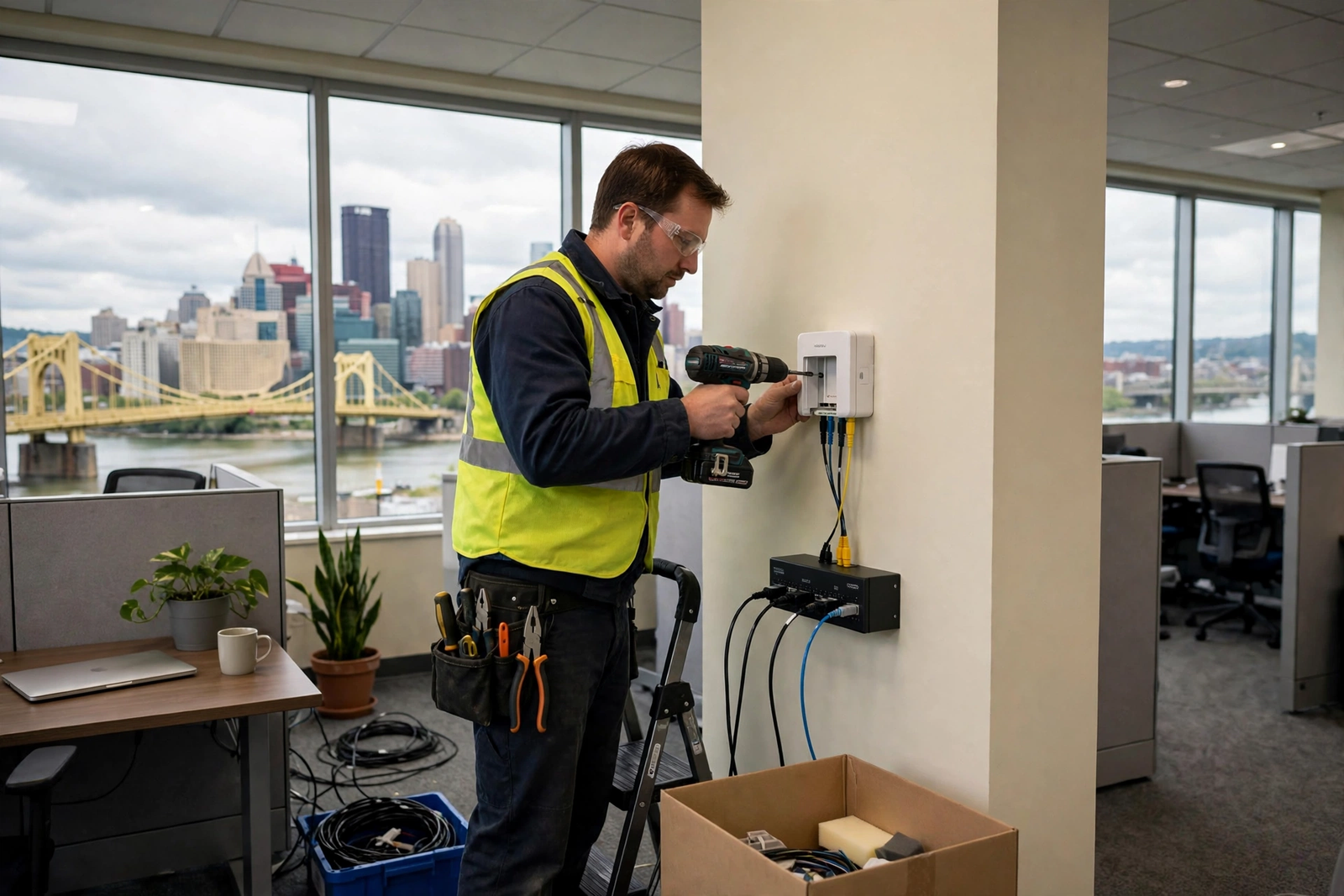
Fiber installation in Pittsburgh follows the same pattern whatever the provider, and the pattern is worth understanding before the appointment is booked. First, the provider checks the address and confirms that fiber reaches the building — or, if it does not, what construction is needed to bring it there. Second, a survey or a site visit confirms the entry point, the route through the building and the location of the router. Third, the fiber is run into the building and terminated at an optical network terminal, the gateway is installed and configured, and the connection is tested. Fourth, the business’s own network — its router, its access points, its printers and card readers — is connected and tested at the busiest time, not the quietest.
The time it takes depends almost entirely on the building. A building with fiber already in the riser can often be connected in days; a building that needs a new fiber run, a landlord permission or a street works permit can take weeks or months, and the construction charge is the least transparent part of business fiber pricing in this batch’s research — no published installation or construction price was found for AT&T or several rivals, and this guide gives no invented figure. Before signing, a business should get four things in writing: the installation charge and what it covers, the date the service goes live, whether the price quoted is the price for the full term or a promotional price that rises, and what happens if the installation cannot be completed — who pays for the aborted work and whether the contract can be cancelled without penalty.
Business Fiber Equipment and Gateway in Pittsburgh
The equipment on a business fiber connection is simpler than most businesses expect, and the questions to ask are few but important. The provider installs an optical network terminal where the fiber enters the building, and a gateway or router that turns the fiber connection into the office network, with Wi-Fi for the office and, usually, a separate guest network. AT&T includes its gateway on Business Fiber, Comcast includes equipment on its standard cable tiers, and other providers vary — so the business should confirm whether the gateway is included, whether it is rented or owned, what it costs to replace, and whether the business can use its own router instead. A static IP address, where the business needs one for a server, a camera system or remote access, is sold in blocks by most providers and is by quote only in this batch’s research, except that Spectrum’s published static IP figure is $14.99 a month.
Two equipment decisions deserve attention in a fiber installation. The first is the router location: it needs power, ventilation and a central position if it is also providing Wi-Fi, and a router hidden in a cupboard at one end of the building will not serve the other end. The second is the access points: a large office, a warehouse or a multi-floor building needs more than one, and the cost of the access points and their cabling should be in the budget from the start rather than discovered after the fiber is live. A business that plans its internal network at the same time as its fiber installation will have a working office on day one; a business that treats the internal network as an afterthought will have a fast connection and a slow office.
Fiber Backup and Failover for Pittsburgh Businesses
Fiber is reliable, but it is not invulnerable, and a business that cannot trade without internet needs a backup. The most common failure is a cut cable during street works or building works, and the most useful backup is a connection on a different network — fiber from one provider with cable or 5G from another, with automatic failover between them. That costs far less than dedicated access, it survives a single provider outage, and it can be installed in days. AT&T builds 5G backup into its 1 Gig tier and above, but the backup needs the specified gateway, does not work during a power loss, and does not carry static IP addresses or voice-over-IP traffic over to the backup connection, so a business that depends on a hosted phone system should plan its failover separately rather than assuming the backup covers everything.
A cheaper and simpler backup for many Pittsburgh businesses is a 5G fixed-wireless line on a different network from the primary connection — T-Mobile or Verizon at $35 a month with a voice line or $60 standalone — kept as a standby and tested monthly. The test matters: a backup that has never been tested is not a backup, it is a hope, and the first time it is needed is the worst time to discover that it does not work. A business should test its failover at least once a quarter, at its busiest hour, with its real devices, and should confirm that card readers, printers and the phone system all work on the backup, not just the laptops. For a business with a contractual uptime obligation, dedicated internet access with a service level agreement is the right product, at roughly $300 to $700 a month for 100 Mbps and $700 to $2,000 for 1 Gig nationally, by quote only.
AT&T Fiber does not serve Pittsburgh in any verified way. AT&T is not the legacy telephone company here — Verizon is — and the federal data lists AT&T Business in Pittsburgh only as fixed wireless, reaching about 77 percent of homes at 10 to 100 Mbps, with no AT&T fiber filing for the city or for any sampled Pittsburgh-area ZIP code. A dealer website claims AT&T Fiber is available in parts of Pittsburgh and cites a statewide 36 percent figure, but that is a Pennsylvania-wide number, not a Pittsburgh figure, and a dealer site is not AT&T. That matters because a business that starts its search with AT&T Fiber, as a business in most other American cities reasonably would, will usually find that the address check comes back negative, and the weeks spent chasing it are weeks lost. The honest picture is that the Pittsburgh market is led by Verizon Fios and Comcast Business, with Comcast Business cable reaching almost every building in the city as the near-universal fallback.
AT&T Business Fiber is sold nationally in five symmetrical tiers: 300 Mbps at $60 a month, 500 Mbps at $100, 1 Gig at $140, 2 Gig at $185 and 5 Gig at $285, with no data caps, a gateway included and no annual contract on the shared plans. With an eligible AT&T business wireless plan those list prices fall to $40, $60, $90, $135 and $235 a month. Secondary sources put the regular post-promotion rates at $70, $110 and $160 a month for the 300 Mbps, 500 Mbps and 1 Gig tiers. Those are national list prices, checked in November 2026, and they apply only where AT&T Fiber actually reaches an address. In Pittsburgh those national prices are shown for reference only: on the federal evidence they apply nowhere in the city, because AT&T Fiber has no recorded footprint here. The 5G backup built into the 1 Gig tier and above needs the specified gateway, does not work during a power loss, and does not carry static IP addresses or voice-over-IP traffic over to the backup connection, so a business that depends on a hosted phone system should plan its failover separately rather than assuming the backup covers everything.
AT&T’s genuinely available Pittsburgh product for most addresses is Internet Air for Business. AT&T Internet Air for Business, the fixed-wireless product, is priced nationally at $65 a month for the Standard plan and $105 a month for Premium, or $60 and $100 with AutoPay and paperless billing, and $40 and $80 with an eligible business wireless plan. AT&T fixed wireless reaches about 86 percent of Pittsburgh homes in Philadelphia, about 77 percent of businesses in Pittsburgh and about 94 percent of downtown Portland homes, depending on the city, so for most Pittsburgh businesses that cannot order AT&T Fiber, Internet Air is the AT&T product that actually works at their address. For larger sites, AT&T also sells Dedicated Internet by quote — up to 1 Tbps — and that enterprise product is priced per building and per service level agreement, not from the standard small-business tier list.
For a comparison with a city where the fiber incumbent is different, our guide to business fiber internet in Chicago, Illinois works through the same speeds, installation and backup questions on a different network, and the installation checklist there applies just as well in Pittsburgh.
The fiber-versus-cable decision is the same in every city, and our guide to how to order and install AT&T Business Fiber covers the same upload-speed and reliability comparison on a larger metro market, where the cable incumbent’s speeds and step-ups follow the same pattern as in Pittsburgh.
Speed is the number every Pittsburgh business asks about first, and it is also the number most often bought wrong. The right speed is set by what the business actually does at its busiest hour, not by the fastest tier on the page. A useful way to think about it is in concurrent use: a video call needs roughly 3 to 5 Mbps per participant in each direction, a cloud point-of-sale terminal needs very little, a large file upload to a cloud drive needs as much upload as the business can get, and a nightly cloud backup of a few hundred gigabytes needs either a very fast upload or a very long night. The upload speed matters more than the download speed for most modern offices, which is why symmetrical fiber is worth real money and why cable’s much slower uploads are the first thing to check on a cable quote.
As a planning guide for a Pittsburgh business: a one-to-five-person office doing email, browsing, card payments and occasional video calls is usually well served by 300 Mbps symmetrical fiber, or by 300 Mbps cable where fiber does not reach. A five-to-twenty-person office with constant video calls, cloud applications and a shared drive should look at 500 Mbps to 1 Gig. A twenty-plus-person office, a business with a guest network, or one that uploads large files daily should look at 1 Gig to 2 Gig. Above 2 Gig is for specialised uses — media production, large design files, a server room — and a business that is quoted 5 Gig should ask what its current connection actually delivers at peak before paying for it.
Two cautions apply to every speed claim in Pittsburgh. First, the speed on the page is the maximum the plan can deliver, not a guaranteed speed; shared cable and fixed wireless slow down at busy times, and only dedicated access carries a speed guarantee. Second, the Wi-Fi inside the building is often the real bottleneck: a 1 Gig connection behind an old router or a single access point in a large office will feel like a 100 Mbps connection. Before paying for a faster tier, a Pittsburgh business should check that its router, its cabling and its access points can actually pass the speed it is buying — otherwise the upgrade buys nothing but a larger bill.
Installation is where Pittsburgh business internet projects most often slip, and the slip is almost always about the building rather than the provider. The first question is whether the building is already wired for the provider chosen: a building with fiber in the riser can often be connected in days, while a building that needs a new fiber run, a landlord permission or a street works permit can take weeks or months. The second question is the internal wiring: the point where the provider’s line enters the building, the path to the router, and the state of the cabling to each desk. A provider quote that assumes the entry point is beside the server room and a building where it is at the opposite end of the floor are two different jobs with two different prices.
Before signing, a Pittsburgh business should get four things in writing: the installation charge and what it covers, the date the service goes live, whether the price quoted is the price for the full term or a promotional price that rises, and what happens if the installation cannot be completed — who pays for the aborted work and whether the contract can be cancelled without penalty. Construction charges are the least transparent part of business internet pricing in Pittsburgh: no published price was found for AT&T or rival installation and construction charges in this batch’s research, and this guide gives no invented figure. The only safe approach is a written quote for the specific address, including any construction, before the contract is signed.
On the day itself, the practical checklist is short: confirm the appointment window and who needs to be on site, make sure the router location has power and ventilation, have the business’s network details ready — how many devices, whether there is a guest network, whether card readers or printers need fixed addresses — and test the connection at the busiest time on the first day, not the quietest. A static IP address, where the business needs one for a server, a camera system or remote access, is sold in blocks by most providers and is by quote only in this batch’s research; Spectrum’s published static IP figure is $14.99 a month, and for other providers the guide says confirm in writing rather than guessing.
Disclaimer: This article contains affiliate links to AT&T Business services; we may earn a commission at no extra cost to you. Ortelcom.com is an independent publisher not affiliated with or endorsed by AT&T. Pricing, speeds and availability are not guaranteed, were checked 14 November 2026, and vary by address and promotions. Confirm all details before ordering. AT&T trademarks belong to their owner.
Business Internet Reliability and Uptime in Pittsburgh, Pennsylvania
Reliability is the quality a Pittsburgh business notices only when it fails, and it is the hardest quality to compare from a provider’s page, because every provider claims high reliability and almost none publishes a service level agreement on its standard small-business tiers. Fiber is the most reliable standard connection in Pittsburgh: it is not affected by weather in the way fixed wireless is, it does not slow down at busy times in the way shared cable can, and its symmetrical speeds stay consistent through the working day. Cable is next, with a mature network and a long record in the city, but with the shared-network slowdowns that come with it. Fixed wireless is the least consistent, because its speed depends on the tower, the weather and the number of users sharing it at the time — which is why it is best used as a backup or as a primary only where nothing wired reaches.
On the standard tiers in this guide, only Verizon Fios Business carries a published reliability claim — 99.99 percent network reliability — and the dedicated-access products carry contractual uptime agreements of 99.9 to 100 percent, priced by quote. For the standard tiers, the practical questions to ask are simpler and more useful than any percentage: how quickly does the provider respond when the connection fails, is there a local technician or a remote call centre, and what compensation applies if the service is down for a day. A business should also ask whether the provider’s network in Pittsburgh has a single point of failure at the building — one cable into the premises — and, if it does, whether a second connection on a different network is worth the cost. Two connections from different networks, with automatic failover, is the cheapest real reliability a small business can buy, and it costs far less than a day of lost trading.
The other half of reliability is inside the building. A business that loses internet because its own router failed has not had a provider outage, and the fix is a spare router, a battery backup for the network equipment and a written note of who to call and what to restart. Power cuts deserve the same attention: AT&T’s 5G backup does not work during a power loss, and neither does a fixed-wireless gateway without power, so a business in a building with unreliable power should budget for an uninterruptible power supply for its router and its point-of-sale terminals. Reliability in Pittsburgh is a system — the provider’s network, the building’s wiring and the business’s own equipment — and the weakest part of that system is the one that will fail first.
Fixed wireless — 5G business internet — is the fastest-growing part of the Pittsburgh business market, and it deserves a serious look for three kinds of business: one that cannot get fiber or cable at its address, one that needs a backup connection alongside a wired line, and one that values a quick install over the fastest possible speeds. The technology has real limits that the marketing rarely leads with. Speeds vary by tower, by time of day and by how many devices share the connection, and the federal filings for Pittsburgh show typical fixed-wireless speeds far below the headline figures on the providers’ pages. A business that runs point-of-sale terminals, card readers and a handful of laptops will usually be fine; a business that moves large files, runs video production or backs up to the cloud all day will usually not be.
T-Mobile Business Internet is the widest fixed-wireless option in all four of this batch’s cities. Its current tiers are Rely at $35 a month with a business voice line or $60 a month standalone, Amplified at $45 with a voice line or $70 standalone, and All-In at $55 with a voice line or $80 standalone, with a five-year price guarantee, a free Wi-Fi 7 gateway, no annual contract and a 15-day trial. Older tier names — Small Business Grow, Business Advanced and 5G Business Internet at $70 — still appear in articles from May 2026, but they are superseded by the current Rely, Amplified and All-In names, and this guide uses the current figures. SuperBroadband, which pairs 5G with Starlink backup, starts at $250 a month with a 36-month commitment and is a different product for businesses that cannot tolerate an outage.
Verizon 5G Business Internet comes in 100, 200 and 400 Mbps tiers. The 100 Mbps tier is $69 a month regular, $65 on offer, and $35 a month when bundled with a qualifying business smartphone plan; the 200 Mbps tier is $99 regular, $85 on offer and $55 bundled; the 400 Mbps tier exists but is not priced on Verizon’s page and is by quote. Verizon offers a 10-year price guarantee, includes the router on a monthly payment plan and offers up to $1,500 in switching credits, with current offers ending 31 December 2026 and some running to 10 January 2027. Older summaries that quote $39 a month bundled for the 100 Mbps tier are superseded by the current $35 figure, and this guide uses the current figure.
Used as a backup, fixed wireless is genuinely useful in Pittsburgh: a fiber or cable primary with a 5G backup on a different network survives a cut cable or a provider outage, and the monthly cost of a $35 or $60 backup line is small against a day of lost trading. Used as the only connection, it needs a trial at the real address — the 15-day T-Mobile trial exists for exactly this reason — and the business should test it at its busiest hour, with its real devices, before cancelling anything else. A fixed-wireless connection that is fast at 9 in the morning and slow at 3 in the afternoon is not a business-grade primary connection.
Most Pittsburgh businesses will never need dedicated internet access, and this guide says so plainly, because the standard shared tiers from the providers above cover the great majority of offices. Dedicated internet access is the enterprise product for businesses that cannot share bandwidth with anyone else: a data centre, a call centre, a medical imaging practice, a design studio moving very large files, or a business with a contractual uptime requirement. It is sold by quote at equipped buildings, with a service level agreement that guarantees symmetrical speeds and uptime, and the price depends on the building, the construction needed to reach it and the speed ordered.
Dedicated internet access, the enterprise product sold by quote at equipped buildings, runs nationally at roughly $300 to $700 a month for 100 Mbps and roughly $700 to $2,000 a month for 1 Gig. Those are national broker ranges for 2026, not prices for any named provider in this city, and a real quote depends on the building, the construction needed and the service level agreement. In Pittsburgh the dedicated providers are the enterprise arms of the same networks — AT&T Dedicated Internet, Comcast enterprise fiber, Verizon Internet Dedicated, Zayo and Lumen — plus regional enterprise fiber where it exists. None of them publishes a Pittsburgh price, and any article that quotes a single dedicated-access price for Pittsburgh is inventing it. The right approach is to get two or three quotes for the same speed and the same service level agreement, and to compare the installation charge, the term and the early-termination terms as carefully as the monthly price, because the construction charge is often the largest number in the first year.
A cheaper middle step exists for many Pittsburgh businesses: two shared connections from different networks — for example fiber from one provider and cable or 5G from another — with automatic failover between them. That costs far less than dedicated access, it survives a single provider outage, and it can be installed in days rather than the weeks or months a dedicated build can take. It does not give the guaranteed speeds or the uptime contract of dedicated access, so it is not a substitute for a business that has a contractual uptime obligation, but for a retail shop, a restaurant group or a professional office it is usually the better spend.
Frequently Asked Questions About Business Internet in Pittsburgh, Pennsylvania
Which business internet provider is best in Pittsburgh, Pennsylvania?
There is no single best provider in Pittsburgh, because the answer depends on the exact address. Verizon Fios and Comcast Business lead the market, with Comcast Business cable as the near-universal fallback, and the best choice is the provider that reaches the specific building with the speed the business needs at a price that does not rise without warning. A business should check its address against the top two or three providers, get written quotes, and compare the two-year total cost rather than the first-month price.
How much does business internet cost in Pittsburgh, Pennsylvania?
Published starting prices in Pittsburgh run from about $35 a month for fixed wireless with a voice line to about $65 to $70 a month for entry-level fiber or cable, and up to $149 to $285 a month for 1 Gig and above depending on the provider. The real cost is the two-year total, including the post-promotion step-up, equipment, installation and fees, and this guide works through that total in the cost sections above. Every price in this guide is a starting price before taxes and fees, checked in November 2026.
Is AT&T Business Fiber available in Pittsburgh, Pennsylvania?
AT&T Fiber does not serve Pittsburgh in any verified way. AT&T is not the legacy telephone company here — Verizon is — and the federal data lists AT&T Business in Pittsburgh only as fixed wireless, reaching about 77 percent of homes at 10 to 100 Mbps, with no AT&T fiber filing for the city or for any sampled Pittsburgh-area ZIP code. A dealer website claims AT&T Fiber is available in parts of Pittsburgh and cites a statewide 36 percent figure, but that is a Pennsylvania-wide number, not a Pittsburgh figure, and a dealer site is not AT&T. AT&T’s genuinely available product for most Pittsburgh addresses is Internet Air for Business, its fixed-wireless service, priced nationally at $65 a month for Standard and $105 for Premium, or $60 and $100 with AutoPay and paperless billing, and $40 and $80 with an eligible business wireless plan. A Pittsburgh business should check its exact address rather than assuming AT&T Fiber is available.
How long does business fiber installation take in Pittsburgh, Pennsylvania?
It depends on the building. A building with fiber already in the riser can often be connected in days, while a building that needs a new fiber run, a landlord permission or a street works permit can take weeks or months. Before signing, get the installation charge, the go-live date and the cancellation terms in writing for the specific address, and confirm what happens if the installation cannot be completed.
Do I need a static IP address for my Pittsburgh business?
Most small businesses do not. A static IP is needed mainly for a server, a camera system, remote access or a hosted phone system that requires a fixed address. Where it is needed, it is sold in blocks by most providers and is by quote only in this batch’s research, except that Spectrum’s published figure is $14.99 a month. Confirm the price in writing before signing, and do not pay for a static IP that the business does not use.
Choosing Business Internet in Pittsburgh, Pennsylvania: The Short Version
The short version of this guide is a five-step checklist. First, check the exact business address against Verizon Fios and Comcast Business, because the best connection in Pittsburgh is the one that reaches the building. Second, check Comcast Business cable as the fallback, because it reaches almost every building and gives a firm price to compare against. Third, check the 5G options as a backup or as a primary where no wired option reaches, and test them at the real address. Fourth, get written quotes for the same speed from two or three providers, and compare the two-year total cost — including the post-promotion step-up, the equipment, the installation and the fees — rather than the first-month price. Fifth, confirm the installation date, the contract term and the early-termination terms in writing before signing anything.
A Pittsburgh business that follows those five steps will end up with a connection that fits its real needs, at a price it can budget for, from a provider that serves its address — and it will not have wasted weeks chasing a provider that does not. The market in Pittsburgh is genuinely competitive, with fiber, cable and fixed wireless all available at most addresses, and the businesses that get the best result are the ones that check their address first, compare written quotes second, and sign third. Prices in this guide were checked in November 2026, and they will change, so the written quote for the specific address is always the final word.
If AT&T Fiber reaches your Pittsburgh address, it is worth a direct check: check AT&T Business Fiber availability for your Pittsburgh, Pennsylvania business address and compare the quote against the providers below before you sign anything.
The fiber-versus-cable decision is the same question in every city, and our AT&T Business Fiber versus cable guide compares the two head to head on speeds, uploads, reliability and the two-year cost, so a business can see exactly what fiber buys over cable before it chooses.

