
Business fiber internet is available across much of San Antonio, Texas, and for most offices it is the right connection to buy. The short answer is that AT&T Business Fiber is the strongest business fiber choice in San Antonio, Texas, with symmetrical speeds from 300 Mbps to 5 Gig, list prices from 60 dollars a month, no annual contract, no data caps, a gateway included and free installation on eligible online orders, and the widest fiber footprint in the city at roughly six in ten serviceable locations. Google Fiber is a genuine second fiber network in the neighborhoods it has built, reaching about four in ten locations citywide and far higher shares in the west and northeast, with business plans from 100 dollars a month. Spectrum Business fiber reaches selected commercial buildings, and Astound Broadband offers fiber-powered service in selected neighborhoods. The question for any San Antonio, Texas business is not whether fiber is good, but whether fiber is built at its exact address, how fast the installation will be, and which speed tier the business actually needs.
San Antonio, Texas is a good fiber market because the city has been building for more than a decade. AT&T has been laying fiber in San Antonio, Texas since 2014, and its network is strongest across the north and northwest sides, including the Stone Oak corridor and the suburbs along Loop 1604, as well as Alamo Heights, Castle Hills, Terrell Hills, Leon Valley, Live Oak, Schertz and Selma. Google Fiber builds neighborhood by neighborhood and is concentrated in the west and northeast, around Westover Hills and the surrounding area, where current ZIP-level data reports coverage of about 93 percent of locations in the 78247 area. Newer subdivisions and office parks often have fiber laid during construction, which makes installation a same-week visit. Older buildings near downtown and the River Walk district are a mixed picture: some have fiber, some still terminate in copper, and two buildings on the same street can get different answers. That is why this guide treats the address check as the first step of installation, not an afterthought, and why every coverage figure here comes from public Federal Communications Commission filings or the providers themselves rather than a marketing map.
Fiber matters because of what it does differently from cable and 5G. A fiber connection is symmetrical, so uploads match downloads, which is what makes cloud backups, video calls and large file transfers work without the bottlenecks that cable uploads create. Fiber is also more consistent: the speed a business pays for is the speed it gets, without the congestion slowdowns that 5G fixed wireless suffers at busy times. And fiber scales: the same line that delivers 300 Mbps today can be raised to 1 Gig or 5 Gig later without new construction, which is useful for a business that plans to grow. The rest of this guide covers fiber availability by provider and by neighborhood, the speeds and prices of each tier, what installation actually involves from the first address check to the day the gateway lights up, and how to keep the connection running with backup and the right equipment.
Check AT&T Business Fiber Availability for Your San Antonio, Texas Address
Symmetrical fiber speeds from 300 Mbps to 5 GIG, with no data caps and a gateway included.
Business Fiber Internet in San Antonio, Texas at a Glance
The table below summarizes business fiber internet in San Antonio, Texas as checked 19 November 2026. Every price is a starting price before taxes and fees, and every coverage figure is an estimate from public Federal Communications Commission filings, not a promise for a specific address.
| Business Fiber Provider | Speeds | Starting Price | Fiber Availability | Installation |
|---|---|---|---|---|
| AT&T Business Fiber | 300 Mbps to 5 Gig symmetrical | From 60 dollars a month list | About 6 in 10 locations | Free on eligible online orders |
| Google Fiber Business | 1 Gig and 2 Gig symmetrical | From 100 dollars a month | About 4 in 10 locations | Professional installation included |
| Spectrum Business Fiber | Up to 1 Gig, uploads 500 Mbps or more in some areas | By quote for fiber buildings | Selected commercial buildings | Confirm in writing |
| Astound Business fiber-powered | 50 Mbps to 2 Gig symmetrical on Business Class | From 29.95 dollars a month online offer | Selected neighborhoods | Free on eligible online orders |
| LOGIX and Zayo enterprise fiber | 100 Mbps to 10 Gig and higher | By quote only | On-net buildings | By quote, 2 to 4 weeks if lit |
Three facts in that table decide most fiber purchases in San Antonio, Texas. First, AT&T Business Fiber is the only shared fiber product that goes to 5 Gig, which matters for a business that needs more than 2 Gig without an enterprise contract. Second, Google Fiber Business stops at 2 Gig but includes a 99.9 percent uptime agreement and a static internet protocol address on the 2 Gig tier, which AT&T only matches through its built-in 5G backup on the 1 Gig tier and above. Third, installation is free or included on the two main fiber products when the building is already lit, which means the cost of switching to fiber is usually the monthly price and nothing else, unless the building needs construction. The sections below work through each provider’s fiber availability in detail, because the table is only useful once a business knows which rows apply to its own address.
AT&T Business Fiber in San Antonio, Texas: Fiber Speeds and Fiber Pricing
AT&T Business Fiber is the leading business fiber internet option in San Antonio, Texas, and the product is straightforward: five symmetrical tiers, published national pricing, no annual contract, no data caps, a gateway included and free installation on eligible online orders. The tiers are 300 Mbps at 60 dollars a month, 500 Mbps at 100 dollars a month, 1 Gig at 140 dollars a month, 2 Gig at 185 dollars a month and 5 Gig at 285 dollars a month, all before taxes and fees. Businesses that bundle an eligible AT&T business wireless plan pay 40, 60, 90, 135 and 235 dollars a month for the same five tiers. Those are list prices checked 19 November 2026, and they are the same prices AT&T publishes in every fiber market, so a San Antonio, Texas business pays the same as a business in Dallas, Texas or Austin, Texas for the same tier, as our guide to business fiber internet in Dallas, Texas confirms.
The speeds are symmetrical at every tier, which is the practical difference between fiber and cable: a 1 Gig AT&T Business Fiber plan uploads at 1 Gig, while a 1 Gig cable plan uploads at up to 35 Mbps. For a business that backs up to the cloud, hosts video calls all day, or sends large files to clients, that upload speed is the whole reason to choose fiber. The 1 Gig tier and above add built-in 5G backup at no extra cost, which means the connection can fail over to a wireless link if the fiber line is cut, a feature that matters for point-of-sale systems, clinics and any business that cannot afford to go dark. Secondary sources report regular post-promotion rates of 70, 110 and 160 dollars a month for the 300 Mbps, 500 Mbps and 1 Gig tiers, against list prices of 60, 100 and 140 dollars, so a business should ask in writing what the price becomes when any introductory period ends. The residential promotional prices of 35, 50 and 65 dollars a month that appear in AT&T advertising are residential prices and must never be quoted as business prices. AT&T notes that a Monthly State Cost Recovery Charge applies in Texas, Ohio and Nevada on residential service; whether it applies to a given business order in San Antonio, Texas is a matter for the written quote, and no dollar figure is stated here because no verified business figure is available.
AT&T fiber availability in San Antonio, Texas is the widest of any fiber network in the city. Federal Communications Commission filings put AT&T fiber at close to two in three serviceable locations in Bexar County, and the build is strongest across the north and northwest sides, including the Stone Oak corridor and the suburbs along Loop 1604, as well as Alamo Heights, Castle Hills, Terrell Hills, Leon Valley, Live Oak, Schertz and Selma. That footprint has been building since 2014, and newer subdivisions in the far west and northwest often have fiber laid during construction, which makes installation quick. Older neighborhoods near downtown are a mixed picture, and two buildings on the same street can get different answers, so the address check is the only reliable test. A business that finds AT&T fiber available should also check which speed tiers are built at its address, because not every fiber-lit building supports the 5 Gig tier, and the 2 Gig and 5 Gig tiers require a compatible multi-gig gateway and network equipment to deliver their full speed over a wired connection.
Google Fiber in San Antonio, Texas: Fiber Availability by Neighborhood
Google Fiber is genuinely present in San Antonio, Texas, and it is the only other large fiber network in the city besides AT&T. The network is real, it is growing neighborhood by neighborhood, and it is the fastest residential fiber in the city at up to 8 Gig, although the business plans stop at 2 Gig. Federal Communications Commission filings put Google Fiber at about 39 percent of San Antonio, Texas locations citywide, with much higher shares in the neighborhoods it has built: current ZIP-level data reports Google Fiber at about 93 percent of locations in the 78247 area and about 68 percent in the 78249 area, concentrated in the west and northeast parts of the city around Westover Hills and the surrounding area, while in the Stone Oak area the figure is about 33.3 percent. Those percentages describe reported coverage, not a promise for a specific address, and they move as the build continues, but the pattern is consistent: Google Fiber is strong in some neighborhoods and absent in others.
Google Fiber Business is sold separately from the residential plans, and it comes in two tiers as of September 2026: Business 1 Gig at 100 dollars a month and Business 2 Gig at 250 dollars a month, both starting prices plus taxes and fees, both symmetrical fiber with no data caps. Business 1 Gig includes a Wi-Fi 6 router, a 99.9 percent uptime service level agreement and 24 hour dedicated support, and Business 2 Gig adds two mesh extenders, a static internet protocol address and a faster response agreement. There is no annual contract and no installation fee on the business plans as published. The residential plans are cheaper and faster, with 1 Gig at 70 dollars a month on the older lineup and a newer lineup offering 500 Meg at 55 dollars, 3 Gig at 70 dollars, 5 Gig at 100 dollars and 8 Gig at 150 dollars a month, all symmetrical with equipment included and no annual contract, but they do not carry the business uptime guarantee or dedicated business support, so a business should not order a residential plan for a commercial address simply because the headline speed is higher.
The honest assessment of Google Fiber in San Antonio, Texas is that it is an excellent second fiber option where it is available, and a non-option where it is not. At 100 dollars a month, Business 1 Gig matches AT&T Business Fiber 500 Mbps on price and beats it on speed, while offering the same symmetrical uploads and no data caps, plus a formal uptime guarantee and a flat price that does not rise after twelve months. The limitations are that business plans stop at 2 Gig, there is no redundancy option beyond the single fiber line, and the network covers roughly four in ten locations against AT&T at roughly six in ten. Where both fiber networks reach the same address, the choice comes down to price, the uptime guarantee, and whether the business needs more than 2 Gig, in which case AT&T Business Fiber at 5 Gig is the only shared fiber option. Where only Google Fiber reaches the address, take it: it is a strong product with flat pricing, and the bill does not jump after twelve months the way a promotional cable price does.
Spectrum Business Fiber in San Antonio, Texas
Spectrum Business is best known in San Antonio, Texas for cable, but it also sells fiber service to selected commercial buildings, and a business in a fiber-lit building should ask specifically for the fiber product rather than assuming the cable plan is the only option. Spectrum Business Fiber reaches about 58.5 percent of locations in the Stone Oak area according to Federal Communications Commission data, with speeds up to 1 Gig and uploads of 500 Mbps or more in some neighborhoods, which is a meaningful footprint that many businesses overlook. In the 78253 area, Spectrum Business fiber reaches about 33.3 percent of locations, and in a central neighborhood it reaches about 41.8 percent, so the fiber footprint is real but patchy, and it varies by building rather than by ZIP code.
Spectrum Business fiber is priced by quote for commercial buildings rather than published as a fixed tier list, so this guide states no monthly price for it, and a business should get a written quote for its exact building. The cable plans that most San Antonio, Texas businesses actually buy are Internet Premier at up to 500 Mbps download from 65 dollars a month, Internet Ultra at up to 750 Mbps from 95 dollars a month, and Internet Gig at up to 1 Gig download from 115 dollars a month, all promotional prices with standard rates applying after twelve months, and uploads of up to 10 Mbps on Premier and up to 35 Mbps on Ultra and Gig. The difference between those cable uploads and fiber uploads is the reason to ask for the fiber product: a business that backs up to the cloud or sends large files will feel the difference every day. Spectrum Business also offers dedicated fiber with symmetrical speeds up to 100 Gbps for enterprise customers, priced by quote, which is a different product from the shared fiber discussed here. The comparison with AT&T fiber is covered in detail in our guide to AT&T Business Fiber versus cable.
Astound Business Fiber in San Antonio, Texas
Astound Broadband, the company that now carries the former Grande Communications network, offers fiber-powered business internet in selected San Antonio, Texas neighborhoods, running from Helotes to Universal City and covering major areas including Joint Base San Antonio Fort Sam Houston and Joint Base San Antonio Lackland. The network is neighborhood-limited rather than citywide: Federal Communications Commission data shows Astound fiber at about 18.2 percent of locations in one central neighborhood, and its cable service at only about 1.3 percent in a far west ZIP, so the address check is decisive and no amount of negotiation extends the network to an unserved building.
Astound Business Class Internet offers symmetrical speeds from 50 Mbps to 2 Gbps for businesses that need matching uploads, which is the product to ask for if the standard tiers are asymmetrical cable. Its current San Antonio, Texas business page lists up to 500 Mbps at 29.95 dollars a month with a one-year internet price lock, up to 1000 Mbps at 49.95 dollars a month with a one-year price lock, and up to 1500 Mbps at 119.95 dollars a month with a three-year price lock, all with no contract required and free installation on eligible online orders. Those offers expire 30 November 2026, require AutoPay and an internet and business phone bundle, apply only to selected on-net locations, and the standard internet price applies after the first twelve months on the two lower tiers. The price that matters for budgeting is not the headline but the total: the offer does not include a Network Access and Maintenance Fee, also called an Internet Infrastructure Fee, of up to 21.85 dollars a month, so a 500 Mbps plan costs about 51.80 dollars a month once that fee is added, before taxes. Even with the fee, Astound Business is often the cheapest way to get a gigabit connection in San Antonio, Texas, where its network reaches, and a small shop, restaurant or startup office in a covered neighborhood should get a written quote.
Disclaimer: This article contains affiliate links to AT&T Business services; we may earn a commission at no extra cost to you. Ortelcom.com is an independent publisher not affiliated with or endorsed by AT&T. Pricing, speeds and availability are not guaranteed, were checked 19 November 2026, and vary by address and promotions. Confirm all details before ordering. AT&T trademarks belong to their owner.
Business Fiber Installation in San Antonio, Texas: What Happens on the Day
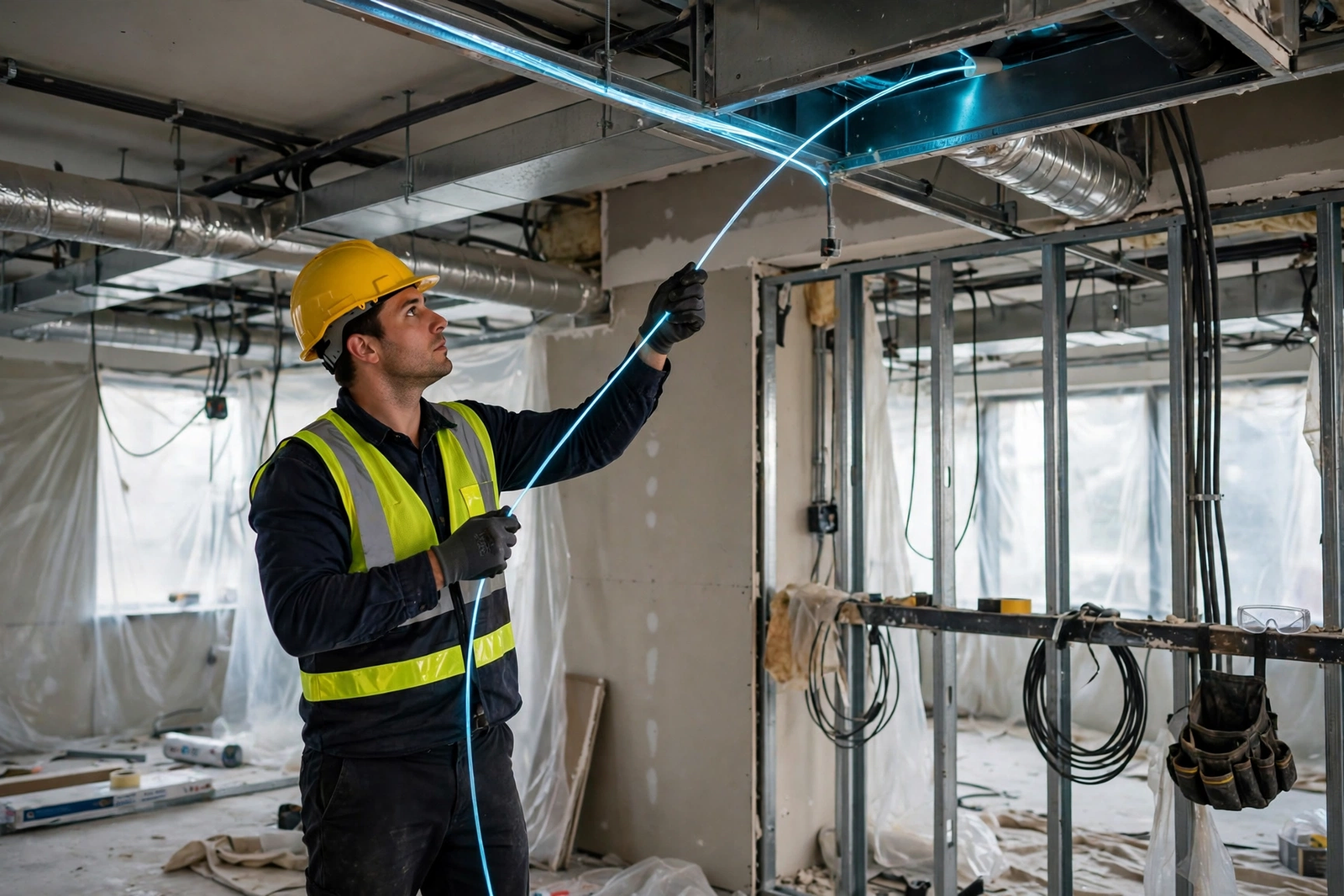
Business fiber installation in San Antonio, Texas follows the same sequence on every provider, and knowing the sequence in advance is what keeps the day short. The first step is the address check, which confirms whether fiber is built at the exact suite and which speed tiers are available there. The second step is the order, which sets the speed tier, the installation date and any construction requirement. The third step is the site survey, which happens on the installation day for a building that is already lit, or earlier for a building that needs construction. The fourth step is the physical work: the technician runs fiber from the street or the building entry point to the suite, installs an optical network terminal on the wall, connects the gateway, and tests the line. The fifth step is the handover: the technician confirms the speed on a wired test, connects the office network, and leaves the business online.
For a building that is already lit with fiber, the installation visit usually takes two to four hours, and the business can normally keep working through most of it, with only a short interruption while the old connection is swapped for the new one. The technician needs access to the suite, to the building’s telecom room or riser, and to a power outlet near the point where the optical network terminal will sit. The optical network terminal is a small wall-mounted box that converts the light signal in the fiber into an electrical signal the gateway can use, and it stays with the premises rather than with the business, so it should not be moved or unplugged without the provider’s guidance. The gateway is the box that provides Wi-Fi and wired Ethernet ports, and on AT&T Business Fiber it is included in the monthly price, while Google Fiber Business includes a Wi-Fi 6 router. A business that already has its own router, firewall or mesh Wi-Fi system should tell the technician on arrival, because the gateway can usually be set to pass the connection through to the business’s own equipment, and that conversation is much easier before the installation is finished than after the technician has left.
The most common installation problem in San Antonio, Texas is not technical but administrative: the building. A business in a multi-tenant office building needs the landlord’s or the building manager’s permission for the provider to run fiber to the suite, and some buildings have an exclusive arrangement with one provider, or a preferred provider list, that limits the choice. A business that is signing a lease should ask the landlord three questions before committing: which fiber providers are already in the building, whether there is an access agreement in place, and whether any provider has an exclusive right to serve the building. A business that is already in a building should ask the same questions of the building manager before ordering, because an installation that is blocked at the telecom room door wastes the appointment and the day. For the full ordering sequence, see our guide to how to order and install AT&T Business Fiber.
Business Fiber Installation Timeline in San Antonio, Texas
The timeline for business fiber installation in San Antonio, Texas depends on one fact: whether the building is already lit. If lit fiber already reaches the building, two to four weeks from order to live service is realistic, and many installations are scheduled within a week, because the work is limited to the run from the building entry point to the suite and the installation of the optical network terminal and gateway. If a new lateral or a building entrance agreement is needed, local dedicated internet providers report a timeline of thirty to ninety days, because the work involves permits, trenching or conduit, and coordination with the landlord and the city. That range is the reason a business should order fiber before signing a lease that assumes gigabit speeds on move-in day, and the reason a business moving premises should order the new connection at the same time as the lease, not after the move.
Construction cost follows the same pattern as the timeline. Where the building is already lit, installation is free on eligible AT&T Business Fiber online orders and included on Google Fiber Business plans, so the one-time cost is usually zero. Where construction is needed, the cost depends on the distance from the street to the suite, the soil and surface, permits, and the building’s existing wiring, and it can run into thousands of dollars. Some providers waive construction for a longer contract term, and some charge it as a one-time fee, so the question to ask is not whether installation is free but what the total one-time cost is, including construction, the optical network terminal, internal wiring to the suite, and any landlord access fee. Get that figure in writing before committing, and confirm the installation date in the same document, because a verbal promise of a date is not a scheduled installation. The second affiliate link in this article is for the business that has already checked its timeline: check AT&T Business Fiber availability and installation options for your San Antonio, Texas address.
Business Fiber Speeds in San Antonio, Texas: Choosing the Right Tier
Choosing a business fiber speed tier in San Antonio, Texas is a matter of counting people and counting uploads, not of buying the biggest number. A solo consultant or a two-person office that mostly uses email, video calls and cloud documents is well served by AT&T Business Fiber 300 Mbps at 60 dollars a month, which is more than enough for two people on video calls with cloud applications running. A busy office of five to ten people with cloud applications, video conferencing and regular large file transfers should start at 500 Mbps at 100 dollars a month, which leaves headroom for everyone to work at once. An office of ten to twenty people, a clinic moving imaging files, or a design studio sending large files to clients should start at 1 Gig at 140 dollars a month, which also adds the built-in 5G backup. The 2 Gig tier at 185 dollars a month and the 5 Gig tier at 285 dollars a month are for high-bandwidth environments: offices with dozens of simultaneous users, video production, large data transfers, or a genuine need for very high network capacity. Most small businesses that buy 5 Gig never use it, and the money is better spent on a backup connection or better Wi-Fi.
The other speed question is upload speed, and it is the reason fiber wins the comparison with cable at the same download speed. A 1 Gig fiber plan uploads at 1 Gig, while a 1 Gig cable plan uploads at up to 35 Mbps, which means a cloud backup that takes minutes on fiber can take hours on cable. A business should test its real usage before choosing: run a speed test on the current connection at the busiest time of day, note the upload speed, and ask whether the work that waits on uploads, such as backups, video calls and file sends, is the work that matters most. If it is, fiber is the answer, and the tier should be chosen on upload needs rather than download needs. A business that only downloads, streams and browses can save money on a lower tier or on cable, but a business that uploads for a living should not. Our guide to business internet providers in Austin, Texas works through the same speed-tier logic for a neighboring market.
Business Fiber Internet Equipment in San Antonio, Texas: ONT, Gateway and Wi-Fi

Business fiber internet in San Antonio, Texas needs three pieces of equipment, and understanding each one avoids the most common post-installation problems. The optical network terminal, usually called the ONT, is a small wall-mounted box that converts the light signal in the fiber into an electrical signal. It is installed by the provider, it stays with the premises, and it needs power, so it should sit near an outlet and should not be moved or unplugged. The gateway is the box that connects to the ONT and provides Wi-Fi and wired Ethernet ports; on AT&T Business Fiber the gateway is included in the monthly price, and on Google Fiber Business a Wi-Fi 6 router is included. The third piece is the office network itself: switches, access points and cabling that distribute the connection to desks, meeting rooms and point-of-sale terminals.
The most common equipment mistake is relying on a single gateway to cover a large office. A gateway’s Wi-Fi covers a small office well, but a larger space with thick walls, multiple rooms or a warehouse floor needs additional access points wired back to the gateway, and the 2 Gig and 5 Gig tiers need a compatible multi-gig gateway and network equipment to deliver their full speed over a wired connection, because a standard gigabit switch will cap the connection at 1 Gig no matter what tier is ordered. A business that orders 2 Gig or 5 Gig should confirm that its switches, cabling and computers support multi-gig Ethernet, or the extra speed will never reach a desk. A business with a static internet protocol address requirement should confirm whether it is included: Google Fiber Business 2 Gig includes a static address, AT&T Business Fiber quotes static addresses by plan, and Spectrum Business reports a static address at about 14.99 dollars a month. The equipment conversation should happen before the installation day, not after, because the technician can place the ONT and gateway for the best coverage only if the business knows where its desks and access points will be.
Business Fiber Backup in San Antonio, Texas: 5G Failover and Second Lines
Every business in San Antonio, Texas should plan for its fiber connection to fail, because fiber lines get cut during road work, storms knock out power, and a single provider outage can close a shop for a day. The cheapest backup is the one built into the primary plan: AT&T Business Fiber at 1 Gig and above includes built-in 5G backup at no extra cost, so the office fails over to a wireless link automatically when the fiber line drops. For lower tiers, the practical backup is a 5G business internet plan from a different carrier than the primary line, such as T-Mobile Business Internet from 35 dollars a month with a voice line or AT&T Internet Air for Business at 65 dollars a month for Standard and 105 dollars a month for Premium on the list, so that a single network problem cannot take down both connections. A dual-WAN router that holds both connections and switches between them automatically is a small one-time cost that pays for itself the first time the primary line drops during a busy afternoon.
A second fiber line from a different provider is the strongest backup, and it is the right choice for a hospital, a call center or a business that cannot tolerate any downtime, because the two networks do not share the same trench, the same equipment or the same outage. In San Antonio, Texas that usually means AT&T Business Fiber as the primary line and Google Fiber Business as the backup where both networks reach the building, or a Spectrum Business cable line as the backup where only one fiber network is available. The backup line does not need to be the same speed as the primary: a 300 Mbps fiber backup that keeps card terminals, email and phones working during an outage is worth far more than a second gigabit line that is never used. Test the failover before it is needed, because a backup that has never been tested is a hope rather than a plan, and the time to discover that it does not work is not during an outage.
Switching to Business Fiber in San Antonio, Texas
Switching to business fiber in San Antonio, Texas is straightforward when it is done in the right order, and the right order is to install the new connection before cancelling the old one. Order the fiber plan, confirm the installation date, and keep the existing connection running until the fiber line is tested and the office network is moved across. That overlap costs one month of the old plan, but it avoids the gap that closes a business for a day when an installation slips. On the installation day, test the new connection on a wired connection before the technician leaves, confirm the speed matches the tier ordered, and connect the office network, the phones and the point-of-sale terminals one at a time so that any problem is found while the technician is still on site.
After the switch, keep the old connection for a week if the contract allows it, as a fallback while the new line proves itself, and then cancel it in writing, keeping the cancellation confirmation. Update the business’s records with the new static internet protocol address if one was assigned, because remote access, security cameras and any service that whitelists the office address will stop working until the new address is registered. Finally, read the first bill against the written quote on the day it arrives, because the price on the first bill should match the price in the quote, and any difference is worth a call on the day it appears. A business that follows that sequence gets the benefit of fiber without the risk of a gap, and the whole switch usually takes less than a month from order to cancellation of the old line. For pricing in a nearby market, see our guide to business internet costs in Fort Worth, Texas, which uses the same AT&T tiers.
Frequently Asked Questions About Business Fiber Internet in San Antonio, Texas
How much does business fiber internet cost in San Antonio, Texas?
AT&T Business Fiber list prices are 60 dollars a month for 300 Mbps, 100 dollars for 500 Mbps, 140 dollars for 1 Gig, 185 dollars for 2 Gig and 285 dollars for 5 Gig, or 40, 60, 90, 135 and 235 dollars a month with an eligible business wireless plan, all before taxes and fees and checked 19 November 2026. Google Fiber Business costs 100 dollars a month for 1 Gig and 250 dollars a month for 2 Gig. Installation is free on eligible AT&T Business Fiber online orders and included on Google Fiber Business plans where the building is already lit.
Which business fiber internet providers serve San Antonio, Texas?
AT&T Business Fiber and Google Fiber Business are the two large fiber providers, with Spectrum Business fiber in selected commercial buildings and Astound Broadband fiber-powered service in selected neighborhoods. Enterprise fiber from LOGIX Fiber Networks and Zayo is available by quote for larger offices. Coverage varies by address, so check each provider at the exact business address.
How long does business fiber installation take in San Antonio, Texas?
If lit fiber already reaches the building, two to four weeks from order to live service is realistic, and the installation visit usually takes two to four hours. If a new lateral or a building entrance agreement is needed, the timeline extends to thirty to ninety days. Older buildings near downtown can take longer, while newer buildings in Stone Oak and the far west side are often ready within a week.
Is business fiber internet faster than cable in San Antonio, Texas?
Yes, for uploads. A 1 Gig fiber plan uploads at 1 Gig, while a 1 Gig cable plan uploads at up to 35 Mbps. Download speeds are comparable at the gigabit tier, but the symmetrical upload is what makes cloud backups, video calls and large file transfers work without bottlenecks, and it is the main reason to choose fiber over cable at a similar monthly price.
Business Fiber Installation Checklist for San Antonio, Texas
Work through this checklist before ordering business fiber internet in San Antonio, Texas. Check AT&T Business Fiber, Google Fiber and Spectrum Business fiber at the exact address, not the ZIP code, and confirm which speed tiers are built there. Ask the landlord or building manager which fiber providers are already in the building and whether an access agreement is in place. Get the monthly price, the post-promotion price and any installation or construction charge in writing. Confirm whether the gateway is included, whether a static internet protocol address is included or extra, and whether the plan includes 5G backup. Choose the tier by upload needs and headcount, not by the biggest number. On installation day, confirm the speed on a wired test before the technician leaves, and test the failover before it is needed. Finally, keep the old connection running until the new fiber line is tested, and read the first bill against the quote on the day it arrives.

