
Verdict: An SLA is a written service level agreement that states what level of internet service a provider commits to deliver to a business — including availability, support, and remedies if those commitments are missed — and residential internet generally does not have one because consumer terms are written for household use, not for business continuity. That written commitment is the real difference between a business connection and a home connection, even more than speed. A business that loses connectivity loses sales, bookings, card payments, and customer trust in real time, so it needs a documented promise and a process when things go wrong, not just a hope that the service stays up. A household that loses connectivity for an hour is inconvenienced; a business that loses it for an hour may be closed.
This guide explains what is internet SLA business buyers are actually signing, in plain terms, without inventing a specific uptime percentage, response time, or credit amount for AT&T — no such figure is sourced in this article, and any specific commitment must be confirmed in the written agreement for your service. It covers what an SLA defines, how credits and remedies typically work in principle, what is usually excluded, why residential terms differ, and what to check before you sign. It uses official AT&T Business Fiber pricing checked in October 2026 as the connection context, so you can weigh the SLA question alongside the speed-tier decision rather than in isolation.
Business Internet SLA Explained and AT&T Business Fiber
Check Fiber availability and ask for the written SLA terms on your business quote.
What is internet SLA business buyers are actually signing?
A service level agreement, or SLA, is the part of a business internet contract that turns a general promise of service into measurable commitments. In everyday language, it answers three questions in writing: how available the service should be, how quickly the provider should respond and act when there is a problem, and what happens if those commitments are not met. Without an SLA, a provider may still run a reliable network and a helpful support team, but the business has no documented standard to point to, no agreed way to measure performance, and no agreed remedy if performance falls short. With an SLA, both sides share the same definitions, the same measurement method, and the same process for raising and resolving a failure.
That distinction matters because business internet is bought for continuity, not just for speed. A fast connection that is down during a lunch rush, a booking window, or a card-payment peak has failed the business even if its headline speed looks impressive on a good day. An SLA does not prevent outages — no provider can promise that a connection will never fail, and any agreement that seemed to promise perfection should be read with suspicion — but it does define what counts as a failure, how it is reported, how it is measured, and what the provider owes in response. That clarity is what a business is paying for, alongside the speed tier, when it chooses a business service over a residential one.
It is also important to understand what an SLA is not. It is not a guarantee that nothing will ever go wrong, it is not a substitute for backup connectivity, and it is not the same as a marketing claim about reliability. Marketing language describes a service in general terms; an SLA defines it in contractual terms, with scope, exclusions, and a claims process. A business should therefore read the SLA itself, not just the sales summary of it, and should ask for the written terms before signing. If a provider cannot produce written SLA terms for the service you are considering, that absence is itself useful information about what you are buying.
Business internet SLA explained: the terms inside the agreement
A typical business internet SLA explained in plain terms covers several building blocks, and it helps to recognise each one when you read an agreement. Availability, often called uptime, is the proportion of time the service is expected to be working over a defined period, usually a month. The agreement should state how availability is measured, over what period, and what counts as downtime — for example, whether a brief interruption counts, whether planned maintenance counts, and whether a failure in your own equipment counts. Without those definitions, an availability figure on its own is hard to compare between providers, because two providers may measure the same word differently.
Response and repair commitments are the second building block. These state how quickly a provider should acknowledge a fault report, how quickly it should begin work, and, where stated, how quickly it aims to restore service. Response time and repair time are different things: a fast acknowledgement does not by itself mean a fast fix, and a business should check both, as well as what priority its fault receives and whether support is available outside business hours. A third building block is the scope of the commitment: which parts of the service are covered, whether the commitment applies to the connection to your premises, to the wider network, or to both, and what happens at multi-site businesses where one site fails but others do not.
Finally, most SLAs include measurement, reporting, and claims rules. The agreement should say how performance is monitored, whether the business receives reports, how a business raises a claim if a commitment is missed, and what evidence or timing the claim requires. A commitment without a claims process is difficult to use in practice, because the business may not know it is entitled to a remedy, or may miss a deadline for claiming it. When you read an SLA, look for all of these blocks together — availability, response and repair, scope, and claims — rather than judging the agreement by a single headline figure. The business internet versus residential internet guide sets out the wider differences between the two service types, of which the SLA is one of the most important.
Internet service level agreement business terms to read closely
When you sit down with an internet service level agreement business document, read the definitions before the headlines. Definitions decide whether a real-world outage counts as an SLA failure at all. Check whether downtime is measured from when you report the fault or from when the provider detects it, because that gap can matter. Check whether the measurement period is a calendar month, a billing cycle, or another period, and whether a single long outage and several short outages are treated the same way. Check whether planned maintenance windows are excluded, and whether you will be told about them in advance. A business that runs evening or weekend trade should pay particular attention to maintenance windows, because a window that is harmless for a daytime office may fall in another business’s peak hours.
Next, read the exclusions and the responsibilities placed on the customer. Most SLAs exclude failures caused by the customer’s own equipment, wiring inside the premises, power loss at the site, or events outside the provider’s control, such as severe weather damage to third-party infrastructure. Those exclusions are not necessarily unreasonable, but they define the boundary of the commitment, and a business should know where that boundary lies before it needs to rely on it. Also check what the agreement requires of you: reporting a fault promptly, giving access for repairs, keeping equipment powered and accessible, or following a troubleshooting step before a fault is accepted. A claim can fail on a procedural point even when the underlying outage was real, so the procedure matters as much as the promise.
SLA vs residential internet: why consumer terms differ
The SLA vs residential internet comparison starts with purpose. Residential internet is sold to households for personal use, under consumer terms that are designed to be simple, standardised, and priced for mass-market use. Those terms generally describe the service, the price, and the support channels, but they typically do not include a business-style SLA with measured availability commitments, repair targets, and credit remedies. That is not an oversight or a hidden penalty; it reflects a different bargain. A household service is not priced to carry the cost of business-grade commitments, business-hours support structures, and compensation processes, and most households would not use those features if they were included.
Business terms, by contrast, are written around continuity and accountability. A business customer is expected to read and rely on the contract, to report faults through business channels, and to claim remedies through a defined process. The provider, in return, commits to measurable standards and to a remedy if they are missed. That structure also explains why a business service may cost more than a residential service at a similar headline speed: part of the price reflects the support, measurement, and remedy apparatus behind the SLA, not just the raw speed. The comparison that matters is therefore not speed alone, but speed plus the written commitment, the support route, and the remedy, taken together.
Two cautions keep this comparison honest. First, do not assume in absolute terms that no residential service anywhere offers any form of guarantee; consumer terms vary, and some providers describe reliability or satisfaction measures in consumer language. The accurate statement is that residential services generally and typically do not carry a business-style SLA, because consumer terms are written differently. Second, do not assume that a home connection used for business work gains business protections simply because the work is business work. The terms follow the service, not the activity. A business run over a residential connection is generally operating outside business terms, which can matter for support priority, for fault handling, and for any claim after an outage. If business continuity matters, the service itself should be a business service, with its terms read in advance.
Business internet uptime guarantee: what it does and does not promise
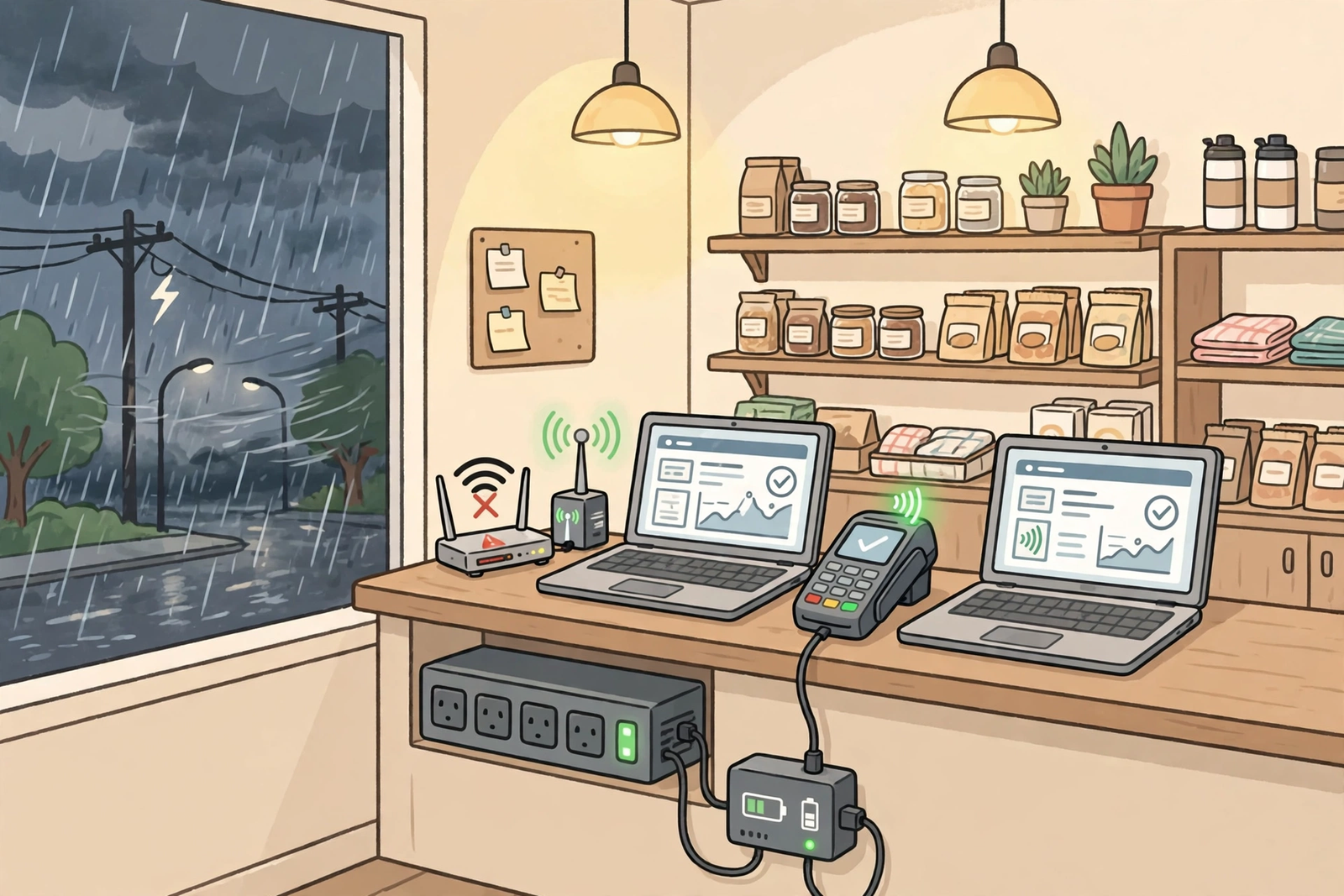
A business internet uptime guarantee is the availability part of an SLA, expressed as a commitment over a period. It is often the figure that gets quoted in sales conversations, and it is also the figure most easily misunderstood. An uptime commitment does not mean the connection will be working at every moment without exception. It means that, measured over the defined period and under the defined rules, the service is expected to meet the stated level, and that falling below it triggers the agreed process. Short interruptions, planned maintenance, and excluded causes may not count toward the measurement at all, depending on the definitions. That is why this article does not quote a specific percentage for AT&T: no such figure is sourced here, and quoting an invented or borrowed percentage as if it applied to your service would mislead you about the commitment you would actually be signing.
Uptime commitments also interact with backup. An SLA, however strong, does not keep a single connection working during a physical line failure, a power cut at the premises, or a local infrastructure fault. That is why backup matters as a separate decision. On AT&T Business Fiber, tiers of 1 GIG and above include built-in 5G backup, checked October 2026, which provides a fallback if the wired line fails. Lower Fiber tiers do not include that built-in backup in the same way, so a business on 300 Mbps or 500 Mbps that needs continuity should ask about backup options separately. The SLA defines what the provider commits to for the primary service; backup defines what keeps the business trading when the primary service fails despite that commitment. Both belong in a continuity plan, and neither replaces the other.
| Business internet SLA element | What it defines | Question to ask before signing |
|---|---|---|
| Availability or uptime commitment | Expected availability over a defined period, under defined measurement rules | How is it measured, over what period, and what counts as downtime? |
| Response and repair commitments | How quickly faults are acknowledged and worked on | Are response time and repair time stated separately, and is support available when I trade? |
| Scope and exclusions | Which services, sites, and causes are covered or excluded | Does this SLA cover my exact service, tier, and site, and what is excluded? |
| Remedies and credits | What happens if a commitment is missed | What remedy applies, how is it claimed, and by what deadline? |
| Customer responsibilities | What the business must do to report and support a fault | What reporting, access, or troubleshooting steps are required of me? |
SLA business internet terms: credits, remedies and exclusions in principle
Credits and remedies are how an SLA gives a missed commitment a consequence. In principle, if a provider fails to meet a defined commitment, and the failure falls within the scope of the agreement, the business may be entitled to a remedy — commonly a service credit against a future bill, calculated under the agreement’s rules. This article does not state a specific credit amount or percentage for AT&T, because none is sourced here, and credit rules vary by agreement. What matters for a reader is the structure: a credit is usually not automatic, it usually must be claimed within a stated time, it usually requires the fault to have been reported through the agreed channel, and it is usually capped or scaled in a way the agreement defines. A business that does not know the claims process may miss a remedy it was entitled to, through delay alone.
Remedies also have limits that should be understood before signing. An SLA credit, where one applies, typically compensates for the service charge for the affected period in some proportion; it does not generally compensate for lost sales, lost bookings, or other business losses, unless the agreement says otherwise in terms you have specifically agreed. That distinction is important for expectations. An SLA protects the service relationship and gives the provider a financial reason to meet its commitments, but it is not business-interruption insurance. Businesses whose losses from an outage would be large should consider backup connectivity, and where appropriate, insurance, as separate protections, rather than expecting an SLA credit to cover trading losses. The business internet buying checklist pairs well with this guide, because it places the SLA question alongside speed, backup, equipment, and installation checks in one pre-order review.
Exclusions complete the picture. As noted earlier, customer equipment, premises wiring, power, and events outside the provider’s control are commonly excluded, and planned maintenance is commonly handled separately. A business should read exclusions not as reasons to distrust the agreement, but as the boundary of what is being promised. If a likely failure mode for your site — for example, a long cable run, a shared building riser, or a site with frequent power issues — falls in an excluded category, that is useful knowledge: it tells you to address that risk separately, with better wiring, power protection, or backup, rather than assuming the SLA covers it. A clear exclusion is more useful than a vague promise, because it lets you plan around the gap.
Disclaimer: This article contains affiliate links to AT&T Business services. We may earn a commission if you purchase through them, at no extra cost to you. Ortelcom.com is an independent publisher and is not affiliated with or endorsed by AT&T. Pricing, speeds, and availability are not guaranteed, were checked in October 2026, and vary by address and promotions — please confirm all details before ordering. AT&T and all related marks are trademarks of their respective owners.
SLA business internet terms: choosing a service with the agreement in mind

Choosing a business internet service with the SLA in mind means reading the agreement before the price comparison, not after it. Start by asking for the written SLA terms for the exact service and tier on your quote — Fiber 300 Mbps, 500 Mbps, 1 GIG, 2 GIG, or 5 GIG, or another service if that is what you are considering — and confirm the terms match the quote, not a different product. Then work through the building blocks from this guide: availability definitions, response and repair commitments, scope and exclusions, customer responsibilities, and the claims process. Note anything that is vague, and ask for clarification in writing. A provider that can answer clearly about its SLA is giving you a useful signal about how fault handling will work in practice.
Next, weigh the SLA alongside speed and price, using official Fiber prices checked in October 2026 as the pricing context. Fiber list prices are $60 for 300 Mbps, $100 for 500 Mbps, $140 for 1 GIG, $185 for 2 GIG, and $285 for 5 GIG, and with an eligible wireless plan they are $40, $60, $90, $135, and $235 respectively. Speeds are symmetrical, there are no data caps, there is no annual contract on the terms described here, and ActiveArmor security features are included. The guide to how much internet speed a business needs helps with the tier choice, while this guide helps with the commitment choice; the two decisions together determine whether the service fits the business. A higher tier does not automatically carry stronger SLA terms, and a lower tier is not automatically weaker in SLA terms, so do not assume the relationship — check the written terms for the tier you are actually buying, and start from the AT&T Business Fiber availability check.
What is internet SLA business: frequently asked questions
What is internet SLA business cover in simple terms?
An internet SLA for a business is a written agreement that defines the level of service a provider commits to deliver, including availability, response and repair commitments, scope and exclusions, and the remedy and claims process if a commitment is missed. It turns a general promise of reliable service into measurable, contractual terms that both sides can refer to after a fault. It does not prevent outages, and it is not a substitute for backup connectivity.
Does business internet SLA explained mean my connection will never go down?
No. No SLA can prevent every outage, and a business internet SLA explained honestly always includes measurement rules, exclusions, and a claims process rather than a promise of perfection. The value of the SLA is clarity: what counts as a failure, how it is measured, how quickly the provider should act, and what remedy applies if a commitment is missed. Backup connectivity is the separate protection that keeps the business trading during an outage.
Why does SLA vs residential internet matter for a small business?
It matters because a small business loses sales, bookings, and customer trust during an outage, while a household is generally inconvenienced rather than closed. Business terms are written around continuity, with measured commitments and a remedy process, while residential terms are generally written for household use without a business-style SLA. A business run over a residential connection is generally operating without those business protections, whatever the work being done.
What should I check in SLA business internet terms before signing?
Check the written SLA for your exact service and tier, including how availability is measured and over what period, what counts as downtime, response and repair commitments, scope and exclusions, your own responsibilities for reporting and access, and the claims process and deadline for any remedy. Confirm any specific uptime, response, or credit figure in that written document for your service, rather than relying on a sales summary or on figures quoted for a different service.
Is a business internet uptime guarantee the same as a speed guarantee?
No. An uptime guarantee concerns availability — whether the service is working over a period — while speed concerns how fast data moves when the service is working. A connection can meet its uptime commitment while running slowly because of Wi-Fi, wiring, or congestion, and a fast connection can still fail its uptime commitment if it goes down. Check both separately: the SLA for availability and support, and the tier, equipment, and Wi-Fi setup for speed.
An SLA is, at its heart, a clarity document. It tells a business what to expect, how performance is measured, what is excluded, and what happens when a commitment is missed — and it tells the provider, in return, what standard it will be held to. Residential internet generally does not carry that kind of written business commitment, because consumer terms are built for a different bargain, and that difference is one of the strongest reasons to put business work on a business service. Read the written agreement for your exact service and tier, confirm any specific uptime, response, or credit terms in that document, plan backup for the failures no agreement can prevent, and keep the claims process where your team can find it. Done that way, an SLA stops being fine print and becomes part of how the business stays open.

