
If your business address is served by both AT&T and Verizon fiber, the AT&T Business Fiber vs Verizon Fios Business decision is a good problem to have: both deliver true fiber with symmetrical upload and download speeds, no data caps, and business-grade support — and both leave cable internet far behind on uploads. Here is the short verdict: choose Verizon Fios Business if you want the lowest standalone monthly price at the popular 500 Mbps tier, built-in static IPs, and an uptime SLA in the plan; choose AT&T Business Fiber if your business also uses AT&T wireless (the bundle discounts are steep), you need 5 GIG speeds, or you want the broader national fiber footprint. The rest of this 2026 comparison breaks down prices, speeds, contracts, and business features tier by tier, based on published plans, so you can match the right fiber to your business.
Checking availability for your address? See current AT&T Business Fiber plans and promos — final pricing and availability vary by address and current promotions.
Looking for the fiber-first option?
Check whether AT&T Business Fiber serves your office and compare the 300 Mbps to 5 GIG speed tiers.
Key Takeaways: Fiber vs Fios Business Comparison
For a closer look at the plans themselves, see our AT&T Business Fiber overview.
- Both AT&T Business Fiber and Verizon Fios Business offer symmetrical fiber speeds with no data caps — uploads match downloads on every tier.
- On standalone list pricing, the two are nearly tied: AT&T is cheaper at 300 Mbps and 1 Gig, Fios is cheaper at 500 Mbps and 2 Gig, and the differences are only a few dollars.
- AT&T Business Fiber wins the bundle math: with an eligible AT&T Business wireless plan plus AutoPay and paperless billing, 1 GIG drops to $90/mo and 2 GIG to $135/mo.
- Verizon Fios Business includes 1+ static IP addresses, an SLA-backed uptime guarantee, and a 30-day money-back guarantee; best pricing is on a 2-year term.
- AT&T is the only one of the two offering 5 GIG business fiber speeds, a real advantage for bandwidth-heavy offices.
- Availability is address-dependent for both providers — always confirm serviceability before comparing final prices.
For the full tier-by-tier numbers, see our AT&T Business Fiber pricing breakdown.
Fiber vs Fios at a Glance: What This AT&T Business Fiber vs Verizon Fios Business Comparison Covers
This is a fiber vs fios matchup in the truest sense: two fiber-to-the-premises networks competing head to head for small and midsize businesses. Unlike fiber vs cable comparisons, there is no lopsided upload story here — both sides are symmetrical. The decision comes down to pricing structure, bundle opportunities, included business features, top-end speed availability, and contract terms.
If cable is on your shortlist too, our AT&T Business Fiber vs Spectrum Business comparison covers that matchup head-to-head.
The table below summarizes the fiber vs fios matchup at a glance. Detailed tier-by-tier business fiber pricing follows in the sections after it.
| Factor | AT&T Business Fiber | Verizon Fios Business |
|---|---|---|
| Technology | Fiber to the premises, symmetrical | Fiber to the premises, symmetrical |
| Entry price (300 Mbps) | $60/mo list ($40 with eligible AT&T wireless) | $69/mo |
| Top speed | 5 GIG | 2 Gig |
| Data caps | None | Unlimited data |
| Static IPs | Available (plan-dependent) | 1+ static IP included |
| Uptime guarantee | Business-grade reliability; terms vary | SLA-backed uptime guarantee |
| Contract options | Terms vary by plan and promo | Best pricing on 2-year term |
| Money-back guarantee | Promo-dependent | 30-day money-back guarantee |
| Standout promo | $300–$500 reward cards on select promos | Up to $200 Visa prepaid card on high tiers (promo) |
Pricing checked October 2026 — confirm at checkout. Final prices vary by address, contract term, and current promotions.
AT&T Business Fiber Plans: Business Fiber Pricing and Speed Tiers
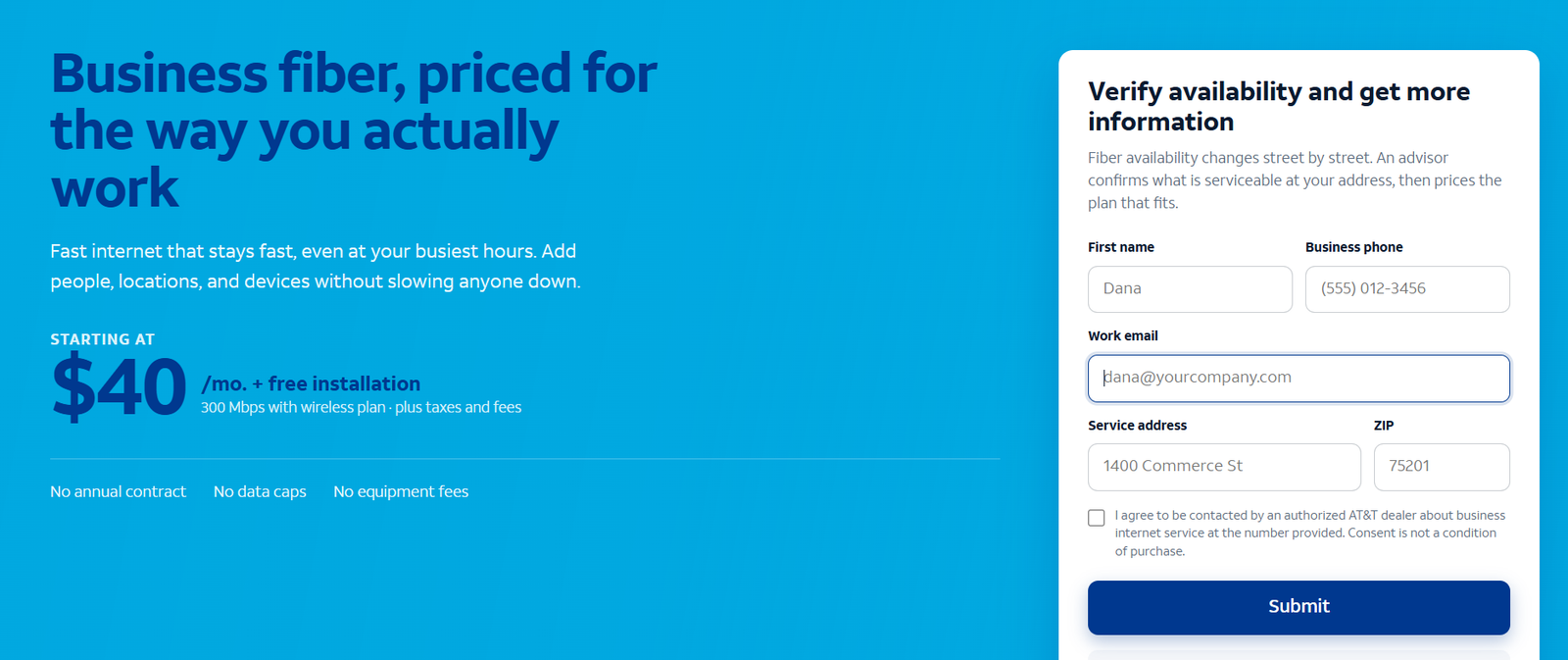
AT&T Business Fiber sells five speed tiers, all symmetrical with no data caps. The published list prices below are the standalone rates; the bundled rates apply when you pair fiber with an eligible AT&T Business wireless plan and enroll in AutoPay and paperless billing.
| AT&T Business Fiber plan | Download / upload | List price | With eligible AT&T wireless + AutoPay |
|---|---|---|---|
| 300 Mbps | 300 / 300 Mbps | $60/mo | $40/mo |
| 500 Mbps | 500 / 500 Mbps | $100/mo | $60/mo |
| 1 GIG | 1,000 / 1,000 Mbps | $140/mo | $90/mo |
| 2 GIG | 2,000 / 2,000 Mbps | $185/mo | $135/mo |
| 5 GIG | 5,000 / 5,000 Mbps | $285/mo | $235/mo |
Pricing checked October 2026 — confirm at checkout. List prices are before bundle discounts; bundled rates require an eligible AT&T Business wireless plan plus AutoPay and paperless billing, and pricing varies by address and promotions.
The bundle math is where AT&T Business Fiber pulls ahead of nearly every competitor. A business already paying for AT&T wireless lines can get 1 GIG symmetrical fiber for $90/mo — less than most cable business plans charge for far slower uploads. The discount scales with the tier: $20 off at 300 Mbps, $40 off at 500 Mbps, $50 off at 1 GIG and 2 GIG, and $50 off at 5 GIG. If your company is already in the AT&T wireless ecosystem, the effective business fiber pricing is hard to beat.
AT&T also runs reward-card promotions on business fiber — typically $300 to $500 in reward cards depending on the tier and promo period — which further lowers the first-year effective cost. These promos rotate, so the exact card value at your address may differ from what is advertised nationally.
Check AT&T Business Fiber availability and current promos for your business address
AT&T Business Fiber Strengths: Symmetrical Fiber Speeds and Included Perks
The core strength of AT&T Business Fiber is the combination of symmetrical fiber speeds and business-ready inclusions at every tier. Every plan includes matching upload and download speeds, which matters for video conferencing, cloud backups, large file uploads, and point-of-sale systems that sync constantly with the cloud.
AT&T includes its ActiveArmor security features and a Wi-Fi gateway with business fiber plans, so there is no separate equipment rental stacking onto the monthly bill the way cable providers often charge for modems. There are no data caps or overage fees, which removes the metering anxiety that comes with some business internet plans when backups or video-heavy workflows spike usage.
The 5 GIG tier is a genuine differentiator in this fiber vs fios comparison: Verizon Fios Business currently tops out at 2 Gig in its published business lineup, while AT&T offers a full 5,000 Mbps symmetrical tier. Few small businesses need 5 GIG today, but bandwidth-heavy operations — design studios moving huge files, offices with dozens of simultaneous video streams, businesses hosting on-premises servers — can grow into it without switching providers.
AT&T Business Fiber Limitations: Business Fiber Pricing Fine Print
The biggest limitation is the gap between list pricing and bundled pricing. The headline bundle rates — $40/mo for 300 Mbps, $90/mo for 1 GIG — only apply with an eligible AT&T Business wireless plan plus AutoPay and paperless billing. A business that does not use AT&T wireless pays the higher list price, where the fiber vs fios price gap narrows to a few dollars per tier.
Availability is the second caveat. AT&T Business Fiber has a large national footprint, but fiber still does not reach every commercial address — some buildings are served only by AT&T’s older copper or fixed-wireless options. Always run an address check rather than assuming the tier you want is available at your location.
Finally, promotional pricing and reward-card offers change frequently. The $300–$500 reward card figures cited here reflect recent promos; the actual offer at your address on the day you order may be higher, lower, or structured differently. Treat promos as a bonus, not the basis of the decision.
Verizon Fios Business Plans: Speeds, Static IPs and Contract Terms
Verizon Fios Business plans run from 300 Mbps to 2 Gig, all symmetrical with unlimited data. Published business pricing is $69/mo for 300 Mbps, $99/mo for 500 Mbps, $149/mo for 1 Gig, and $179/mo for 2 Gig, with the best pricing available on a 2-year term. Shorter or month-to-month terms typically cost more, so the 2-year commitment is the price most businesses should compare against.
| Verizon Fios Business plan | Download / upload | Price (best on 2-yr term) | Key inclusions |
|---|---|---|---|
| 300 Mbps | 300 / 300 Mbps | $69/mo | Symmetrical, unlimited data, static IP |
| 500 Mbps | 500 / 500 Mbps | $99/mo | Symmetrical, unlimited data, static IP |
| 1 Gig | 1,000 / 1,000 Mbps | $149/mo | Symmetrical, unlimited data, static IP |
| 2 Gig | 2,000 / 2,000 Mbps | $179/mo | Symmetrical, unlimited data, static IP |
Pricing checked October 2026 — confirm at checkout. Best pricing requires a 2-year term; pricing varies by address and current promotions.
Two inclusions set Fios Business apart in the fiber vs fios matchup. First, 1 or more static IP addresses are included with business plans — useful for businesses hosting their own servers, running VPNs, or using security cameras and VoIP systems that need a fixed address. Second, Verizon backs Fios Business with an SLA uptime guarantee and dedicated business support, which gives IT managers a contractual reliability commitment rather than a best-effort promise.
Verizon also offers a 30-day money-back guarantee on Fios Business, which lowers the risk of committing to a 2-year term: if the service does not perform, you can exit early. Promotional offers have included up to a $200 Visa prepaid card on higher tiers, though promo details vary by market and time. Note that Frontier is now part of Verizon, which extends the broader Verizon fiber footprint story — worth knowing if your business has locations in former Frontier territories.
Verizon Fios Business Plans: Where Fios Shines for Business
Fios Business shines on included business features at the base price. Static IPs, an uptime SLA, and business-class support come standard rather than as add-ons, which simplifies budgeting — the $99/mo 500 Mbps plan is genuinely $99/mo of business-ready fiber, not a consumer plan with business features bolted on afterward.
The 30-day money-back guarantee is another real advantage for cautious buyers. Committing to a 2-year term for the best price is easier to swallow when there is a no-penalty exit window if installation or performance disappoints. Combined with symmetrical fiber speeds and unlimited data on every tier, Fios Business is a clean, predictable package: pick a speed, sign the term, and the price you see is close to the price you pay.
Verizon Fios Business Plans: Limitations Worth Knowing
The main limitation of Verizon Fios Business plans is the top speed: 2 Gig is the ceiling in the published business lineup, while AT&T Business Fiber reaches 5 GIG. Most small businesses will never need more than 1–2 Gig, but bandwidth-intensive operations planning for growth may prefer AT&T’s headroom.
Availability is also more geographically concentrated than AT&T’s national fiber footprint. Fios is strongest in the Northeast and Mid-Atlantic; outside the core Fios footprint, Verizon business internet may mean different technologies. As with AT&T, always verify fiber serviceability at your exact address — “Verizon serves my city” does not guarantee Fios reaches your building.
Finally, the best pricing requires a 2-year term. Businesses that need flexibility — short leases, seasonal operations, uncertain growth — will pay more for shorter terms, which can erase Fios’s small standalone price advantage at the 500 Mbps and 2 Gig tiers.
Fiber vs Fios Head to Head: Full Business Fiber Pricing Comparison
The table below lines up the complete fiber vs fios comparison: every speed tier, uploads, business features, and contract terms side by side.
| Comparison point | AT&T Business Fiber | Verizon Fios Business |
|---|---|---|
| 300 Mbps monthly price | $60 list / $40 with AT&T wireless bundle | $69 (best on 2-yr term) |
| 500 Mbps monthly price | $100 list / $60 with bundle | $99 (best on 2-yr term) |
| 1 Gig monthly price | $140 list / $90 with bundle | $149 (best on 2-yr term) |
| 2 Gig monthly price | $185 list / $135 with bundle | $179 (best on 2-yr term) |
| 5 Gig monthly price | $285 list / $235 with bundle | Not offered |
| Upload speeds | Symmetrical on all tiers | Symmetrical on all tiers |
| Data caps | None | Unlimited |
| Static IP | Available (plan-dependent) | 1+ static IP included |
| Security features | ActiveArmor included | Business security options |
| Equipment | Wi-Fi gateway included | Equipment terms vary by plan |
| Contract terms | Vary by plan and promo | Best pricing on 2-year term |
| Money-back guarantee | Promo-dependent | 30-day money-back guarantee |
| Uptime commitment | Business-grade reliability | SLA-backed uptime guarantee |
| Current promos | $300–$500 reward cards (select promos) | Up to $200 Visa prepaid on high tiers (promo) |
| Best for | AT&T wireless customers; 5 GIG needs; broadest footprint | Lowest standalone 500 Mbps–2 Gig pricing; included static IPs and SLA |
Pricing checked October 2026 — confirm at checkout. All prices vary by address, contract term, and current promotions.
Disclaimer: This article contains affiliate links to AT&T Business services. We may earn a commission if you purchase through them, at no extra cost to you. Ortelcom.com is an independent publisher and is not affiliated with or endorsed by AT&T. Pricing, speeds, and availability are not guaranteed, were checked in October 2026, and vary by address and promotions — please confirm all details before ordering. AT&T and all related marks are trademarks of their respective owners.
Business Fiber Pricing by Tier: Which Provider Costs Less?
On standalone list pricing, the fiber vs fios price race is genuinely close — close enough that promos and contract terms can flip the winner at any given tier. At 300 Mbps, AT&T’s $60/mo beats Fios’s $69/mo by $9. At 500 Mbps, Fios’s $99/mo edges AT&T’s $100/mo by a single dollar. At 1 Gig, AT&T’s $140/mo beats Fios’s $149/mo by $9. At 2 Gig, Fios’s $179/mo beats AT&T’s $185/mo by $6. In other words, without bundles, neither provider dominates business fiber pricing — the difference at most tiers is under $10/mo.
The picture changes dramatically with AT&T’s wireless bundle. At $40/mo for 300 Mbps, $60/mo for 500 Mbps, $90/mo for 1 GIG, and $135/mo for 2 Gig, bundled AT&T Business Fiber undercuts Fios’s 2-year-term pricing by $29–$59/mo at every tier. Over a 2-year term, that is $696 to $1,416 in savings versus Fios’s best pricing — before counting reward-card promos. The honest catch: those savings only exist if your business uses (or switches to) eligible AT&T Business wireless plans and keeps AutoPay and paperless billing active.
Two-year total cost of ownership tells the same story. A standalone AT&T 1 GIG plan at $140/mo costs $3,360 over two years versus $3,576 for Fios 1 Gig at $149/mo — a modest $216 AT&T edge. With the wireless bundle, AT&T 1 GIG at $90/mo totals $2,160, a $1,416 advantage. Subtract a $300–$500 reward card promo and the first-year effective cost drops further. For Fios, the math to watch is the 2-year term requirement: the $99–$179 prices assume you commit, and shorter terms cost more, which can erase the small standalone edge at 500 Mbps and 2 Gig.
Symmetrical Fiber Speeds: How AT&T and Fios Uploads Compare
Symmetrical fiber speeds are the headline feature both providers share, and they are the reason fiber beats cable for business regardless of which brand you choose. Every tier on both sides delivers uploads equal to downloads: 500/500, 1000/1000, 2000/2000. For context, business cable plans at similar download speeds typically offer only 10–35 Mbps uploads — a 15x to 50x disadvantage.
What do symmetrical uploads actually buy a business? Video conferencing is the most visible: a 10-person office on simultaneous HD video calls needs roughly 30–50 Mbps of sustained upload, which both providers clear easily at any tier, while a 35 Mbps cable upload would saturate. Cloud backups are the second: nightly offsite backups of point-of-sale data, design files, or security footage finish in minutes on 500+ Mbps uploads instead of grinding through the night. VoIP call quality, large email attachments, and remote-desktop sessions all benefit the same way.
Because both providers are symmetrical, uploads are not a differentiator in this fiber vs fios matchup — the differentiator is how much symmetrical speed you get per dollar, and how high the ceiling goes. AT&T’s 5 GIG tier offers 5,000 Mbps uploads where Fios tops out at 2,000 Mbps. For the vast majority of small businesses, 300–1,000 Mbps symmetrical is already more upload than they will ever use; the practical takeaway is that either choice solves the upload problem that plagues cable.
Fios Business vs AT&T Business on Reliability and Support
On raw network technology, fiber is fiber: both providers run fiber to the premises with the low latency and weather immunity that make fiber more reliable than cable or DSL. The difference in the fios business vs att business reliability conversation is contractual. Verizon includes an SLA-backed uptime guarantee with Fios Business — a written service-level commitment with remedies if uptime falls short — plus dedicated business support. AT&T Business Fiber is engineered for business-grade reliability and includes ActiveArmor security, but its published business fiber plans do not lead with the same explicit SLA framing.
For most small businesses, either network will feel rock-solid day to day; fiber outages are rare on both. The SLA matters most to businesses where downtime has a direct revenue cost — retailers whose POS goes down, clinics that cannot access records, offices with client-facing SLAs of their own. If your business needs a contractual uptime commitment to show your own customers or insurers, Fios’s explicit SLA is a tangible advantage.
Support structure also differs. Verizon routes Fios Business customers to business support teams, while AT&T Business Fiber customers get business support with ActiveArmor security tooling in the mix. Neither provider publishes detailed support SLAs in the plan summaries used for this comparison, so businesses with strict support requirements should ask both providers for written terms before signing.
Best Business Fiber Internet for Three Business Types
The best business fiber internet is not one-size-fits-all — it depends on how your business uses bandwidth, whether you bundle wireless, and how much speed headroom you need. Here is how the fiber vs fios decision plays out for three common scenarios.
Best Business Fiber Internet for a Retail Shop
A retail store with POS terminals, a few security cameras, guest Wi-Fi, and back-office PCs typically needs 300–500 Mbps symmetrical. On standalone pricing, AT&T’s $60/mo 300 Mbps plan is the cheapest entry point in this comparison, while Fios’s $99/mo 500 Mbps plan offers more headroom for a dollar less than AT&T’s $100/mo list. If the shop’s owner already carries AT&T wireless, the $40/mo bundled 300 Mbps or $60/mo bundled 500 Mbps plans are the clear value winners. Either provider’s symmetrical speeds handle cloud POS sync and camera uploads without the bottlenecks cable would create during busy hours.
Best Business Fiber Internet for a Video-Heavy Office
An office with 15–30 staff on frequent video calls, cloud file sharing, and VoIP phones should target 1 GIG symmetrical. Here AT&T’s $140/mo list price beats Fios’s $149/mo, and the $90/mo wireless-bundle price beats everything in this comparison by a wide margin. Fios counters with its included static IP and SLA uptime guarantee — meaningful if the office hosts its own VPN or video bridge. For pure video-call performance, both are excellent; the decision hinges on bundle eligibility and whether the SLA has contractual value for the business.
Best Business Fiber Internet for Multi-Location Businesses
Businesses with several locations should weigh footprint first and price second. AT&T’s broader national fiber footprint makes it easier to standardize on one provider across states, and the wireless bundle discount multiplies across every location that also uses AT&T wireless. Fios is compelling where all locations sit inside the core Fios footprint — especially in the Northeast and Mid-Atlantic — and its included static IPs simplify multi-site VPN setups. Companies with locations in former Frontier territories should note that Frontier is now part of Verizon, which may expand single-provider options there.
Who Should Choose AT&T Business Fiber vs Verizon Fios Business
Choose AT&T Business Fiber if your business uses AT&T wireless (the bundle discounts of $20–$50/mo per tier are the single biggest savings lever in this comparison), if you need 5 GIG speeds now or want the headroom later, if you operate across multiple states and value the broader footprint, or if a $300–$500 reward card promo meaningfully lowers your first-year cost. The gateway-included, no-data-cap, ActiveArmor-bundled package is particularly strong value at the bundled rates.
Choose Verizon Fios Business if you want the lowest standalone price at 500 Mbps or 2 Gig without bundling wireless, if included static IPs matter for your servers, VPN, or VoIP setup, if an SLA-backed uptime guarantee has contractual value for your business, or if the 30-day money-back guarantee makes the 2-year term commitment comfortable. Fios is the simpler “what you see is what you get” business fiber buy.
Either way, run an address check with both providers before deciding — the best business fiber internet on paper is worthless if it does not reach your building, and street-level availability is the most common reason businesses end up with their second choice.
Fiber vs Fios FAQs: Business Fiber Internet Questions Answered
Are Verizon Fios Business Plans Really Cheaper at 500 Mbps?
On standalone pricing, yes — but barely. Verizon Fios Business plans price 500 Mbps at $99/mo on a 2-year term versus AT&T Business Fiber’s $100/mo list, a $1/mo difference. However, AT&T’s wireless bundle drops its 500 Mbps plan to $60/mo, which undercuts Fios by $39/mo. So Fios is cheaper only for businesses that do not bundle AT&T wireless; bundled AT&T wins decisively.
Do Both Providers Deliver Symmetrical Fiber Speeds?
Yes. Both AT&T Business Fiber and Verizon Fios Business deliver symmetrical fiber speeds on every tier — uploads equal downloads from 300 Mbps up through 2 Gig (and 5 GIG on AT&T). Neither provider throttles uploads the way cable does, so video calls, cloud backups, and large uploads perform equally well on either network at the same tier.
Which Is the Best Business Fiber Internet for Video Calls?
Both are excellent for video calls thanks to symmetrical uploads and low fiber latency. For a video-heavy office, the practical tiebreaker is price per symmetrical megabit: AT&T’s $90/mo bundled 1 GIG is the best value if you use AT&T wireless, while Fios’s $149/mo 1 Gig with included static IP and SLA suits offices that host their own conferencing infrastructure. Either will handle dozens of simultaneous HD calls.
Is There a Catch in AT&T’s Business Fiber Pricing Bundle Discount?
The main conditions are straightforward: the discounted business fiber pricing requires an eligible AT&T Business wireless plan plus AutoPay and paperless billing. If you cancel the wireless lines or drop AutoPay, the fiber price reverts toward the list rate. Businesses already paying for AT&T wireless get the discount essentially for enrolling in AutoPay — but businesses on other carriers should price the wireless switch honestly before counting the savings.
Fios Business vs AT&T Business: Which Contract Terms Are Better?
It depends on what you value. Fios Business offers its best pricing on a 2-year term with a 30-day money-back guarantee as a safety net — good for businesses that want price certainty with an exit option. AT&T Business Fiber’s terms vary by plan and promo, with reward-card offers sweetening the deal. Neither provider’s published plan summaries used here detail early-termination fees, so ask for the full contract terms in writing before you sign with either.
Best Business Fiber Internet Verdict: Choosing Your Fiber vs Fios Winner
There is no single best business fiber internet winner in the AT&T Business Fiber vs Verizon Fios Business matchup — there is only the best fit for your business. If you use AT&T wireless, AT&T Business Fiber’s bundle pricing ($90/mo for 1 GIG, $135/mo for 2 GIG) is the best value in this comparison by a wide margin, and the 5 GIG tier gives you unmatched headroom. If you want the lowest standalone price with business features baked in — static IPs, an uptime SLA, and a 30-day money-back guarantee — Verizon Fios Business is the cleaner buy, particularly at 500 Mbps and 2 Gig.
Whichever direction you lean, confirm fiber availability at your exact address first, compare the final quoted price (not just the advertised rate), and read the contract term before committing. Both are genuine business fiber — symmetrical, uncapped, and far ahead of cable — so the “wrong” choice here is still a fast, reliable connection.
Ready to price AT&T Business Fiber for your business? Check AT&T Business Fiber plans, bundle discounts, and current promos — pricing checked October 2026; confirm all details at checkout.

