
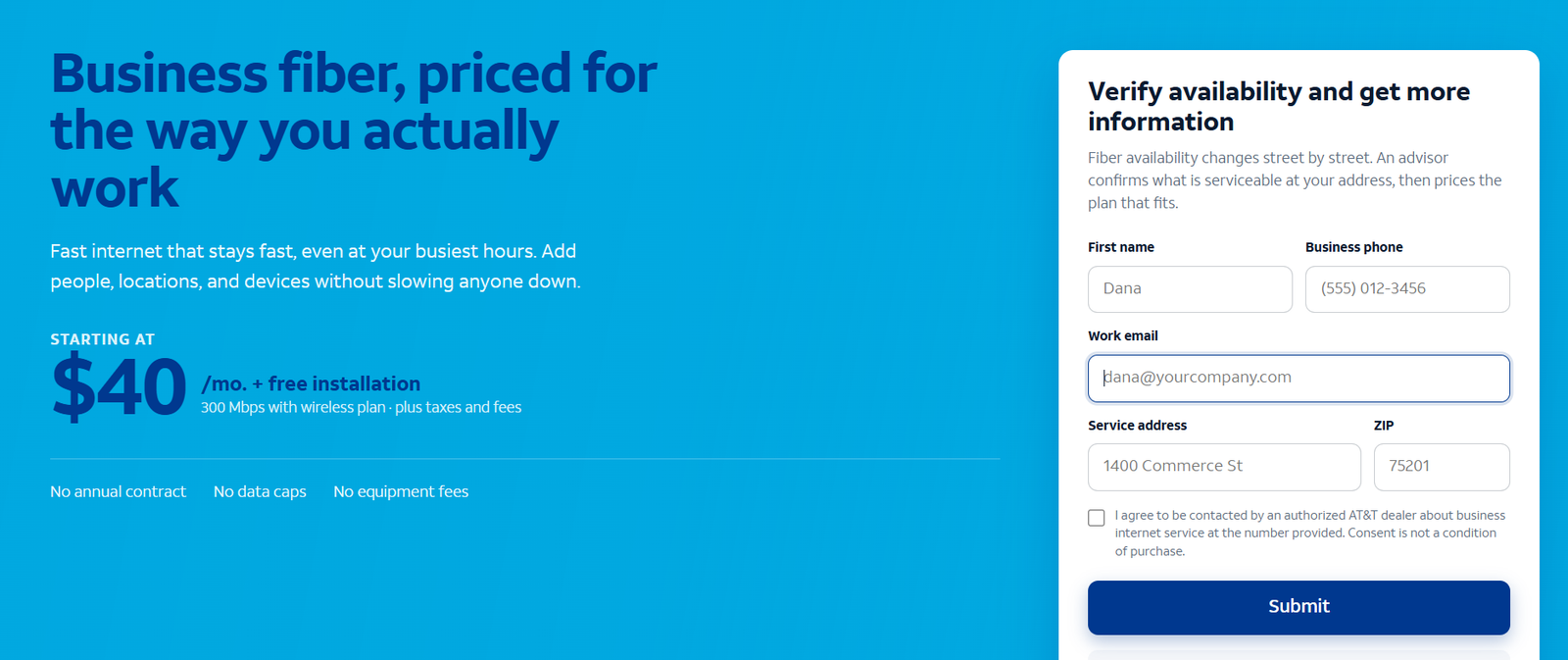
The short answer: AT&T business internet deals usually combine three things: promotional introductory pricing (bundled AT&T Business Fiber rates observed on October 20, 2026 started around $40/mo for the 300 Mbps tier), bundle discounts for pairing fiber or Internet Air with AT&T business wireless lines, and limited-time reward offers such as reward or gift cards when you order through a qualifying channel. What matters more than any headline is the mechanics: promotional rates rise to standard rates when the introductory period ends, bundle pricing typically requires AutoPay and paperless billing plus qualifying wireless service, and reward cards generally require ordering, activating, and keeping service for a stated period. This guide explains how each type of AT&T business internet deal works, what the fine print usually says, and how to calculate what an offer genuinely saves you.
Checking current AT&T business internet offers?
Compare current AT&T Business Fiber availability, speeds and bundled pricing for your business address before you order.
How AT&T Business Internet Deals Work: Promotional Pricing, Bundle Discounts and Reward Offers
Most business internet “deals” are not a single discount. They are usually a combination of up to three separate mechanisms, and understanding which ones are in play is the difference between a genuine saving and a headline that evaporates on the second bill.
The three levers are promotional pricing (an introductory monthly rate below the standard rate), bundle discounts (a lower internet rate when the account also carries qualifying AT&T business wireless lines), and reward offers (a one-time reward card, gift card or bill credit for ordering through a qualifying channel and keeping service for a stated period). Some offers add a fourth sweetener, such as waived installation or included equipment, but the first three do almost all of the work.
| Deal type | How it works | What usually triggers it | What to verify |
|---|---|---|---|
| Promotional pricing | Introductory monthly rate below the standard rate | Ordering during the promotion window at a qualifying address | When the promotion ends and what the rate becomes |
| Bundle discount | Lower internet rate when combined with qualifying wireless lines | Enrolling in AutoPay and paperless billing and adding wireless | Which wireless plans qualify and the per-line terms |
| Reward offer | One-time reward or gift card, or a bill credit | Ordering through a qualifying channel and keeping service for a stated period | The claim process, the eligibility period and exclusions |
Providers structure offers this way for a simple reason: acquiring a business customer costs money, and a customer who bundles internet with wireless lines and stays past the introductory period is worth far more than the discount given up front. That is good news for you as long as you read the terms, because the provider’s incentive to keep you is exactly what makes the promotional math work in your favor – provided you confirm every condition in writing.
Before taking any offer, run it through our business internet buying checklist: it forces the promotional rate, the standard rate, the bundle conditions and the reward terms onto one scorecard so you can compare offers honestly.
AT&T Business Fiber Deal Pricing: What the Bundled Rates Mean
AT&T Business Fiber is the product behind most of the headline business internet deals: symmetrical speeds from 300 Mbps to 5 GIG, list pricing in the neighborhood of $70 to $285/mo, and bundled rates starting from around $40/mo. Current fiber offers are also advertised with no annual contract, no data caps and no equipment fees, and AT&T ActiveArmor security is included with the service.
The table below shows the bundled and list pricing observed on October 20, 2026. Treat every figure as approximate: prices can change, and availability depends on your business address.
| Speed tier | Symmetrical speed | Bundled rate observed | Standard/list context |
|---|---|---|---|
| Fiber 300 | 300 Mbps | ~$40/mo | Toward the low end of the ~$70-$285/mo list range |
| Fiber 500 | 500 Mbps | ~$60/mo | ~$100/mo observed |
| Fiber 1 GIG | 1 Gbps | ~$90/mo | ~$140/mo observed |
| Fiber 2 GIG | 2 Gbps | ~$135/mo | List higher, toward the top of the range |
| Fiber 5 GIG | 5 Gbps | ~$235/mo | List higher, toward the top of the range |
Bundled rates typically require AutoPay and paperless billing plus qualifying AT&T business wireless service on the account. If any of those conditions lapses, the monthly rate can rise – which is exactly why the “deal” price and the “keep” price are two different numbers you should track separately.
What the ~$40 Fiber 300 Bundled Deal Rate Includes
The entry-tier deal is aimed at very small offices: one to five people doing email, cloud apps, card payments and a few simultaneous video calls. At the bundled rate it is priced like a residential gigabit plan but carries business terms – currently no annual contract, no data caps and included security. The limitation is headroom: a 300 Mbps symmetrical line is comfortable for light use but leaves little room for a growing team, so price the tier you will need in twelve months, not just the tier that looks cheapest today.
Fiber 500 and 1 GIG Deal Pricing: The Mid-Tier Sweet Spot
These two tiers are where most small businesses land. The bundled rates observed – about $60/mo for 500 Mbps and about $90/mo for 1 GIG, versus list figures around $100 and $140 – represent the largest absolute monthly savings in the lineup. For a 10 to 15-person office, the per-person cost at the bundled 1 GIG rate works out to roughly $6 to $9 per person per month, which is why this tier is usually the value pick: enough symmetrical headroom for video-heavy days without paying for capacity you will never use.
2 GIG and 5 GIG Deal Pricing: Top-Tier Promotional Math
The top tiers show the steepest bundled discounts in percentage terms – roughly $135/mo for 2 GIG and $235/mo for 5 GIG against list pricing toward the top of the $70-$285/mo range. These tiers suit creative studios moving large files, multi-site hubs, and offices running local servers or heavy backup workloads. For a typical office under 20 people, though, the extra capacity is insurance rather than necessity: do the per-person math before letting a dramatic headline discount push you into a tier you cannot fill.
See the full tier-by-tier figures in our AT&T Business Fiber pricing breakdown, and plan details in our AT&T Business Fiber guide.
Internet Air for Business Offers: Standard vs Premium Pricing
AT&T Internet Air for Business – the 5G fixed-wireless option for locations where fiber is not available – carries its own deal structure. Pricing observed was approximately $65/mo list for the Standard plan and $105/mo list for the Premium plan, falling to about $40/mo and $80/mo respectively with bundled discounts after AutoPay and wireless conditions. Present every Air figure as approximate: availability is by address, and actual speeds vary with 5G signal and network conditions.
| Plan | List price (approx) | Bundled price (approx) | Suits |
|---|---|---|---|
| Standard | ~$65/mo | ~$40/mo | Small offices, pop-ups, temporary sites, backup lines |
| Premium | ~$105/mo | ~$80/mo | Heavier use at locations without fiber access |
Standard Plan Offers: ~$40 Bundled Pricing Mechanics
The Standard bundled rate brings 5G business internet down to the same neighborhood as the entry fiber deal, which makes it attractive for short-term or hard-to-wire locations: retail pop-ups, construction offices, and small branches waiting on fiber build-out. The bundled rate depends on the same AutoPay, paperless billing and wireless conditions as the fiber bundle, so confirm each one applies at your address before counting on the lower figure.
Premium Plan Offers: ~$80 Bundled Pricing Mechanics
The Premium tier costs more because it is meant for locations that lean harder on the connection – more users, more video, larger uploads. The ~$25/mo gap between list and bundled pricing is real money over a year, but it only materializes if you meet and keep the bundle conditions. If your location later gets fiber, compare the cost of switching against riding out the Air plan: installation timelines for fiber can run weeks to months.
Internet Air Deal Limitations: Speed Variability and Coverage
The honest limitation of any Air deal is physics: 5G speeds vary with signal strength, tower congestion and building materials. A deal that looks unbeatable on price can disappoint if your specific address has marginal coverage. Check availability for your exact address, ask what speeds similar nearby businesses see, and keep a backup plan – such as a wireless failover line – if the connection will carry anything you cannot afford to lose. Full figures are in our Internet Air for Business pricing guide.
Business Wireless Bundle Offers: How the Multi-Line Discounts Work
AT&T Business Wireless runs on Unlimited Your Way plans starting from $30/line, with the per-line price depending on multi-line, AutoPay and paperless billing conditions. The wireless side has its own tier structure – Starter, Performance and Elite, described in qualitative terms – but for deal purposes the wireless plans matter mainly as the key that unlocks bundled internet pricing.
How the From-$30-Per-Line Wireless Offer Works
The “from $30/line” figure is the floor, reached when several conditions stack: multiple business lines on the account, AutoPay enrolled, and paperless billing active. Fewer lines or missing conditions mean a higher per-line price. When you are evaluating a bundle deal, price the wireless lines your team actually needs first – the internet discount is only a deal if the wireless spend behind it is spend you would make anyway.
Bundle Conditions: AutoPay, Paperless Billing and Multi-Line Requirements
Every bundle discount has maintenance conditions, and the expensive mistakes happen after signup: disabling AutoPay, switching back to paper bills, or dropping below the qualifying number of wireless lines can each raise the internet rate back toward list. Before you sign, get the answers in writing – which conditions apply, what happens if one lapses, and how quickly the rate changes. Our AT&T business wireless pricing guide and fiber and wireless bundle guide walk through the mechanics line by line.
How Fiber and Wireless Bundle Deals Stack
Stacking is straightforward once you see the order of operations: qualify your address for the internet product, choose the fiber or Air tier, add the wireless lines, then enroll in AutoPay and paperless billing. The bundle discount lands on the internet side of the bill, while multi-line discounts apply on the wireless side. Neither discount changes what the products are – it only changes what you pay, and only while every condition holds.
Combining Fiber and Wireless Offers in One Bill
One account, one bill, two discounts: that is the pitch, and administratively it is genuinely simpler than juggling separate providers. The practical tip is to keep a copy of the original quote showing each discount as a separate line item. When a bill looks wrong six months later – and with stacked offers, bills sometimes do – the line-item quote is what lets support fix it in one call instead of three.
Order Channel Matters: Why Business Internet Deals Vary by How You Order
The same address can see different offers depending on how you order: online-exclusive promotions, phone-order bundles, and in some cases business-account promotions that do not appear on the public site. Reward offers in particular are often tied to the ordering channel. The rule is simple: compare the offer available through the channel you will actually use, and confirm the terms for that channel before you commit – a better headline on a channel you will not use is not a better deal.
How AT&T Business Internet Reward Offers Work: Reward Cards Explained
Reward offers – usually prepaid reward cards, gift cards or bill credits – are one-time acquisition incentives, not ongoing discounts. They change frequently, the amounts vary by promotion, and this article deliberately does not quote a figure: any specific dollar amount you see in a guide like this one is likely stale by the time you read it. What does not change much is the mechanics of how these offers work, and that is what you should understand before chasing one.
Typically, earning a reward requires four things: ordering through the qualifying promotional channel, completing installation and activation of the service, keeping the qualifying service active for the stated period, and then claiming the reward – often through an online redemption step inside a stated claim window. Miss any step, especially the claim window, and the reward evaporates.
Reward Card Mechanics: Ordering, Activation and Service-Period Rules
The service-period requirement is the heart of every reward offer: it is the provider’s way of making sure the incentive goes to a genuine new customer rather than a signup that cancels in week two. Read it as a commitment device. If the required period is longer than you are comfortable committing to a location – say you might move offices in six months – the reward is not free money; it is a discount on a commitment you may not want.
Common Reward Offer Exclusions to Watch
Reward offers routinely exclude existing customers adding a line at an address that already has service, transfers and moves, downgrades during the qualifying period, and sometimes business accounts ordering through non-promotional channels. They may also be limited to specific speed tiers. None of this is hidden – it is in the offer terms – but almost nobody reads offer terms until something goes wrong. Read them before you order, while you can still walk away.
How to Claim a Business Internet Reward Card Without Losing It
The unglamorous truth is that most lost rewards are lost to paperwork, not eligibility. Save the order confirmation showing the promotion code, calendar the earliest and latest claim dates, complete installation promptly so the service-period clock starts, and file the claim the day you become eligible rather than the week the window closes. Then confirm the reward arrived. A reward you never claim is the most expensive kind of deal: you met every condition and got nothing.
Disclaimer: Ortelcom.com is an independent publisher, not AT&T and not an official AT&T website, and is not endorsed by AT&T. Links in this article are affiliate links to ortelcom.com/recommends/ – we may earn a commission at no extra cost to you. Product names, prices, speeds and offers were checked on the date shown in this article, can change without notice, and availability depends on your business address. AT&T trademarks belong to their owner. This information is for general guidance only – please confirm final pricing, terms and availability on the provider’s page before you order.
Worked Example: Two-Year Savings From a Business Fiber Bundle Deal
Assumptions for the examples below: prices are approximate, observed October 20, 2026; bundled rates assume AutoPay, paperless billing and qualifying wireless service stay active; standard rates are the non-promotional list figures; taxes and fees are excluded; and reward offers are excluded from the math because their amounts vary by promotion.
Deal Example: 10-Person Office on Fiber 500 With Wireless Bundle
A 10-person professional office takes Fiber 500 at the bundled ~$60/mo rate instead of the ~$100/mo list rate – a $40/mo difference, or $480 per year. Over two years the saving is $960, before counting any reward offer. That is the number to compare against the cost of the wireless lines that unlock the bundle: if the team already needs five business wireless lines, the bundle discount is nearly pure saving; if the lines were bought only to chase the discount, most of the $960 was spent to “save” it.
| Period | Bundled rate | List rate | Saving |
|---|---|---|---|
| Year 1 | ~$720 | ~$1,200 | ~$480 |
| Year 2 | ~$720 | ~$1,200 | ~$480 |
| Two-year total | ~$1,440 | ~$2,400 | ~$960 |
Deal Example: Seasonal Retail Pop-Up on Internet Air Standard
A seasonal retail pop-up needs six months of connectivity at a location without fiber. Internet Air Standard at the bundled ~$40/mo rate versus ~$65/mo list saves ~$25/mo, or ~$150 over the season – modest, but the real deal here is avoided installation cost and the ability to shut the line down when the season ends. For temporary sites, flexibility is worth more than the monthly discount, which is why the Air deal structure suits pop-ups better than a fiber promotion would.
AT&T Business Internet Deals Fine Print: Terms to Check Before You Order
Every deal section above has pointed at the fine print; here it is in one place. None of these terms is a reason to avoid deals – they are the rules of the game, and players who know the rules win.
Promotional Rate Expiry: What Happens When the Deal Ends
Promotional rates end. The standard rate that replaces them is the number that determines your true long-run cost, so it belongs in your comparison math from the start. Calendar the expiry date when you sign, and diary a reminder 60 to 90 days before it: that is your window to renegotiate, re-shop, or confirm you are happy at the standard rate.
Availability: Business Internet Deals Apply Only at Qualifying Addresses
Business internet availability is address-specific down to the building, and promotional pricing only applies where the underlying product is offered. A deal advertised nationally may not reach your street. Check availability for your exact address early – our AT&T Business Fiber availability walkthrough shows how – and get the qualification result tied to the quoted rate before you plan around it.
Equipment, Installation and Early Termination Terms
Current fiber promotions are advertised with no equipment fees and no annual contract, but installation fees and timelines still vary by address – a standard install in a serviceable building is a different proposition from a location needing construction. And while a “no annual contract” offer has no early termination fee, reward offers carry their own service-period requirements, which function as a soft commitment. Confirm each of these separately; they are different terms that happen to live on the same order.
Who Should Take a Business Internet Deal – and Who Should Wait
Deals favor three situations: you are opening a new location and need service anyway, your current promotion or contract expires within 90 days, or you already plan to carry AT&T wireless lines so the bundle conditions cost you nothing extra. In all three cases the discount lands on spend that was happening regardless.
Wait or skip when the deal requires things you do not need. Do not add wireless lines solely to unlock a bundle discount unless the two-year math clears it. Do not chase a reward offer if you might move before the service period ends. And do not delay needed connectivity waiting for a better promotion – promotions cycle constantly, but every week without adequate internet has a cost too, usually larger than the discount you are waiting for.
The bottom line on AT&T business internet deals: the promotional rate is only a deal if the standard rate, the bundle conditions and the reward terms all survive your checklist. Run the two-year math, confirm the terms in writing, and check AT&T Business Fiber plans for your address before the current offers change.
AT&T Business Internet Deals FAQ: Real Questions About Offers and Rewards
Are AT&T business internet deals available at my address?
Possibly – but business internet deals are only as real as the address qualification behind them. Promotional pricing applies where the underlying product is offered, which varies street by street for fiber and by 5G coverage for Internet Air. Check availability for your exact business address first, then confirm that the quoted promotional rate is tied to that qualification result.
Do AT&T business internet reward cards require a contract?
Reward offers generally require keeping qualifying service active for a stated period, which functions like a commitment even when the underlying internet plan itself has no annual contract. Read the reward terms separately from the service terms: you can have a no-contract internet plan paired with a reward offer that effectively commits you for the qualifying period.
Can I combine a reward offer with bundled pricing?
Sometimes. Offers carry combinability rules, and a reward promotion may or may not stack with bundled internet pricing or other discounts. The only reliable answer is the current offer terms for the channel you are ordering through – confirm in writing before you count both savings in your math.
What happens to my business internet deal if I move?
Deals are address-specific: promotional pricing and reward eligibility are generally tied to the original service address. Moving can end promotional pricing and may disqualify an in-progress reward. If a move is on the horizon, confirm the transfer and move policy before ordering, and weigh the risk against waiting.
Do business internet deals require AutoPay?
Bundled rates typically require AutoPay and paperless billing, often plus qualifying wireless service. Confirm exactly which conditions apply to your quote and what happens to the rate if one lapses – the difference between the bundled and standard rate is the price of forgetting.
Are AT&T business fiber deals different from residential internet deals?
Yes. Business fiber deals run on business terms – business support, business installation scheduling, and currently no annual contract on promotions – while residential promotions are a separate product with separate terms. A residential deal cannot simply be ordered for a business address. Our business vs residential internet comparison breaks down the real differences.
When is the best time to buy AT&T business internet?
Sixty to ninety days before you need service or before your current promotion expires: enough time for address qualification, installation scheduling and comparing offers without pressure. Promotions cycle throughout the year, so there is no single magic month – but buying under time pressure, days before a move or an expiry, is how businesses end up on standard rates.
What should I compare before taking an AT&T internet deal?
Total two-year cost at the standard rate, the bundle conditions and their failure modes, the reward offer’s service period and claim process, and at least one alternative technology for leverage. Size the speed tier first with our business internet speed guide – the cheapest deal on the wrong speed is not a deal at all.
AT&T business internet deals reward the prepared buyer: know your address qualification, know your speed needs, price the standard rate alongside the promotional one, and read the reward terms before you order. Do that, and the headline discount becomes real money instead of a surprise on the second bill.

