
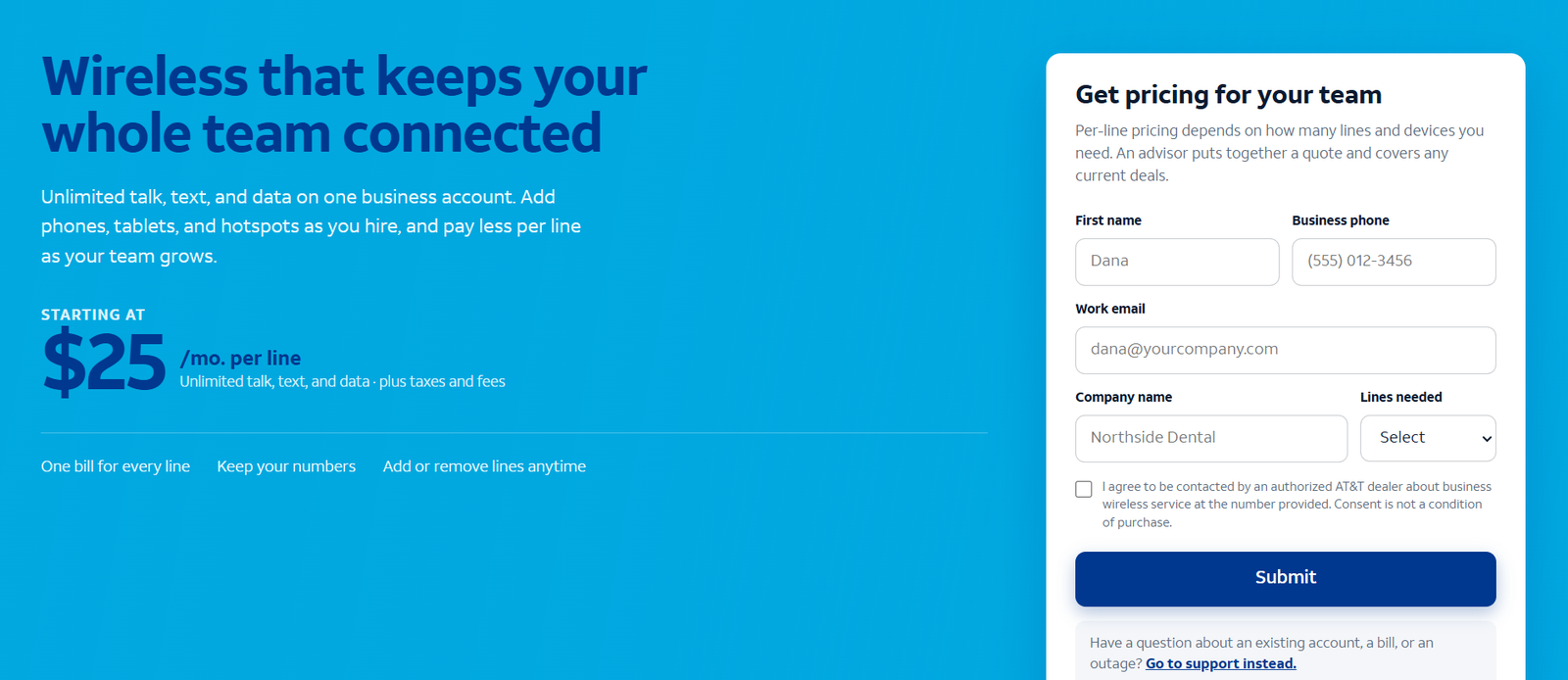
The short answer: AT&T business wireless pricing starts around $30 per line per month — but only once you stack the conditions AT&T attaches to that number: multiple lines on the account, AutoPay and paperless billing. Most businesses pay more than $30 per line because they mix tiers, add fewer lines, or skip one of the discounts. AT&T Business Wireless runs on the Unlimited Your Way model with three tiers — Starter, Performance and Elite — and you can put different employees on different tiers, which is where smart cost control happens. This guide breaks down what each line actually costs, how the discounts stack, what fees and device costs add on top, and how to size the cheapest plan mix for your team.
See current AT&T Business Wireless pricing for your team size
Check which Unlimited Your Way tiers are available to your business and confirm the current per-line price.
AT&T Business Wireless Pricing at a Glance
The table below summarizes how AT&T Business Wireless pricing is structured. Per-line pricing is approximate and varies by tier, line count and discounts — confirm current figures before ordering.
| Element | What it costs (approximate) | Notes |
|---|---|---|
| Starting per-line price | ~$30/line/mo | Requires multiple lines, AutoPay and paperless billing |
| Unlimited Your Way tiers | Starter, Performance, Elite | Mix and match tiers across lines |
| Multi-line discount | Per-line price falls as line count rises | More lines, lower average cost per line |
| AutoPay + paperless billing | Per-line discount | Must stay enrolled to keep the rate |
| Devices | Purchased or financed separately | Not included in the per-line service price |
| Taxes and fees | Added on top | Budget a few dollars per line beyond the quoted rate |
The ~$30 starting price is the headline number, and it is real — but it is the floor, not the average. The per-line price climbs with the tier you pick, falls with the number of lines you add, and depends on keeping AutoPay and paperless billing active. If you are new to the product itself, our AT&T Business Wireless plans explained guide walks through how the Unlimited Your Way model works in full.
How Much Does AT&T Business Wireless Cost Per Line?
The per-line cost of AT&T business wireless is a range, not a number. The starting point of around $30 per line per month assumes the most favorable setup: enough lines to reach the lowest per-line pricing, AutoPay enrolled, paperless billing enrolled. Change any of those variables and the per-line price moves up.
Think of the per-line price as the result of four inputs:
1. The tier. Starter is the entry Unlimited Your Way tier and the cheapest per line; Performance sits in the middle with more premium features; Elite is the top tier with the richest feature set. Higher tiers cost more per line — the gap between tiers is the first thing that moves your bill.
2. The number of lines. AT&T prices business wireless the way most carriers do: the per-line rate drops as you add lines. A 3-line account pays materially more per line than a 15-line account on the same tiers. This is the single biggest lever for larger teams.
3. AutoPay and paperless billing. The per-line discount for enrolling in AutoPay and paperless billing is baked into the advertised starting prices. Drop either one and the per-line rate rises — across 20 lines, that small per-line increase adds up to real money every month.
4. Promotions and business offers. AT&T periodically runs business wireless promotions — device credits, line discounts, switcher incentives. These change, which is why the ~$30 floor is described as approximate: your quoted price on the day you order is the one that counts.
Unlimited Your Way Tiers: Starter, Performance and Elite Costs
Unlimited Your Way is the framework: every line on the account gets unlimited talk and text plus data, and you choose one of three tiers per line. The tiers differ in premium data, hotspot allowances and priority — described here qualitatively because specific allowances change with promotions.
AT&T Business Wireless Starter Tier Cost and Features
Starter is the entry tier and the cheapest per line. It is built for employees whose phone use is ordinary: calls, texts, email, light app use, occasional navigation and web browsing. Starter lines get the core unlimited experience with the most basic feature set — fewer premium-data perks and the smallest hotspot allowance of the three tiers.
Who it suits: office staff who are on Wi-Fi most of the day, part-time employees, shared or pool phones, and any line where the phone is a communication tool rather than a primary work device. If half your lines can sit on Starter without anyone noticing, that is often the cheapest compliant way to run the account.
AT&T Business Wireless Performance Tier Cost and Features
Performance is the middle tier — more per line than Starter, less than Elite — with a richer feature set: more premium data and a larger hotspot allowance for employees who tether laptops or work heavily from their phones. This is the tier most knowledge workers land on.
Who it suits: employees who regularly work away from Wi-Fi, salespeople who tether in the field, managers who join video calls from their phones, and anyone whose productivity visibly depends on mobile data. For a typical office, Performance is the default tier and Starter is the exception — which is why mixed-tier accounts are the norm, not the failure mode.
AT&T Business Wireless Elite Tier Cost and Features
Elite is the top tier and the most expensive per line, with the largest premium-data and hotspot allowances plus the most premium perks of the three. It is built for the heaviest mobile users: executives, field engineers, video-heavy roles and anyone who would otherwise burn through the lower tiers’ allowances.
Who it suits: a small slice of most teams — the 10 to 20 percent of employees whose mobile usage is genuinely extreme. Putting everyone on Elite is the fastest way to overpay; putting the heavy users on Elite while the rest sit on Performance or Starter is the fastest way to control the bill. Confirm the current tier features and per-line prices before ordering, since AT&T adjusts them.
How Multi-Line and AutoPay Discounts Lower the Per-Line Price
The discount stack is where the ~$30 starting price comes from, and understanding it is the difference between the advertised price and your price.
Multi-line pricing. Each additional line lowers the average per-line cost. The curve is steepest at the beginning: going from 1 line to 5 lines cuts the per-line rate substantially; going from 20 to 25 lines moves it less. Businesses with 10+ lines are solidly in the zone where the per-line economics look good; businesses with 1–3 lines should expect per-line rates well above the $30 floor.
AutoPay and paperless billing. Enrolling in both earns a per-line monthly discount. The mechanics are simple — a bank account or debit card on file, bills delivered electronically — but the discipline matters: if AutoPay lapses (expired card, closed account), the discount drops off and the per-line rate rises until you re-enroll. Set a calendar reminder to check the payment method quarterly.
Stacking them. The advertised starting price assumes all of the above at once: enough lines, AutoPay, paperless billing. Remove any one and you are paying the un-discounted rate for that line. When you get a quote, ask for it two ways — with and without the discounts — so you know exactly what each condition is worth to your bill.
Business wireless as a bundle lever. An AT&T wireless account can also unlock bundled pricing on other AT&T business products — notably Internet Air for Business, where the bundled rate depends partly on an eligible wireless line. Our fiber and wireless bundle guide walks through how the pairing works across products.
Business Wireless vs Consumer Wireless Pricing: What Is Different
Business and consumer wireless plans look similar on the surface — unlimited talk, text and data, tiered options — but the pricing logic differs in ways that matter to a finance team.
Mixed tiers on one account. Business accounts can put different employees on different tiers (Starter for the front desk, Elite for the road warriors) under one bill. Consumer family plans can mix too, but the business account is built around role-based assignment from the start, with centralized management.
Centralized billing and management. One bill, one account owner, lines added and removed as staff join and leave. The administrative cost of managing 20 consumer lines individually — separate logins, separate bills, separate support calls — is a hidden cost business pricing eliminates.
Business support and SLAs. Business accounts get business-grade support channels. When a sales rep’s phone dies the morning of a client visit, the support experience is not the consumer queue.
Device and upgrade programs. Business accounts often have access to device financing and upgrade terms structured for fleets rather than individuals — spreading device costs across the account instead of per-person purchases.
The honest comparison: a business with 10+ lines almost always does better on a business account than on cobbled-together consumer lines, even before the per-line pricing — the management overhead alone justifies it. A 2-person business should price both and compare honestly.
Business Wireless Fees, Taxes and Device Costs
The per-line service price is not the total. Three categories sit on top of it, and all three are easy to forget when budgeting.
Taxes and regulatory fees. Wireless bills carry federal, state and local taxes plus carrier surcharges. These vary by location but reliably add several dollars per line per month. A quote of $30/line becomes roughly $35/line all-in in many areas — multiply by your line count before you budget.
Devices. Phones are separate from service. You either buy devices outright, finance them monthly, or bring your own. Device financing installments appear on the same bill as service, which makes the bill look like the plan costs more than it does — separate the two mentally (and in your budget) so you can see the true service cost per line.
One-time charges. Activation fees, upgrade fees and early-termination charges (if a term applies) show up once, not monthly. Ask about them before ordering: a “free” line that carries a $35 activation fee and a device installment is not free.
International and overage-style charges. Unlimited domestic talk and text does not mean unlimited everything. International calling, international roaming and premium services are typically billed separately — and one employee’s two-week trip abroad can produce a memorable bill. Set international expectations in writing for traveling staff.
Disclaimer: Ortelcom.com is an independent publisher, not AT&T and not an official AT&T website, and is not endorsed by AT&T. Links in this article are affiliate links to ortelcom.com/recommends/ — we may earn a commission at no extra cost to you. Product names, prices, speeds and offers were checked on the date shown in this article, can change without notice, and availability depends on your business address. AT&T trademarks belong to their owner. This information is for general guidance only — please confirm final pricing, terms and availability on the provider’s page before you order.
Which Business Wireless Tier Is the Best Value for Your Team
Value in business wireless means the cheapest tier each employee can actually live on — not the cheapest tier for everyone, and not the top tier for everyone. The role-based approach wins:
Default most office staff to Performance. For knowledge workers who are on Wi-Fi much of the day but need reliable mobile data off it, Performance is the value tier — enough premium data and hotspot for real work without Elite’s premium.
Drop light users to Starter. Front-desk staff, part-time employees, warehouse scanners on shared devices, anyone whose phone is mostly calls and texts. Every line you move from Performance to Starter saves money every month with zero productivity cost.
Reserve Elite for genuine heavy users. Executives who live on their phones, field staff who tether laptops all day, video-heavy roles. If fewer than 1 in 5 lines need Elite, the account is probably sized right.
Review quarterly. Usage patterns change — the salesperson who needed Elite last year may be desk-bound now. A 15-minute quarterly review of per-line usage against tier assignments is the highest-ROI admin task in business wireless.
How to Lower Your Business Wireless Bill
Beyond the discount stack, five levers cut the bill:
1. Right-size the tiers. The single biggest lever. Audit every line against actual usage — most accounts have 20–30% of lines on a higher tier than the usage justifies.
2. Consolidate lines onto one account. Scattered consumer lines and multiple small business accounts all pay higher per-line rates than one consolidated account. Bring them together.
3. Keep AutoPay and paperless billing enrolled. The discount is per line per month — across a 25-line account, letting it lapse is an expensive oversight.
4. Time device upgrades. Device installments are often the largest line item after service. Extending the upgrade cycle from 2 years to 3 cuts device costs by a third — and most business phones are perfectly usable at 3 years.
5. Ask about current business offers. Promotions change; the offer available when you signed up is not necessarily the best one now. An annual 20-minute call to review the account against current offers routinely finds savings. Compare the total against AT&T Business Fiber pricing too if you are bundling connectivity and wireless on one relationship.
Business Wireless Pricing Limitations and Fine Print Worth Reading
An honest pricing guide includes the caveats:
The $30 floor has conditions. Multi-line, AutoPay, paperless billing — the advertised starting price assumes all of them. Your price with 2 lines and no AutoPay will be materially higher. Always get the quote for your actual configuration.
Tier features change. Premium-data allowances, hotspot amounts and priority policies are adjusted by AT&T over time. A tier comparison from last year may not describe this year’s tiers — confirm current features before assigning employees.
Device costs are separate and large. A fleet of 20 financed flagship phones can exceed the monthly service cost. Budget devices and service separately or the service price will mislead you.
Taxes and fees are real. Several dollars per line per month, every month. Include them in every cost example and budget.
Promotions expire. Device credits and line discounts often phase out after 12–36 months. Know when yours end — the bill that arrives the month after a promotion expires is never a pleasant surprise.
Coverage varies by location. Pricing is national; performance is local. A plan is only a good value where the network actually serves your people — check coverage at the addresses that matter before committing lines.
Business Wireless Cost Examples: 5, 15 and 40 Lines (With Stated Assumptions)
The examples below use the ~$30/line starting point as a floor and scale up with stated assumptions. Assumptions for all three: per-line service prices are illustrative estimates built from the advertised starting price plus tier and line-count effects; taxes and fees add roughly $5/line/month; devices are excluded (financed separately); AutoPay and paperless billing are enrolled.
Wireless Cost Example: 5-Person Office With Mixed Unlimited Tiers
A 5-person professional office: 3 lines on Performance (~$40/line illustrative), 2 on Starter (~$32/line illustrative). Service: (3 × $40) + (2 × $32) = $184/month, plus ~$25 in taxes and fees = roughly $209/month (~$2,500/year) before devices. The two Starter lines save about $16/month versus putting everyone on Performance — small, but it compounds.
Wireless Cost Example: 15-Person Company With Field Staff
A 15-person services company: 8 on Performance (~$38/line — lower per-line rate at this line count), 4 on Starter (~$30/line), 3 on Elite (~$55/line illustrative for heavy field users). Service: (8 × $38) + (4 × $30) + (3 × $55) = $589/month, plus ~$75 in taxes and fees = roughly $664/month (~$7,970/year) before devices. Consolidating from scattered consumer lines (often $60+/line) to this account saves thousands annually.
Wireless Cost Example: 40-Person Operation With Role-Based Tiers
A 40-person operation: 20 on Performance (~$35/line at this scale), 12 on Starter (~$30/line), 8 on Elite (~$52/line). Service: (20 × $35) + (12 × $30) + (8 × $52) = $1,476/month, plus ~$200 in taxes and fees = roughly $1,676/month (~$20,100/year) before devices. At this scale, the quarterly tier audit matters most — moving just 5 lines from Performance to Starter saves roughly $300/month, or $3,600/year.
The bottom line on AT&T business wireless pricing: expect the per-line price to land somewhere between the ~$30 floor and roughly double it, depending on your tiers, line count and discounts — and check current business wireless pricing for your team size before you order, since promotions move the numbers.
AT&T Business Wireless Pricing FAQs
How much does AT&T business wireless cost per line?
Pricing starts around $30 per line per month with multiple lines, AutoPay and paperless billing. Most businesses pay more per line depending on the tiers they choose (Starter, Performance, Elite), their line count and which discounts apply. Taxes, fees and devices are extra.
What is the cheapest AT&T business wireless plan per line?
The cheapest configuration is the Starter tier with enough lines to reach the lowest multi-line pricing, plus AutoPay and paperless billing — that is the setup behind the ~$30/line starting price. Fewer lines or higher tiers raise the per-line cost.
Can I mix Starter, Performance and Elite tiers on one business account?
Yes — that is the core of the Unlimited Your Way model. Different employees can be on different tiers under one account and one bill, which lets you match the tier to each role instead of overpaying for a one-size-fits-all plan.
How do multi-line discounts work on AT&T business wireless?
The per-line rate decreases as you add lines to the account. The effect is largest when going from a few lines to around 10, and continues more gradually beyond that. Consolidating scattered lines onto one account is usually the fastest way to lower the average per-line price.
What happens to my per-line price if I cancel AutoPay?
You lose the AutoPay/paperless-billing per-line discount, so the rate per line rises until you re-enroll. Across many lines the increase is significant — keep the payment method current so the discount never lapses.
Are phones included in the per-line wireless price?
No. The per-line price covers service (talk, text, data on the chosen tier). Devices are purchased outright, financed monthly, or brought from elsewhere — budget them separately from the service cost.
How much are taxes and fees on AT&T business wireless?
They vary by location but typically add several dollars per line per month — roughly $5/line is a reasonable planning figure in many areas. Always budget the all-in cost, not just the quoted service rate.
Is AT&T business wireless cheaper than consumer plans?
For teams of around 10 or more lines, business accounts usually win on per-line pricing plus centralized billing and management. Very small teams (1–3 lines) should price both business and consumer options and compare honestly.
Does AT&T business wireless require a contract?
Terms depend on the current offer — some business wireless promotions carry device or service agreements. Confirm whether the quote you receive includes a term commitment, and what the early-termination terms are, before you sign.
Can I add or remove lines as my team changes?
Yes — business accounts are built for that. Add lines when you hire, remove them when people leave. Removing lines can raise the per-line rate on the remaining lines if you drop below a multi-line discount threshold, so check the pricing effect before you remove several at once.
How does business wireless pricing compare to AT&T Internet Air for Business pricing?
They are different products billed differently: wireless is per line per month (from ~$30/line), while Internet Air for Business is per location per month (Standard ~$65 list / ~$40 bundled, Premium ~$105 / ~$80). Many businesses buy both — wireless for the team, Internet Air as office or backup connectivity. See our Internet Air for Business pricing guide for the connectivity side.
Where can I confirm the current AT&T business wireless price for my company?
Pricing, promotions and tier features change — the figures in this guide are approximate and were checked on the date shown. Confirm the current per-line price for your line count and tier mix on the provider’s page before you order, and ask for the quote both with and without AutoPay/paperless discounts.
Before you sign, run the numbers against our business internet buying checklist — several of its 12 questions (total cost of ownership, contract terms, scalability) apply to wireless decisions too.

