
The short answer: choose business fiber internet if it is available at your address — its symmetrical speeds, low latency and reliability make it the best foundation for most offices. Choose 5G fixed wireless (AT&T Internet Air for Business) when fiber is unavailable, when you need internet in days rather than weeks, or as a backup connection. Choose cable only where fiber is not available and 5G coverage is weak — and confirm the upload speeds before you commit. The rest of this guide turns that verdict into a decision you can defend to your CFO.
Looking for the fiber-first option?
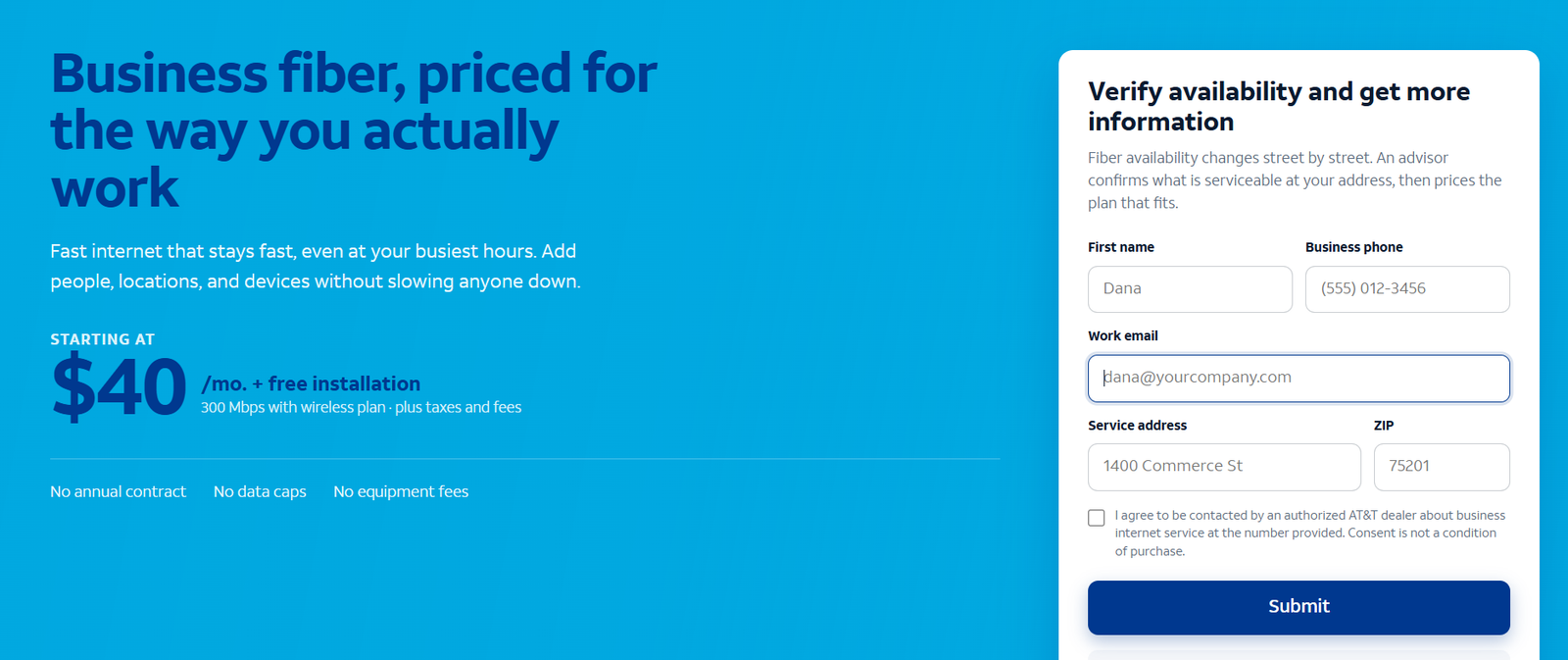
Check whether AT&T Business Fiber serves your office and compare the 300 Mbps to 5 GIG speed tiers.
How to Choose Business Internet: The 5-Minute Decision Framework
Most business internet decisions can be made with four questions, in this order:
- What is available at your address? Fiber first, then 5G fixed wireless, then cable. Availability eliminates options before you waste time comparing them. Our guide to checking AT&T Business Fiber availability walks through the lookup process and what each result means.
- How much upload bandwidth does your work actually need? This single question separates fiber from everything else. If your team lives on video calls, cloud apps, VoIP and large file uploads, symmetrical fiber wins. If the office mostly downloads and browses, 5G or cable may be plenty. Size it properly with our business internet speed sizing guide.
- How fast do you need it installed? Fiber installation can take weeks where construction is required; 5G fixed wireless can be running in days with a self-installed gateway. Deadlines change the answer.
- What does the total cost look like over 2 years? Compare installation, equipment, monthly service, fees and any bundling discounts — not just the headline monthly rate. See our AT&T Business Fiber pricing breakdown for what each tier costs.
Answer those four and the right technology usually picks itself. The sections below give you the detail to back each answer up.
Business Fiber Internet: When It Is the Right Choice for Your Office
Fiber-optic internet carries data as light through glass strands, which is why it delivers symmetrical speeds — the same bandwidth up and down — with very low latency. For a business, that combination is the gold standard: video calls stay sharp, cloud backups finish in minutes instead of hours, and dozens of users can work at once without the connection degrading. Our business fiber internet explainer covers the technology in depth.
What business fiber internet gives your team
Symmetrical speeds from 300 Mbps to 5 GIG on AT&T Business Fiber, latency typically under 20 ms, and consistency: fiber speeds barely move between peak and off-peak hours, unlike shared cable nodes that slow down when the neighborhood gets home from work. ActiveArmor security is included, there are no annual contracts on current offers, no data caps and no equipment fees — the terms are business-friendly by default.
Business fiber internet speeds and pricing at a glance
AT&T Business Fiber tiers run 300, 500, 1000 (1 GIG), 2000 (2 GIG) and 5000 Mbps (5 GIG), all symmetrical. List pricing runs roughly $70 to $285 per month, with bundled pricing (AutoPay, paperless billing and an eligible wireless line) observed from about $40 per month for the 300 tier. The full tier-by-tier breakdown is in our AT&T Business Fiber pricing guide.
Who fiber internet suits best
Offices with 5+ people, any team heavy on video conferencing or cloud applications, creative and engineering firms moving large files, businesses running VoIP phone systems, point-of-sale networks, and anyone who needs a connection that behaves the same at 3 PM as at 3 AM. If fiber reaches your building, the decision is usually over — the remaining question is only which speed tier to buy.
5G Fixed Wireless Business Internet: When Wireless Internet Wins
5G fixed wireless — AT&T Internet Air for Business — delivers internet over the 5G cellular network to a gateway device in your office. No trench, no fiber drop, no technician drilling through your walls: the gateway plugs in, connects to the nearest 5G signal, and broadcasts Wi-Fi. Our 5G business internet explainer details how the technology works.
How 5G business internet works in practice
The gateway needs a solid 5G signal at your location — performance is entirely signal-dependent. Place it near a window, ideally facing the nearest tower, and speeds can be excellent. Bury it in an interior server closet and they will not be. This is the fundamental difference from fiber: fiber performance is engineered, 5G performance is environmental.
5G business internet speeds, pricing and limitations
Internet Air for Business comes in Standard and Premium plans, listed around $65 and $105 per month respectively (about $40 and $80 bundled with AutoPay, paperless billing and eligible wireless, based on marketplace figures observed October 20, 2026 — approximate, availability by address, speeds vary). Speeds are strong where the signal is strong and can dip where it is not. Data policies and plan terms should be confirmed before ordering. Full details are in our Internet Air for Business pricing guide.
Who 5G business internet suits best
Businesses that need internet this week, not next month. Temporary sites, pop-ups, construction offices and event venues. Locations where fiber construction is months away or uneconomical. And — critically — as a backup connection: 5G failover over a completely separate network path from your fiber is one of the best reliability upgrades a small business can buy.
Cable Business Internet: The Middle-Ground Connection Option
Cable business internet runs over the same coaxial infrastructure as residential cable TV. It is widely available, installs quickly, and is often the cheapest option on paper — which is why it remains the default for many small businesses. But the technology has structural characteristics a buyer should understand before committing.
How cable business internet works
Coaxial cable was designed to push television downstream into homes, and that heritage shows: cable plans are heavily asymmetrical, with downloads far outpacing uploads. The local node is shared with neighboring subscribers, so speeds can sag during evening peak hours. Business cable plans typically add better support and sometimes SLAs over residential cable, but the underlying physics are the same.
Cable internet speeds, pricing and limitations
Business cable commonly advertises downloads of 200 Mbps to 1 Gbps, but uploads often sit at 20–35 Mbps even on the fastest tiers — roughly one-thirtieth of what a fiber gigabit plan uploads. Pricing is typically in the $60–$150 per month range depending on tier and market (approximate industry-typical range), often with promotional rates that step up after 12 months. The two questions to ask any cable quote: what is the upload speed, and what does the price become after the promotion expires?
Who cable internet still suits
Small offices with light, download-heavy usage where fiber is genuinely unavailable and 5G signal is poor. Retail locations whose main needs are point-of-sale and browsing. Businesses that already have cable and whose usage has not outgrown it — if it is not broken, the switching cost may exceed the benefit. Our fiber vs cable comparison goes deeper on the trade-offs.
Fiber vs 5G vs Cable: Side-by-Side Business Internet Comparison
The table below compares the three technologies on the dimensions that matter to a business buyer. Treat cable figures as approximate industry-typical ranges.
| Dimension | Fiber (AT&T Business Fiber) | 5G fixed wireless (Internet Air) | Cable business internet |
|---|---|---|---|
| Speeds | 300 Mbps–5 GIG symmetrical | Varies with signal; strong where 5G is strong | ~200 Mbps–1 Gbps down; ~20–35 Mbps up (typical) |
| Latency | Very low (often under 20 ms) | Low to moderate; varies | Moderate; higher at peak times |
| Consistency | Excellent — dedicated fiber | Signal-dependent | Shared node; slows at peak |
| Installation | Days to weeks; may need construction | Days; self-install gateway | Days; existing coax usually |
| Monthly cost (approx.) | ~$40–$285 depending on tier and bundling | ~$40–$105 depending on plan and bundling | ~$60–$150 depending on tier and market |
| Contracts | No annual contract on current offers | Confirm current terms | Often 1–3 year terms |
| Best for | Primary connection, most offices | Fast setup, temporary sites, backup | Budget option where fiber is absent |
Business Internet Cost Comparison: Fiber, 5G and Cable Monthly Prices
Headline prices mislead; total cost decides. A fiber 300 plan at roughly $40 per month bundled with no equipment fees and no annual contract can be cheaper over two years than a cable plan advertised at $70 that jumps to $120 after month 12, adds $15 per month in equipment rental, and locks you into a 2-year term with an early-termination fee.
When comparing quotes, normalize them: installation charges, equipment purchase or rental, the post-promotion monthly rate, contract length and early-termination fees, and any bundling discounts. Our worked examples below show how the math plays out for three typical offices.
How bundling changes the business internet cost comparison
Bundling AT&T fiber with AT&T wireless can cut the monthly internet price substantially — the bundled fiber 300 figure of about $40 per month versus list pricing near $70 shows the scale. If the business already pays for mobile lines, the bundle discount is close to free money; if it does not, run the combined total before assuming the bundle wins.
Disclaimer: Ortelcom.com is an independent publisher, not AT&T and not an official AT&T website, and is not endorsed by AT&T. Links in this article are affiliate links to ortelcom.com/recommends/ — we may earn a commission at no extra cost to you. Product names, prices, speeds and offers were checked on the date shown in this article, can change without notice, and availability depends on your business address. AT&T trademarks belong to their owner. This information is for general guidance only — please confirm final pricing, terms and availability on the provider’s page before you order.
How to Match Business Internet Speed to Your Team Size and Workload
Technology choice and speed tier are separate decisions. A 10-person office on fiber 300 will outperform a 10-person office on a gigabit cable plan for video-heavy work, because uploads — not downloads — are the constraint. Size by peak-hour concurrent use: count the simultaneous video calls, cloud syncs and VoIP lines, multiply by per-activity bandwidth (roughly 3–5 Mbps per HD video call each way, 1–2 Mbps per VoIP call, plus headroom for file transfers), and buy the tier that covers the peak with 30–50% headroom.
Business internet speed starting points by office size
As rough starting points: 1–5 people, 300 Mbps symmetrical fiber or 5G fixed wireless; 5–15 people, 500 Mbps to 1 GIG fiber; 15–40 people, 1–2 GIG fiber; 40+ or file-heavy creative work, 2–5 GIG fiber. These are starting points for discussion, not prescriptions — the workload math above is what actually decides.
Business Internet Availability: Checking What Serves Your Address
Availability is the gatekeeper of this entire decision. Fiber maps are address-specific: one side of a street can be serviceable while the other is not, and multi-tenant buildings depend on whether the building is wired. Check fiber availability first; if the result is negative, check 5G fixed wireless coverage for the address; cable availability is usually the fallback that is nearly everywhere.
When fiber shows as unavailable, ask why: some addresses are a few months from construction, and getting on the notification list beats settling for a 2-year cable contract. Record the date you checked — availability changes as networks expand.
Business Internet Contracts, Installation and Setup Timelines
Fiber installation ranges from a few days (building already wired) to several weeks (new construction, permits, landlord access). 5G fixed wireless typically ships in days and self-installs in under an hour. Cable usually installs within a week on existing coax.
On contracts: AT&T Business Fiber currently carries no annual contract, which keeps your options open if availability or needs change. Cable business plans frequently require 1–3 year terms — read the early-termination clause and the post-promotion price before signing. Whatever you choose, confirm who owns the equipment, what happens to your phone numbers if you run VoIP, and whether the installer or you are responsible for internal wiring.
Backup and Failover: Why Some Businesses Buy Two Business Internet Connections
For businesses where an outage stops revenue — retail point-of-sale, restaurants, medical offices, any company with a hosted phone system — a single connection is a single point of failure. The classic small-business setup is fiber primary with 5G fixed wireless as automatic failover: two different technologies, two different network paths, so a fiber cut or a cell-site issue alone cannot take you offline.
The backup does not need to be fast — it needs to be separate. A modest 5G plan that keeps card payments and phones alive during a 4-hour fiber outage pays for a year of itself in a single incident. Size the backup for critical traffic only: POS, phones, email — not the 4K video calls.
Business Internet Decision Examples: 3 Scenarios (With Stated Assumptions)
Assumptions for all three: prices are approximate, observed October 20, 2026, bundled rates assume AutoPay, paperless billing and eligible wireless where stated, availability by address.
Choosing business internet for a 6-person professional office
A 6-person accounting firm: heavy email and cloud apps, 3–4 concurrent video calls at peak, cloud backup overnight. Fiber is available. Decision: AT&T Business Fiber 500 at roughly $60 per month bundled. The symmetrical 500 Mbps covers peak video with headroom; 5G would work but the office values consistency; cable’s 20–35 Mbps upload is the disqualifier. Two-year cost: about $1,440 plus any installation.
Choosing business internet for a 20-person company opening in 3 weeks
A 20-person services company signing a new lease with a hard move-in date. Fiber shows as unavailable at the new address for at least 2 months. Decision: Internet Air for Business Premium at roughly $80 per month bundled as the day-one connection, with a fiber order placed for installation when construction completes — the 5G gateway then becomes the failover. Two-connection thinking turns a coverage gap into a reliability upgrade.
Choosing business internet for a 45-person creative agency
A 45-person agency moving multi-gigabyte video files daily, constant video collaboration, hosted VoIP. Fiber is available. Decision: AT&T Business Fiber 2 GIG. The symmetrical upload is non-negotiable at this file volume — neither 5G variability nor cable’s ~35 Mbps upload ceiling is acceptable as the primary. Add a 5G failover line so client deadlines survive a fiber cut.
Common Business Internet Buying Mistakes to Avoid
Buying on download speed alone. The advertised download number is the least informative figure for business use; uploads, latency and consistency decide real-world performance.
Ignoring the post-promotion price. A $70 cable plan that becomes $120 in month 13 costs more over two years than a $90 fiber plan that stays $90.
Signing a long contract where fiber is coming. If fiber construction is months away, a 2-year cable term can trap you. Prefer no-contract or short-term options as a bridge.
Forgetting internal networking. A gigabit internet plan behind a five-year-old router and dead-zone Wi-Fi performs like a slow plan. Budget for the LAN, not just the WAN.
The bottom line on how to choose business internet: check availability first, buy for uploads and peak hours, compare two-year total cost — and if fiber reaches your address, take it. To compare the leading fiber option for your office, check current AT&T Business Fiber availability and pricing before you sign anything else. Before you commit, run the final numbers against our business internet buying checklist.
How to Choose Business Internet FAQs
What is the best type of business internet for a small office?
Fiber is the best primary connection for most small offices where available, thanks to symmetrical speeds and reliability. 5G fixed wireless is the best fast-setup or backup option, and cable is a workable fallback where neither is available.
How do I check which business internet options are available at my address?
Use each provider’s address lookup tool — availability is address-specific. Check fiber first, then 5G fixed wireless, then cable. Our fiber availability guide explains how to read the results.
Is 5G business internet as good as fiber for an office?
Not as a primary connection for demanding offices: fiber’s symmetrical speeds, low latency and consistency are engineered, while 5G performance depends on signal strength and can vary. 5G is excellent for fast deployment, temporary sites and backup.
How much should a small business pay for internet per month?
Roughly $40–$150 per month covers most small-business needs: bundled fiber 300 near $40, mid-tier fiber $60–$90, 5G fixed wireless $40–$105 depending on plan and bundling, cable $60–$150 depending on market. Compare two-year totals, not just month one.
What upload speed does a business need?
It depends on concurrent video calls, cloud uploads and VoIP lines — but as a rule, businesses that live on video calls should treat 100+ Mbps of upload as the floor, which effectively means fiber. See our speed sizing guide.
Should I bundle business internet with wireless phone lines?
Often yes — bundling AT&T fiber or Internet Air with AT&T wireless can cut the monthly internet price substantially. Run the combined total; if you already pay for business mobile lines, the bundle discount is usually worth taking.
Is cable internet bad for business?
Not bad — limited. Low uploads, peak-hour slowdowns and promotional pricing that rises are the main drawbacks. For light, download-heavy use where fiber is unavailable, cable is a reasonable choice.
How long does business fiber installation take?
Anywhere from a few days (building already wired) to several weeks if new construction, permits or landlord access are needed. Order as early as possible when opening or moving an office.
Do I need a backup internet connection for my business?
If an outage stops revenue — POS, phones, bookings — yes. Fiber primary with 5G automatic failover is the classic small-business setup: two technologies, two network paths.
Can I get business internet without a long-term contract?
Yes — AT&T Business Fiber currently has no annual contract, and 5G fixed wireless is typically flexible. Cable business plans more often require 1–3 year terms, so read the early-termination clause.
What equipment do I need for business internet?
At minimum the provider’s gateway plus business-grade Wi-Fi coverage for your space. Fiber has no equipment fees on current AT&T offers; 5G needs the provider’s gateway; cable modems are often rented monthly — another line item to compare.
Should a new business get fiber even if 5G is cheaper?
If fiber is available and the business depends on video calls, cloud apps or large uploads, yes — the consistency and symmetrical speeds are worth the difference. If usage is light and setup speed matters more, 5G fixed wireless is the pragmatic pick.
Choosing well once beats renegotiating later. Start with availability, size for your peak hour, and compare the two-year total — the right business internet decision is usually the boring, well-documented one.

