
Choosing between AT&T Business Wireless and Verizon Business Wireless comes down to how your team actually uses mobile data. The verdict up front: per-line base pricing is close — AT&T’s Unlimited Your Way 3.0 runs $30 to $50 per line for 5+ lines, while Verizon’s Business Unlimited Start 2.0 is $30 per line and the My Biz Plan is $34 per line with AutoPay. AT&T’s edge is hotspot allowances and included international perks — up to 300GB of hotspot on Premium 3.0 (and an unlimited-hotspot Ultimate 3.0 tier), plus Roam Latin America and 7 free days of International Day Pass on the top plan. Verizon’s edge is customization — the My Biz Plan lets you build each line with add-ons like the $10 Premium Network Experience for unlimited priority data and 100GB of hotspot. There is no runaway winner here; pick by hotspot needs, travel patterns, and how much you value à-la-carte control.
For the full plan lineup in one place, see our AT&T Business Wireless plans guide.
This guide compares AT&T Business Wireless vs Verizon Business Wireless across per-line pricing, premium data allowances, mobile hotspot caps, video streaming quality, international features, and the team scenarios where each carrier fits best. All pricing reflects published business rates checked in October 2026. Business wireless pricing varies with line count and promotions — the per-line figures below are quoted on the standard multi-line basis each carrier publishes, and you should confirm your exact quote at checkout.
Ready to price your team’s mobile lines?
See AT&T Business Wireless plans and per-line pricing for your team size.
AT&T Business Wireless vs Verizon Business Wireless: Quick Verdict
For the rate details behind this verdict, see our AT&T Business Wireless pricing breakdown.
If your team burns through mobile hotspot data — field technicians tethering laptops, sales reps working from client sites, anyone whose laptop lives on a phone connection — AT&T’s higher tiers are hard to beat: 100GB to 300GB of hotspot on Advanced and Premium 3.0, and an Unlimited-tier option with effectively uncapped hotspot. If you want to fine-tune every line and only pay for premium features where they matter, Verizon’s My Biz Plan with its $10 add-ons gives you that control. For lean office teams that mostly use Wi-Fi and need an affordable unlimited base, both carriers land at $30 per line — AT&T’s Standard 3.0 and Verizon’s Business Unlimited Start 2.0 are priced identically at the 5+ line level.
And if T-Mobile is on your shortlist too, see our AT&T Business Wireless vs T-Mobile comparison.
The honest summary: AT&T wins on included hotspot and travel perks at the top end; Verizon wins on plan flexibility; the entry-level price war is a tie. The rest of this guide breaks down exactly where each dollar goes.
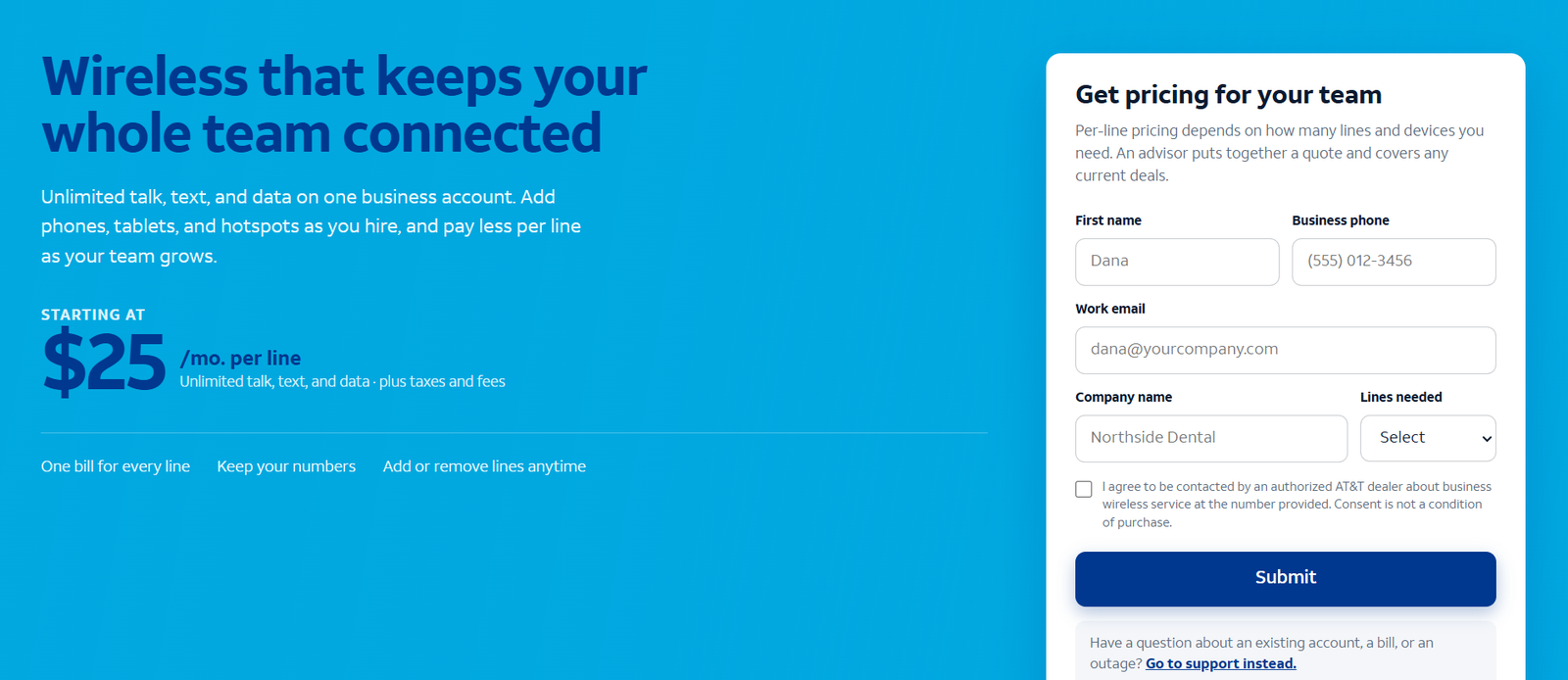
AT&T Unlimited Your Way 3.0: Plan Tiers Explained
AT&T Unlimited Your Way 3.0 is the carrier’s business wireless lineup, with per-line pricing that drops as you add lines. The figures below are the published 5+ line rates — fewer lines cost more per line, which matters for very small teams and is covered in the pricing section below.
| Tier | Price/line (5+ lines) | Premium data | Mobile hotspot | Video quality | Standout extras |
|---|---|---|---|---|---|
| Standard 3.0 | $30/mo | 5GB, then speeds may slow when network is busy | 5GB | SD | Entry unlimited for light users |
| Advanced 3.0 | $40/mo | Unlimited premium data | 100GB | HD | Big hotspot jump for $10 more |
| Premium 3.0 | $50/mo | Unlimited premium data | 300GB | 4K UHD | Roam Latin America; 7 days International Day Pass free |
| Premium 2.0 with Turbo | $60/mo | Unlimited premium data | 200GB | HD and above | Turbo priority tier |
| Ultimate 3.0 | $60/mo | Unlimited premium data | Unlimited (speeds slow to 3 Mbps after 500GB) | Top tier | For extreme hotspot users |
Standard 3.0 at $30 per line is the budget entry: unlimited talk, text, and data, but only 5GB of premium data before speeds may slow during network congestion, plus 5GB of mobile hotspot and SD-quality video streaming. It suits office staff who spend the day on Wi-Fi and just need a reliable line for calls, email, and light browsing on the go. The limitation to understand is the 5GB premium-data threshold — heavy commuters streaming video over cellular will feel the deprioritization.
Advanced 3.0 at $40 per line is where the lineup gets serious: unlimited premium data (no deprioritization threshold), 100GB of mobile hotspot, and HD video. That $10 step up from Standard buys twenty times the hotspot allowance and removes the congestion caveat entirely. For most small businesses, Advanced 3.0 is the value sweet spot — it covers field workers, tethering, and heavy data use without jumping to the top tier.
Premium 3.0 at $50 per line triples the hotspot to 300GB, steps video up to 4K UHD, and adds the international package: Roam Latin America included and 7 days of International Day Pass free per year. This is the tier for executives and sales teams who travel, tether constantly, and need their phone to be a full connectivity hub. The international inclusions alone can offset the $10 premium over Advanced for anyone who crosses borders regularly.
Above that sit two $60 tiers for extreme use cases. Premium 2.0 with Turbo offers 200GB of hotspot with Turbo priority treatment, while Ultimate 3.0 goes further with effectively unlimited hotspot — speeds only step down to 3 Mbps after a massive 500GB of hotspot use in a cycle. These are niche tiers for mobile command centers, not typical office lines, but they demonstrate how far AT&T’s hotspot allowances scale compared to the competition.
AT&T Unlimited Your Way 3.0 Standard for Cost-Conscious Teams
AT&T Unlimited Your Way 3.0 Standard makes sense when mobile data is a backup, not a primary connection. Think front-desk staff, warehouse teams on facility Wi-Fi, or part-time employees who need a company line for calls and messaging. At $30 per line for 5+ lines, it matches Verizon’s cheapest business unlimited tier dollar for dollar — the comparison between the two entry plans comes down to network preference and promotions rather than price. Just be realistic about the 5GB premium-data cap: if the team streams or tethers regularly, the $40 Advanced tier pays for itself in avoided slowdowns.
When AT&T Unlimited Your Way Premium 3.0 Justifies $50 a Line
Premium 3.0 earns its $50 per line in three situations: the employee tethers a laptop daily (300GB of hotspot covers serious tethering), the employee travels internationally (Roam Latin America plus 7 free International Day Pass days), or the employee simply needs guaranteed-unlimited premium data with 4K video. Put one traveling executive on Premium 3.0 while the office staff sits on Standard or Advanced — Unlimited Your Way lets you mix tiers across lines, so you only pay top-tier pricing where it is actually used.
Business Phone Plan Pricing: AT&T Line-Count and AutoPay Basics
Business phone plan pricing is quoted per line per month, and the per-line rate depends on how many lines are on the account — more lines, lower per-line cost. AT&T’s published Unlimited Your Way 3.0 rates above reflect the 5+ line tier; a two-line account pays more per line than a ten-line account on the same plan names. Verizon structures its business pricing the same way, which is why honest comparisons always state the line-count basis.
AutoPay and paperless billing discounts are baked into the advertised rates at both carriers — the prices you see assume you enroll. Verizon’s My Biz Plan, for example, is $34 per line with AutoPay and $39 without, a $5 monthly penalty per line for skipping it. Across a ten-line account, that is $600 a year for a billing preference, so enroll in AutoPay unless you have a specific reason not to. Promotions change frequently at both carriers — device deals, bring-your-own-device credits, and limited-time per-line discounts can shift the math month to month. All figures in this guide were checked in October 2026; confirm your exact quote, including taxes and fees, before signing.
Verizon My Biz Plan: Base Pricing and Customization
Verizon’s My Biz Plan takes the opposite approach from AT&T’s tiered lineup: instead of three fixed tiers, you start with a base unlimited plan and customize each line with add-ons. The base My Biz Plan costs $34 per line per month with AutoPay ($39 without) and includes unlimited talk, text, and data. From there, each line can be individually upgraded — the headline add-on being the Premium Network Experience at $10 per line per month, which adds unlimited priority (premium) data and 100GB of mobile hotspot to that line.
The customization model is Verizon’s real differentiator. A ten-person company does not have to put everyone on the same plan: give the two road warriors the $10 Premium Network Experience add-on ($44 per line effective) and keep the eight office staff on the $34 base. That surgical spending is something AT&T’s tiered model cannot match line-by-line — with AT&T you move the whole line to a higher tier rather than bolting a single feature onto a base plan. For businesses with sharply varied usage across employees, Verizon’s approach can deliver the lowest total bill.
Verizon also offers Business Unlimited Start 2.0 at $30 per line for 5+ lines with AutoPay — its answer to AT&T’s Standard 3.0 at the same $30 price point. Start 2.0 is the no-frills unlimited base for teams that need affordable lines without premium features. Above that, Verizon’s Business Unlimited Plus and Business Unlimited Pro plans are quote-based for existing business customers: Verizon prices these through its business sales team based on account size and needs, so any article listing fixed per-line prices for Plus or Pro is guessing. Contact Verizon Business sales for a custom quote on those tiers — and treat any “published” Plus/Pro per-line price you see elsewhere with skepticism.
Verizon My Biz Plan Add-Ons Worth Considering
The add-on menu is where the Verizon My Biz Plan earns its keep. The $10 Premium Network Experience is the one most businesses should evaluate first: unlimited priority data removes congestion slowdowns and the 100GB hotspot allowance covers serious tethering — together they approximate AT&T’s $40 Advanced 3.0 tier at an effective $44 per line. Businesses should price their actual add-on mix rather than comparing base prices alone: a My Biz line with two or three add-ons can end up costing more than AT&T’s all-inclusive tier, while a bare base line stays the cheapest option in this comparison.
Verizon My Biz Plan vs Business Unlimited Start 2.0
Verizon’s two entry options serve different buyers. Business Unlimited Start 2.0 at $30 per line (5+ lines, AutoPay) is the plain affordable unlimited — pick it when every line just needs basic unlimited service and nobody needs premium features. The My Biz Plan at $34 per line is the flexible foundation — pick it when some lines will need add-ons and you want per-line control. The $4 per line difference is the price of flexibility; for a five-line account that is $20 per month, or $240 a year, to keep the customization door open.

Business Wireless Plans Comparison: AT&T vs Verizon Side by Side
Here is the full business wireless plans comparison across both carriers’ published business tiers, on a consistent 5+ line, AutoPay basis where the carriers publish one:
| Plan | Price/line | Premium data | Mobile hotspot | Video quality | International |
|---|---|---|---|---|---|
| AT&T Standard 3.0 | $30/mo | 5GB, then may slow when busy | 5GB | SD | — |
| AT&T Advanced 3.0 | $40/mo | Unlimited | 100GB | HD | — |
| AT&T Premium 3.0 | $50/mo | Unlimited | 300GB | 4K UHD | Roam Latin America; 7 days International Day Pass free |
| AT&T Ultimate 3.0 | $60/mo | Unlimited | Unlimited (3 Mbps after 500GB) | Top tier | Top-tier travel features |
| Verizon Business Unlimited Start 2.0 | $30/mo | Standard priority | Base allowance; confirm at checkout | Standard | Check current travel options |
| Verizon My Biz Plan (base) | $34/mo ($39 w/o AutoPay) | Base priority | Base allowance; confirm at checkout | Standard | Add-ons available |
| Verizon My Biz + Premium Network Experience | $44/mo effective | Unlimited priority data | 100GB | Improved | Add-ons available |
| Verizon Business Unlimited Plus / Pro | Quote-based | Contact Verizon Business sales | Contact Verizon Business sales | — | Contact Verizon Business sales |
Read the table in three price bands. At $30 per line, AT&T Standard 3.0 and Verizon Start 2.0 are functionally tied — both are affordable unlimited bases with modest premium-data and hotspot allowances, and the choice comes down to network preference, coverage at your locations, and current promotions. Neither is “better” on paper; both are built for light users on Wi-Fi most of the day.
At $40–$44 per line, AT&T Advanced 3.0 ($40, with 100GB hotspot and unlimited premium data included) faces Verizon’s My Biz Plan with the $10 Premium Network Experience add-on ($44 effective, 100GB hotspot, unlimited priority data). The feature sets are remarkably close — AT&T wins this band by $4 per line with HD video included, while Verizon wins on the principle that you only pay the extra $10 on lines that need it.
Above $50 per line, AT&T pulls ahead on included features: Premium 3.0’s 300GB hotspot, 4K video, and international package have no direct Verizon equivalent at a published price, since Verizon’s Plus and Pro tiers are quote-based. A Verizon shop needing that level of hotspot would build it through My Biz add-ons or negotiate a custom Plus/Pro quote — both valid paths, but neither as simple as AT&T’s flat $50 published tier.
Disclaimer: This article contains affiliate links to AT&T Business services. We may earn a commission if you purchase through them, at no extra cost to you. Ortelcom.com is an independent publisher and is not affiliated with or endorsed by AT&T. Pricing, speeds, and availability are not guaranteed, were checked in October 2026, and vary by address and promotions — please confirm all details before ordering. AT&T and all related marks are trademarks of their respective owners.
AT&T vs Verizon Business Wireless: Hotspot and Video Quality Compared
Mobile hotspot is the single biggest feature gap between the two carriers’ published plans. AT&T’s tiers scale aggressively: 5GB on Standard 3.0, 100GB on Advanced 3.0, 300GB on Premium 3.0, and effectively unlimited on Ultimate 3.0. Verizon’s published hotspot story is thinner at the base — the meaningful hotspot allowance in Verizon’s lineup comes via the $10 Premium Network Experience add-on (100GB) or through quote-based Plus/Pro tiers. For a business where tethering is a daily workflow rather than an emergency backup, AT&T’s published tiers offer more hotspot per dollar at every band, and the Ultimate 3.0 tier stands alone for extreme users.
Video streaming quality follows the tier ladder at AT&T: SD on Standard 3.0, HD on Advanced 3.0, 4K UHD on Premium 3.0. These caps apply to video streamed over the cellular connection and matter most to teams that watch training content, join video calls, or stream media over mobile data. Verizon does not publish the same explicit video-quality ladder for its business base plans, so businesses that care about this should confirm current video streaming policies with Verizon Business sales before comparing — do not assume parity in either direction.
On premium data and deprioritization, the carriers use different vocabulary for similar concepts. AT&T’s Standard 3.0 includes 5GB of premium data before speeds may slow during congestion; Advanced 3.0 and above include unlimited premium data with no such threshold. Verizon’s base plans run at standard network priority, with the Premium Network Experience add-on upgrading a line to unlimited priority data. In plain terms: if your team works through congested areas or peak hours, pay for the tier or add-on that includes priority data on whichever carrier you choose — it is the cheapest performance insurance in business wireless.
AT&T vs Verizon Business Wireless Hotspot Caps for Field Teams
Field teams are where hotspot caps become a purchasing criterion rather than a footnote. A service technician tethering a laptop for diagnostics, parts ordering, and video calls with dispatch can burn 3–5GB per day — 60–100GB per month — which exhausts small hotspot allowances in the first two weeks. AT&T’s Advanced 3.0 (100GB) covers that comfortably and Premium 3.0 (300GB) covers it three times over. On Verizon, the equivalent field line needs the $10 Premium Network Experience add-on for its 100GB. Price the field team’s real usage, not the base plan price, and the carrier decision often makes itself.
AT&T vs Verizon Business Wireless Video Streaming Quality
For most office teams, video quality caps are a minor factor — they are on Wi-Fi all day. They matter for mobile-first roles: trainers streaming video at client sites, real-estate teams doing video walkthroughs over cellular, or anyone joining video conferences from the road. AT&T’s published ladder (SD/HD/4K UHD by tier) lets you buy the quality level you need explicitly. If video-over-cellular is central to your workflow, that transparency is a genuine advantage; verify Verizon’s current policy for the specific plan you are considering so the comparison is apples to apples.
Best Business Cell Phone Plans for International Travel
International features are AT&T’s clearest published advantage in this comparison. Premium 3.0 at $50 per line includes Roam Latin America — use your plan’s talk, text, and data across Latin America — plus 7 days of International Day Pass free each year for travel beyond that. For a sales executive doing quarterly trips to Mexico City or São Paulo, those inclusions replace per-trip travel passes that would otherwise cost real money several times a year. No other published tier in this comparison bundles that much international value at its price point.
Verizon’s international story lives in its add-on and travel-pass catalog rather than in the base business plans compared here. Verizon does offer international travel options for business lines, but the specifics — which passes, current pricing, and what is included versus extra — change with promotions and plan combinations. Do not let any article tell you Verizon “includes” or “excludes” a specific travel perk without a date attached; check Verizon’s current business travel options at checkout and compare them against AT&T’s published Premium 3.0 inclusions for your actual destinations.
Best Business Cell Phone Plans for Teams That Travel to Latin America
If Latin America is a regular destination, AT&T Premium 3.0 deserves a serious look specifically because of the included Roam Latin America feature — it turns the $50 tier into a travel-ready plan with no extra passes to buy or expense reports to file. Put your travelers on Premium 3.0 and keep everyone else on Advanced or Standard; the per-line mixing means you are not paying travel features for staff who never leave the state. For travel outside Latin America, compare the 7 included International Day Pass days against whatever Verizon currently offers for the same routes before deciding.
Business Phone Plan Pricing: 5-Line Cost Scenarios
Abstract per-line prices become concrete with a five-line team. Here is what each carrier’s published pricing means per month for five lines, before taxes, fees, and promotions:
| Configuration | Monthly total (5 lines) |
|---|---|
| AT&T Standard 3.0 (all 5 lines) | $150/mo |
| Verizon Business Unlimited Start 2.0 (all 5 lines) | $150/mo |
| Verizon My Biz Plan base (all 5 lines, AutoPay) | $170/mo |
| AT&T Advanced 3.0 (all 5 lines) | $200/mo |
| Verizon My Biz + Premium Network Experience (all 5 lines) | $220/mo |
| AT&T Premium 3.0 (all 5 lines) | $250/mo |
| Mixed: 2× AT&T Premium 3.0 + 3× Standard 3.0 | $190/mo |
| Mixed: 2× Verizon My Biz + add-on + 3× base | $190/mo |
Two things stand out. First, the entry-level tie is exact: $150 per month at both carriers for five basic unlimited lines. Second, the mixed configurations show how both carriers reward thoughtful line-by-line planning — putting only the two heavy users on premium tiers lands both carriers at $190 per month, $60 less than blanketing all five lines with mid-tier plans. The carriers’ different philosophies (AT&T’s tiers vs. Verizon’s add-ons) converge on nearly identical totals when you actually optimize. That is why the “which is cheaper” question has no universal answer: it depends entirely on your team’s usage mix.
Remember what these totals exclude: taxes, regulatory fees, and device financing, which vary by location and add a meaningful percentage on top. They also exclude promotions — both carriers regularly run bring-your-own-device credits, multi-line discounts, and limited-time per-line reductions that can beat every number in this table. Treat published pricing as the starting point for negotiation, not the final price. All figures checked October 2026 — confirm at checkout. Check current AT&T Business Wireless pricing for your team size.
Best Business Cell Phone Plans by Team Type
Field teams — technicians, installers, delivery crews, and anyone whose office is a vehicle — should be priced on hotspot first. AT&T’s Advanced 3.0 ($40, 100GB hotspot) or Premium 3.0 ($50, 300GB) covers tethering-heavy workflows; on Verizon, budget the $10 Premium Network Experience add-on per field line. Do not put field staff on base tiers to save $10 per line and then watch them burn through 5GB of hotspot by the second week.
Office staff on facility Wi-Fi all day are the easiest lines to buy: AT&T Standard 3.0 or Verizon Start 2.0 at $30 per line. These employees need reliable calls, messaging, and email on the go — not hotspot or priority data. This is also where the line-count math matters most: a 20-person office at $30 per line is $600 per month before fees, so even small per-line promotions are worth chasing.
Traveling executives and sales teams need the international and priority-data story, not just the domestic one. AT&T Premium 3.0’s Roam Latin America and 7 free International Day Pass days make it the simplest published answer for frequent travelers. For Verizon-based teams, price the current travel add-ons for your actual routes and compare honestly — the right answer depends on destinations, not brand loyalty.
Best Business Cell Phone Plans for Mobile Hotspot-Heavy Roles
Some roles treat the phone as the internet connection itself: pop-up retail staff running card readers off tethering, event teams with laptops, remote workers in areas without wired broadband. For these roles, AT&T’s Ultimate 3.0 at $60 per line — with effectively unlimited hotspot (full speed to 500GB, then 3 Mbps) — is the only published tier in this comparison that removes the hotspot question entirely. Nothing else in either carrier’s published lineup goes that far; Verizon’s answer at this usage level is a custom Plus/Pro quote through business sales.
AT&T Business Wireless vs Verizon Business Wireless: Frequently Asked Questions
Is AT&T Unlimited Your Way Cheaper Than the Verizon My Biz Plan?
At the base, no — they are close but not identical. AT&T’s Standard 3.0 is $30 per line (5+ lines) while the Verizon My Biz Plan base is $34 with AutoPay ($39 without). But the comparison flips depending on configuration: AT&T’s Advanced 3.0 at $40 undercuts a My Biz line with the $10 Premium Network Experience add-on ($44 effective), while a bare My Biz base line is cheaper than AT&T’s Advanced tier. The honest answer is that neither carrier is systematically cheaper — price your actual line mix, including which lines need add-ons or higher tiers, and compare totals.
What Does Business Phone Plan Pricing Depend On?
Four things: the number of lines on the account (more lines means lower per-line rates), AutoPay and paperless billing enrollment (Verizon’s My Biz Plan, for instance, is $5 more per line without it), the tier or add-ons selected per line, and current promotions. Device financing is separate from plan pricing at both carriers. Because all four move, the per-line figures in this guide — checked October 2026 — are a snapshot; your quote at checkout is what counts.
Do Business Wireless Plans Comparison Tables Include Taxes and Fees?
No — and neither does this one. Published per-line prices at both AT&T and Verizon exclude taxes, regulatory fees, and surcharges, which vary by state and locality and add a noticeable percentage to the bill. They also exclude device payments. When comparing carriers, compare the pre-tax plan totals (as this guide does) and then confirm the all-in monthly cost with each carrier’s quote, since fee structures differ.
Which Is Better for Unlimited Hotspot: AT&T vs Verizon Business Wireless?
AT&T, on published plans. AT&T’s Ultimate 3.0 at $60 per line offers effectively unlimited mobile hotspot — full speed up to 500GB per cycle, then 3 Mbps — which is the most generous published hotspot allowance in this comparison by a wide margin. Verizon’s published hotspot path tops out at the 100GB Premium Network Experience add-on unless you go the custom-quote route with Business Unlimited Plus or Pro. If truly unlimited hotspot is the requirement, AT&T’s published tier is the straightforward answer.
How Often Do Business Phone Plan Pricing and Promotions Change?
Constantly. Both carriers rotate device deals, bring-your-own-device credits, per-line discounts, and limited-time plan promotions throughout the year — sometimes monthly. A plan that is the best value in October can be undercut by a holiday promotion in November. Use this guide’s pricing (checked October 2026) to understand the carriers’ structures and relative positioning, which change slowly, but always pull a fresh quote before buying, because the promotional layer on top changes fast.
AT&T Business Wireless vs Verizon Business Wireless: Final Verdict
There is no unsupported winner in the AT&T Business Wireless vs Verizon Business Wireless comparison — but there are clear best-fit answers. Choose AT&T if your team needs generous mobile hotspot (100GB to effectively unlimited across the tiers), values the included international package on Premium 3.0, or prefers simple flat tiers to add-on math. Choose Verizon if you want per-line customization through the My Biz Plan, have widely varied usage across employees, or prefer to pay premium prices only on the lines that earn them. At the $30 entry level, both carriers are priced identically — let coverage at your locations and current promotions break that tie.
The smartest move for most small businesses is the mixed approach both carriers allow: put heavy users on premium tiers, travelers on travel-ready tiers, and office staff on the affordable base — then compare the optimized totals rather than the headline prices. Run that math with your real headcount and usage, confirm the October 2026 pricing at checkout, and you will land on the right carrier for your team. Check AT&T Business Wireless plans and current promotions for your business to get a quote based on your line count.

