
Bundle deals are the oldest trick in telecom marketing: combine internet, phone, and wireless on one bill, advertise a big “savings” number, and hope nobody does the arithmetic. Sometimes the savings are real — AT&T’s fiber-with-wireless discounts genuinely take $20 to $50 a month off fiber tiers. Sometimes the “bundle” is just three full-price services stapled together with a gift card on top. This guide does the arithmetic for you, with every price checked in October 2026.
The verdict: bundling AT&T Business Fiber with an eligible AT&T Business wireless plan produces real, recurring savings — $20/month on 300 Mbps, $40/month on 500 Mbps, and $50/month on 1 GIG, every month you keep both. Adding the Business Phone add-on (from $15/month) makes sense when you’d pay for a business phone line anyway; it is not a discount in itself. The bundle math only works if you actually need the wireless lines — buying wireless service you don’t need just to discount fiber is spending dollars to save dimes. And always budget at list price: discounts require an eligible AT&T Business wireless plan plus AutoPay and paperless billing, and they disappear if those conditions lapse.
Below: the exact discount breakdown per fiber tier, a worked standalone-vs-bundled example with both totals, where reward cards fit, and the honest line between bundling that saves money and bundling that just looks like it does. Prices vary by address and promotions — confirm before ordering.
Looking for the fiber-first option?
Check whether AT&T Business Fiber serves your office and compare the 300 Mbps to 5 GIG speed tiers.
Business Internet and Phone Bundle Savings: What AT&T Actually Discounts (Checked October 2026)
| Fiber tier | List price | With eligible wireless plan (AutoPay + paperless) | Monthly savings | Annual savings |
|---|---|---|---|---|
| 300 Mbps | $60/mo | $40/mo | $20/mo | $240/yr |
| 500 Mbps | $100/mo | $60/mo | $40/mo | $480/yr |
| 1 GIG | $140/mo | $90/mo | $50/mo | $600/yr |
| Internet Air Standard | $65/mo | $40/mo | $25/mo | $300/yr |
| Internet Air Premium | $105/mo | $80/mo | $25/mo | $300/yr |
A note on how the Internet Air rows work: the $25 monthly savings there is the combination of the $5 AutoPay/paperless discount and the $20 wireless discount. The fiber rows show the wireless discount effect against list; with AutoPay/paperless the standard $5 reduction applies on top in the usual stacking. The key column is the last one: these are recurring, every-month savings — not a 12-month promo that snaps back to full price. That distinction is what separates a real bundle discount from promotional theater.
What the bundle does not discount: the Business Phone add-on (from $15/month) is an add-on price, not a discounted price — you’re buying a phone line at its standalone add-on rate. Reward cards ($300–$500 on fiber) are one-time incentives, not recurring savings. Keep those categories separate in your head: recurring monthly discounts, add-on services at their own prices, and one-time promos. Only the first category is “bundle savings” in the meaningful sense.
See fiber bundle pricing for your business →
For the full package details, see our AT&T fiber and wireless bundle guide.
Fiber Wireless Bundle Savings: The $20, $40, and $50 Monthly Breakdown
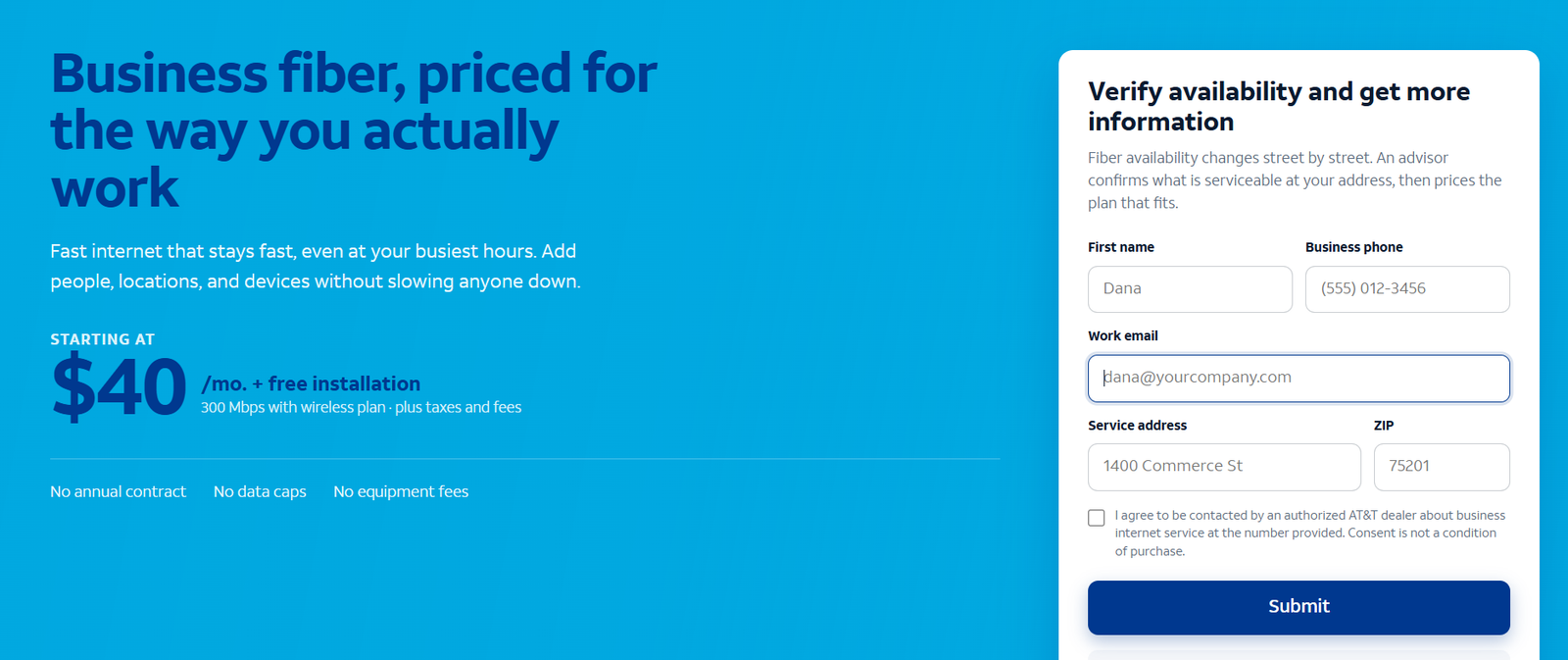
Let’s look at each fiber tier’s bundle discount individually, because the value proposition changes with the tier. On 300 Mbps, the discount takes you from $60 to $40 — a full third off. For a very small office, that $40/month price point makes fiber cheaper than many cable business tiers while delivering symmetrical 300/300 speeds with no data caps. This is the tier where the bundle discount does the most relative work: it turns an already-cheap tier into the obvious choice for micro-businesses already on AT&T wireless.
On 500 Mbps, the discount takes you from $100 to $60 — $40 a month, $480 a year. This is the sweet spot for small teams: $60/month for symmetrical 500 Mbps with no caps and no annual contract is genuinely aggressive pricing, and it’s the tier where the bundle discount most clearly beats buying standalone. A 500 Mbps standalone buyer pays $1,200 a year; the bundled buyer pays $720. That’s not a rounding error — it’s a different price class.
On 1 GIG, the discount takes you from $140 to $90 — $50 a month, $600 a year, and it comes with the free built-in 5G backup that only ships on 1 GIG and faster. The bundled 1 GIG buyer gets gigabit symmetrical fiber plus automatic cellular failover for $90/month — less than many standalone cable gigabit business plans, with backup included. If your business already runs AT&T wireless lines, 1 GIG at the bundled price is the value peak of the whole lineup.
The condition, stated plainly every time: these prices require an eligible AT&T Business wireless plan plus AutoPay and paperless billing. Lose the wireless plan — switch carriers, downsize below eligibility — and the fiber price reverts toward list. When you model the bundle, model both numbers: the discounted price you’re paying now, and the list price you’d pay if the wireless side changes. Never sign a mental contract at the discounted price alone.
Internet and Phone Bundle Business Math: A Worked Standalone vs Bundled Example
Time for the full arithmetic. We’ll compare two versions of the same 8-person office: one buying everything standalone, one bundling.
The office: 8 employees, needs 500 Mbps symmetrical fiber, 8 wireless lines (Unlimited Your Way Standard at $30/line for 5+ lines with AutoPay/paperless — $240/month for the lines), and 2 business phone lines via the Business Phone add-on (from $15/month each — $30/month).
Standalone totals (no bundle discounts): fiber 500 Mbps at $100 list + wireless lines $240 + phone add-on $30 = $370/month, or $4,440/year.
Bundled totals (eligible wireless + AutoPay/paperless): fiber 500 Mbps at $60 + wireless lines $240 + phone add-on $30 = $330/month, or $3,960/year. Annual savings: $480.
Assumptions and conditions, stated explicitly: wireless line pricing uses the 5+ line band with bank-account AutoPay and paperless billing; the phone add-on is priced at its “from $15/month” floor — your actual per-line phone cost may be higher depending on features, so confirm with a rep; the fiber discount requires the eligible wireless plan to stay active plus AutoPay/paperless — if any condition lapses, fiber reverts toward the $100 list price and the $480 annual savings shrinks or vanishes; reward cards are excluded from the annual math because they’re one-time, not recurring. This example also assumes the business genuinely needs 8 wireless lines — which brings us to the theater question.
The theater version: now imagine a 3-person consultancy with no wireless lines that buys 2 AT&T wireless lines it doesn’t need ($60/month at the low end) purely to unlock the $40/month fiber discount. Net effect: +$60 wireless spend, −$40 fiber discount = +$20/month worse off, before counting devices and activation. That’s bundling as theater: the discount is real, but the bundle costs more than standalone. The rule is simple — never buy a service to discount another service unless the first service has standalone value to you.
The real-savings version: a 12-person company already paying for 12 AT&T wireless lines adds fiber and the phone add-on. The wireless spend was happening anyway, so the $40–$50/month fiber discount is pure savings against the standalone fiber price — $480–$600 a year for changing nothing about the wireless side. That’s bundling working as intended: the discount rewards consolidation you’re already doing.
Calculate your bundle savings on AT&T Business Fiber →
AT&T Business Phone Bundle: What the $15/Month Phone Add-On Covers
The Business Phone add-on starts from $15 a month per line — and I want to be careful about what “from” means here, because add-on pricing varies with features. What I can say from verified pricing: it’s positioned as the cheap way to add business voice to an AT&T Business internet account, well under the cost of a standalone business phone system or a separate VoIP contract for a basic line. What I can’t tell you from public pricing: the exact feature set at the $15 floor versus higher tiers — things like auto-attendant, call routing, and device inclusion. Confirm the feature list with an AT&T Business rep before you count lines in your budget.
When the phone add-on makes sense in a bundle: you’re already getting AT&T fiber or Internet Air, you need 1–5 basic business lines, and you’d otherwise pay a separate VoIP provider $20–$30 per line per month. Consolidating voice onto the same account simplifies billing and support — one provider, one bill, one throat to choke when something breaks. When it doesn’t make sense: you already have a VoIP system you’re happy with (migrating working phone systems to save a few dollars a month is rarely worth the disruption), or you need advanced call-center features the basic add-on may not include.
One honest note: the phone add-on is not a bundle discount. Nobody is taking $X off your phone bill for bundling — you’re simply buying the phone line at its add-on price alongside internet. Marketing sometimes presents “internet + phone” as a discounted bundle; the discount, if any, lives on the internet side (the wireless-linked fiber discount), not the phone side. Keep the categories straight and you won’t overvalue the bundle.
Reward Cards on Fiber Bundles: $300–$500 and the Fine Print
For the current offers in one place, see our roundup of AT&T business internet deals.
AT&T Business Fiber orders frequently come with reward cards in the $300–$500 range — effectively a sign-up bonus. Treat them exactly as what they are: a one-time incentive, not savings. A $400 reward card on a $60/month bundled 500 Mbps plan covers about six and a half months of the discount-free difference — nice, but it doesn’t change the monthly math.
The fine print that matters: reward cards typically arrive weeks after installation, not at order time; they usually require the account to stay active and in good standing through fulfillment; and they’re tied to the specific offer at order time — the card amount advertised today may differ next month. Never let a reward card decide between two otherwise-equal options, and never budget as if the card is cash in hand on day one. Real bundle value is the recurring monthly discount; the card is a cherry on top.
Also note: reward card offers change frequently and vary by channel — ordering online, by phone, or through a dealer can carry different card amounts for the same plan. If the card matters to you, compare the card offer across channels at order time and get the amount confirmed in writing before you commit.
Bundle Discounts That Are Theater vs Real Savings
For a broader framework, see our guide on how to choose business internet.
Let’s formalize the theater-vs-real test, because it applies to every bundle pitch you’ll ever see, not just AT&T’s. A bundle discount is real savings when all three hold: (1) you’d buy each service in the bundle anyway at something close to its standalone price; (2) the discount is recurring monthly, not a 12-month promo that reverts; (3) the conditions (wireless plan active, AutoPay, paperless) are things you’d maintain regardless. AT&T’s fiber-with-wireless discount passes all three for businesses already on AT&T wireless — the wireless spend is pre-existing, the discount recurs monthly, and AutoPay/paperless is free to maintain.
A bundle discount is theater when any of these hold: you’re buying a service you don’t need to unlock the discount (the consultancy buying phantom wireless lines); the “savings” are measured against an inflated reference price nobody pays; the discount expires after a promo period and the revert price wasn’t disclosed upfront; or the bundle locks you into a contract that costs more to exit than the discount ever saved. AT&T Business Fiber’s no-annual-contract term removes the last trap — you can leave if the math stops working, which is a meaningful consumer protection most cable bundles don’t offer.
The one-line test to run on any bundle: price each service standalone, price the bundle, and ask “would I buy every piece of this at its bundle-implied price even without the others?” If yes, the savings are real. If the bundle only makes sense as a package, at least one piece is theater.
Disclaimer: This article contains affiliate links to AT&T Business services. We may earn a commission if you purchase through them, at no extra cost to you. Ortelcom.com is an independent publisher and is not affiliated with or endorsed by AT&T. Pricing, speeds, and availability are not guaranteed, were checked in October 2026, and vary by address and promotions — please confirm all details before ordering. AT&T and all related marks are trademarks of their respective owners.
No Annual Contract: Why Fiber Bundle Discounts Don’t Lock You In
One of the most underrated features of AT&T Business Fiber is also one of the simplest: no annual contract. You can take the bundled price — $40, $60, or $90 a month depending on tier — and leave whenever the math stops working for you. That changes the risk profile of the bundle completely. With a typical cable bundle, the discount is bait on a 2–3 year contract hook: the savings are real for the term, but you’re financing them with commitment. Here, the discount is month-to-month, which means it’s genuinely optional savings rather than a golden handcuff.
Practically, this means two things. First, you can try the bundle without commitment risk: add fiber alongside your existing wireless, verify the discounted price on your first bills, and keep your old internet until the new one passes acceptance (never cancel the old line early — the overlap month is cheap insurance). Second, if AT&T’s wireless pricing ever stops working for you, you can move wireless carriers and simply absorb the fiber price reverting toward list — no early termination fee punishes the decision. Always confirm the no-contract term on your specific order, since promos and reward cards can occasionally carry their own stay-active conditions even when the base plan doesn’t.
Internet Air in the Bundle: $40 Standard and $80 Premium With Wireless
Fiber isn’t the only service the wireless discount touches. Internet Air Standard drops to $40 a month and Premium to $80 a month with an eligible wireless plan plus AutoPay/paperless — $300 a year in savings on either tier. For businesses where fiber isn’t available at the address, this is the bundle story: wireless lines you already pay for take a meaningful bite out of fixed-wireless internet too.
The bundle logic is identical to fiber’s: the discount is real when the wireless lines are pre-existing, theater when they’re purchased to chase the discount. One practical difference — Internet Air’s lower absolute prices mean the dollar savings are smaller ($25/month including the AutoPay component versus $40–$50 on fiber), so the “buy wireless to save on internet” theater is even worse math here. And remember Internet Air’s fixed-wireless constraint: it must be used at the qualified business address, so multi-location businesses need to think per-address, not per-account.
Where the Internet Air bundle shines: retail and pop-up locations already running AT&T wireless for staff phones, where $40/month Standard is nearly disposable as a secondary or backup connection, and field offices where a $40/month primary connection beats a $100+ cable install. It’s the cheapest seat at the bundle table.
Business Internet Phone Bundle FAQ
Do I need AT&T wireless lines to get the fiber bundle discount?
Yes — the $20/$40/$50 monthly fiber discounts require an eligible AT&T Business wireless plan, plus AutoPay and paperless billing. Without the wireless plan, you pay closer to list price ($60/$100/$140 depending on tier). If you don’t have AT&T wireless lines and don’t need them, don’t buy them just for the discount — the math doesn’t work, as the worked example above shows.
Is the Business Phone add-on worth $15 a month per line?
It can be, when you’d otherwise pay a separate VoIP provider $20–$30 per line — consolidating saves money and simplifies billing. It’s less compelling if you already have a working phone system you’re happy with, since migration disruption usually costs more than the monthly savings. Confirm the feature set at the $15 floor with a rep before budgeting, since add-on pricing varies with features.
Do bundle discounts require a contract?
AT&T Business Fiber itself carries no annual contract, and the bundle discounts are month-to-month — they last as long as the conditions (eligible wireless plan, AutoPay, paperless billing) hold. That’s meaningfully different from cable bundles that tie discounts to 2–3 year terms. Confirm the no-contract term on your specific order, since individual promos or reward cards can carry their own stay-active conditions.
Can I bundle Internet Air instead of fiber?
Yes. With an eligible wireless plan plus AutoPay/paperless, Internet Air Standard is $40/month and Premium is $80/month (down from $65/$105 list). The same rule applies: the discount is real savings when the wireless lines are already in place, and poor math when wireless is bought just to chase it.
What happens to my bundle price if I cancel the wireless lines?
The fiber or Internet Air price reverts toward list — that’s the condition the discount rests on. Budget both numbers when you model the bundle: the discounted price you pay while the wireless plan is active, and the list price if the wireless side ever changes. Because there’s no annual contract on fiber, you’re never trapped — but the savings do depend on keeping the wireless lines.
Are the $300–$500 reward cards guaranteed?
No — treat reward cards as promotional and variable. Amounts change over time and by order channel, cards typically arrive weeks after installation, and they usually require the account to stay active and in good standing through fulfillment. Get the card amount confirmed in writing at order time, and never let the card decide between two otherwise-equal options.
The bottom line on business internet and phone bundles: AT&T’s fiber-with-wireless discounts are among the more honest bundle deals in business telecom — recurring monthly savings of $240 to $600 a year, no annual contract, no promo-period snapback. The phone add-on from $15/month is fairly priced consolidation, not a discount, and reward cards are a nice bonus, not a reason to buy. Run the two-line test — standalone total versus bundled total, with the wireless-already-in-place condition stated out loud — and you’ll know in sixty seconds whether the bundle saves you real money or just looks like it does.

