
If you run a business in Denver, Colorado, the short answer to the question of which internet provider to choose is this: start by checking what fiber is actually available at your exact address, because Denver is a two-network city in practice, and the best provider on your street may not be the best provider two neighborhoods over. Quantum Fiber, the fiber brand of Lumen, and Comcast Business cover the largest share of Denver business addresses, and between them they serve most offices, shops, clinics, and restaurants in the city. AT&T Business Fiber is also worth checking, because where it is available it offers symmetrical speeds from 300 Mbps to 5 GIG with no data caps and a gateway included, but its fiber footprint in Denver, Colorado is limited and address-specific, so it should be treated as a strong option to check rather than a default. This guide explains the business internet providers in Denver in practical terms: who actually serves the city, what each provider sells, what it costs, where each option works best, and how to buy without locking your business into the wrong contract.
Denver, Colorado is a growing business hub with a dense downtown core, a large technology corridor in the Denver Tech Center, and busy commercial districts in Cherry Creek, RiNo, LoDo, and along the light rail lines. That growth has attracted a crowded field of business internet providers, from the incumbent telephone network now run by Lumen to the dominant cable network run by Comcast Business, plus fiber specialists, fixed wireless carriers, and national dedicated internet providers that serve larger offices and multi-location businesses. The result is real choice, but also real confusion, because advertised speeds and prices are national figures that only become concrete once you enter your exact business address. Federal Communications Commission data shows that availability varies sharply by neighborhood: fiber is densest in Downtown, LoDo, RiNo, Cherry Creek, and the Denver Tech Center, while some residential-heavy and outer neighborhoods have far fewer fiber options and rely more on cable or fixed wireless. Treat every price and speed in this guide as a starting point for an address check, not as a promise for your suite.
Check AT&T Business Fiber Availability for Your Denver Address
Symmetrical fiber speeds from 300 Mbps to 5 GIG, with no data caps and a gateway included.
Best Business Internet Providers in Denver, Colorado at a Glance
Before comparing providers one by one, it helps to see the Denver market as a whole. The table below summarizes the main business internet providers in Denver, Colorado, the technology each one sells, the speeds comparison sources report, and the type of business each one suits best. Prices are shown as the ranges that comparison sources and broker data report for 2026, and they vary by address, term, and promotions, so use them to shortlist providers and then get an address-specific quote before deciding.
| Provider | Technology | Speeds reported | Typical business pricing | Best for |
|---|---|---|---|---|
| AT&T Business Fiber | Fiber | 300 Mbps to 5 GIG symmetrical | Business plans from $40 per month nationally | Offices where fiber is available at the address |
| Quantum Fiber | Fiber | Up to 8 Gbps | From around $50 per month | Businesses in central Denver neighborhoods |
| Comcast Business | Cable | Up to 2 Gbps download | Shared plans roughly $100 to $350 per month for up to 1 Gbps | Fast installs and wide coverage |
| CenturyLink (Lumen) | Fiber and DSL | Fiber up to 1 Gbps | Varies by address and speed | Existing Lumen buildings and dedicated lines |
| Spectrum Business | Cable | Up to 1 Gbps download | Varies by address and speed | Shops and offices in Spectrum-served areas |
| T-Mobile 5G Business Internet | Fixed wireless | Speeds vary by signal | Varies by plan | Quick setup and backup connections |
| AT&T Internet Air for Business | Fixed wireless | Speeds vary by signal | Varies by plan | Backup and addresses without fiber |
Get A Free AT&T Business Fiber Quote
Symmetrical fiber speeds from 300 Mbps to 5 GIG, with no data caps and a gateway included.
Two patterns stand out in that table. First, fiber is the fastest and most consistent technology, but no single fiber provider covers all of Denver, Colorado, so the fiber winner at your address depends on which network reaches your building. Second, cable from Comcast Business is the most widely available fast option, with comparison sources reporting coverage near 99 percent in many neighborhoods, which makes it the practical default for businesses that need service quickly or sit outside the densest fiber areas. Fixed wireless from T-Mobile and AT&T Internet Air for Business fills the gaps, especially for temporary locations, pop-up shops, and backup connections. Dedicated Internet Access from providers such as Lumen, Zayo, Cogent, and Crown Castle Fiber serves larger offices that need guaranteed symmetrical bandwidth and a service level agreement, at prices that start well above shared plans.
AT&T Business Fiber: Denver Business Internet Speeds and Availability
AT&T Business Fiber is the product these Denver guides lead to, so it deserves an honest first look. Nationally, AT&T Business Fiber offers symmetrical speeds from 300 Mbps to 5 GIG, no data caps, a gateway included, and no annual contract on shared plans, with business plans from $40 per month on AT&T’s own city pages. Those are strong specifications for a small or mid-sized business: symmetrical speeds matter because video calls, cloud backups, and point-of-sale systems all upload as much as they download, and no data caps means a busy month never triggers overage charges. The catch in Denver, Colorado is availability. AT&T is not the incumbent telephone provider in Denver, and Federal Communications Commission data shows AT&T mainly reaching Denver neighborhoods at up to 100 Mbps through older DSL and fixed wireless technology, not through a citywide fiber network. That means AT&T Business Fiber availability in Denver is genuinely address-limited, and many Denver businesses will find that the fiber product is not available at their building even though AT&T advertises it nationally.
That honest limitation does not make AT&T irrelevant in Denver, Colorado. Where AT&T Business Fiber is available at a Denver address, it is competitive with any fiber provider in the city on speed, symmetry, and simplicity, and it is worth checking first because the check costs nothing and takes minutes. You can check AT&T Business Fiber availability for your Denver address and get a straight answer for your building before spending time comparing other providers. If the answer is yes, compare the quoted speed and price against Quantum Fiber and Comcast Business at the same address and choose on the numbers. If the answer is no, AT&T Internet Air for Business, the fixed wireless product, is the realistic AT&T fallback in Denver, and it can serve as a primary connection for a small office or as a backup connection alongside a wired provider. For a step-by-step walkthrough of what happens after you order, see our guide on how to order and install AT&T Business Fiber, which covers the survey, the install appointment, and the equipment you should expect.
When you check AT&T availability in Denver, Colorado, check the exact suite, not just the street address. Fiber availability can differ between floors of the same building and between a street-facing storefront and a suite at the back of a shared office park, because the deciding factor is whether fiber has been run into your specific unit and whether the building owner has an agreement with the provider. Ask the provider whether the quoted speed is available at your suite, whether installation needs landlord permission or a building wiring charge, and whether the price quoted is the price after any introductory period. If AT&T fiber is not available, ask specifically about Internet Air for Business at your address, since fixed wireless coverage depends on the nearest cell site and can be strong in one part of a neighborhood and weak in another.
Quantum Fiber: Denver Business Fiber Internet Providers With Symmetrical Speeds
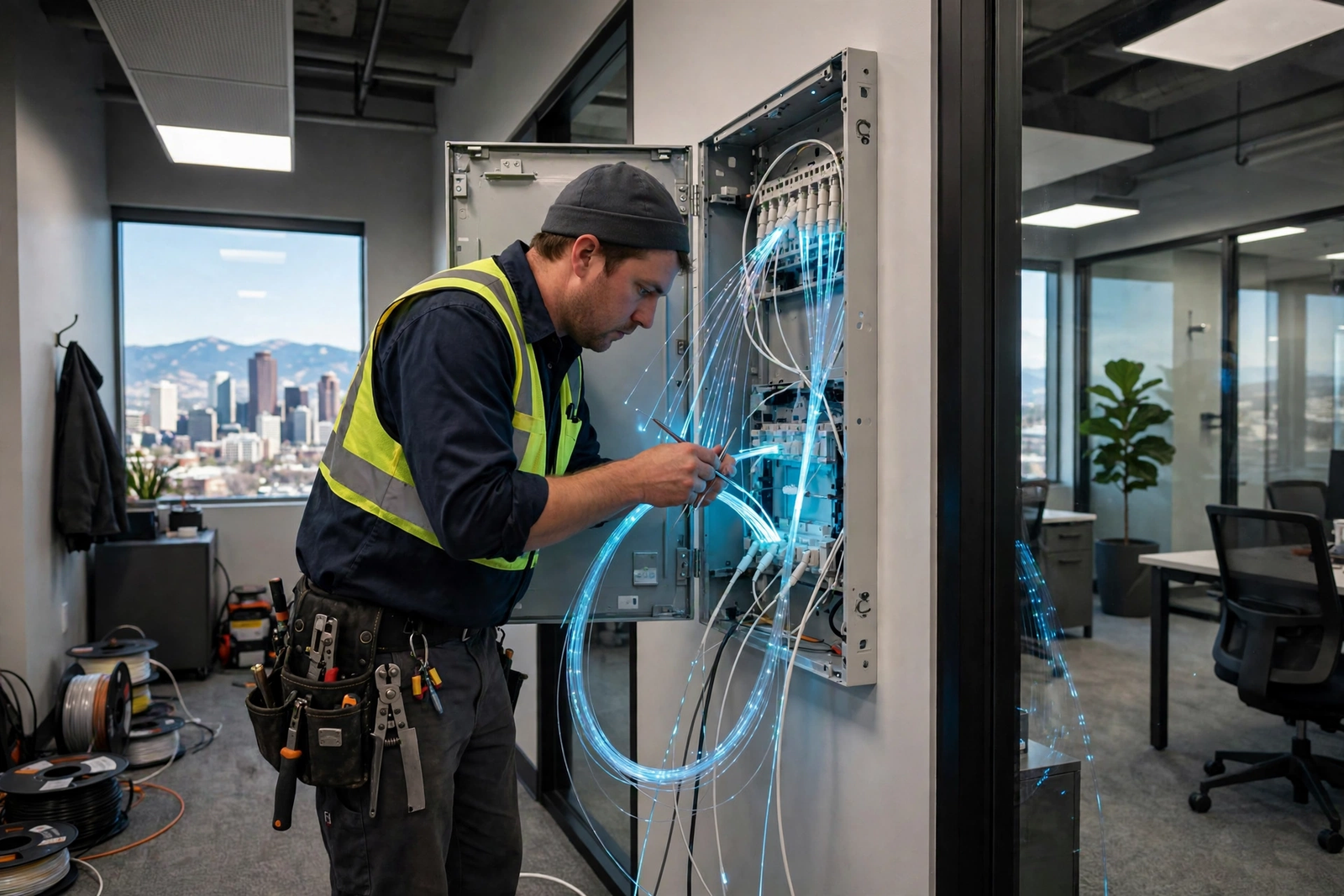
Quantum Fiber is the fiber brand of Lumen, the company that operates the former CenturyLink network in Denver, Colorado, and it is the largest fiber provider in the city by coverage. Comparison sources report Quantum Fiber offering speeds up to 8 Gbps, with plans starting at around $50 per month, and covering roughly 90 percent or more of premises in many central neighborhoods. That combination of speed and coverage makes Quantum Fiber the first provider to check for most Denver businesses that want fiber, particularly in Downtown, LoDo, RiNo, Cherry Creek, and the Denver Tech Center, where fiber is densest. Speeds are symmetrical on fiber plans, so uploads match downloads, which matters for cloud-based point-of-sale systems, video conferencing, and offsite backups.
Quantum Fiber’s main weakness is the same as every fiber provider’s: coverage is not universal. Outside the densest central neighborhoods, availability falls away, and some business parks, older buildings, and outer neighborhoods may have no Quantum Fiber at all. Prices also vary by speed tier and by whether the address qualifies for a promotional rate, so the starting price of around $50 per month is a floor for the slowest tier rather than a promise for gigabit service. When you get a Quantum Fiber quote, ask whether the price includes the gateway and installation, whether it rises after an introductory period, and what the contract term is, because those details decide the real first-year cost. If Quantum Fiber reaches your building, compare it directly with AT&T Business Fiber where available and with Comcast Business cable, and weigh symmetrical fiber speeds against cable’s faster installation and wider coverage.
Comcast Business: Denver Business Internet Providers on Cable
Comcast Business is the dominant cable provider in Denver, Colorado, and for many businesses it is the most practical choice, not because cable is the fastest technology, but because it is available almost everywhere and installs quickly. Comparison sources report Comcast Business covering close to 99 percent of premises in many Denver neighborhoods, with download speeds up to 2 Gbps on its fastest shared plans. For a shop, restaurant, clinic, or office that needs service this week rather than next month, that coverage and speed of install often matters more than the theoretical top speed of a fiber plan that may not reach the building for months.
Cable has real limitations that Denver business owners should understand before signing. Upload speeds on cable are much lower than download speeds, so a plan advertised at 1 Gbps download may only offer 35 to 100 Mbps upload, which can bottleneck video calls, cloud backups, and remote access if several people work at once. Cable speeds are also shared with nearby users, so performance can dip at peak hours in busy commercial areas, although business plans get priority over residential traffic on the same network. Shared business fiber and cable plans in Denver typically run roughly $100 to $350 per month for speeds up to 1 Gbps, according to 2026 broker data, and Comcast Business sits inside that range for most tiers. Ask for the upload speed in writing, ask whether the quoted price is an introductory rate, and ask what the price becomes after the first year, because cable providers commonly raise prices after a 12-month term.
Comcast Business also sells dedicated internet and Ethernet services for larger Denver offices, plus phone and security bundles that some businesses find convenient. Bundling can save money, but it can also tie your internet contract to services you do not need, so compare the bundled price against buying internet alone and adding phone separately. If your business depends on uploads, or if you run a call center, a design studio, or a medical office with large imaging files, fiber from Quantum Fiber or AT&T Business Fiber will usually serve you better than cable, provided it reaches your address. If your business mostly browses, takes card payments, and runs a few video calls, Comcast Business cable is often more than enough, and its availability makes it the safe shortlist choice.
Denver Business Internet Speeds: How Much Your Team Actually Needs
Providers advertise speeds, but businesses buy outcomes: video calls that do not freeze, card payments that clear instantly, and files that upload before the client meeting starts. The table below gives a practical starting point for Denver business internet speeds, based on how many people work at once and what they do. Use it to avoid the two common mistakes: buying far more speed than a small shop needs, and buying a cheap plan whose upload speed chokes a busy office.
| Business type | People online at once | Download speed to look for | Upload speed to look for |
|---|---|---|---|
| Solo office or small shop | 1 to 3 | 100 to 300 Mbps | 20 to 100 Mbps |
| Small office or cafe | 4 to 10 | 300 to 500 Mbps | 100 to 300 Mbps |
| Mid-sized office or clinic | 11 to 25 | 500 Mbps to 1 Gbps | 300 Mbps to 1 Gbps |
| Large office or call center | 26 or more | 1 Gbps or higher | 1 Gbps symmetrical |
| Design studio or media team | 5 to 15 | 1 Gbps | 1 Gbps symmetrical |
Upload speed deserves special attention in Denver, Colorado, because it is where cable and fiber differ most. A fiber plan with 500 Mbps symmetrical gives you 500 Mbps in both directions, while a cable plan advertised at 500 Mbps download may only give you 50 Mbps upload. If your team spends the day on video calls, uploads large files to the cloud, or runs a server that remote staff connect to, upload speed is the number that decides whether the connection feels fast or slow. Businesses that only browse, email, and take card payments can live happily on modest upload speeds, but any business that creates and sends large files should treat symmetrical fiber as the default and cable as a compromise. Our guide on how to choose business internet walks through the same speed decision in more detail, including how to count connected devices and guest Wi-Fi users that most owners forget.
Speed needs also change with the number of connected devices, not just the number of people. A Denver restaurant with ten staff, twenty smart devices, a point-of-sale system, security cameras, and guest Wi-Fi for fifty diners can have more devices online than a twenty-person office, and each camera and terminal takes a slice of bandwidth. Before choosing a speed tier, count the devices that will be connected during your busiest hour, including cameras, printers, card readers, smart thermostats, and guest phones, and add a margin of at least 25 percent for growth. If the count surprises you, that is a sign to step up a tier rather than buy the cheapest plan and discover the shortfall during a lunch rush.
Fixed Wireless Business Internet Options in Denver, Colorado
Fixed wireless is the fastest way to get a Denver business online, and it deserves a place on every shortlist, either as a primary connection for a small location or as a backup for a larger one. T-Mobile 5G Business Internet and AT&T Internet Air for Business both serve Denver, Colorado, delivering internet over the mobile network to a gateway device that you plug in at your premises, with no trench, no wiring visit, and often same-week activation. Speeds vary with signal strength, distance from the nearest cell site, and network congestion, so fixed wireless is less predictable than fiber or cable, but for many small businesses it is fast enough, and its simplicity is hard to beat.
Fixed wireless works best in three Denver situations. The first is a new or temporary location, such as a pop-up shop, a construction office, or a business waiting for a fiber install, where waiting weeks for a wired install would cost more than the wireless plan. The second is a small office or shop with light needs, where the gateway’s speeds are plenty and the low setup effort matters more than top-end performance. The third, and most common, is as a backup connection: a fixed wireless gateway on a different network from your wired provider keeps card payments and basic operations running if the main line goes down, and automatic failover routers make the switch without staff having to do anything. Ask any fixed wireless provider for a trial or a realistic speed estimate at your address, and test it during your busiest hours before relying on it, because a gateway that tests well at midnight can struggle at noon in a busy commercial district.
Denver Business Internet Availability by Neighborhood

Denver, Colorado is not one broadband market but many, and availability changes by neighborhood in ways that surprise business owners who move across town. Fiber is densest in Downtown, LoDo, RiNo, Cherry Creek, and the Denver Tech Center, where office towers, new apartment buildings, and business parks have attracted multiple fiber networks. In those areas a business can often choose between Quantum Fiber, a dedicated fiber provider, and cable, and prices are more competitive because providers compete for the same buildings. Comparison sources report Quantum Fiber covering roughly 90 percent or more of premises in many central neighborhoods, which is unusually high for a fiber network and reflects how much of Denver’s core has been built or rebuilt in the fiber era.
Outside the core, the picture changes. Neighborhoods such as Montbello, Green Valley Ranch, and parts of southeast Denver have good cable coverage from Comcast Business but thinner fiber, and some business parks on the city edge rely on a single provider or on fixed wireless. Older commercial buildings can also be a problem even in central neighborhoods: a building constructed before fiber was standard may need a wiring run, landlord permission, and a construction survey before fiber can be installed, which adds weeks and sometimes a construction charge. That is why two businesses on the same street can get very different answers, and why an address check matters more than any coverage map. If you are signing a lease, check internet availability before you sign, not after, and ask the landlord which providers already serve the building and whether any provider has exclusive wiring rights.
Multi-location Denver businesses face the same neighborhood problem multiplied across sites. A chain with a Downtown flagship, a Cherry Creek shop, and a warehouse near the airport may find fiber at one site, cable at the second, and only fixed wireless at the third, and trying to force one provider onto all three sites usually means overpaying at one site or accepting slow service at another. The practical approach is to buy the best available connection at each site and manage them centrally with a single IT contact or a managed service, rather than insisting on a single provider everywhere. Businesses comparing other cities can see the same pattern in our guide to the best business internet providers in Sacramento, California, where fiber is also concentrated in central neighborhoods and cable fills the gaps.
Disclaimer: This article contains affiliate links to AT&T Business services; we may earn a commission at no extra cost to you. Ortelcom.com is an independent publisher not affiliated with or endorsed by AT&T. Pricing, speeds and availability are not guaranteed, were checked 6 November 2026, and vary by address and promotions. Confirm all details before ordering. AT&T trademarks belong to their owner.
How to Choose Business Internet Providers in Denver, Colorado
Choosing between the business internet providers in Denver, Colorado comes down to five questions, and answering them in order saves most businesses from the common traps. First, what is actually available at your exact suite, not just your street? Second, how much upload speed do you really need during your busiest hour? Third, how fast do you need the service installed, and can you wait for a fiber build if that is the better long-term option? Fourth, what does the price become after any introductory period, and what are the install, equipment, and early termination charges? Fifth, what happens when the connection fails, and how quickly will the provider fix it?
Work through those questions with a simple checklist before you sign anything. Confirm availability in writing for your suite, including whether installation needs landlord permission. Get the upload speed, not just the download speed, in the quote. Ask for the price after the introductory period and the total first-year cost including installation and equipment. Ask about the contract term and the early termination fee, and whether a no-contract option exists. Ask about the service level agreement: how quickly the provider promises to respond to an outage, and whether that promise carries a credit if it is missed. Ask whether the gateway is included or rented, and whether you can use your own router. Finally, ask for a backup option, whether that is a second wired provider, a fixed wireless gateway, or a mobile hotspot, because even the best network goes down occasionally and a Denver business that cannot take card payments loses money by the minute.
One more practical point: do not choose a provider on advertised speed alone. Two plans both advertised at 1 Gbps can feel very different in practice if one is symmetrical fiber and the other is cable with a 35 Mbps upload, or if one is a dedicated line with a service level agreement and the other is a shared line with no uptime promise. Read the quote the way you would read a lease: look for the numbers that are guaranteed, the numbers that are merely typical, and the charges that only appear in the fine print. A provider that is transparent about upload speeds, install timelines, and post-introductory pricing is usually a safer choice than a provider whose quote looks cheaper because half the cost is hidden.
Denver Business Internet Pricing and Contract Pitfalls to Avoid
Denver business internet pricing follows the national pattern, with shared plans cheaper than dedicated ones and fiber usually priced above cable at the same download speed. According to 2026 broker data, shared business fiber and cable in Denver typically run roughly $100 to $350 per month for speeds up to 1 Gbps, while Dedicated Internet Access runs about $300 to $700 per month for 100 Mbps symmetrical and about $700 to $2,000 per month for 1 Gbps. AT&T Business Fiber’s national business plans start from $40 per month on AT&T’s own city pages, and Quantum Fiber plans start at around $50 per month, but those entry prices are for the slowest tiers, and a gigabit fiber plan will cost several times more. For a sense of how the same pricing questions play out in another large city, see our breakdown of business internet cost in Los Angeles, California, which covers the same shared-versus-dedicated split and the same hidden fees.
The pitfalls that cost Denver businesses money are rarely the monthly price itself. Installation charges are the first: a standard install may be free or low cost, but a fiber build into a building that has never had fiber can cost hundreds or thousands of dollars, sometimes waived if you sign a longer term. Equipment charges are the second: a gateway may be included, rented for $10 to $15 per month, or sold outright, and that difference adds up over a three-year term. Early termination fees are the third: a three-year contract with a large termination fee is a bad fit for a business on a one-year lease. Price rises after an introductory period are the fourth: a plan quoted at $99 per month for 12 months that rises to $199 per month in month 13 is not a $99 plan. Static IP addresses, extra Wi-Fi access points, and managed router services are the fifth: each is a legitimate add-on, but each should be priced separately so you can decide whether you need it. Get every one of these in writing before you sign, and compare providers on total first-year and second-year cost, not on the first month’s price.
Frequently Asked Questions About Business Internet Providers in Denver, Colorado
What are the best business internet providers in Denver, Colorado?
Quantum Fiber and Comcast Business are the strongest overall choices for most Denver businesses, because Quantum Fiber offers the widest fiber coverage with symmetrical speeds up to 8 Gbps, while Comcast Business offers cable up to 2 Gbps download with coverage near 99 percent in many neighborhoods. AT&T Business Fiber is worth checking wherever it is available, since it offers symmetrical speeds from 300 Mbps to 5 GIG with no data caps, but its Denver fiber footprint is limited, so it is an address-specific option rather than a citywide default. Spectrum Business, T-Mobile fixed wireless, and AT&T Internet Air for Business fill out the shortlist, and dedicated providers such as Lumen, Zayo, and Cogent serve larger offices.
Is fiber internet available for businesses in Denver, Colorado?
Yes, fiber internet is available for many Denver businesses, and it is densest in Downtown, LoDo, RiNo, Cherry Creek, and the Denver Tech Center, where Quantum Fiber covers roughly 90 percent or more of premises in many central neighborhoods according to comparison sources. Availability falls away in outer neighborhoods and in older buildings that have never been wired for fiber, so the only reliable answer is an address check for your exact suite. If fiber is not available at your building, cable from Comcast Business or fixed wireless from T-Mobile or AT&T Internet Air for Business are the usual alternatives.
How fast should business internet be in Denver, Colorado?
A solo office or small shop is usually well served by 100 to 300 Mbps download, a small office with 4 to 10 people should look at 300 to 500 Mbps, and a mid-sized office with 11 to 25 people should look at 500 Mbps to 1 Gbps. Upload speed matters as much as download speed: businesses that run video calls, cloud backups, and large file uploads should aim for symmetrical speeds, which means fiber, while businesses that mainly browse and take card payments can manage on cable upload speeds. Count connected devices as well as people, and add a margin of at least 25 percent for growth.
Can I get business internet in Denver, Colorado without a contract?
Yes, several Denver providers offer no-contract or month-to-month options. AT&T Business Fiber has no annual contract on shared plans nationally, and fixed wireless services are often month-to-month. Cable and fiber providers may offer lower monthly prices on 12-month or longer terms, so compare the no-contract price against the contract price and the early termination fee before deciding. A short-term or no-contract plan is usually the better choice for a business on a short lease or in a temporary location.
What is the cheapest business internet in Denver, Colorado?
The cheapest advertised business plans in Denver start at around $40 to $50 per month for entry-level fiber tiers from AT&T Business Fiber nationally and Quantum Fiber locally, but those prices are for the slowest speeds and may rise after an introductory period. For most small businesses, a realistic budget is roughly $100 to $350 per month for a shared fiber or cable plan up to 1 Gbps, according to 2026 broker data. Compare total first-year cost including installation and equipment, not just the first month’s price, and be wary of any quote that does not state the price after the introductory period.
Final Word on Choosing Denver Business Internet
Denver, Colorado rewards businesses that check availability before they fall in love with a provider. Quantum Fiber is the fiber leader in the city, Comcast Business is the coverage and speed-of-install leader, and AT&T Business Fiber is a strong option wherever its limited Denver footprint reaches your building, with AT&T Internet Air for Business as the realistic fallback where fiber does not reach. Start with address checks at all three, compare symmetrical speeds and total first-year costs rather than advertised download speeds and first-month prices, and keep a backup connection in mind from day one. Done that way, the provider you choose will be the one that actually serves your suite at the speed your team needs, at a price you can predict, and that is the whole point of a buying guide.
If your Denver business is still deciding between fiber and cable, or between a shared plan and a dedicated line, the deciding question is simple: how much does an hour without internet cost you? For a shop that cannot take card payments, or an office that cannot join video calls, the answer is usually enough to justify fiber with a backup connection, even if the monthly price is higher. Spend the extra hour getting address-specific quotes, read the contract terms before you sign, and choose the provider whose network reaches your building, whose upload speed matches your work, and whose price stays honest after the first year.

