
Business fiber internet in Chicago, Illinois is available from AT&T Business Fiber at speeds from 300 Mbps to 5 GIG, all symmetrical, with no data caps and a gateway included, and it is the fastest and most reliable business internet technology in the city — but it does not reach every building. AT&T fiber reaches about 83 percent of homes in Portage Park, about 32 percent in the Near South Side, and only about 3 percent in West Ridge, according to FCC-based neighborhood reporting, so the first question for any Chicago business is not which fiber plan to buy, but whether fiber reaches its suite. Where it does, a 1 GIG fiber connection lists at $140 per month, or $90 with an eligible AT&T business wireless plan, and it includes built-in 5G backup. This guide to business fiber internet in Chicago, Illinois covers the providers, the plans, the installation steps, the timelines, and the costs, so you can tell in one read whether fiber is available at your address and what it will take to get it installed.
Chicago, Illinois is a fiber city in progress rather than a finished one. The Loop, River North, and the West Loop have the densest fiber in the city, with AT&T fiber in many office towers and dedicated enterprise fiber from carriers such as Zayo available to large tenants, while the neighborhoods have a patchwork: strong fiber in Portage Park, growing fiber in Lincoln Park and Lakeview, and thin fiber in Rogers Park and West Ridge, where cable still does most of the work. Astound Business offers fiber up to 2 Gbps in selected buildings, and Comcast Business offers dedicated fiber up to 10 Gbps for larger offices, but for most small and mid-sized Chicago businesses, the fiber decision is an AT&T decision, because AT&T is the only provider selling shared fiber plans across a large part of the city. All prices and availability figures in this guide were checked on the publish date, and every one of them varies by address, promotion, and building, so treat them as planning figures and confirm the exact quote for your address before ordering.
Check AT&T Business Fiber Availability for Your Chicago Address
Symmetrical fiber speeds from 300 Mbps to 5 GIG, with no data caps and a gateway included.
Business Fiber Internet in Chicago, Illinois at a Glance
The table below summarizes business fiber internet in Chicago, Illinois: the providers that sell it, the speeds they offer, and the type of business each one suits. Shared fiber is the product most Chicago businesses should buy, because it delivers symmetrical gigabit speeds at a small-business price. Dedicated fiber is a different product, sold on a quote-only basis to larger offices, and it is worth knowing the difference before you ask for a quote, because the two products are priced in entirely different ways.
| Provider | Fiber product | Top speed | Starting price | Best for |
|---|---|---|---|---|
| AT&T Business Fiber | Shared fiber | 5 GIG symmetrical | $60 per month | Most Chicago businesses |
| Astound Business | Shared fiber in selected buildings | Up to 2 Gbps | From $44.95 per month | Budget offices in Astound buildings |
| Comcast Business | Dedicated fiber | Up to 10 Gbps | Quote only | Larger offices needing a service level agreement |
| Zayo Group | Dedicated enterprise fiber | Far above 10 Gbps | Quote only | Enterprise and data-heavy tenants |
Get A Free AT&T Business Fiber Quote
Symmetrical fiber speeds from 300 Mbps to 5 GIG, with no data caps and a gateway included.
AT&T Business Fiber in Chicago, Illinois: Plans, Speeds, and Availability
AT&T Business Fiber is the main shared-fiber product for Chicago businesses, and its plan structure is simple: five symmetrical tiers, no data caps, a Wi-Fi gateway included, and no annual contract on the shared plans. Published list prices checked on the publish date are 300 Mbps at $60 per month, 500 Mbps at $100, 1 GIG at $140, 2 GIG at $185, and 5 GIG at $285, all before taxes and fees, falling to $40, $60, $90, $135, and $235 per month with an eligible AT&T business wireless plan. The 300 Mbps tier suits a solo office or a two-person shop with 3 to 5 users, the 500 Mbps tier suits 5 to 10 users, the 1 GIG tier suits 10 to 20 users and is the sweet spot for most Chicago offices, and the 2 GIG and 5 GIG tiers suit larger offices, design studios, and businesses that move large files all day. Before you order, check AT&T Business Fiber availability and pricing for your Chicago address to confirm which tiers reach your building, because dealer landing pages sometimes show lower promotional prices that are not the standard list price.
Availability is where the Chicago fiber story gets specific. Comparison data describes AT&T as the largest provider in the Chicago area, with service available to a majority of households and fiber speeds up to 5,000 Mbps where the network is built. But FCC-based neighborhood reporting shows the footprint is uneven: AT&T Business Fiber reaches roughly 83 percent of homes in Portage Park, about 32 percent in the Near South Side, and only about 3 percent in West Ridge, and in Rogers Park it is barely present at all, while AT&T’s older DSL network still covers roughly 98 percent of homes there at speeds up to 100 Mbps. DSL is not fiber and should never be sold as a substitute for it, so a Rogers Park business that is offered AT&T should ask specifically whether the quote is for fiber or for DSL. The 1 GIG tier and higher include built-in 5G backup, which keeps the office online if the fiber line itself is cut, as long as the specified gateway is in place, but the backup does not work during a power loss, so a business that cannot tolerate any outage still needs battery backup for the gateway. Our guide to how to order and install AT&T Business Fiber walks through the order, survey, and installation steps in full, and it is the best companion to this guide if you are ready to book an install.
Other Business Fiber Internet Providers in Chicago, Illinois
AT&T is not the only fiber name in Chicago, Illinois, but the alternatives are narrower in reach and different in kind, so they need to be understood on their own terms. Astound Business, the business brand of Astound Broadband, formerly RCN in Chicago, offers fiber in selected buildings, with speeds up to 2 Gbps symmetrical in fiber-served areas and no data caps. Its Chicago business page lists internet up to 110 Mbps at $44.95 per month, up to 500 Mbps at $64.95, and up to 1,000 Mbps at $174.95, with a one-year price lock, no contract required, and free installation. FCC-based neighborhood data puts Astound Business fiber at about 20 percent of homes in the Near South Side and about 5 percent in Rogers Park, so most Astound customers are buying cable rather than fiber, and the fiber price should always be confirmed for the specific building. Astound also charges a Network Access and Maintenance Fee of up to $21.85 per month, which is not in the advertised price and should be added before comparing.
Comcast Business sells dedicated fiber with speeds up to 10 Gbps, but dedicated fiber is a different product from the shared fiber plans in this guide: it is a private line for one business, priced by quote, usually with a multi-year term and a service level agreement, and it is aimed at larger offices, multi-location businesses, and companies that need guaranteed uptime and repair times. A small Chicago business that asks Comcast for fiber will usually be offered its cable plans first, with dedicated fiber only where the business case justifies it, and the quote process takes longer than a shared-fiber order. Zayo Group is the other enterprise fiber name that appears in Chicago coverage data, with FCC data crediting it with the fastest advertised business speeds in some neighborhoods, but Zayo sells dedicated, quote-only enterprise circuits, not small-business plans, so it belongs on a shortlist only for large tenants that need dedicated capacity. For most Chicago businesses, the practical fiber choice is between AT&T shared fiber where it is available and Astound fiber where the building is served, with Comcast dedicated fiber as the enterprise step up. Our comparison of business internet providers in Denver, Colorado shows the same pattern in another major city, where one shared-fiber provider leads and dedicated fiber serves the larger end of the market.
Business Fiber Internet vs Cable in Chicago, Illinois
The difference between business fiber internet and cable in Chicago, Illinois comes down to one word: symmetrical. Fiber uploads at the same speed it downloads, so a 1 GIG fiber plan uploads at 1 GIG, while a cable plan that downloads at 1 Gbps may upload at only 35 Mbps, and that gap shows up every time a Chicago office backs up to the cloud, sends a large design file, runs a video call, or uploads security camera footage. For a household that mostly streams and downloads, cable is fine, but for a business that lives in the cloud, upload speed is the number that determines whether the working day feels fast or slow, and only fiber delivers it at gigabit levels. Fiber is also less affected by neighborhood congestion than cable, because the fiber line is not shared with the whole street in the same way, and its latency is lower, which matters for video calls, voice-over-IP phones, and remote desktop work.
Cable still has two genuine advantages in Chicago, Illinois, and they should be stated fairly. The first is availability: Comcast Business cable reaches about 97 percent of Chicago addresses, while AT&T fiber reaches a majority of households citywide but far less in some neighborhoods, so a business in West Ridge or Rogers Park may have no fiber option at all and cable is the only wired choice. The second is installation speed: where the coaxial cable is already in the building, a cable install can happen in days, while a fiber install that needs a new drop can take weeks. The price comparison is closer than it looks, too: Comcast’s 300 Mbps tier starts at $70 per month, or $60 on promotion, against AT&T fiber’s $60 list, but Comcast’s price rises to $100 in months 13 to 24 and $140 in months 25 to 36, while AT&T’s list price has no scheduled first-year rise, so fiber is usually cheaper over two years. A business that can get fiber should usually buy fiber, and a business that cannot should buy cable and plan to re-check fiber availability every year, because the fiber footprint is still growing.
Business Fiber Internet Installation in Chicago, Illinois: Step by Step
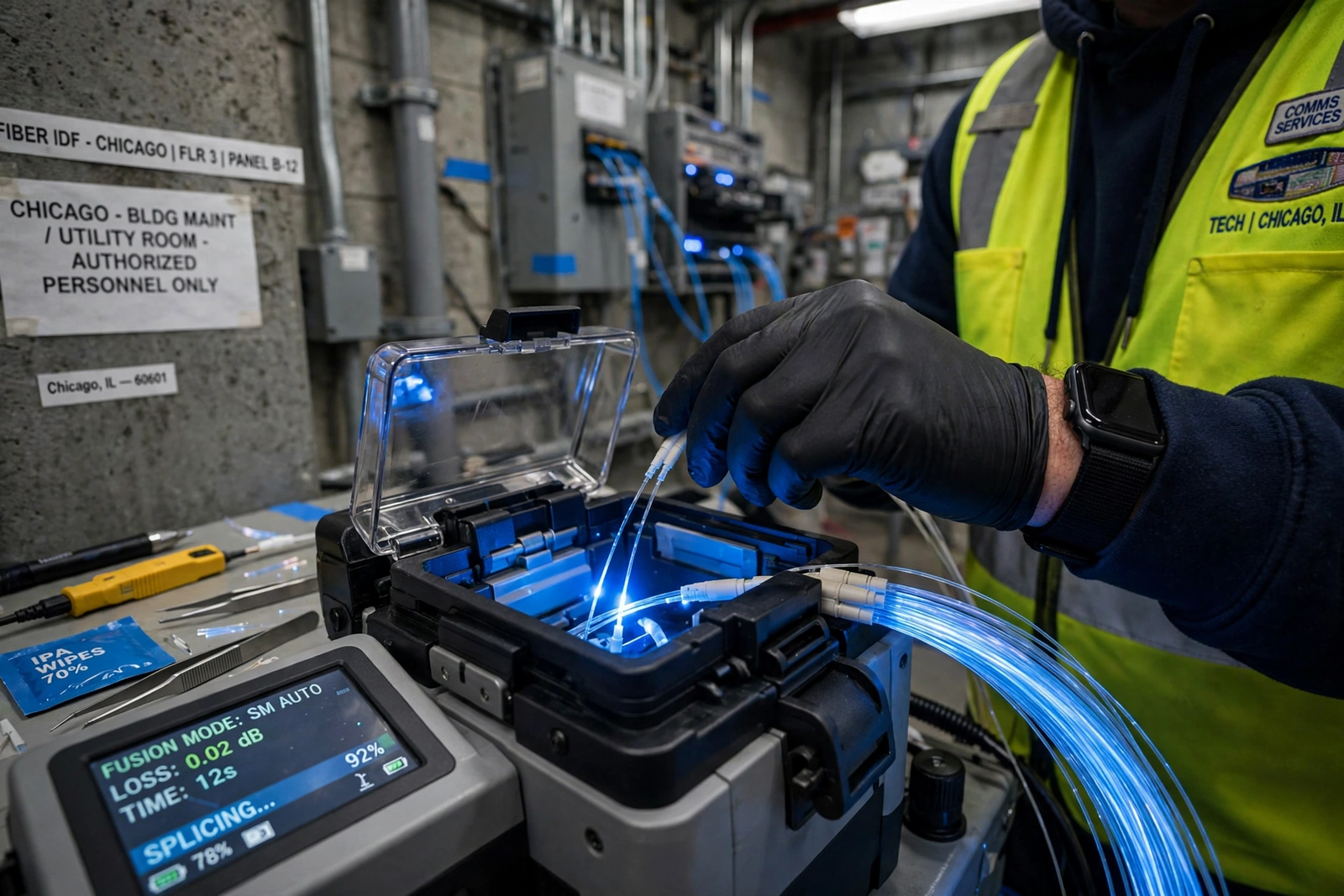
Installing business fiber internet in Chicago, Illinois follows a clear sequence, and knowing it in advance is what keeps an install on schedule. Step one is the address check and the quote: the provider confirms which fiber tiers reach your building, whether the building is already wired for fiber, and what the price will be, and you should get that quote in writing with the installation fee, the monthly price after any promotion, and the contract term stated. Step two is the site survey, which happens when the building is not already wired or when the fiber drop needs new construction: a technician visits, checks where the fiber enters the building, how it reaches your suite, and whether any drilling, conduit, or landlord permission is needed. In Chicago, Illinois, the survey matters more than in many cities, because older Loop office towers and historic neighborhood buildings can have risers, conduits, and landlord rules that slow the work, and a business that skips the survey is the business that discovers the problem on installation day.
Step three is landlord approval, and it is the step most often underestimated. If you lease your space, the provider usually needs the landlord or property manager to approve the fiber installation, especially where new cabling, a new entry point, or work in common areas is involved, and that approval can take days or weeks depending on the building. Ask the property manager early which providers already have equipment in the building, whether there are exclusivity clauses, and who signs the access permission, because a building that already has AT&T fiber installed can skip straight to the in-suite work. Step four is the installation appointment itself: a technician brings the fiber into the suite, installs the optical network terminal, connects the Wi-Fi gateway, and tests the connection, and the appointment typically takes two to four hours for a standard office where the building is already wired. Step five is the network setup: the gateway is configured, the office Wi-Fi network is named and secured, any static IP addresses are assigned, and the connection is speed-tested on a wired connection, not just on Wi-Fi, so the business knows it is getting the speed it pays for. Step six is the cutover: the old connection is cancelled only after the fiber line has been tested and the business has run on it for at least a day, because cancelling early is how a business ends up with no internet at all.
How Long Does Business Fiber Installation Take in Chicago, Illinois?
The honest answer is that business fiber installation in Chicago, Illinois takes anywhere from a few days to several weeks, and the building determines the timeline more than the provider does. If the building is already wired for fiber and the suite needs only an in-suite install, the work can often be scheduled within a week and completed in a single two-to-four-hour appointment. If the building needs a new fiber drop, a construction survey, or landlord approval, the timeline extends to two to six weeks, and in older buildings or buildings where the fiber route crosses common areas, it can take longer. Winter is the other Chicago factor: outdoor construction and building access slow down in the worst of a Chicago winter, so a fiber install that needs exterior work should be booked with extra lead time between December and February, and a business opening on a fixed date should start the fiber order at least a month before the opening.
Three things shorten the timeline. First, order early and run the address check before you sign the lease, because a building that is already fiber-lit is worth more to a business than a building that needs a new build. Second, get the landlord involved on day one, because landlord approval is the most common delay and it is entirely avoidable with an early conversation. Third, keep the old connection running until the fiber line is tested, because the cost of a week of overlap is small compared with the cost of a day with no internet. Our guide to how to choose business internet explains how to plan a primary and a backup connection so the business stays online through the changeover, and our breakdown of business internet cost in Tampa, Florida shows how installation timelines and costs compare in a city with a different building stock.
Chicago Business Fiber Internet Availability by Neighborhood
Chicago, Illinois is a city of 77 community areas, and business fiber availability changes from one to the next, because the networks were built neighborhood by neighborhood over decades. The Loop, River North, and the West Loop have the densest fiber in the city, with AT&T fiber in many office towers, dedicated enterprise fiber available to large tenants, and strong 5G from all three mobile carriers as a backup option, but even in the Loop a business should check its specific floor and suite, because a fiber-lit tower does not guarantee fiber to every floor. The West Loop, with its concentration of restaurants, agencies, and food businesses, is particularly well served, and restaurant operators there should pay attention to upload speed, because cloud point-of-sale, online ordering, and security cameras all push data upstream at the same time.
The North Side tells a mixed story. Lincoln Park, Lakeview, and Wicker Park have broad Comcast cable coverage and growing AT&T fiber, with Astound fiber in selected buildings, and Portage Park is one of the strongest AT&T fiber neighborhoods in the city, at about 83 percent of homes. Rogers Park and West Ridge are the cautionary examples: Comcast cable reaches roughly 98 to 100 percent of homes in both, but AT&T Business Fiber reaches only about 3 percent in West Ridge, and Astound fiber is around 5 percent in Rogers Park, so a business in those neighborhoods will usually be choosing between cable and 5G rather than between two fiber networks. On the South Side, the Near South Side has AT&T Business Fiber at about 32 percent of homes and Astound fiber at about 20 percent, with Comcast cable at about 94 percent, while Hyde Park and Pilsen have solid cable coverage with fiber still expanding. The pattern is consistent across the city: fiber is the prize where it has been built, cable is the safety net everywhere, and the only way to know which you can buy is an address check. Our guide to business fiber internet in Orlando, Florida shows the same neighborhood-by-neighborhood pattern in a very different city, and the lesson travels: never assume citywide coverage from a provider’s national map.
Disclaimer: This article contains affiliate links to AT&T Business services; we may earn a commission at no extra cost to you. Ortelcom.com is an independent publisher not affiliated with or endorsed by AT&T. Pricing, speeds and availability are not guaranteed, were checked 8 November 2026, and vary by address and promotions. Confirm all details before ordering. AT&T trademarks belong to their owner.
Business Fiber Internet Costs in Chicago, Illinois
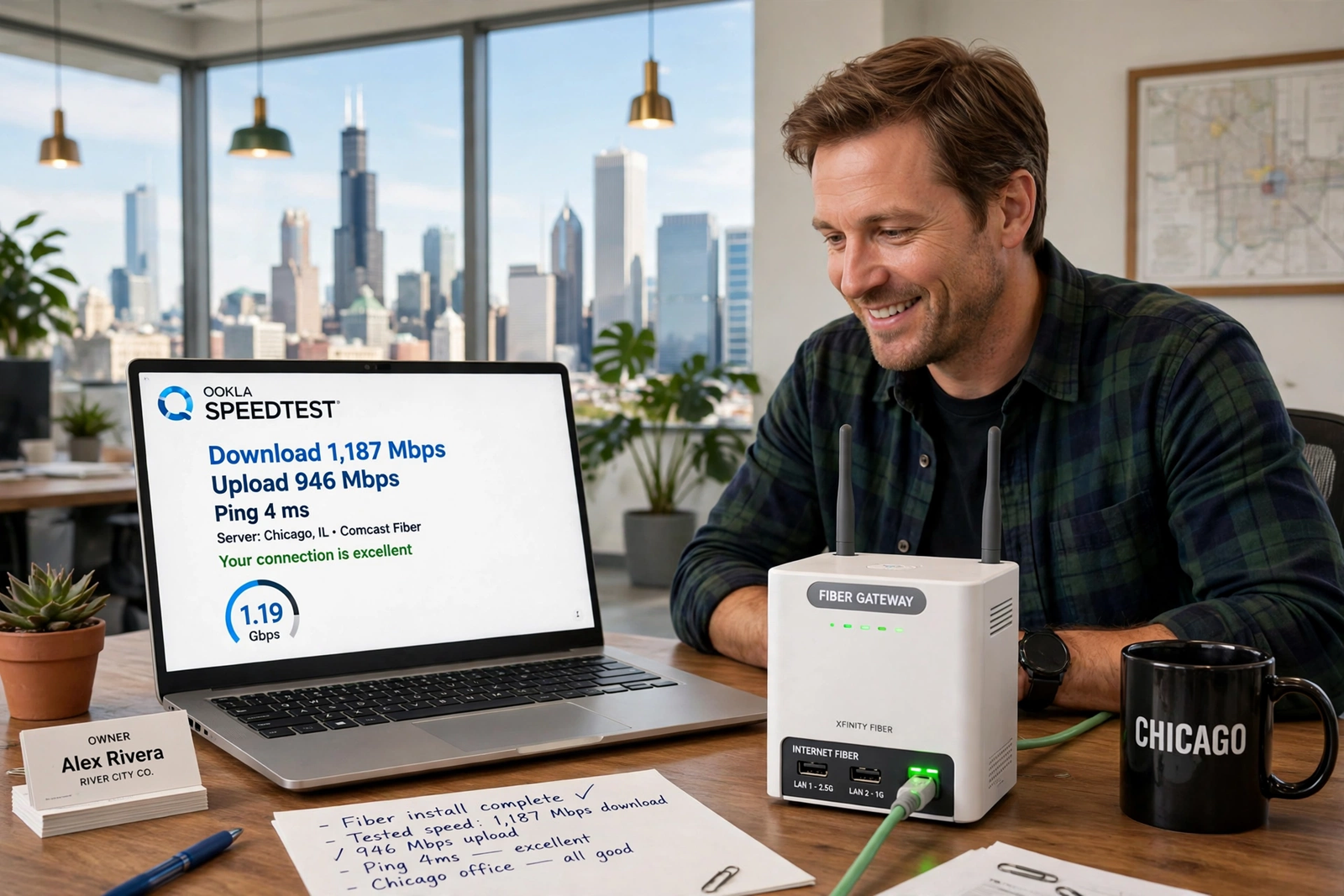
Business fiber internet costs in Chicago, Illinois are simple to budget once the headline price is separated from the total bill. AT&T Business Fiber lists at $60, $100, $140, $185, and $285 per month for 300 Mbps, 500 Mbps, 1 GIG, 2 GIG, and 5 GIG, falling to $40, $60, $90, $135, and $235 with an eligible AT&T business wireless plan, all before taxes and fees, with installation advertised as free on the shared plans and the gateway included rather than rented. Over two years, the 1 GIG tier costs $3,360 at list or $2,160 with the wireless discount, and that two-year total is the number to compare against cable, not the first month’s price. Astound Business fiber, where the building is served, lists from $44.95 per month for 110 Mbps to $174.95 for 1,000 Mbps, but its Network Access and Maintenance Fee of up to $21.85 per month should be added before comparing, which brings the 1 Gig tier to up to $196.80 per month. Dedicated fiber from Comcast Business or Zayo is priced by quote and costs substantially more, because it is a private line with a service level agreement rather than a shared plan, and a business that needs dedicated fiber should expect a multi-year term and a construction charge where a new build is required.
The costs that sit outside the monthly price are the ones to budget for separately. A fiber install that needs new construction or a building survey can carry a construction charge, a business that needs extra Wi-Fi access points for a larger office should budget $200 to $1,000 as a one-time hardware cost, and a small uninterruptible power supply for the gateway costs $100 to $300 and keeps the 5G backup working through a short power cut, which matters because the built-in 5G backup does not work during a power loss. Taxes and regulatory fees apply on top of every plan and vary by location. The cheapest fiber is the fiber that is already in the building, because the installation is fastest and cheapest, and the most expensive fiber is the fiber that needs a new build, so the building matters as much as the plan. A business that is choosing between two Chicago leases should ask about fiber availability before signing, because a lease in a fiber-lit building can save thousands of dollars in installation costs and weeks of waiting.
Chicago Business Fiber Internet Limitations Worth Knowing
Business fiber internet in Chicago, Illinois has real limitations, and an honest guide says so. The largest is coverage: fiber does not reach every building, and the neighborhoods with the least fiber are often the neighborhoods where small businesses most need an affordable fast connection, which means some Chicago businesses will pay cable prices for cable performance through no fault of their own. The second is installation time: a fiber install that needs a new drop, a construction survey, or landlord approval can take weeks, and a business that needs internet this week will usually have to start on cable or 5G and move to fiber later. The third is the building itself: older Chicago commercial buildings can have wiring that limits the speed a connection can actually deliver inside the suite, and a business that pays for 1 GIG but runs it through decade-old internal cabling will not see 1 GIG at the desk, so the internal wiring should be checked as part of the installation.
There are also limits in the fiber plans themselves. Shared fiber speeds are advertised as up to the tier speed, and actual speeds vary with the time of day, the number of users, and the equipment in the office. The 5G backup built into AT&T’s 1 GIG and higher tiers needs the specified gateway and does not work during a power loss. And the 5 GIG tier, while impressive on paper, delivers a maximum single-device wired speed of 4.7 Gbps, so a business that buys 5 GIG for a single workstation is paying for capacity it cannot use on one device. The right fiber plan is the one that matches the business’s real usage, not the fastest plan on the page, and a business that is unsure should start at 1 GIG and upgrade later, because AT&T’s no-annual-contract shared plans make changing tiers far easier than a cable contract does.
Frequently Asked Questions About Business Fiber Internet in Chicago, Illinois
Is business fiber internet available in Chicago, Illinois?
Yes, business fiber internet is available in Chicago, Illinois, but coverage varies sharply by neighborhood and by building. AT&T Business Fiber reaches about 83 percent of homes in Portage Park, about 32 percent in the Near South Side, and only about 3 percent in West Ridge, according to FCC-based neighborhood reporting, and Astound fiber is available in selected buildings. Check availability at your exact address, and ask the building manager which providers already have equipment in the building.
How much does business fiber internet cost in Chicago, Illinois?
Business fiber internet in Chicago, Illinois lists from $60 per month for AT&T Business Fiber 300 Mbps to $285 per month for 5 GIG, with 1 GIG at $140 per month, all before taxes and fees, and prices fall to $40, $60, $90, $135, and $235 with an eligible AT&T business wireless plan. Astound Business fiber lists from $44.95 per month where available, plus a network access fee of up to $21.85 per month. Installation is advertised as free on AT&T shared plans, and the gateway is included.
How long does business fiber installation take in Chicago, Illinois?
Business fiber installation in Chicago, Illinois takes from a few days to several weeks. If the building is already wired for fiber, the work can often be scheduled within a week and completed in a single two-to-four-hour appointment. If the building needs a new fiber drop, a construction survey, or landlord approval, the timeline extends to two to six weeks, and winter weather can add further delay to outdoor work. Start the order at least a month before a fixed opening date.
Is fiber better than cable for a Chicago, Illinois business?
For most Chicago, Illinois businesses, fiber is better than cable, because fiber uploads at the same speed it downloads, while cable uploads far more slowly than it downloads, and that difference shows up in cloud backups, video calls, and large file uploads. Cable still wins on availability, reaching about 97 percent of Chicago addresses against fiber’s patchy footprint, and on installation speed where the cable is already in the building. A business that can get fiber should usually buy fiber, and a business that cannot should buy cable and re-check fiber availability every year.
Do I need landlord permission to install business fiber in Chicago, Illinois?
Often, yes. If you lease your space in Chicago, Illinois, the fiber provider usually needs the landlord or property manager to approve the installation, especially where new cabling, a new entry point, or work in common areas is involved. Ask the property manager early which providers already have equipment in the building and who signs the access permission, because landlord approval is the most common cause of installation delay and it is entirely avoidable with an early conversation.
What speed of business fiber do I need in Chicago, Illinois?
Most Chicago, Illinois small businesses are well served by 300 Mbps to 1 GIG of business fiber. A solo office or two-person shop can work on 300 Mbps, a 5 to 10 person office should look at 500 Mbps to 1 GIG, and a 20-person office with heavy cloud use should start at 1 GIG and consider 2 GIG. Choose by upload needs as well as download: if the business backs up to the cloud, sends large files, or runs video calls all day, symmetrical fiber upload speed matters more than the download number.
Final Verdict: Business Fiber Internet in Chicago, Illinois
Business fiber internet in Chicago, Illinois is the best connection a Chicago business can buy, where it is available, and AT&T Business Fiber is the provider most Chicago businesses should check first. Its symmetrical speeds from 300 Mbps to 5 GIG, no data caps, included gateway, no annual contract, and built-in 5G backup on 1 GIG and higher tiers make it the strongest default choice in the city, with the 1 GIG tier at $140 per month, or $90 with an eligible wireless plan, suiting most offices of 10 to 20 people. Astound fiber is worth a quote in the buildings it serves, and dedicated fiber from Comcast Business or Zayo is the right step up for larger offices that need a service level agreement and guaranteed uptime.
The work that matters most is not choosing a plan but checking an address: run the availability check, ask the building manager which providers are already installed, get the landlord involved early, and keep the old connection running until the fiber line is tested. Chicago, Illinois rewards the businesses that do that work, because the city has more fiber choice than most American cities, and the businesses that end up happiest with their internet are the ones that treated the address check and the installation plan as the first steps, not the last ones.

