
If you run a business in Chicago, Illinois, the short answer to the question of which business internet provider to choose is this: start with AT&T Business Fiber where it reaches your building, because it offers symmetrical speeds from 300 Mbps to 5 GIG with no data caps and a gateway included, and keep Xfinity from Comcast Business as the near-universal fallback, because its cable network reaches roughly 97 percent of Chicago addresses. Chicago is one of the best-connected business cities in the United States, with fiber, cable, and 5G fixed wireless all competing across the Loop and the neighborhoods, but coverage is uneven from one block to the next, and the provider that serves your suite matters far more than the provider with the fastest advertised speed. This guide to the best business internet providers in Chicago, Illinois compares the real options for Chicago businesses — wired fiber, cable, and 5G fixed wireless — with honest coverage limits, published prices, and the buying steps that keep you from signing the wrong contract.
Chicago, Illinois is the third-largest city in the United States, home to roughly 2.6 million people and one of the densest concentrations of small businesses, restaurants, professional firms, and logistics companies in the country. The Loop and West Loop hold the corporate core, River North and the Near North Side hold agencies and tech firms, and neighborhood commercial corridors from Lincoln Park to Pilsen to Hyde Park hold thousands of storefronts that all depend on the same thing: internet that stays up during the lunch rush, the client video call, and the card payment at the register. Federal Communications Commission broadband data shows that most Chicago businesses can choose between at least two wired providers, but the fiber picture changes sharply by neighborhood. AT&T Business Fiber reaches about 83 percent of homes in Portage Park, about 32 percent in the Near South Side, and only about 3 percent in West Ridge, according to FCC-based neighborhood reporting. That spread is the single most important fact in this guide: in Chicago, Illinois, you do not buy a provider, you buy an address.
Check AT&T Business Fiber Availability for Your Chicago Address
Symmetrical fiber speeds from 300 Mbps to 5 GIG, with no data caps and a gateway included.
Best Business Internet Providers in Chicago, Illinois at a Glance
The table below summarizes the best business internet providers in Chicago, Illinois, the technology each one sells, the speeds comparison sources report, and the type of business each one suits best. Shared fiber is the right choice for most businesses, because it is fast, symmetrical, and far cheaper than a dedicated line. Cable is the fallback where fiber does not reach a building, and 5G fixed wireless is the fast-setup option for temporary sites, pop-ups, and backup. Prices are published starting points checked on the publish date, before taxes and fees, and every one of them varies by address, promotion, and contract term, so treat the table as a comparison tool and confirm the exact quote for your address before ordering.
| Provider | Technology | Top speed | Starting price | Best for |
|---|---|---|---|---|
| AT&T Business Fiber | Fiber | 5 GIG symmetrical | $60 per month | Most Chicago businesses where available |
| Xfinity from Comcast Business | Cable and fiber | 2 Gbps download | $70 per month | Near-universal Chicago coverage |
| Astound Business | Cable and fiber | 1 Gbps business tier | $44.95 per month | Budget offices in Astound buildings |
| T-Mobile Small Business Internet | 5G fixed wireless | Up to 400 Mbps | $35 per line per month with voice line | Fast setup and backup |
| Verizon 5G Business Internet | 5G fixed wireless | Up to 400 Mbps | $69 per month | Defined speed tiers on 5G |
Get A Free AT&T Business Fiber Quote
Symmetrical fiber speeds from 300 Mbps to 5 GIG, with no data caps and a gateway included.
Two names that Chicago business owners often ask about need a straight answer up front. Spectrum Business is a strong provider in many American cities, but its Chicago presence is limited and sources conflict about it: one coverage guide lists Chicago among the big cities Spectrum misses, a Charter dealer page states plainly that the Spectrum footprint does not cover Chicago, and broadband comparison data shows Spectrum availability of about 33 percent in one Chicago ZIP code, which points to scattered suburban or edge coverage rather than a reliable city network. Treat Spectrum as a check-your-address option in the Chicago suburbs, not as a core Chicago provider. The other name is Zayo Group, an enterprise fiber carrier that FCC data credits with the fastest advertised business speeds in some Chicago neighborhoods, but Zayo sells dedicated, quote-only enterprise circuits, not the shared small-business plans this guide compares, so it belongs on a shortlist only for large offices that need dedicated fiber and a service level agreement.
AT&T Business Fiber: Chicago Business Internet Speeds and Availability
AT&T Business Fiber is the strongest all-round choice for Chicago businesses that can get it, and the reason is simple: it is the only widely available Chicago option that gives you the same speed up and down on every tier. The published shared-fiber tiers are 300 Mbps, 500 Mbps, 1 GIG, 2 GIG, and 5 GIG, all symmetrical, with no data caps, a Wi-Fi gateway included, and no annual contract on the shared plans. Published list prices checked on the publish date are $60, $100, $140, $185, and $285 per month before taxes and fees, falling to $40, $60, $90, $135, and $235 per month with an eligible AT&T business wireless plan. Those are the official list figures; dealer landing pages and limited-time promotions sometimes show lower numbers, and those lower numbers are promotions or bundled offers, not the standard list price. Before you order, check AT&T Business Fiber availability for your Chicago address to confirm which tiers reach your building and what the current offer is.
Availability is the real story with AT&T in Chicago, Illinois. Comparison data describes AT&T as the largest provider in the Chicago area, with service available to a majority of households, and its fiber network reaches up to 5,000 Mbps where it is built. But FCC-based neighborhood reporting shows how patchy that footprint is at street level: AT&T Business Fiber reaches roughly 83 percent of homes in Portage Park, about 32 percent in the Near South Side, and only about 3 percent in West Ridge. In Rogers Park, AT&T fiber is barely present at all, while its older DSL network still covers roughly 98 percent of homes there at speeds up to 100 Mbps — a reminder that AT&T’s legacy copper is not a substitute for its fiber. If your building is on the fiber footprint, the 1 GIG tier at $140 per month is the sweet spot for most offices of 10 to 20 people, and it includes built-in 5G backup, which keeps the office online if the fiber line itself is cut, as long as the specified gateway is in place. Note the limit honestly: the 5G backup does not work during a power loss, so a business that cannot tolerate any outage still needs a battery backup or a second connection on a different network.
For a Chicago business, the practical advantages of AT&T Business Fiber go beyond the headline speed. Symmetrical upload matters far more to a business than to a household, because offices upload constantly: cloud backups, point-of-sale batches, security camera footage, large design files, and video calls all push data upstream, and a cable plan that downloads at 1 Gbps but uploads at 35 Mbps will feel slow every time your team sends a file. AT&T also includes the gateway rather than charging a monthly rental, and the no-annual-contract term means a growing business is not locked into a speed tier it will outgrow in six months. The trade-offs are equally clear. Installation can take longer than cable where fiber still needs to be brought into the building, some older Chicago commercial buildings need landlord permission and a construction survey before fiber can be installed, and the list price rises after any promotional period, so the quote you sign is the number that matters, not the advertised starting price. Our guide to how to order and install AT&T Business Fiber walks through the order, survey, and installation steps in detail, and it is worth reading before you book an install date around a move or a launch.
Xfinity Comcast Business: Chicago Business Internet Coverage and Cable Speeds
Xfinity from Comcast Business is the provider most Chicago businesses can actually buy, and in a city where fiber coverage is patchy, that counts for a lot. FCC-based reporting puts Xfinity business internet availability in Chicago at about 97 percent, and its cable network reaches roughly 98 to 100 percent of homes in neighborhoods such as Rogers Park, West Ridge, and Portage Park. Comcast describes Chicago as core territory for its network, and its business plans run over the same hybrid fiber-coaxial plant that serves the city’s homes, with a dedicated fiber option up to 10 Gbps for larger offices that need it. If AT&T fiber does not reach your building, Comcast Business is usually the first call, and often the only wired call.
Comcast Business publishes four small-business tiers: up to 300 Mbps, up to 500 Mbps, up to 1.25 Gbps, and up to 2 Gbps download, with starting prices of $70, $100, $150, and $180 per month on one-year pricing with AutoPay and paperless billing from a bank account. A promotional Essential offer shows $60 per month for the first 12 months on the 300 Mbps tier, but the price steps up to $100 per month for months 13 to 24 and $140 per month for months 25 to 36, which is the most important number in the whole Comcast price list and the one most often missed. Equipment is included, the SecurityEdge security service is included on all plans, and Comcast Business internet plans do not include data caps. The catch is the contract: advertised business prices require a one-year term agreement, and an early termination fee applies if you leave early, so a business that expects to move or change size within a year should get the termination terms in writing before signing. Upload speeds are the other honest limitation. Cable is asymmetric by design, so even the 2 Gbps download tier uploads far more slowly than a fiber plan, and a business that lives in the cloud should test upload performance during the trial period rather than trusting the download number alone.
Comcast Business also sells a five-year price lock guarantee on some plans, which appeals to businesses that want predictable bills, and it offers Wireless Connect, a 5G backup add-on that keeps the office online if the cable line fails. For a Chicago restaurant, retailer, or professional office that needs service this week, Comcast’s installation is usually faster than a fiber build, because the coaxial cable is often already in the building. That speed of install is a genuine advantage for a new lease or a business opening on a fixed date. Our comparison of business internet providers in Denver, Colorado shows the same Comcast pattern in another major city, where cable’s near-universal coverage makes it the default where fiber is still being built.
Astound Business: Chicago Business Internet Pricing for Budget Offices
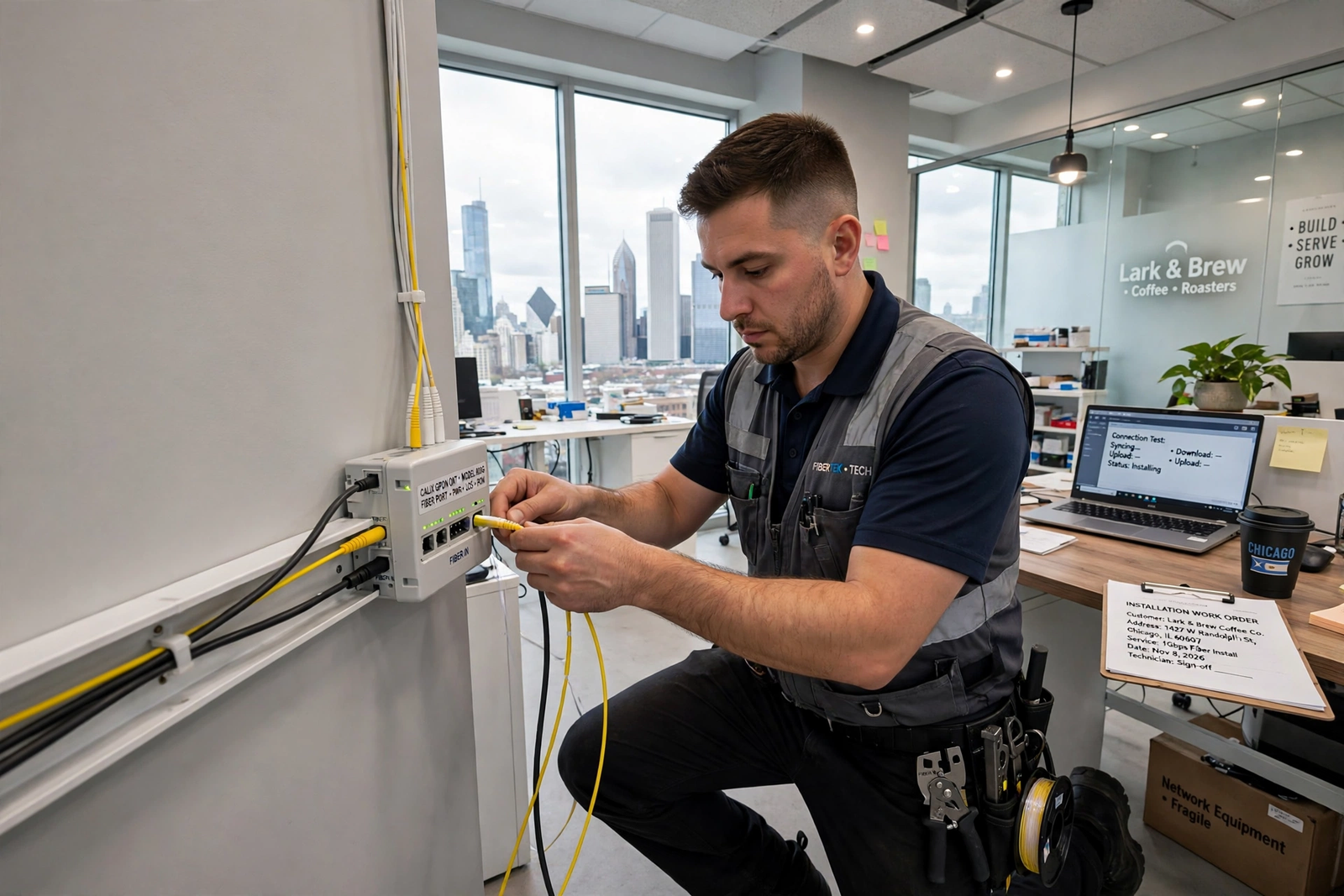
Astound Business, the business brand of Astound Broadband, formerly RCN in Chicago, is the budget option that surprises a lot of Chicago business owners, because its published business prices undercut both AT&T and Comcast on the lower tiers. Astound’s Chicago business page lists internet up to 110 Mbps at $44.95 per month, up to 500 Mbps at $64.95 per month, and up to 1,000 Mbps at $174.95 per month, with a one-year internet price lock, no contract required, free installation, and a $500 gift card on the 1 Gig tier. The offer expires 30 November 2026 and requires AutoPay and an internet and business phone bundle for new business customers at selected on-net locations, so the headline price is conditional, not universal. Astound’s residential Chicago pricing is even lower, with 1 Gig fiber around $40 to $45 per month and a 1.5 Gig tier near $60 to $65 per month, but business plans are priced separately and should be quoted separately.
The honest picture of Astound in Chicago, Illinois is a strong value in the buildings it serves and a non-option everywhere else. FCC-based neighborhood data puts Astound Business fiber at about 20 percent of homes in the Near South Side and about 5 percent in Rogers Park, with cable coverage around 97 percent in Rogers Park and about 78 percent in the Near South Side, so its cable network is far wider than its fiber network. That matters because the cable tiers upload slowly, just like any other cable service, while the fiber tiers are symmetrical up to 2 Gbps in fiber-served areas. The other cost to budget for is Astound’s Network Access and Maintenance Fee, also called the Internet Infrastructure Fee, of up to $21.85 per month, which is not included in the advertised plan price and can add more than $260 a year to the bill. Add that fee to the 500 Mbps tier and the real monthly cost is closer to $87 than $65. For a small office in a building Astound already serves, especially a startup or a business watching every dollar, Astound is worth a quote. For a business that needs guaranteed upload speed or a service level agreement, get the terms in writing and compare them against fiber before deciding.
T-Mobile and Verizon 5G Business Internet in Chicago, Illinois
5G fixed wireless is the fastest way to get a Chicago business online, because there is no cable to pull and no construction survey: the gateway arrives, plugs in near a window, and the office is connected the same day. T-Mobile Small Business Internet sells three tiers: Rely at $35 per line per month with AutoPay and any voice line, or $60 per month without discounts; Amplified at $45 per line per month with a voice line, or $70 without; and All-in at $55 per line per month with a voice line, or $80 without. Speeds run up to 400 Mbps, with T-Mobile advertising at least 25 Mbps and typical performance often near 100 Mbps, and the service carries a five-year price guarantee on eligible plans. Verizon 5G Business Internet is priced from $69 per month, with defined tiers of 100, 200, and 400 Mbps, and a bundle offer brings the 100 Mbps plan to $35 per month when paired with a qualifying Verizon business smartphone plan. Both services are available across Chicago, Illinois wherever the carrier’s 5G network is strong, which in practice means most of the city, though speeds vary by address, building materials, and network congestion.
Fixed wireless is best understood as a specialist tool rather than a default choice. It suits temporary offices, pop-up retail, construction site offices, food trucks and market stalls, and businesses waiting for a fiber install, and it makes an excellent backup connection alongside a wired primary, because it fails for different reasons than a cut cable. Its limitations are real and should be stated plainly. Speeds are not guaranteed and fall during congestion, heavy usage can be deprioritized, and the service is tied to the address where it was activated, so it cannot simply move to a new office without requalification. A business that runs cloud point-of-sale, video calls, and large uploads all day will feel the difference between a 5G connection and a symmetrical fiber line, especially at peak hours in a dense downtown building where many users share the same cell. If you need a backup connection for your Chicago office, our guide to how to choose business internet explains how to size a primary and a backup connection so the backup actually carries the business when the primary fails.
Spectrum Business in Chicago, Illinois: Limited Availability and Conflicting Reports
Spectrum Business deserves its own short section, because Chicago business owners moving from other cities often arrive expecting it and find a confusing picture. Spectrum is one of the largest cable providers in the United States, and its business plans are genuinely competitive nationally: its business page lists 500 Mbps at $50 per month, 750 Mbps at $95, and 1 Gig at $115, with no contract and no data caps, and an optional three-year price guarantee. But those national prices do not help a Chicago business if the network does not reach the address. One coverage guide lists Chicago among the major cities Spectrum misses, a Charter dealer page states that the Spectrum footprint does not cover Chicago, and Spectrum’s own Illinois coverage is reported at only about 6 percent of the state, concentrated in suburban and downstate areas rather than the city. Broadband comparison data shows Spectrum availability of about 33 percent in one Chicago ZIP code, which suggests scattered coverage at the edges of the metro rather than a citywide network.
The honest conclusion is that Spectrum Business is not a reliable option for a business inside the city of Chicago, Illinois, and any quote should be verified street by street rather than assumed from the national brand. Businesses in Chicago suburbs such as West Chicago and the surrounding DuPage County communities have better Spectrum coverage, so a company with a suburban warehouse or a second location outside the city should check each address separately. If you are comparing providers across cities, our look at business internet cost in Denver, Colorado shows how much provider line-ups change from one metro to another, and Chicago is no exception. Do not plan a Chicago office around Spectrum availability, and do not sign a lease that assumes it.
Chicago Business Internet Availability by Neighborhood

Chicago, Illinois is a city of 77 community areas, and internet availability genuinely changes from one to the next, because the networks were built neighborhood by neighborhood over decades. The Loop, River North, and the West Loop have the densest choice in the city: AT&T fiber in many office towers, Comcast cable almost everywhere, Astound in selected buildings, and strong 5G from all three mobile carriers, plus dedicated enterprise fiber from carriers such as Zayo for large tenants. A business opening in the Loop should still check its specific floor and suite, because a fiber-lit tower does not guarantee fiber to every floor, and older Loop buildings sometimes need a construction survey before a new fiber drop can be installed. The West Loop, with its concentration of restaurants, agencies, and food businesses, is particularly well served, but restaurant operators should pay attention to upload speed, because cloud point-of-sale, online ordering, and security cameras all push data upstream at the same time.
North Side neighborhoods tell a mixed story. Lincoln Park, Lakeview, and Wicker Park have broad Comcast cable coverage and growing AT&T fiber, with Astound fiber in selected buildings, and 5G fixed wireless works well across most of the North Side. Portage Park is one of the strongest AT&T fiber neighborhoods in the city, at about 83 percent of homes, which makes it a good place to be if fiber is the priority. Rogers Park and West Ridge are the cautionary examples: Comcast cable reaches roughly 98 to 100 percent of homes in both, but AT&T Business Fiber reaches only about 3 percent in West Ridge, and Astound fiber is around 5 percent in Rogers Park, so a business in those neighborhoods will usually be choosing between cable and 5G rather than between two fiber networks. On the South Side, the Near South Side has AT&T Business Fiber at about 32 percent of homes and Astound fiber at about 20 percent, with Comcast cable at about 94 percent, while Hyde Park and Pilsen have solid cable coverage with fiber still expanding. The pattern is consistent across the city: cable is the safety net everywhere, fiber is the prize where it has been built, and the only way to know which you can buy is an address check. Our guide to business internet providers in Tampa, Florida shows the same neighborhood-by-neighborhood pattern in a very different city, and the lesson travels: never assume citywide coverage from a provider’s national map.
Disclaimer: This article contains affiliate links to AT&T Business services; we may earn a commission at no extra cost to you. Ortelcom.com is an independent publisher not affiliated with or endorsed by AT&T. Pricing, speeds and availability are not guaranteed, were checked 8 November 2026, and vary by address and promotions. Confirm all details before ordering. AT&T trademarks belong to their owner.
How to Choose Business Internet in Chicago, Illinois: A Buying Guide
Choosing business internet in Chicago, Illinois is a five-step process, and skipping any step is how businesses end up overpaying or under-connected. Step one is the address check, and it comes before everything else, because no price comparison matters until you know which networks reach your suite. Run the address through AT&T, Comcast Business, and Astound, and if you are considering 5G fixed wireless, check the carrier’s coverage at the exact address too, because 5G performance changes with building materials and distance from the cell. If your building is a multi-tenant commercial property, ask the property manager which providers already have equipment in the building, because a provider that is already wired in can install in days, while a provider that needs a new build can take weeks and may need landlord permission.
Step two is sizing the speed honestly. Count the people who will be online at the same time, then add the devices: point-of-sale terminals, printers, security cameras, phones, and guest Wi-Fi all consume bandwidth, and a 10-person office with cloud applications, video calls, and a camera system needs more than a 10-person office that mostly sends email. As a planning guide, a solo office or a two-person shop can work on 300 Mbps, a 5 to 10 person office should look at 500 Mbps to 1 GIG, and a 20-person office with heavy cloud use should start at 1 GIG and consider 2 GIG. Remember that the number that matters for uploads is the upload speed, not the download speed, and only fiber gives you the same speed in both directions. Step three is reading the full price, not the advertised price: ask for the price after the promotional period, the installation fee, the equipment fee, any network access fee, the taxes, and the early termination fee, and get all of it in writing before you sign. Step four is asking about the service level agreement, because a business plan without an uptime guarantee and a repair-time commitment is a residential plan with a business label, and a restaurant or a medical office cannot afford to wait three days for a repair. Step five is planning the backup: a second connection on a different network, or a 5G backup built into the fiber plan, is what keeps the card reader working when the primary line goes down, and in Chicago, Illinois, where winter storms and construction cuts are real risks, that backup is cheap insurance.
Two practical Chicago details deserve attention during the buying process. First, installation timing is seasonal in a practical sense: construction and building access slow down in the worst of a Chicago winter, and a fiber install that needs outdoor work should be booked with extra lead time between December and February. Second, if you are signing a commercial lease, negotiate internet access into the lease conversation, because some Chicago landlords have exclusive arrangements with one provider, and discovering that after you sign is an expensive surprise. Ask the landlord which providers are already in the building, whether there are any exclusivity clauses, and whether a new fiber drop would need a construction review. A business that moves into a building with AT&T fiber already installed has a very different set of options from a business in a building where only cable reaches the suite.
Chicago Business Internet Limitations Worth Knowing
Every Chicago business internet option has limits, and an honest buying guide says so. Fiber is the best technology, but its coverage is incomplete, and the neighborhoods with the least fiber are often the neighborhoods where small businesses most need an affordable fast connection, which means some Chicago businesses will pay cable prices for cable performance through no fault of their own. Cable is nearly universal, but its upload speeds are a fraction of its download speeds, its prices rise sharply after the first year, and its one-year contract with an early termination fee punishes businesses that move or change size. Astound is the cheapest wired option in the buildings it serves, but its network access fee of up to $21.85 per month is a real cost that the advertised price hides, and its fiber footprint is small, so most Astound customers are buying cable, not fiber. Fixed wireless is the fastest to install, but its speeds are not guaranteed, it slows during congestion, and it is tied to one address, so it is a backup or a temporary solution for most businesses rather than a primary connection for a busy office.
There are also limits that have nothing to do with the provider. Older Chicago commercial buildings, especially in the Loop and in historic neighborhood corridors, can have wiring that limits the speed a connection can actually deliver inside the suite, and a business that pays for 1 GIG but runs it through decade-old internal cabling will not see 1 GIG at the desk. Wi-Fi is another common bottleneck: a single consumer router will not cover a 5,000-square-foot restaurant or a two-floor office, and businesses that blame the provider for slow Wi-Fi are often looking at a coverage problem, not a connection problem. Budget for proper access points, and test speeds on a wired connection before concluding the service is slow. Finally, remember that every price in this guide is a published starting point checked on the publish date, and the price you are quoted can differ by address, promotion, and contract term, so the only price that matters is the one on the written quote for your address.
Frequently Asked Questions About Business Internet Providers in Chicago, Illinois
What is the best business internet provider in Chicago, Illinois?
There is no single best business internet provider in Chicago, Illinois, because the answer depends on your address. AT&T Business Fiber is the strongest choice where it is available, thanks to symmetrical speeds from 300 Mbps to 5 GIG, no data caps, and no annual contract. Xfinity from Comcast Business is the best fallback, because its cable network reaches about 97 percent of Chicago addresses. Astound Business is the best budget option in the buildings it serves, and 5G fixed wireless from T-Mobile or Verizon is the best option for fast setup or backup. Run an address check with at least two providers before deciding.
How fast is business internet in Chicago, Illinois?
Business internet speeds in Chicago, Illinois run from 25 Mbps on the slowest 5G fixed wireless plans to 5 GIG on AT&T Business Fiber, with Comcast Business cable reaching 2 Gbps download and Astound fiber reaching up to 2 Gbps in fiber-served buildings. Most small businesses are well served by 300 Mbps to 1 GIG, and the speed that matters most for offices is usually the upload speed, which is symmetrical only on fiber. Test your actual speeds on a wired connection after installation, because Wi-Fi and old internal wiring can both reduce the speed you see at the desk.
How much does business internet cost in Chicago, Illinois?
Business internet in Chicago, Illinois typically costs between $35 and $285 per month before taxes and fees, depending on the provider, the speed, and the contract. AT&T Business Fiber lists from $60 per month for 300 Mbps to $285 for 5 GIG, Comcast Business starts at $70 per month for 300 Mbps, Astound Business starts at $44.95 per month for 110 Mbps, and T-Mobile 5G business internet starts at $35 per line per month with a voice line. Always ask for the price after the promotional period, the installation and equipment fees, and any network access fee, because the advertised starting price is rarely the full monthly bill.
Is fiber internet available for businesses in Chicago, Illinois?
Yes, fiber internet is available for businesses in Chicago, Illinois, but coverage varies sharply by neighborhood and by building. AT&T Business Fiber reaches about 83 percent of homes in Portage Park but only about 3 percent in West Ridge, according to FCC-based neighborhood reporting, and Astound fiber is available in selected buildings. Comcast also offers dedicated fiber up to 10 Gbps for larger offices. Check availability at your exact address, and ask the building manager which providers already have equipment in the building.
Can I get business internet in Chicago, Illinois without a contract?
Yes. AT&T Business Fiber shared plans carry no annual contract, Astound Business offers no-contract business plans with a one-year price lock, and T-Mobile and Verizon 5G business internet have no annual contract. Comcast Business advertised prices require a one-year term agreement with an early termination fee. Spectrum Business also advertises no-contract plans, but its Chicago coverage is limited, so verify availability at your address first.
What is the best backup internet for a Chicago, Illinois business?
The best backup internet for a Chicago, Illinois business is a second connection on a different network from the primary, so a single cut or outage cannot take both down. AT&T Business Fiber on 1 GIG and higher includes built-in 5G backup, Comcast Business offers Wireless Connect as a 5G backup add-on, and a standalone T-Mobile or Verizon 5G fixed wireless line works as a backup for any primary connection. Remember that 5G backup built into a fiber plan does not work during a power loss, so businesses that cannot tolerate any outage should also plan for battery backup.
Final Verdict: Best Business Internet Providers in Chicago, Illinois
The best business internet provider in Chicago, Illinois is the one that reaches your building with the right speed at a price you can verify in writing, and for most businesses that search starts with AT&T Business Fiber and ends with a decision between fiber and cable. If AT&T fiber reaches your suite, its symmetrical speeds, no data caps, included gateway, and no annual contract make it the strongest default choice in the city, with the 1 GIG tier at $140 per month suiting most offices of 10 to 20 people. If fiber does not reach your building, Comcast Business cable is the reliable fallback, with near-universal Chicago coverage and speeds up to 2 Gbps, as long as you budget for the price increase after the first year and the one-year contract. Astound Business is worth a quote wherever it serves your building, because its lower tiers undercut both rivals, but add the network access fee to the price before comparing. And 5G fixed wireless from T-Mobile or Verizon is the right tool for fast setup, temporary sites, and backup, rather than the primary connection for a busy office.
Whatever you choose, do the three things that matter most: check availability at your exact Chicago address with at least two providers, get the full price in writing including the post-promotion rate and every fee, and plan a backup connection on a different network. Chicago, Illinois gives its businesses more choice than most American cities, but that choice only helps if you use it, and the businesses that end up happiest with their internet are the ones that treated the address check and the written quote as non-negotiable steps rather than afterthoughts.

