
Choosing between dedicated internet and shared business fiber is really a choice between certainty and speed-per-dollar. Here is the verdict up front. Buy Dedicated Internet Access (DIA) when an hour of downtime costs real money — you get guaranteed bandwidth, a contractual uptime SLA with service credits, and priority repair that shared fiber cannot promise. Buy shared business fiber when your internet matters but an outage is an inconvenience, not a revenue event — symmetrical tiers from 300 Mbps to 5 GIG with no data caps deliver far more megabits per dollar, and that is the right call for most small and mid-sized businesses.
For a closer look at the shared option’s plans and tiers, see our AT&T Business Fiber overview.
This guide explains dedicated internet access from the ground up — contention ratios, CIR, SLAs, and who actually needs them — then puts DIA head-to-head against shared business fiber across the dimensions that drive buying decisions. You will get a worked outage-cost example, a decision framework you can run in fifteen minutes, and an honest look at the hybrid approach most growing businesses end up choosing.
Dedicated Internet vs Business Fiber: The Short Verdict
Looking for the fiber-first option?
Check whether AT&T Business Fiber serves your office and compare the 300 Mbps to 5 GIG speed tiers.
The core trade is simple. DIA sells you certainty: a 1:1 uncontended connection where your committed information rate (CIR) is guaranteed around the clock, backed by a service-level agreement that pays you credits when the provider misses. Shared business fiber sells you speed: best-effort bandwidth over a shared fiber network at a flat monthly tier price — for example, AT&T Business Fiber’s published tiers run $60 to $285 per month — with no hard guarantees on repair times. Certainty costs multiples of speed: DIA is quote-based everywhere and typically runs several times the price of an equivalent shared tier.
New to the technology? Start with our explainer on what business fiber internet is.
Our verdict framework: calculate what one hour of downtime costs you (we show the math below). If that number exceeds the monthly premium for DIA, the dedicated circuit pays for itself the first time it prevents — or quickly fixes — an outage. If it does not, put the savings into a fast shared fiber tier plus a 5G backup connection and move on to more productive decisions.
Dedicated Internet vs Fiber at a Glance: Key Differences
For the published rates behind these tiers, see our AT&T Business Fiber pricing breakdown.
Start with the side-by-side summary, then read the deep dives that follow for what each row means in practice. If you only have two minutes, this table plus the outage-cost math section will get you 80% of the way to a decision.
| Dimension | Dedicated Internet Access (DIA) | Shared business fiber |
|---|---|---|
| Bandwidth model | 1:1 dedicated; CIR guaranteed | Shared PON; speeds “up to” the tier |
| Speeds | Symmetrical, guaranteed | Symmetrical tiers, 300 Mbps–5 GIG (best effort) |
| Uptime SLA | Yes — often 99.99%, with service credits | No hard SLA on most SMB tiers |
| Repair commitment | Priority restoration, contracted repair windows | Best-effort; no guaranteed repair window |
| Monitoring | 24/7 NOC monitoring typical | Standard provider monitoring |
| IP addressing | Static IP blocks / BGP common | Typically dynamic; static options vary |
| Install lead time | Weeks to months; may require construction | Days to weeks; usually existing plant |
| Contract | Multi-year common | Monthly or 1–2 year common |
| Price model | Quote-based per Mbps; costs multiples of shared fiber | Flat tier pricing (e.g., $60–$285/mo published) |
The table makes the positioning clear: DIA is an insurance product that happens to carry internet traffic, while shared business fiber is a speed product. Businesses that buy DIA are buying the SLA column — guaranteed throughput, contracted repair, and credits when the provider fails. Businesses that buy shared fiber are buying the bottom rows — fast installation, simple pricing, and enormous bandwidth per dollar.
Dedicated Internet Access Explained: How DIA Actually Works
Dedicated Internet Access means your business gets a private, uncontended path to the internet. In network terms the contention ratio is 1:1: the capacity you pay for is yours alone, at 3 PM on a Tuesday and at 9 AM on a Monday, regardless of what every other customer on the provider’s network is doing. There is no “rush hour” on a DIA circuit because there is no one else in your lane.
That exclusivity is what you are actually buying. A shared connection can advertise the same headline speed and still slow down when the surrounding network gets busy; a DIA circuit delivers its committed rate even then. For applications that cannot tolerate jitter or slowdowns — voice calls, video conferencing, payment processing, remote-desktop sessions — that consistency matters more than the headline number on the plan.
CIR and Contention: Dedicated vs Shared Bandwidth Basics
CIR — committed information rate — is the contractual heart of DIA: the throughput your provider guarantees, in writing, 24 hours a day. Buy a 100 Mbps DIA circuit with a 100 Mbps CIR and you get 100 Mbps, always. Shared broadband has no CIR; it has an “up to” speed, which is the maximum the technology can deliver when conditions are ideal — a capability statement, not a promise.
Contention ratio expresses how many customers share the same upstream capacity. Residential and small-business broadband commonly runs at contention ratios like 20:1 or 50:1 — twenty or fifty subscribers sharing one unit of backhaul. DIA’s 1:1 ratio is the entire value proposition in a single number: when you need the bandwidth, it is there, because nobody else can take it from you.
SLA Internet Business Guarantees: Uptime, Credits and Repair Times
The SLA is what turns DIA from “a nice connection” into a business-grade service. A typical DIA SLA guarantees around 99.99% network uptime — which sounds abstract until you convert it: 0.01% downtime is about 4.4 minutes per month, or under 53 minutes per year. If the provider misses that target, the SLA pays you service credits, which aligns the provider’s incentives with yours in a way best-effort broadband never does.
Just as important is the repair commitment. DIA contracts specify mean time to repair (MTTR) targets — often measured in hours, not days — with escalation paths and 24/7 network operations center (NOC) monitoring watching your circuit continuously. When a DIA circuit has a problem, the provider usually knows before you do and is contractually on the clock. Shared fiber support, by contrast, fixes problems as fast as it can, with no contractual deadline attached.
Who Needs Dedicated Internet Access Explained for Their Business?
DIA earns its premium wherever connectivity is directly tied to revenue or safety. Call centers live or die on call quality — jitter on a shared connection becomes abandoned calls and lost sales. SaaS companies serving customers from their own office infrastructure need guaranteed upstream for deployments and demos. Healthcare practices running telehealth, financial firms moving market data or processing transactions, and multi-location headquarters syncing large datasets all share the same profile: the cost of degraded performance exceeds the cost of the circuit.
The common thread is not company size — a ten-person trading desk can need DIA more than a two-hundred-person marketing agency. It is consequence: if an hour of slow or dead internet costs you more than the monthly DIA premium, you are the customer DIA was built for. The outage-cost math section below makes this concrete with real numbers.
Business Fiber Internet Explained: How Shared Fiber Works
Shared business fiber — the category AT&T Business Fiber sits in — delivers internet over a passive optical network (PON) where your business shares the fiber plant’s capacity with neighboring subscribers. “Shared” sounds like a compromise, and technically it is one — but modern PON networks are so over-provisioned relative to typical business use that most subscribers never notice the sharing. You get fiber’s low latency and symmetrical speeds at a fraction of DIA’s price.
The key phrase in every shared fiber plan is “up to.” A 1 GIG tier means speeds up to 1 Gbps under good conditions — still symmetrical, still with no data caps on AT&T’s business tiers, but not contractually guaranteed the way a CIR is. For email, cloud apps, video calls, and file sync — the actual workload of most offices — best-effort gigabit fiber is more than enough, which is why shared fiber dominates the small and mid-sized business market.
AT&T Business Fiber Tiers: Business Fiber Internet Speeds and Prices
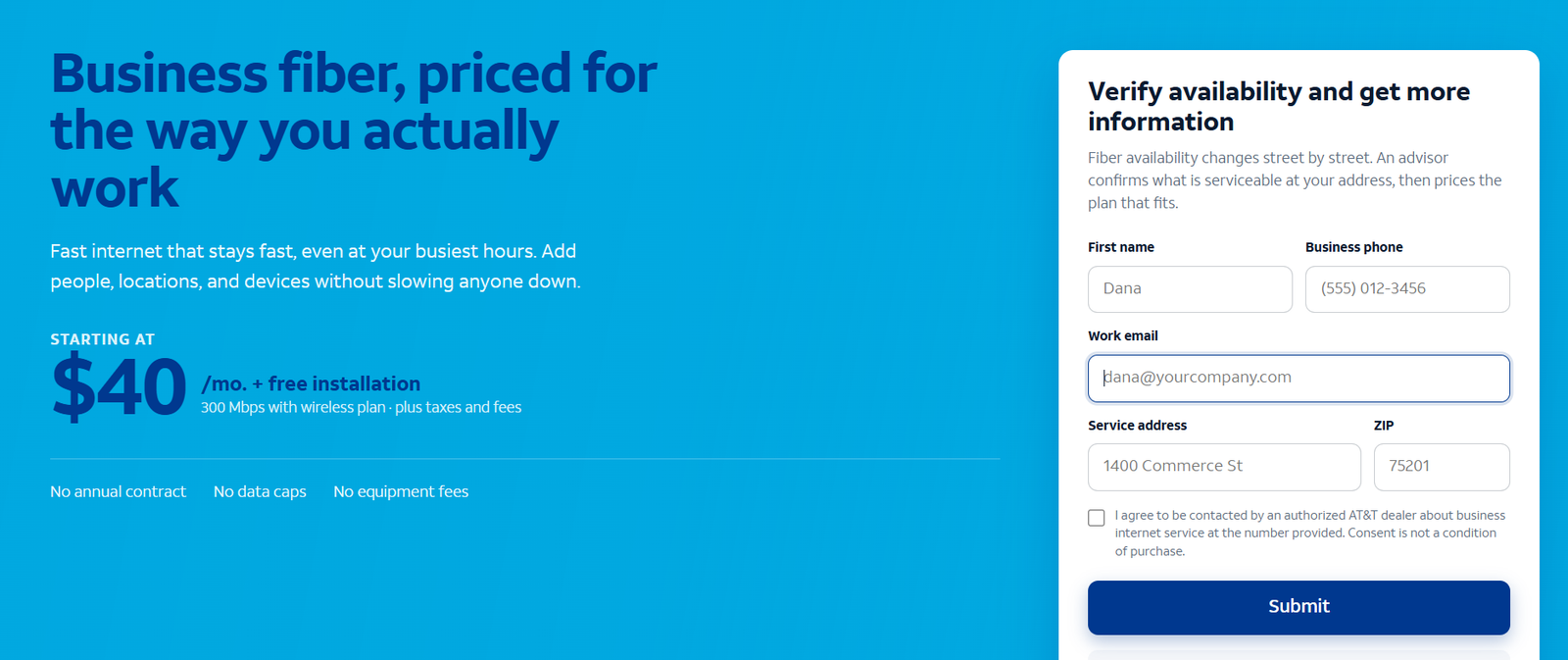
AT&T Business Fiber publishes five symmetrical speed tiers with no data caps: 300 Mbps at $60 per month ($40 when bundled with wireless), 500 Mbps at $100 ($60 bundled), 1 GIG at $140 ($90 bundled), 2 GIG at $185 ($135 bundled), and 5 GIG at $285 ($235 bundled). Every tier includes the gateway and AT&T’s ActiveArmor security features, and bundling with AT&T wireless on the same account cuts $20–$50 off the monthly price depending on the tier.
Compare that price ladder to DIA’s quote-based model: a full gigabit of shared, symmetrical, uncapped fiber for $140 a month ($90 bundled) is the value proposition that makes shared fiber the default choice. DIA’s premium buys guarantees, not raw speed — at the same monthly spend, shared fiber almost always delivers more megabits.
| AT&T Business Fiber tier | Monthly price | With wireless bundle |
|---|---|---|
| 300 Mbps | $60 | $40 |
| 500 Mbps | $100 | $60 |
| 1 GIG | $140 | $90 |
| 2 GIG | $185 | $135 |
| 5 GIG | $285 | $235 |
All tiers include symmetrical speeds, no data caps, an included gateway, and ActiveArmor security. If you already run AT&T wireless lines for your team, the bundle discount applies on top — one more reason to price fiber and wireless together rather than in isolation.
Why Business Fiber Internet Costs Less Per Megabit
Shared fiber’s economics come from statistical multiplexing: because not every subscriber maxes out their connection at the same moment, the provider can sell more total “up to” speed than the underlying plant could deliver if everyone peaked simultaneously — and pocket the efficiency. DIA cannot do this by definition, since your capacity is reserved exclusively for you whether you use it or not. You are paying for idle insurance, which is exactly the point of the product.
The practical result: a 1 GIG shared fiber tier at $140 a month costs about $0.14 per megabit of headline speed, while DIA’s per-megabit pricing — quote-based, but universally a multiple of shared rates — reflects reserved, guaranteed, SLA-backed capacity. Neither price is “wrong”; they are prices for different products. Judge shared fiber on speed per dollar and DIA on risk per dollar, and the comparison stops being confusing.
See which shared fiber tier fits your office: check AT&T Business Fiber plans and availability.
DIA vs Broadband Business: Head-to-Head Comparison
With both technologies explained, here is how they compare on the five dimensions that actually drive buying decisions. Use this section as your evaluation checklist when talking to providers — and notice how many of the questions are about guarantees and repair, not about speed.
Guaranteed vs Best-Effort Speeds: Dedicated vs Shared Bandwidth
DIA guarantees its speed via CIR: the number on the contract is the number you get, at all hours, backed by credits if it is not. Shared business fiber offers “up to” the tier speed — and in practice, modern fiber usually delivers close to it — but nothing in the contract promises it. For most office workloads the practical difference is invisible; for latency-sensitive applications like VoIP, video, and remote desktop at scale, the guarantee is the product.
One nuance that surprises buyers: shared fiber’s top tiers (2 GIG, 5 GIG) can exceed the speed of an affordable DIA circuit while costing less. If your workload is bulk throughput — backups, large file transfers, media uploads — a fat shared pipe often outperforms a thin dedicated one. Guarantees matter most when consistency, not peak speed, is the constraint.
SLA Internet Business Support vs Best-Effort Repair
This is the starkest gap in the comparison. DIA comes with a contractual SLA: roughly 99.99% uptime targets, service credits for misses, contracted repair windows, and 24/7 NOC monitoring. Shared business fiber comes with a support number and best-effort restoration — the provider will fix it as quickly as it can, but no contract specifies how quickly that must be, and no credits arrive if it takes days.
Ask yourself what a two-day outage would cost versus a four-hour one. If the answer is “a rounding error either way,” the SLA column has no value worth pricing. If the answer involves lost revenue, penalties you owe your own customers, or compliance exposure, the SLA is worth more than the bandwidth itself. Most buyers overweight speed and underweight repair time — correct that bias before you sign.
Cost Structure: Quote-Based DIA vs Broadband Business Tiers
Shared business fiber is priced like a utility: pick a tier, pay the published monthly rate — $60 to $285 on AT&T’s ladder, less with a wireless bundle — on a monthly or one-to-two-year term. You know the price before you ever call. DIA is priced like construction: every quote is built around your address, required capacity, and build costs, usually on a multi-year contract, and universally at a multiple of shared fiber’s per-megabit price.
Never accept a DIA quote without asking what the build covers, what the CIR is (not just the port speed), what the SLA credit schedule pays, and what happens to pricing at renewal. And never let anyone quote you a “typical” DIA price from a blog post — including this one. DIA pricing is inherently site-specific; any specific number you see online is either outdated, from a different market, or both.
Installation and Scalability: DIA vs Broadband Business Compared
Shared fiber usually installs in days to weeks using existing neighborhood plant — a technician visit, a gateway, and you are online. DIA often takes weeks to months: site surveys, potential fiber construction to your building, and coordination with building management. If you need connectivity next week, DIA is not your answer regardless of budget.
Scaling cuts the other way. DIA contracts are built to scale in committed increments with the SLA following the capacity upward, while shared fiber scales by jumping tiers — easy and fast, but each jump is still best-effort. Growing businesses often start on shared fiber for speed of deployment and graduate to DIA when the outage-cost math flips in its favor.
Disclaimer: This article contains affiliate links to AT&T Business services. We may earn a commission if you purchase through them, at no extra cost to you. Ortelcom.com is an independent publisher and is not affiliated with or endorsed by AT&T. Pricing, speeds, and availability are not guaranteed, were checked in October 2026, and vary by address and promotions — please confirm all details before ordering. AT&T and all related marks are trademarks of their respective owners.
Outage Cost Math: When Dedicated Internet vs Fiber Pays Off
Here is the decision reduced to arithmetic. Compute your cost of one hour of downtime: take annual revenue, divide by working hours per year, and multiply by the share of revenue that depends on connectivity. A $2M-revenue business operating 2,000 hours a year with 80% of revenue touching the internet loses about $800 per outage hour ($2,000,000 ÷ 2,000 × 0.80). Add any penalties you owe your own customers during downtime — those count too.
Now compare that hourly cost to the DIA premium — the monthly difference between a DIA quote and your shared fiber tier. If DIA costs $400 more per month than shared fiber and your outage hour costs $800, then DIA pays for itself if it prevents or shortens just one hour of outage every two months. If your outage hour costs $100, the same DIA circuit needs to save four outage-hours a month to break even — a much harder case to make.
Two worked scenarios make it tangible. Scenario A: a 30-seat call center where an outage idles every agent. At $25 per agent-hour in wages alone, one dead hour costs $750 before counting lost sales — DIA’s premium is trivially justified, and the SLA’s repair-time guarantee is arguably worth more than the bandwidth. Scenario B: a 12-person professional office doing email, documents, and cloud apps. An outage hour costs perhaps $300–$500 in lost productivity, most work resumes when connectivity returns, and a $140 shared gigabit tier plus a 5G backup covers the risk at a fraction of DIA’s price.
Be honest about the inputs: most businesses overestimate what an outage truly costs (salaried staff do other work; cloud apps queue and sync) and underestimate how often brief outages occur. Run the math with conservative numbers. If DIA still wins, buy it with confidence. If it only wins with aggressive assumptions, it is not winning — it is wishful thinking with a contract attached.
One factor the spreadsheet misses: SLA credits. On a DIA circuit with a 99.99% SLA, the provider owes you credits when it misses — typically a percentage of the monthly fee scaled to the outage length. Those credits do not make you whole, but they convert the provider’s failure into your discount, which is a structural incentive that best-effort broadband simply does not have.
| Your outage-hour cost | DIA monthly premium | Break-even: outage-hours DIA must save per month |
|---|---|---|
| $800/hr | $400/mo | 0.5 hours (one hour every 2 months) |
| $300/hr | $400/mo | 1.33 hours |
| $100/hr | $400/mo | 4 hours |
Assumptions behind this table: the premium is the DIA quote minus the shared fiber tier price; outage cost is revenue per working hour multiplied by the share of revenue dependent on connectivity; and the comparison assumes DIA’s SLA meaningfully reduces outage frequency or duration. Adjust all three to your business before deciding.
Decision Framework: Dedicated Internet vs Business Fiber for Your Company
Run these checks in order. If you answer yes to any of the first three, get DIA quotes before deciding. If you answer yes to the last two and no to the first three, order shared fiber and stop second-guessing — you have your answer.
Choose Dedicated Internet When Dedicated vs Shared Bandwidth Is the Deciding Factor
Choose DIA when an hour of downtime costs more than the monthly DIA premium (run the math above with your numbers); when you run latency-sensitive operations at scale — call centers, trading desks, telehealth, live production; when contracts with your own customers penalize your downtime; or when compliance or security policy effectively requires guaranteed, auditable connectivity with static IP blocks. Multi-location headquarters syncing large datasets between sites is another classic DIA profile.
Also choose DIA when a contractual repair time is itself the requirement. If your business cannot tolerate a “we will get to it when we get to it” restoration window, that requirement alone settles the decision regardless of the bandwidth math — no shared tier can promise what only an SLA delivers.
Choose Business Fiber Internet When Value Per Megabit Wins
Choose shared business fiber when your workload is standard office traffic — email, cloud SaaS, video conferencing for a typical team, file sharing — because a 1 GIG symmetrical tier at $140 a month ($90 bundled) handles it with headroom to spare. Choose it when you need connectivity fast (days, not months), when your outage cost is measured in inconvenience rather than lost revenue, and when you would rather spend the DIA premium on a backup connection than on guarantees.
Most businesses reading this guide land here, and that is fine — it is not a consolation prize. A gigabit of shared fiber with no data caps is an excellent business connection. The vast majority of outages that actually hit small businesses are last-mile or equipment issues that a second connection mitigates better than a fancier first connection ever could.
Hybrid Approach: Business Fiber Internet Plus 5G Backup
The smartest money for many businesses is neither pure DIA nor a single fiber connection: it is shared fiber as the primary plus a 5G business internet service as automatic failover. The fiber delivers the speed and value; the 5G backup delivers the continuity. A dual-WAN router (or a gateway with cellular failover) detects the primary outage and shifts traffic in seconds, covering the most common failure mode — a cut line or a local outage — without DIA’s price tag.
Size the backup for continuity, not comfort: during failover, the office needs email, VoIP, payment processing, and core cloud apps — not 4K streaming. A mid-tier 5G business plan handles that easily. Test the failover quarterly by unplugging the primary; an untested backup is a rumor, not a plan, and the first outage is a terrible time to discover a misconfigured router.
This hybrid is also the right answer while you wait for DIA. If the outage-cost math says you need dedicated access but construction lead times run into months, install shared fiber plus 5G backup now and migrate the primary to DIA when the build completes. You are protected during the gap instead of exposed — and you may find the hybrid performs well enough to revisit the DIA decision entirely.
Start with fast, affordable shared fiber as your primary connection: see AT&T Business Fiber plans and availability for your address.
FAQs: Dedicated Internet vs Business Fiber Questions
Is dedicated internet vs fiber worth it for a 20-person office?
It depends entirely on what those 20 people do. A 20-person office on standard cloud workloads will thrive on a 1 GIG shared fiber tier at $140 a month — DIA would be overkill. A 20-person office running a call center, a trading desk, or a telehealth practice should price DIA, because their outage-hour cost flips the math. Headcount is the wrong variable; revenue at risk per outage-hour is the right one.
When in doubt, start with shared fiber plus a 5G backup and revisit DIA when you have a year of outage history to evaluate. Real data beats projections every time.
What does an SLA internet business contract actually guarantee?
A DIA SLA typically guarantees network uptime around 99.99% (about 4.4 minutes of allowable downtime per month), a committed repair window for outages, latency and packet-delivery targets on some contracts, and service credits paid to you when the provider misses any of these. Read the credit schedule before signing: credits usually scale with outage duration and are capped monthly.
Note what SLAs do not cover: your internal network, your equipment, and outages on your side of the demarcation point. The SLA governs the provider’s network and their response — keep your own gear and wiring in shape, because no credit fixes a failed office switch.
Can business fiber internet handle video calls for a remote team?
Easily. A single HD video call needs roughly 2–4 Mbps each way; a 300 Mbps symmetrical shared fiber tier supports dozens of concurrent calls with room for everything else the office does. Video-call problems on fiber are almost never bandwidth problems — they are Wi-Fi, equipment, or peering issues, so troubleshoot those before blaming the circuit.
Where shared fiber can show limits is a whole company on video simultaneously during a neighborhood peak — the exact scenario DIA’s 1:1 contention eliminates. If all-hands video at 9 AM Monday is your core ritual and call quality is non-negotiable, that is a point for DIA; for everyone else, shared fiber is plenty.
How is DIA vs broadband business fiber different from cable internet?
The “DIA vs broadband business” question is really about guarantees, and cable business internet sits on the broadband side of that line: shared, best-effort, “up to” speeds — usually with much slower uploads than fiber. Business fiber improves on cable with symmetrical speeds and lower latency, but it is still best-effort without an SLA. DIA stands apart from both with guaranteed CIR, contractual repair, and service credits.
If you are choosing between cable and fiber for the shared side of the decision, fiber wins on uploads and consistency at comparable prices. The DIA question is separate: it is about whether you need guarantees at all, not about which shared technology is nicer.
Do I need dedicated vs shared bandwidth for PCI or HIPAA compliance?
Neither PCI DSS nor HIPAA mandates DIA specifically — both are concerned with how you protect data, not with your contention ratio. That said, auditors and security teams often prefer DIA’s static IP blocks, predictable routing, and contractual monitoring because they make the network easier to document and defend during an audit.
Treat DIA as a compliance convenience, not a compliance requirement. If your current shared fiber setup already meets your auditor’s requirements with proper firewalls, encryption, and access controls, DIA adds assurance — not eligibility.
Final Verdict: Dedicated Internet vs Fiber for Your Business
Buy Dedicated Internet Access when downtime has a dollar figure that scares you — guaranteed bandwidth, a 99.99% SLA with credits, and contracted repair times are worth every penny of the quote-based premium. Buy shared business fiber when you want the most speed per dollar: symmetrical tiers up to 5 GIG, no data caps, and simple flat pricing make it the right default for most small and mid-sized businesses.
And if you are caught between them, do not split the difference on a single connection — pair them. Shared fiber primary plus 5G backup covers the common failures at a fraction of DIA’s cost, and you can graduate to DIA later when your outage-cost math says the guarantees have become cheaper than the risk.
Compare shared fiber tiers for your address: check AT&T Business Fiber availability and current pricing.

