
Verdict: The hidden costs in business internet are rarely a single surprise charge. They are the installation, equipment, fees, taxes, and extra charges that sit outside the advertised monthly service price, and the only safe way to budget for them is to get every one of them listed separately on your quote and confirm the amount on your quote before you order, checked October 2026. The monthly service price for AT&T Business Fiber is clear on its own terms — $60 for 300 Mbps, $100 for 500 Mbps, $140 for 1 GIG, $185 for 2 GIG, and $285 for 5 GIG at list, or $40, $60, $90, $135, and $235 with an eligible wireless plan — but that service price is not automatically the total you will pay. Taxes, fees, installation, and equipment charges vary by address, account, and site needs, so a business that budgets only the service price is budgeting an incomplete total.
This guide explains each category of hidden cost in plain language, without inventing a dollar figure for any fee, tax, installation charge, or equipment charge, because those amounts vary and must be confirmed on your quote. It covers what installation can involve, how equipment is charged, which fees and taxes to look for, which extra charges commonly appear after the first bill, and how to add those categories into a realistic first-year total. Use it alongside the official Fiber prices in this guide, ask for each cost on a separate line, and do not sign until the quote shows the monthly service price, the one-time costs, the recurring extras, and the taxes and fees as distinct items.
Hidden Costs Business Internet: Check AT&T Business Fiber Pricing
Compare Fiber speed tiers and check availability for your business address before you budget.
What hidden costs business internet bills can contain
When people talk about hidden costs in business internet, they usually mean one of two different things, and it helps to separate them before you read a quote. The first is a cost that is genuinely disclosed but easy to miss because it sits on a different page of the quote, in a footnote, or on a later bill rather than next to the headline monthly price. The second is a cost that is not fixed at quote time at all, because it depends on the site, the equipment chosen, or the tax treatment of the account, and therefore appears only as a category rather than a firm figure. Both kinds matter for budgeting, but they need different responses. A disclosed-but-buried cost should be pulled into the open and added to your total. A genuinely variable cost should be treated as an open item with a written estimate or a stated basis, and you should confirm the amount on your quote or in writing before installation work begins.
It also helps to understand why two businesses on the same Fiber tier can receive different totals. One business may be in a building where the fiber connection is already in place and the installation work is straightforward, while another may need new wiring, a longer run inside the building, or coordination with a landlord or building manager. One business may already own suitable networking gear, while another needs a new gateway and additional Wi-Fi coverage. Tax and fee treatment can differ by location and by how the account is set up. Those differences are legitimate, but they are only fair when they are shown separately, so the business can see which part of the total is the service price and which part is site-specific or account-specific. The guide to how much business internet costs in 2026 sets out the service prices used here, and this guide builds on those prices by explaining everything that sits around them.
| Hidden cost category | What it usually covers | Monthly or one-time | What to ask |
|---|---|---|---|
| Installation | Work to connect and activate the service at the site | Usually one-time, but confirm on your quote | Is this standard installation, and what extra work would change it? Confirm the amount on your quote. |
| Equipment | Gateway, router, and Wi-Fi gear | Monthly rental, one-time purchase, or included — confirm on your quote | Is equipment included, rented, or purchased? Confirm the amount on your quote. |
| Fees and taxes | Regulatory, administrative, and tax lines | Usually monthly, but varies — confirm on your quote | Which fees and taxes apply to this account and location? Confirm the amount on your quote. |
| Extra charges | Optional features, backup, and later changes | Monthly, one-time, or conditional — confirm on your quote | Which extras are included and which are charged separately? Confirm the amount on your quote. |
Business internet installation costs explained before you sign
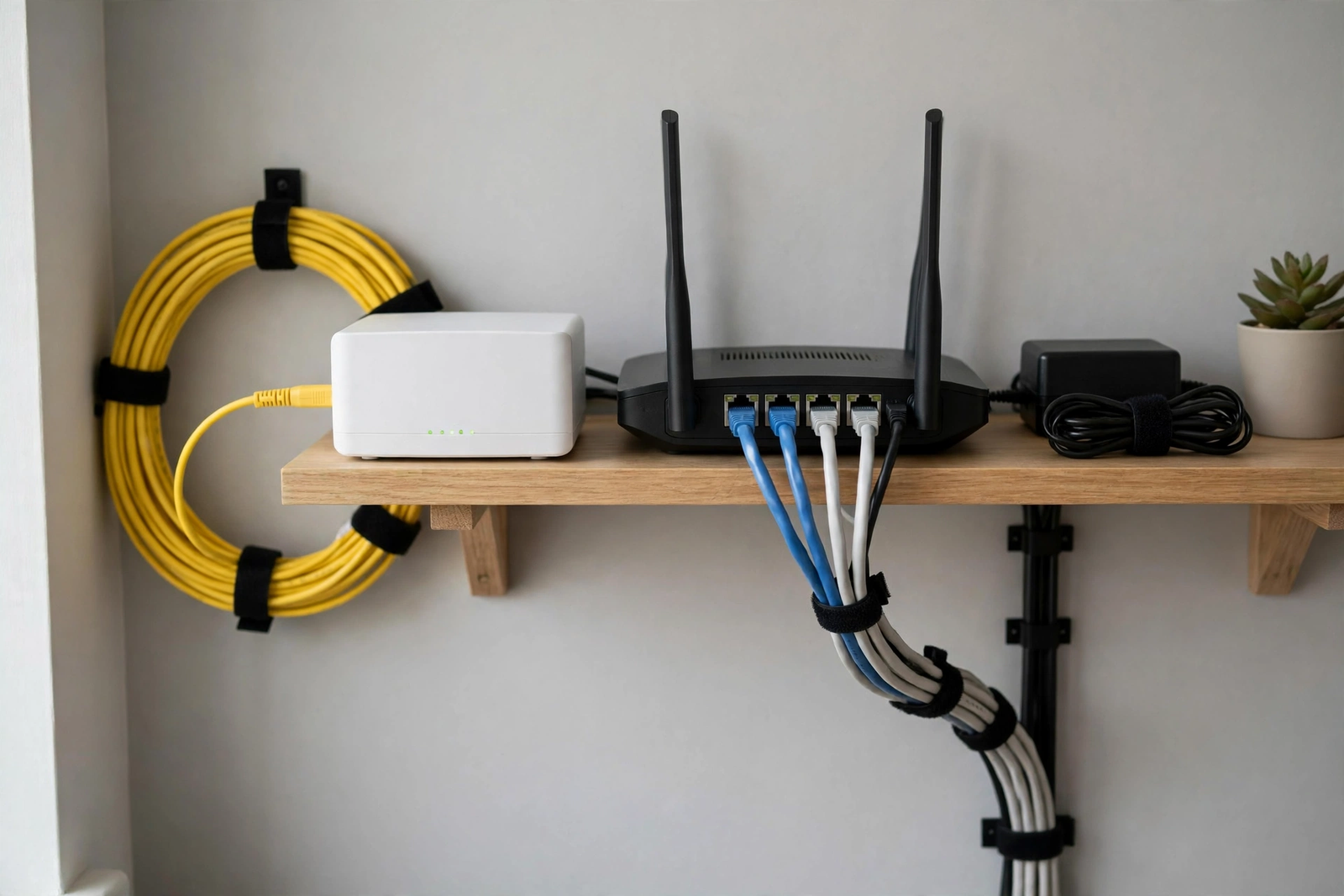
Business internet installation costs are the charges connected with getting the service working at a specific address, and they are the category most likely to differ between two businesses on the same tier. The reason is simple: no two buildings are identical. A modern office with an existing fiber entry point, accessible wiring routes, and a straightforward place for the gateway will usually need less work than a converted building, a multi-floor office, a retail unit inside a larger property, or a site where the connection point is a long way from where the network equipment will sit. Installation cost is therefore most accurately understood as a site-specific figure, not a universal figure, and any guide that states a single installation amount for every business would be misleading. This guide does not do that. Instead, it explains what installation can involve, what can change the figure, and which questions turn an estimate into a firm figure, so you can confirm the amount on your quote before work starts.
Standard installation, where that term is used on a quote, generally means the routine work of connecting the service and activating it under normal site conditions. What counts as normal, however, is defined by the provider and by the site, not by the customer, so the word standard should always be followed by a question: standard for this building, with its current wiring and access, or standard in general. Ask whether the site has been checked, whether the installation figure assumes existing wiring, and whether anything about the building — such as the distance from the entry point, the need to run cable through walls or ceilings, or the need to coordinate with a landlord — could move the job outside the standard scope. If the answer is that the site has not been checked, treat the installation figure as an estimate and ask what would trigger a change, and confirm the amount on your quote once the site position is clear.
Timing and access also affect installation cost and installation planning, even though they are not always shown as a separate line. A site that needs landlord permission, building-management scheduling, out-of-hours access, or work in a shared riser or ceiling space may need more coordination than a site where the business controls access directly. None of that means the installation will be difficult, but it does mean the business should confirm who arranges access, whether any building charges apply, and whether the installation appointment covers the full scope or only the first stage. The guide to preparing an office for fiber installation day explains the practical preparation that helps an appointment go smoothly, and that preparation is also a cost control: a site that is ready, with access agreed and equipment locations decided, is less likely to need a return visit or extra work than a site that is improvised on the day.
Business internet equipment costs: rental, purchase, and replacement
Business internet equipment costs cover the hardware that turns a connection into a working network: the gateway or modem that terminates the service, the router that directs traffic, and the Wi-Fi access points or extenders that carry the signal to desks, meeting rooms, stockrooms, and customer areas. How that hardware is charged varies, and the variation matters more over time than it appears on the first bill. Equipment that is included in the service price costs nothing extra each month. Equipment that is rented adds a recurring monthly line for as long as the rental continues. Equipment that is purchased costs more up front but has no ongoing rental line, although it may still need replacement or support over time. A quote that says equipment is provided, without saying which of those three models applies, has not finished explaining the cost. Ask which model applies to each item, and confirm the amount on your quote for each item separately.
Disclaimer: This article contains affiliate links to AT&T Business services. We may earn a commission if you purchase through them, at no extra cost to you. Ortelcom.com is an independent publisher and is not affiliated with or endorsed by AT&T. Pricing, speeds, and availability are not guaranteed, were checked in October 2026, and vary by address and promotions — please confirm all details before ordering. AT&T and all related marks are trademarks of their respective owners.
Business internet fees and taxes to confirm on your quote

Business internet fees and taxes are the lines on a bill that most often confuse a business, because they are not set by the headline service price and they do not stay the same for every customer. Taxes depend on the location of the service and on how the account is classified. Regulatory and administrative fees depend on the provider, the service type, and the account details. That variability is exactly why this guide states no dollar figure for any fee or tax: a figure that is correct for a business in one state or on one account setup could be wrong for a business elsewhere, and a wrong figure is worse than an honest category with a clear instruction to confirm the amount on your quote. Treat every fee and tax line as a question to be answered for your own address and account, not as a number to be copied from a guide.
Finally, remember that fees and taxes apply to the total picture, not only to the service price. If the business adds equipment rental, optional features, or additional sites, those additions may carry their own fee or tax treatment. A business should therefore ask for a revised total whenever the scope changes, rather than assuming the original fee and tax lines still apply. The AT&T Business Fiber pricing guide sets out the service prices that fees and taxes sit on top of, and it is worth reading that guide alongside this one so the service price and the fee lines are never confused with each other.
Business internet extra charges beyond the monthly service price
Business internet extra charges are the items that are neither the monthly service price nor the standard installation, equipment, fee, and tax lines, but that can still appear on a bill. They include optional features, additional services, and charges triggered by changes after installation. Common examples include a static IP address where the business needs a fixed address for remote access or hosted services, additional security or managed services beyond what is included, backup connectivity for tiers that do not include built-in backup, and charges connected with moving, upgrading, or changing the service. Each of these can be a sensible purchase, but none of them should be assumed to be included, and none of them should be added without a price. Ask whether each extra is included or charged, whether it is monthly or one-time, and confirm the amount on your quote before agreeing to it.
Backup connectivity deserves special attention because it is both an extra charge and a risk decision. AT&T Business Fiber tiers of 1 GIG and above include built-in 5G backup on the terms described in this guide, checked October 2026. Tiers below 1 GIG do not include that built-in backup in the same way, so a business on 300 Mbps or 500 Mbps that needs a fallback connection should ask about backup options separately and budget for them if needed. The same logic applies to Internet Air used as a backup connection: it is a separate service with its own price — Standard at $65 list, $60 with AutoPay and paperless billing, or $40 with an eligible wireless plan, and Premium at $105 list, $100 with AutoPay and paperless billing, or $80 with an eligible wireless plan — and it should be budgeted as a separate service, not assumed to be included with Fiber. A backup that is not budgeted is not a backup plan; it is an unplanned bill at the moment the business can least afford disruption.
Promotional periods also create extra charges in a subtle way: the charge is not an added line, but a price rise when the promotion ends. A quote that shows a discounted price for an initial period and a higher price afterwards is not hiding a charge, provided both prices are shown clearly, but a business that budgets only the initial price will face a jump it did not plan for. Always ask for the post-promotion price, the date or condition on which it takes effect, and the total first-year cost that combines the promotional period, the post-promotion period, and any one-time costs. That first-year total is the fairest single figure for comparison, and it should be calculated from the quote itself, with the service prices in this guide as the reference: Fiber list prices of $60, $100, $140, $185, and $285, or $40, $60, $90, $135, and $235 with an eligible wireless plan, plus installation, equipment, fees, taxes, and extras, each confirmed on your quote.
| Extra charge to check | Why it may appear | What to confirm |
|---|---|---|
| Static IP or additional features | Needed for remote access or hosted services | Included or charged, monthly or one-time — confirm the amount on your quote. |
| Backup connectivity | Fallback if the main connection fails, where not built in | Which tiers include backup and what a separate backup costs — confirm the amount on your quote. |
| Moves, upgrades, and changes | Premises move, tier change, or added site | Which changes are free and which are charged — confirm the amount on your quote. |
| Post-promotion price | Discounted period ends and the standard price applies | Post-promotion price and first-year total — confirm the amount on your quote. |
How to work out your business internet total cost before ordering
Working out your business internet total cost before ordering is a short exercise that prevents most billing surprises, and it needs only the quote, a calculator, and the discipline to keep each category separate. Start with the monthly service price on its stated basis: Fiber at list or with an eligible wireless plan, as set out in this guide. Then add the monthly equipment line, if any, the monthly extras, if any, and the monthly fees and taxes, each confirmed on your quote. That sum is the realistic monthly total. Then add the one-time installation and any one-time equipment or setup lines to get the first-month total, and multiply the monthly total by twelve and add the one-time lines to get the first-year total. A business that does that exercise for every quote it receives will compare like with like, and will spot a quote that looks cheap only because a category is missing.
Worked example with stated assumptions, using only the official prices in this guide: a small office on Fiber 500 Mbps at list should budget $100 per month for service, which is $1,200 per year for service before taxes, fees, equipment, installation, and extras. The same office with an eligible wireless plan should budget $60 per month for service, or $720 per year, a saving of $480 per year on service alone, assuming eligibility continues all year. A comparable office on Fiber 1 GIG should budget $140 per month at list, or $1,680 per year, and $90 per month with an eligible wireless plan, or $1,080 per year, a saving of $600 per year on the same assumption. Those annual figures are service-only. The realistic total is higher once the fee, tax, equipment, installation, and extra lines are added, and lower than a careless estimate only if those lines are genuinely not applicable. The example therefore shows the method, not a promise of a final bill: add the confirmed lines to the service figure, and confirm the amount on your quote for every line you add.
The final step is to keep the quote and the first bills side by side. When the first bill arrives, check each line against the quote: service price and basis, equipment line, fee and tax lines, and any extras. If a line is missing, added, or different, raise it promptly with the quote in hand. Early checking is much easier than unpicking several months of bills later, and it also protects the business if a discount condition, such as AutoPay and paperless billing or an eligible wireless plan, has not been applied as expected. A business that checks its first bill line by line, and that keeps its quote as the reference, turns hidden costs from a recurring surprise into a controlled part of the budget. If you want to move from this guide to a real figure for your address, start through the AT&T Business Fiber pricing and availability check and take the category list in this guide with you, asking for each line separately.
Hidden costs business internet FAQs
What hidden costs business internet quotes most often leave unclear?
The costs most often left unclear are installation scope, equipment charging model, and fees and taxes. Installation is often shown as a single figure without stating what site conditions it assumes. Equipment is often described as provided without saying whether it is included, rented, or purchased. Fees and taxes are often shown as a combined total without a breakdown. The remedy for all three is the same: ask for each category on a separate line, ask what assumptions sit behind it, and confirm the amount on your quote in writing before you order.
Are business internet installation costs always charged separately?
No. Installation may be included in an offer, charged separately as a one-time line, or structured in another way depending on the offer and the site, and the only reliable answer is the one on your own quote. A business should never assume installation is included because another business had it included, and should never assume it is charged because another business was charged. Ask whether installation is included or separate, whether the figure assumes standard site conditions, and what extra work would change it, and confirm the amount on your quote before work begins.
Do business internet equipment costs continue after installation?
They can do, depending on the charging model. Rented equipment continues as a monthly line for as long as the rental continues. Purchased equipment does not carry a rental line, but it may still need replacement or support over time. Included equipment carries no separate line, but the business should still confirm what happens if it fails and whether a replacement is included. Ask for each hardware item to be labelled as included, rented, or purchased, and confirm the amount on your quote for each item and for any replacement terms.
What business internet extra charges should a multi-site business check?
A multi-site business should check installation, equipment, fees, and taxes per site, rather than accepting a single blended figure, and should also check backup arrangements per site, since a site on Fiber 300 Mbps or 500 Mbps does not include built-in 5G backup in the same way as a site on 1 GIG or above. It should also check what happens when a site is added, moved, or closed, and whether any charge applies to those changes. Per-site breakdowns make it possible to see which site drives the total, and to budget a new site accurately instead of guessing from an average. Confirm the amount on your quote for each site separately.
Hidden costs in business internet stop being hidden once they are listed, labelled, and confirmed. The monthly service price is the easiest part of the budget, and it is fully set out in this guide from official AT&T prices checked in October 2026. The harder part — installation, equipment, fees, taxes, and extras — becomes manageable with one habit: never accept a total without its categories, never guess a fee or tax figure, and always confirm the amount on your quote before you order. That habit protects the first bill, the first year, and every site the business adds afterwards, and it turns a quote from a sales document into a budget the business can actually rely on.

