
Internet for restaurants and retail stores in Fort Worth, Texas is a different buying decision from internet for an office, and for most restaurants and stores the short answer is simple: if AT&T Business Fiber reaches your address, take it. It combines symmetrical speeds from 300 Mbps to 5 Gig with published business pricing from $60 a month, no data caps, no annual contract and a gateway included, and the 1 Gig tier and above include built-in 5G backup at no extra cost, which is the backup line a restaurant or store needs when the card terminals stop working. The catch is location. AT&T Business Fiber reaches about eight in ten Fort Worth business addresses, not everywhere, and it is weakest downtown, where a restaurant or store is more likely to find Spectrum fiber or cable at its address, so a downtown restaurant or store in Sundance Square often has to weigh Spectrum cable, a regional fiber provider, or a 5G business internet plan instead. Outside downtown, from Magnolia Avenue to Clearfork, AT&T Fiber is the strongest option in the city.
That split is what this guide is built around. It covers what restaurants and retail stores in Fort Worth, Texas actually need from a connection, provider by provider, with the real coverage picture, the actual published prices as checked on 24 November 2026, the point-of-sale and guest Wi-Fi setup, the payment security rules, the installation process, the hidden fees, and a backup plan for the day the primary line goes down during service. Prices here are starting prices before taxes and fees. It also explains how to keep card payments separate from guest Wi-Fi, how to size the connection for cameras and cloud POS, and how to test the backup line before relying on it, so a Fort Worth restaurant or store can order once and order right.
A restaurant or store connection carries more than email. Card payments, the POS itself, kitchen display systems, online ordering tablets, inventory, cameras and guest Wi-Fi all ride on it, and a cut line during dinner service or a busy Saturday stops sales, not just browsing. Our business fiber internet guide for San Antonio, Texas covers the same decision for offices in a different city, and the method is identical: check the address, compare the second-year price, and get the fees in writing. The difference is the priority order: for a restaurant or store, uptime and backup come first, and headline speed comes second.
Check AT&T Business Fiber Availability for Your Fort Worth, Texas Address
Symmetrical fiber speeds from 300 Mbps to 5 GIG, with no data caps and a gateway included.
Internet for Restaurants and Retail Stores in Fort Worth, Texas at a Glance
The table below is the whole market in one place, judged the way a restaurant or store should judge it: by reliability and backup first, then by price. Treat every price as a starting price before taxes and fees, and expect the final quote to depend on the address, the term and any promotion running at the time. Fort Worth restaurants and stores rarely lack an option, but they very often lack the option they assumed they had, and the difference between the best and the second-best option at a given address can be hundreds of dollars a month or a lost service when the line goes down.
| Provider | Technology | Speeds | Starting price | Fort Worth coverage |
|---|---|---|---|---|
| AT&T Business Fiber | Fiber | 300 Mbps to 5 Gig symmetrical | From $60 per month list; from $40 with eligible wireless | About 81.9% of the city; 38.5% to 96.9% by ZIP |
| Spectrum Business | Cable and fiber | Cable to 2 Gig; fiber in selected buildings | $65 per month (500 Mbps); $95 (750 Mbps); $115 (1 Gig) | Cable about 93.5% to 100% of the city; fiber 63.1% downtown |
| Frontier Business Fiber | Fiber | 500 Mbps to 7 Gig symmetrical | $49.99 per month (500 Mbps); $69.99 (1 Gig); $89.99 (2 Gig) | About 11% to 18% of the area; about 2.4% of business locations; small and address-specific |
| FiberFirst | Fiber | Up to 5 Gig symmetrical | Business by quote; residential 300 Mbps $55 per month | About 5.6% citywide; 35.9% in north Fort Worth ZIP 76137 |
| Nextlink Internet | Fixed wireless | 25 Mbps to 1 Gig | Business by quote | About 73.8% to 100% by ZIP; second-widest fixed wireless in the city |
| T-Mobile 5G Business Internet | 5G fixed wireless | Varies by signal, often 100 to 400 Mbps | $35 to $60 per month depending on plan and bundle | About 59.5% to 99.9% by ZIP; the widest fixed wireless |
| Verizon 5G Business Internet | 5G fixed wireless | 100, 200 or 400 Mbps tiers | From $65 per month on offer; $35 bundled | About 27.5% to 86.8% by ZIP; strongest downtown; Fios fiber is not available |
| AT&T Internet Air for Business | 5G fixed wireless | Varies by signal | $65 Standard, $105 Premium list | About 40.4% to 75.8% by ZIP |
| Rise Broadband | Fixed wireless | Up to 50 Mbps | Business by quote | About 18.3% of the city; strongest in the southwest |
Get A Free AT&T Business Fiber Quote
Symmetrical fiber speeds from 300 Mbps to 5 GIG, with no data caps and a gateway included.
What Restaurants and Retail Stores in Fort Worth, Texas Actually Need from Business Internet
A retail store’s internet connection now sits in the checkout lane: card payments, the POS itself, inventory, cameras and guest Wi-Fi all ride on it. Planning it well means sizing for the store’s real workload, separating payment systems from guest traffic, and, above all, building in a backup path so a cut line does not stop sales. A restaurant adds kitchen display systems, online ordering and delivery tablets, digital menu boards and reservation systems to the same connection, and all of them compete for the same bandwidth during the busiest hour of the day. The connection that works is the one that keeps the card terminals fast and the backup ready, not the one with the biggest number on the advertisement.
Upload speed matters more for a restaurant or store than for an office. Security cameras, cloud backups, menu-photo uploads and inventory syncs all push data up, which is why symmetrical fiber beats cable for a busy restaurant or store: a cable line that downloads at 1 Gig but uploads at 35 Mbps will choke on a dozen cameras and a cloud backup running at the same time. Latency matters too: card authorisation typically completes in 1 to 3 seconds end to end, and latency over 200 ms starts to make it noticeably slower, while card terminals time out at 30 to 60 seconds depending on the model. A slow connection does not just annoy staff; it fails transactions in front of customers.
Restaurant Internet Workloads in Fort Worth, Texas: POS, Cameras and Guest Wi-Fi
Work through what actually runs on the connection before choosing a tier. Cloud POS and card terminals need very little speed, a typical card transaction sends only about 50 KB of data, but they need low latency and constant uptime. Kitchen display systems and online ordering tablets need a stable connection all service, not a fast one for five minutes. Security cameras need upload bandwidth all day, every day, and a dozen cameras can use more upload than the whole POS system. Guest Wi-Fi needs enough download to keep customers happy without starving the registers, which is why it should be rate-limited and kept on its own network. Back-office systems, inventory syncs and cloud backups need upload bandwidth overnight, when nobody is watching. Add the numbers up honestly and most single restaurants and stores land on the 300 Mbps or 500 Mbps fiber tier, with the 1 Gig tier for a busy multi-terminal site, a grocery store or a restaurant group.
Restaurant and Retail POS Systems in Fort Worth, Texas: Keeping Card Payments Online
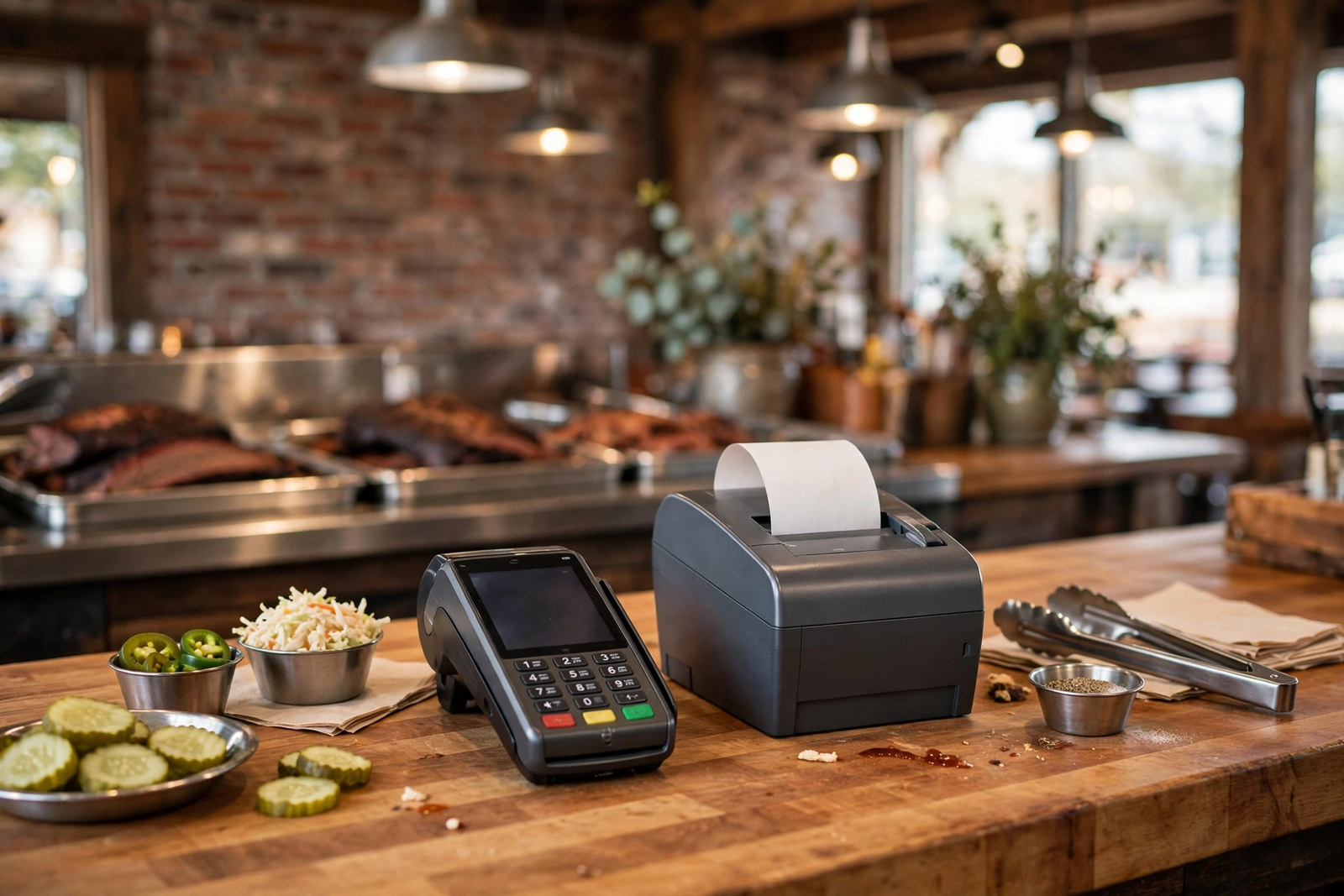
Card payments and POS systems do not need fast broadband, but they do need reliable broadband. A typical card transaction sends only about 50 KB of data, far less than streaming a single song, and a 100 Mbps line is plenty for card and POS use even with multiple terminals. What matters more than headline speed is reliability, low downtime, latency under 200 ms, and network segmentation that keeps card payment terminals on a separate network from guest Wi-Fi and staff devices. A 100 Mbps line with 99.9 percent uptime is genuinely better than a 1 Gig line with 99.5 percent uptime for card payment use, and a restaurant or store should choose the provider with the better repair promise, not the bigger speed number.
Uptime is revenue, and the numbers are stark. One restaurant-network analysis puts the cost of a POS outage at about $875 for every 15 minutes for a restaurant doing $3,000 per hour during dinner service, and that figure is quoted here as a reported illustration from that source, not as a measured fact about Fort Worth. Every minute of outage during peak trading equals lost sales, and a momentary drop during a busy lunch service can fail multiple transactions at once. Modern card terminals from Square, SumUp, Stripe, PayPal Zettle and similar providers carry their own 4G connectivity as a fallback, and traditional merchant acquirers require active annual PCI compliance management, but the terminal’s fallback is a last resort, not a plan. The plan is a primary fiber line with a cellular backup that takes over automatically, tested once a quarter.
PCI DSS and Guest Wi-Fi in Fort Worth Restaurants and Retail Stores

Any store that accepts cards operates under PCI DSS, the payment card industry’s security standard, and one of its central ideas is directly a network-design question: systems that handle cardholder data should be isolated from systems that do not need to touch them. In practice, this means card terminals and POS must never share an open network with guest Wi-Fi, the music streamer, the break-room TV or a customer’s phone. Network segmentation isolates POS, back-office, guest Wi-Fi and connected-device traffic so that only cardholder data systems fall inside the PCI DSS audit scope, and proper segmentation can reduce PCI DSS audit scope by 60 to 80 percent and lower annual compliance costs. PCI DSS 4.0, fully enforced as of March 2025, requires documented segmentation testing at least every six months for service providers and annually for merchants. This guide is not compliance advice; the acquirer or payment provider decides what a merchant must validate, and one guidance source notes that segmentation is strongly recommended rather than a strict requirement, while a flat network puts everything in scope.
Restaurant Guest Wi-Fi and POS Segmentation in Fort Worth, Texas
Proper segmentation is not exotic. A business-grade router and access points can carve one physical connection into separate networks: one for payment systems, one for back-office and cameras, one for guests, each isolated from the others, with the guest network unable to see anything internal. Many POS and payment vendors specify exactly this, and the acquiring bank’s annual PCI questionnaire will ask about it. Guest Wi-Fi deserves one more decision: whether to offer it at all. For a boutique or cafe it can be genuine hospitality; for a quick-turn store it may be pure load. If it is offered, isolate it, rate-limit it so it cannot starve the registers, and put it behind its own network name. A multi-location restaurant group typically deploys this design with centralised policy control, so a rule blocking guest Wi-Fi from the cardholder network at one site applies identically at every site, including locations that opened last week.
AT&T Business Fiber for Restaurants and Retail Stores in Fort Worth, Texas
AT&T Business Fiber is available in Fort Worth, Texas, and AT&T is the incumbent telephone company in the city, the former Southwestern Bell, with AT&T Fiber the leading fiber option across most of the city. FCC business data puts AT&T Fiber at about 81.9 percent of Fort Worth business locations citywide, stronger than in Dallas and far stronger than in Portland or Nashville, with wide variation by ZIP code, from 96.9 percent in 76110 and 90.6 percent in 76107 to 88.7 percent in 76133 and 83.7 percent in 76104, but only 38.5 percent in downtown ZIP 76102. Speeds run to 5 Gig symmetrical where fiber is lit. Where fiber has not reached a street, AT&T Internet Air for Business, the 5G fixed wireless fallback, reaches roughly half to three-quarters of Fort Worth businesses.
AT&T Business Fiber list pricing in November 2026 is $60 per month for 300 Mbps, $100 for 500 Mbps, $140 for 1 Gig, $185 for 2 Gig and $285 for 5 Gig, all symmetrical, meaning the upload speed matches the download speed. Businesses that bundle an eligible AT&T business wireless plan pay less: $40, $60, $90, $135 and $235 per month for the same five tiers. Those are national list prices published on AT&T’s own business plans page, before taxes and fees. There is one conflict worth knowing about: secondary sources report regular post-promotion rates of $70, $110 and $160 per month for the 300 Mbps, 500 Mbps and 1 Gig tiers, so the honest way to budget is to plan on the regular rate and treat the list price as the starting point.
AT&T Business Fiber Speeds and Fiber Pricing for Restaurants in Fort Worth, Texas
The tiers below are the AT&T Business Fiber tiers, and one conflict is live today: AT&T’s own offers page currently shows 300 Mbps at $70 a month and 1 Gig at $170, against the plans page’s $60 and $140, so treat those two tiers as ranges of $60 to $70 and $140 to $170 and confirm the price in writing before ordering. Check AT&T Business Fiber availability for your Fort Worth, Texas address and match the tier to the number of terminals, cameras and guest devices, not to the biggest number on the page.
| AT&T Business Fiber tier | Speeds | List price per month | With eligible wireless plan | Best for |
|---|---|---|---|---|
| Business Fiber 300 | 300 Mbps symmetrical | $60 ($70 regular reported) | $40 | Small office, point-of-sale, video meetings |
| Business Fiber 500 | 500 Mbps symmetrical | $100 ($110 regular reported) | $60 | Busy office, restaurant, cloud-heavy shop |
| Business Fiber 1 Gig | 1 Gig symmetrical, 5G backup included | $140 ($160 regular reported) | $90 | Growing team, cloud software, guest network |
| Business Fiber 2 Gig | 2 Gig symmetrical, 5G backup included | $185 | $135 | High-bandwidth office, large file transfers |
| Business Fiber 5 Gig | 5 Gig symmetrical, 5G backup included | $285 | $235 | Media production, multi-site backups, heavy workloads |
Never confuse business fiber pricing with residential fiber pricing. AT&T’s residential fiber promotions in November 2026 run as low as $35 a month for 300 Mbps in the first year, and those figures circulate widely in search results. They are not business prices, they do not carry business terms, and quoting them as business prices would understate the real cost by nearly half. Business plans also carry business features the residential plans do not, including commercial-use terms, business support and static IP options, and the 1 Gig tier and above add the built-in 5G backup that a restaurant or store cannot get on a residential plan at any price.
Other Business Internet Providers for Restaurants and Retail Stores in Fort Worth, Texas
Spectrum Business is the rival that matters most in Fort Worth, Texas, because its cable network reaches about 93.5 to 100 percent of Fort Worth business locations in every sampled ZIP code, against AT&T fiber at roughly 82 percent citywide, so a restaurant or shop that cannot get AT&T fiber can almost always get Spectrum cable, with published business pricing of $65 per month for 500 Mbps, $95 for 750 Mbps and $115 for 1 Gig, although the 500 Mbps tier is also shown at $50 a month as an online-only figure, so the honest figure is a range of $50 to $65 depending on the channel. That speed is download-led, with uploads of about 20 Mbps on the 500 Mbps tier, which is the real trade-off against AT&T’s symmetrical fiber for cloud point-of-sale, camera upload and card-terminal traffic. Spectrum charges a $10 a month processing fee unless the business uses AutoPay, and a static IP is reported at about $14.99 a month, with one source saying the first static IP is included free, so both must be confirmed in writing. Frontier Fiber is a real but small Fort Worth option, reaching roughly 11 to 18 percent of the area on residential data but only about 2.4 percent of business locations, with published national business pricing of $49.99 a month for 500 Mbps, $69.99 for 1 Gig and $89.99 for 2 Gig on a 24-month price lock, and its 1 Gig tier is the cheapest published business fiber gig nationally, but those are national prices for addresses inside its footprint, not Fort Worth prices. FiberFirst is a genuine second fiber network in north Fort Worth, reaching 35.9 percent of locations in ZIP 76137 with speeds up to 5 Gig, priced by quote for business. Nextlink Internet, the Texas-based fixed wireless provider, reaches 90 to 100 percent of business locations in most Fort Worth ZIP codes and is a genuine option outside the fiber footprint, priced by quote. Google Fiber and Comcast cable do not serve Fort Worth, so neither of them is claimed here. For 5G, T-Mobile fixed wireless reaches about 60 to 100 percent of the city and Verizon about 28 to 87 percent, strongest downtown, and both work best as backup or for smaller sites.
The rule for choosing between these providers is the same as for any business: check the address first, then compare the second-year price, then ask for the service level agreement in writing. A restaurant or store should also ask each provider what happens when the line goes down, because the answer matters more here than in an office. A provider that can promise a repair time in writing is worth more than a provider with a faster headline speed and no promise at all, and a provider that cannot put its repair time in writing should not be signed to a multi-year term.
Disclaimer: This article contains affiliate links to AT&T Business services; we may earn a commission at no extra cost to you. Ortelcom.com is an independent publisher not affiliated with or endorsed by AT&T. Pricing, speeds and availability are not guaranteed, were checked 24 November 2026, and vary by address and promotions. Confirm all details before ordering. AT&T trademarks belong to their owner.
5G Business Internet in Fort Worth, Texas: T-Mobile, Verizon and AT&T Internet Air
5G business internet is the fastest service to install in Fort Worth, Texas and the easiest to misunderstand. It arrives as a small gateway that plugs in and connects over the mobile network, so a business can be online the same day, with no construction, no technician visit and no annual contract. The trade-off is that speeds vary by signal, by tower congestion and by time of day, and uploads are far slower than on fiber.
T-Mobile 5G Business Internet in Fort Worth, Texas
T-Mobile 5G Business Internet costs $60 a month as a standalone plan, or $35 a month when bundled with a business voice line, with a five-year price guarantee and no annual contract. There is a naming conflict in the sources: a March 2026 comparison lists newer plan names, with the Rely plan at $35 a month with a voice line and $60 standalone, Amplified at $45 a month with a voice line and $70 standalone, and All-In at $55 a month with a voice line and $80 standalone. The honest figure is therefore a range of $35 to $60 a month for the entry plan depending on the bundle, and a Fort Worth business should confirm which plan name and price applies at its address. Speeds are not tiered the way fiber is: the business pays one price for unlimited data and gets whatever speed the tower delivers, often 100 to 400 Mbps in a good signal area, and the plan includes a free Wi-Fi 7 gateway and a 15-day trial.
Verizon 5G Business Internet in Fort Worth, Texas
Verizon 5G Business Internet is the most structured of the three 5G options, with defined speed tiers and the longest price guarantee. The 100 Mbps tier costs $65 a month on offer, or $69 a month regular, and $35 a month when paired with a select business smartphone plan. The 200 Mbps tier costs $85 a month on offer, or $99 a month regular, and $55 a month bundled. The 400 Mbps tier exists but is not priced on Verizon’s current page, and older trackers put it at about $199 a month, so get that price by quote. Every plan carries a ten-year price guarantee on the base fee. The hidden cost is the router: Verizon includes it on a monthly payment plan of $9.72 a month over 36 months, which totals $349.99, so the real monthly cost of the 100 Mbps plan is about $75 a month before taxes and fees unless the router is paid for outright.
AT&T Internet Air for Business in Fort Worth, Texas
AT&T Internet Air for Business is the 5G fixed wireless alternative for a Fort Worth business that cannot get AT&T fiber, or that needs a connection fast. The list price is $65 a month for the Standard plan and $105 a month for the Premium plan, falling to $60 and $100 with AutoPay and paperless billing, and to $40 and $80 with an eligible business wireless plan, according to AT&T’s own terms, effective 19 May 2026, and independent trackers that read the same terms in September and October 2026. The Premium plan adds AT&T Turbo for Business, which is 250 GB of priority-treated data per billing cycle and up to 25 percent faster uploads. The Standard plan has no data caps, but AT&T may slow speeds when the network is busy. Some dealer landing pages show $30 and $70 a month for these plans, but those figures stack a $10 a month bill credit for 36 months on top of the bundle discounts, and they are promotional prices, not the list prices, so this guide does not quote them as the cost.
Enterprise Fiber for Restaurant and Retail Groups in Fort Worth, Texas
Enterprise fiber is a different product from the small-business fiber in the rest of this guide, and the difference is the guarantee. A dedicated internet access circuit, known as DIA, gives a restaurant group or retail chain a private, unshared connection with a service level agreement that promises a specific uptime and a specific repair time, and it is priced by quote because the price depends on the building, the distance to the network and the term. In Fort Worth, the enterprise fiber options include AT&T Dedicated Internet, with guaranteed symmetric speeds up to 1 Tbps, Zayo enterprise fiber, Fort Worth Fiber, the local provider claiming more than 2,500 on-net commercial buildings, LOGIX Fiber Networks, and Crown Castle enterprise fiber. No published price list exists for any of them in Fort Worth, so every enterprise quote must be obtained in writing for the address.
How Restaurant and Retail Internet Installation Works in Fort Worth, Texas
Installing business internet in a Fort Worth restaurant or store is usually a one-visit job when the fiber already reaches the building, and a construction project when it does not. If the fiber is already in the street and the building is connected, the provider schedules a technician visit, runs a fiber drop to the suite, installs an optical network terminal, connects the gateway, tests the line and leaves the business online. If the fiber is in the street but not in the building, the provider may need to run fiber through the building, which requires the landlord’s permission, and that is where the timeline stretches. If there is no fiber in the street at all, the provider quotes a construction build, which can take weeks to months and can carry a construction charge to negotiate in writing before signing. Our guide to how to order and install AT&T Business Fiber walks through the ordering steps in detail.
What Happens on Restaurant Internet Installation Day in Fort Worth, Texas
On installation day, the technician confirms the entry point and the location of the network closet or the desk where the gateway will sit, and runs the fiber to that point. The optical network terminal, a small box that converts the light signal into an electrical signal, is mounted on the wall or placed on a shelf, and the gateway connects to it with an Ethernet cable. The technician then activates the service, tests the speed on a wired connection, connects the business Wi-Fi network, and checks that the point-of-sale terminal, the card reader, the kitchen display system and the phones are online. The visit usually takes two to four hours for a straightforward installation, longer if the fiber has to be run through walls or between floors. Schedule the visit outside service hours, and have someone on site who can decide where the gateway goes and which network name and password to use.
How Long Does Restaurant and Retail Internet Installation Take in Fort Worth, Texas
No Fort Worth-specific installation lead time is published by any provider, so this guide gives a typical range rather than a city-specific figure, and says so plainly. When the fiber already reaches the building, installation is usually scheduled within a few business days of the order and completed in a single visit. When the building needs internal fiber work, the timeline stretches to one to three weeks, depending on the landlord’s approval and the building’s wiring. When street construction is needed, the timeline can run to several weeks or a few months, and the business should get the construction schedule in writing before counting on the date. AT&T advertises free installation on eligible online orders, and the other providers generally include standard installation, but construction beyond the standard install can carry a charge. Never schedule an opening, a refit or a busy season launch on an installation date that has not been confirmed in writing.
What Your Restaurant or Store Needs Before the Internet Installation Visit in Fort Worth, Texas
A short checklist before the visit saves a second appointment and a lost service. Confirm the landlord’s written permission for any drilling or cabling, and confirm who owns the inside wiring. Decide where the gateway and the network equipment will live, and make sure there is a power outlet within reach and a clear path for the fiber. Know the Wi-Fi network names and passwords the business wants, one for staff and systems and one for guests, and have the login details for the cloud POS, the ordering apps and the camera system that need reconnecting, because the network name change will disconnect every device at once. List the point-of-sale terminals, the card readers, the kitchen display system, the printers and the security cameras for the technician so each one is tested before the visit ends. Finally, keep the old internet service running until the new line has been tested at full speed through a full service, not just a quiet hour.
Business Fiber Internet Costs and Hidden Fees in Fort Worth, Texas
The monthly price is not the monthly cost, and the gap between the two is where Fort Worth businesses get surprised. Every price in this guide is a starting price before taxes and fees, and the real bill adds taxes, any state cost recovery charge, equipment fees where they apply, and the price of any add-on the business actually needs. The table below works through a two-year total for AT&T Business Fiber at list prices, with taxes and fees excluded because they vary by address, and the regular post-promotion rates shown where the sources report them.
| AT&T Business Fiber tier | Monthly list price | Two-year total at list price | Two-year total at regular rate |
|---|---|---|---|
| 300 | $60 per month | About $1,440 | About $1,680 at $70 per month |
| 500 | $100 per month | About $2,400 | About $2,640 at $110 per month |
| 1 Gig | $140 per month | About $3,360 | About $3,600 at $150 per month |
| 2 Gig | $185 per month | About $4,440 | About $4,440 at list price |
| 5 Gig | $285 per month | About $6,840 | About $6,840 at list price |
The fees that most often surprise a Fort Worth business are the ones that are not in the headline price. Spectrum charges a $10 a month payment processing fee and a $5 a month paper statement fee unless the business uses Auto Pay and paperless billing, and its bundle price rises after the first year on a tenure ladder. Verizon’s 5G router costs $9.72 a month over 36 months unless it is paid for outright, which adds about $350 to the first three years. AT&T’s business fiber includes the gateway and free installation on eligible online orders, but taxes and any state cost recovery charge still apply on top. Ask every provider for the month-one price, the month-thirteen price and every fee on the first bill, in writing, before signing. Our business internet cost guide for Dallas, Texas uses the same method: compare the second year, not the first month.
Backup and Failover for Your Fort Worth, Texas Business Fiber Internet Connection
A Fort Worth business that depends on its internet connection needs a backup line, because fiber cuts happen, construction crews cut cables, and a single point of failure is a business risk, not a technical detail. The simplest backup is the one AT&T already includes: the 1 Gig tier and above of AT&T Business Fiber include built-in 5G backup at no extra cost, so when the fiber goes down, the gateway switches to the mobile network automatically and keeps the essential systems online. A business on the 300 Mbps or 500 Mbps tier needs a separate 5G business internet plan as a second line, with automatic failover through a dual-WAN router.
Failover only works if it is tested. A business should test the backup line at least once a quarter, by unplugging the primary line during a quiet hour and confirming that the card terminal, the phones and the cloud software all keep working on the backup, and then plugging the primary line back in and confirming the switch back. The cost of a backup line and a small battery is a fraction of the cost of a single day closed.
How to Choose the Right Internet for Restaurants and Retail Stores in Fort Worth, Texas
Choosing internet for restaurants and retail stores in Fort Worth, Texas comes down to five questions, answered in order. First, which providers actually reach the address? Check AT&T first, then Spectrum, because they are the two networks that reach most Fort Worth addresses, then Frontier, FiberFirst and the 5G options, because the provider list at the address is the whole decision. Second, how much upload does the business need? A business that mostly downloads can live on cable; a business that uploads, backs up, hosts video calls or sends large files needs symmetrical fiber, and should not settle for a cable upload of 10 or 35 Mbps. Third, what does the price become in month thirteen? Compare the regular rate, not the first-year offer, with taxes and fees included. Fourth, what happens when the line goes down? A business that cannot afford an outage needs either a tier with built-in 5G backup or a separate backup line, and should test it before relying on it. Fifth, how long is the commitment? AT&T’s listed fiber plans have no annual contract, Spectrum’s small-business plans have no contract, and most published fiber tiers have no annual contract, while dedicated fiber products typically carry 24 to 36 month terms.
Work through this checklist in an afternoon. Check the address with AT&T Business Fiber first, then Spectrum Business, Frontier and FiberFirst in the north of the city, and note whether fiber or only cable reaches the building, especially downtown, where Spectrum leads. Get the month-thirteen price and every fee in writing from each provider that serves the address.
Internet for Restaurants and Retail Stores in Fort Worth, Texas: Frequently Asked Questions
What internet speed does a restaurant or retail store need in Fort Worth, Texas?
Most single restaurants and stores need 300 Mbps to 500 Mbps of symmetrical fiber. Card payments and POS systems need very little speed, a typical card transaction sends only about 50 KB of data, but cameras, cloud backups and guest Wi-Fi need upload bandwidth, which is why symmetrical fiber beats cable. A busy multi-terminal site, a grocery store or a restaurant group should look at the 1 Gig tier.
How much does internet for a restaurant or retail store cost in Fort Worth, Texas?
AT&T Business Fiber lists at $60 a month for 300 Mbps, $100 for 500 Mbps and $140 for 1 Gig, or $40, $60 and $90 with an eligible business wireless plan, all before taxes and fees. Add a 5G backup line at $35 to $65 a month if the chosen tier does not include built-in 5G backup, and budget for the month-thirteen price, not just the first month.
How do I keep guest Wi-Fi separate from card payments in Fort Worth, Texas?
Use a business-grade router and access points to carve the connection into separate networks: one for payment systems, one for back-office and cameras, and one for guests, each isolated from the others, with the guest network unable to see anything internal. Rate-limit the guest network so it cannot starve the registers, and put it behind its own network name. This is the segmentation PCI DSS expects, and the acquiring bank’s annual questionnaire will ask about it.
What happens when restaurant internet goes down during service in Fort Worth, Texas?
Without a backup line, card terminals stop, online ordering stops and the POS stops syncing, which is why the standard design is a wireline primary with a cellular backup that takes over automatically. The 1 Gig tier and above of AT&T Business Fiber include built-in 5G backup at no extra cost. Test the backup once a quarter by pulling the primary during a quiet hour and confirming a card transaction goes through.
Is AT&T Business Fiber available for restaurants in Fort Worth, Texas?
AT&T Business Fiber is available in parts of Fort Worth, Texas, with speeds up to 5 Gig where available, and a restaurant or store should check its exact address rather than assuming coverage. Where fiber has not been built, AT&T Internet Air for Business at $65 a month Standard and $105 Premium is the fastest alternative, or the local cable provider’s network.
Do I need a contract for restaurant or retail internet in Fort Worth, Texas?
Not necessarily. AT&T Business Fiber’s listed plans have no annual contract, most small-business cable and fiber plans have no contract, and the 5G business internet plans have no annual contract. Dedicated fiber products typically carry 24 to 36 month terms.
Internet for restaurants and retail stores in Fort Worth, Texas rewards the business that puts uptime first and headline speed second. AT&T Business Fiber is the strongest default where it reaches the address, with symmetrical speeds, published pricing and built-in 5G backup on the 1 Gig tier and above, and it reaches about eight in ten Fort Worth business addresses. Spectrum cable is the strongest fallback almost everywhere else, and Spectrum fiber is the strongest option downtown. Our internet for restaurants and retail stores guide for Oklahoma City, Oklahoma Check the address, separate the card terminals from the guest Wi-Fi, test the backup line, and order once, order right.

