
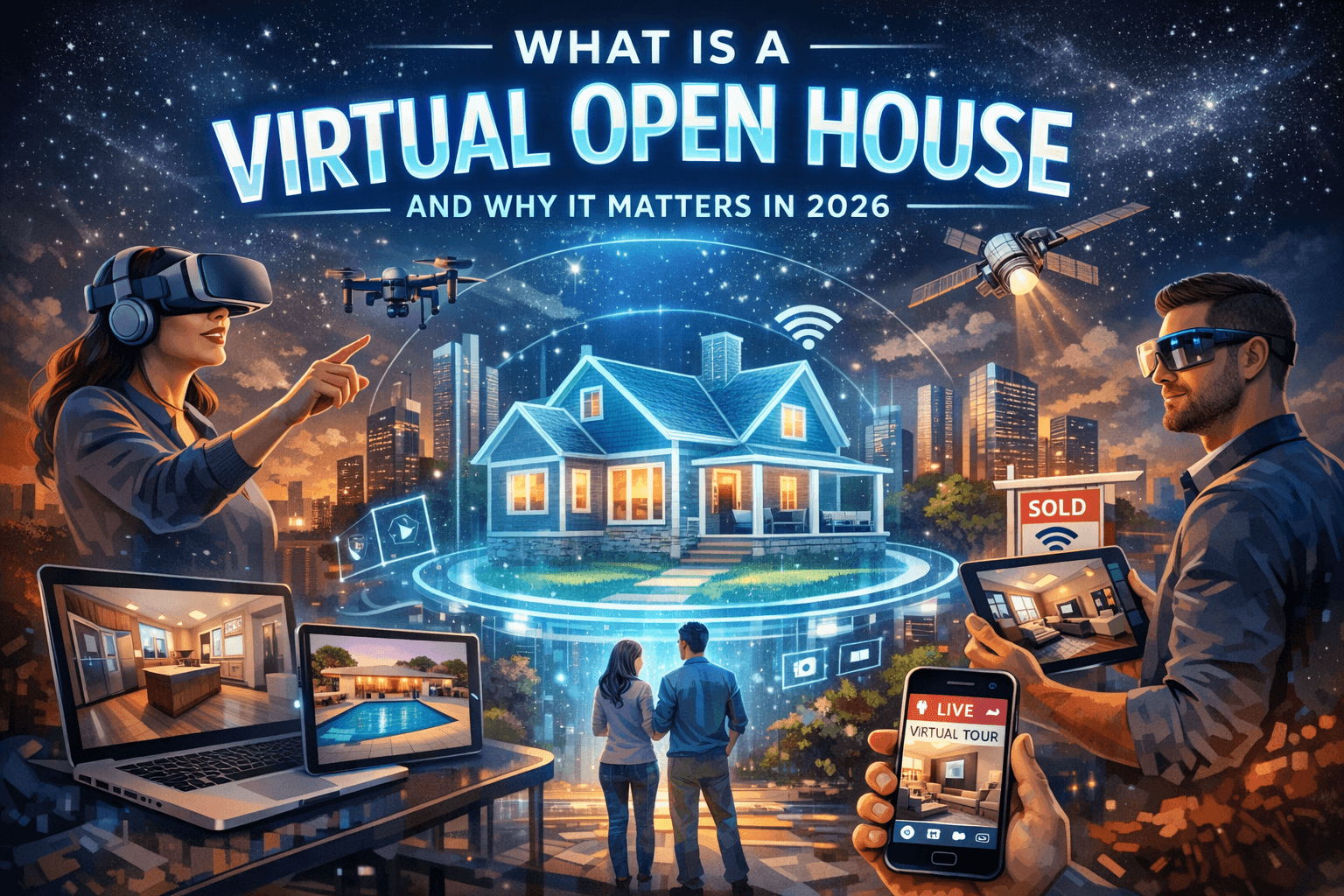
A virtual open house is a live or pre‑recorded online event that allows potential buyers or participants to explore a property, product, or service from anywhere. Using video tours, real‑time Q&A, and interactive features, virtual open houses increase engagement, save time, and expand audience reach — transforming how people evaluate offerings in real estate and other industries. In an era defined by digital experiences, the virtual open house has become one of the most transformative tools in real estate, education, training, and business presentations. What began as a solution during restricted mobility has evolved into a strategic advantage — offering convenience, broader reach, and measurable engagement.
Whether you’re an agent, marketer, homeowner, or event planner, this guide will walk you from what it is to how to execute it well — and how to measure success afterwards.
What Is a Virtual Open House?
A virtual open house is a fully online event where participants can view a property, product, service, or educational content in an immersive way. Instead of attending in person, people join via video, interactive content, or 360° walkthroughs — often on a scheduled live stream or an on‑demand platform.
Traditionally used in real estate to tour homes, it now extends to:
-
Product launches
-
College and university tours
-
Business showcases
-
Trade exhibit previews
-
Online training demonstrations
Why Virtual Open Houses Matter Today
Before diving deeper, it helps to understand why they are so valuable:
➤ Accessibility
Anyone with a device and internet can participate — regardless of location.
➤ Time Efficiency
Viewers can join across time zones and schedules, avoiding travel.
➤ Broader Audience Reach
A virtual event can attract local, national, and international visitors.
➤ Data & Analytics
Hosts gain insights on attendance, dwell time, interaction hotspots, and questions — something very difficult to collect in physical open houses.
Personal Experience: Hosting My First Virtual Open House
I remember hosting my first virtual open house for a suburban listing last spring. The property was beautiful, but buyer turnout had dwindled due to scheduling conflicts and travel hurdles.
What Went Wrong at First…
-
I assumed everyone would prefer traditional tours.
-
I used low‑quality footage that didn’t represent the home well.
-
I didn’t have any interactive elements.
What Changed the Game
Once I upgraded the strategy — using professional 360° video, a moderated live Q&A, and downloadable floorplans — engagement skyrocketed. Within 48 hours, we had more qualified leads than we’d seen in two weeks of in‑person tours.
That experience taught me:
✔ People value flexibility
✔ High‑quality content wins trust
✔ Engagement tools (chat, polls) are essential
Virtual Open House: Real‑World Scenario
The Smith Family Home Sale Case Study (Suburban Chicago)
Situation:
The Smiths were relocating for work and needed to sell quickly. The home was mid‑century, highly desirable — but buyer traffic was slow due to scheduling conflicts.
Action:
We hosted a Saturday virtual open house using:
✔ 360° video walkthrough
✔ Live narration from an agent
✔ Real‑time Q&A chatbot
✔ Digital home packet download
Results:
➡ 150+ attendees
➡ 75% more buyer inquiries
➡ Multiple offers
➡ Sale price above listing
This real‑world success illustrates how virtual open houses can replace or enhance traditional open houses with measurable leads and faster results.
Virtual Open House Tools & Software
| Tool Category | What It Does | Examples |
|---|---|---|
| 360° Video Creation | Captures immersive views | Ricoh Theta, Matterport |
| Live Streaming Platforms | Broadcast host video | Zoom, Facebook Live |
| Interactive Tour Platforms | Maps, click‑through navigation | EyeSpy360, Kuula |
| Lead Capture & CRM | Track and manage leads | HubSpot, Salesforce |
| Chat & Q&A Integration | Collect audience questions | Intercom, Slido |
🎯 Step‑by‑Step: How to Host a Virtual Open House
📌 1. Plan Your Goal
Decide whether you want to educate, sell, generate leads, or build hype.
📌 2. Choose the Format
-
Live broadcast: Real‑time interaction
-
On‑demand recording: 24/7 availability
-
Hybrid: Both
📌 3. Prepare High‑Quality Digital Assets
-
Professional video tour
-
Photos and floor plans
-
Digital brochures
📌 4. Choose the Right Tools
Match tools to audience tech comfort and scale.
📌 5. Promote the Event
Use email, social media, landing pages, and paid ads.
📌 6. Engage Your Audience
Leverage chat, polls, Q&A, and comment moderation.
📌 7. Follow Up
Collect attendee data, send personalized follow‑ups, and track conversions.
Virtual Open House vs. Traditional Open House (Quick Comparison)
| Feature | Virtual Open House | Traditional Open House |
|---|---|---|
| Accessibility | Unlimited, online | Limited to physical visitors |
| Scheduling | Flexible | Needs specific time slots |
| Cost | Low‑medium | High (staff, staging, refreshments) |
| Audience Size | Potentially large | Smaller group |
| Data Tracking | Comprehensive | Minimal |
| Engagement | Interactive online | In‑person touchpoints |
Unique Value: Why Virtual Open Houses Outperform Traditionally
✔ Converts At‑Home Browsers into Leads
Many home shoppers browse listings only when they can tour remotely — and virtual experiences meet that behavior where it naturally occurs: online.
✔ Reduces Pressure on Buyers
Participants can explore without feeling watched or hurried — leading to better decision‑making.
✔ Enables Smart Scheduling
Rather than hosting one open house per weekend, you can host multiple sessions or forever access via recordings.
✔ Improves Safety & Comfort
Particularly relevant for health‑conscious or remote audiences.
✔ Offers Data Analytics
Real‑time insights help refine future events and follow‑ups.
Best Practices – What Works Every Time
-
Test tech before go‑live
-
Use professional visuals
-
Assign a moderator
-
Offer exclusive incentives
-
Provide downloadable resources
-
Follow up within 24 hours
Frequently Asked Questions (FAQ)
1. How long should a virtual open house be?
Most successful virtual open houses run 30–60 minutes with time for walking tours and live Q&A.
2. Can I host a virtual open house without live streaming?
Absolutely! Pre‑recorded tours available on‑demand still drive engagement, especially for asynchronous audiences.
3. What equipment do I need?
At minimum: a good camera or smartphone, tripod, quality lighting, stable internet, and hosting software.
4. Are virtual open houses only for real estate?
No! They work for product reveals, school tours, exhibitions, training demos, and more.
5. How do I collect leads during a virtual open house?
Use registration forms, signup pages, chatbots, and follow‑up emails. Integrate with your CRM to automate collection.
6. What’s the ideal platform to host one?
It depends on your audience and goals. Zoom and Facebook Live are great for accessibility; dedicated tour tools offer 360° experiences.
7. How do I measure success?
Track attendance, engagement time, chat interactions, lead conversions, and follow‑up response rates.
8. Is it better than an in‑person open house?
Both have benefits. Virtual is broader and more measurable; in‑person offers emotional, tactile experiences. Often the best strategy is hybrid.
9. How can I make my virtual open house interactive?
Add Q&A segments, live polls, clickable tour hotspots, downloadable assets, and chat moderators to answer in real time.
10. How do I prepare participants?
Send a confirmation email with the link, a short “what to expect” guide, and a technical tip sheet.
Final Thoughts
Virtual open houses aren’t just a temporary trend. They reflect how audiences expect to discover, interact with, and commit to experiences — whether buying a home, choosing a school, or evaluating a product.
By embracing technology, engaging your audience, and combining digital tools with purposeful strategy, you can unlock a competitive advantage that enhances both reach and results.

