
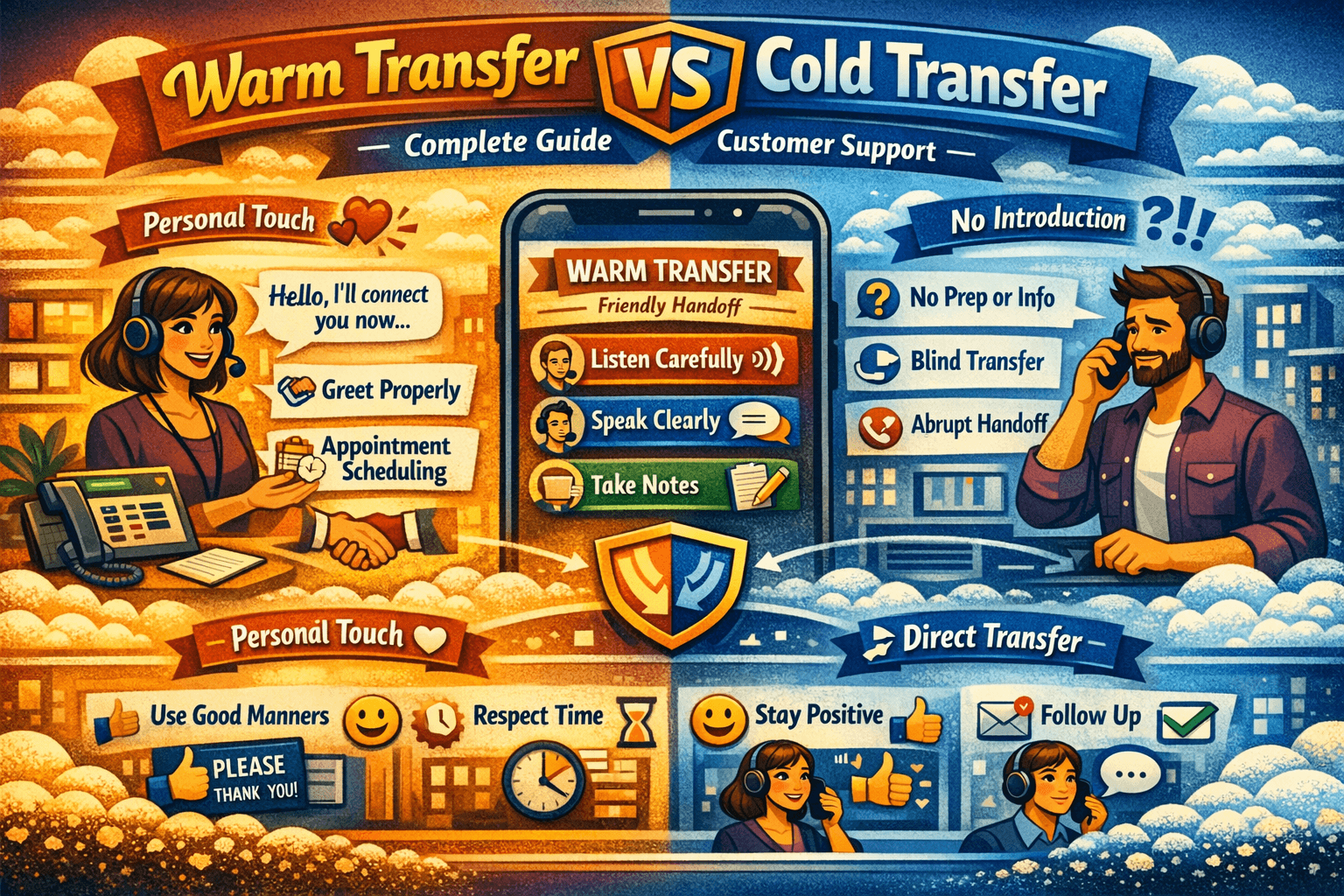
In customer service, a warm transfer means the agent stays on the line to introduce the caller to the next representative and provide context, creating a smooth handoff. A cold transfer sends the caller directly without explanation. Warm transfers improve experience and resolution rates, while cold transfers are quicker but risk confusion and repeat calls. In today’s highly competitive business landscape, customer satisfaction isn’t just a metric — it’s a competitive advantage. One crucial factor in customer interactions is how calls are routed and transferred. The way you handle a customer transfer can influence loyalty, resolution speed, and overall perception of your brand.
What Is a Transfer in Customer Support?
When a caller needs help that the first agent cannot fully provide, the call is “transferred” to another agent, team, or department capable of resolving the inquiry. This sounds simple, but how that transfer happens significantly impacts the outcome.
Two main approaches dominate call transfer strategies:
-
Warm transfer – where an agent stays on the line to introduce the caller to the next agent and share necessary context.
-
Cold transfer – where the agent simply re‑routes the call without prior introduction or context.
Though both achieve the same functional result — connecting the caller with help — their effects on efficiency, customer satisfaction, and first‑contact resolution vary widely.
Historical Background
In early telephone switchboards, operators manually connected callers to the appropriate lines and often remained involved to ensure the connection was correct. This early system reflected the roots of what we now call a warm transfer. As automated and digital systems emerged, many transfers became instantaneous and context‑free — evolving into today’s cold transfers.
Modern contact centers increasingly recognize that the human element still matters. Warm transfers resemble traditional operator practices but leverage specialist expertise, while cold transfers represent streamlined technology‑driven call routing.
What Is a Warm Transfer?
With omnichannel communication, service expectations on the rise, and customers demanding fast, personalized help, understanding how call transfers affect experience is essential for support strategies, hiring decisions, technology investments, and training programs. A warm transfer is a call‑handling method where the initial agent stays on the line while connecting the caller to the next representative. In practice:
-
The first agent briefs the next agent about the caller’s issue.
-
The agent may confirm availability before completing the transfer.
-
The caller hears introductions and context, reducing repetition.
Key Features
✔ Context shared between agents
✔ Personalized handoff
✔ Higher likelihood of first‑call resolution
✔ Builds caller confidence
When Are Warm Transfers Used?
Warm transfers are common in scenarios such as:
-
Escalations to supervisors or specialists
-
Technical support requiring detailed context
-
Customer loyalty or high‑value accounts
-
Healthcare or financial services with sensitive issues
Example Workflow
-
Agent A receives a call and identifies an issue needing escalation.
-
Agent A remains on the line and contacts Agent B.
-
Agent A briefs Agent B with key details.
-
Warm transfer is completed when Agent B picks up and welcomes the caller.
This ensures smooth transitions and reduces caller frustration.
What Is a Cold Transfer?
A cold transfer — also known as a blind or direct transfer — happens when the first agent simply re‑routes the call to the next department without initial introduction or context.
Key Features
✔ Quick and efficient routing
✔ Lower training or process requirements
✔ No pre‑briefing between agents
✔ May require the caller to repeat information
When Are Cold Transfers Used?
Cold transfers are common when:
-
The next team handles general inquiries
-
Call volumes are high and efficiency is prioritized
-
The system directs calls automatically via IVR or queues
Example Workflow
-
Agent A determines the call is better suited for another team.
-
Agent A transfers the call directly.
-
The caller joins a queue for the next available agent.
-
The new agent must ask the caller to repeat their issue.
Though faster operationally, this approach can cause repeat explanations, confusion, or longer resolution times.
Step‑by‑Step Guide: How to Implement Warm and Cold Transfers
Step 1 — Define Your Support Needs
Assess your environment:
-
Do callers frequently require specialist support?
-
Is first‑call resolution a priority?
-
What volume of transfers do agents handle daily?
Understanding this shapes your transfer strategy.
Step 2 — Choose When Each Transfer Type Applies
A balanced transfer strategy ensures both efficiency and satisfaction:
Use warm transfers when:
✔ Caller requires complex support
✔ Customer expresses frustration or urgency
✔ Sensitive topics (billing, health, legal inquiries)
✔ VIP or high‑value accounts are involved
Use cold transfers when:
✔ Calls are routine
✔ Automated systems route calls efficiently
✔ Context isn’t necessary at transfer
Step 3 — Train Agents in Effective Transfer Protocols
For warm transfers:
-
Teach agents how to summarize and hand off context
-
Encourage confidence in speaking with internal reps
-
Provide scripts for smooth transitions
For cold transfers:
-
Ensure directory accuracy
-
Minimize caller delay during transfer
Step 4 — Monitor and Measure Transfer Performance
Track metrics such as:
📊 First‑call resolution
📊 Average handle time
📊 Customer satisfaction scores
📊 Repeat calls due to poor transfer
This data helps refine when and how transfers occur.
Step 5 — Use Technology to Support Transfers
Systems like CRM, automatic call distribution (ACD), and integrated notes help ensure details travel with the caller — even in cold transfers.
Examples include:
-
Screen pop‑ups with caller history
-
Softphone controls that allow preview of next rep availability
-
Internal chat for agent handoffs
Benefits of Warm Transfers and Cold Transfers
Benefits of Warm Transfers
-
Higher Customer Satisfaction
Personal introductions reduce frustration and build trust. -
Better First‑Call Resolution
When context is shared up front, the next agent resolves issues faster. -
Reduced Need for Repetition
Callers don’t have to repeat information — improving speed and quality. -
Stronger Team Communication
Internal collaboration increases agent confidence and accuracy. -
Improved Perception of Professionalism
Warm transfers demonstrate care and dedication.
Benefits of Cold Transfers
-
Speed and Efficiency
Cold transfers save time by minimizing steps. -
Simple Workflow
Fewer requirements mean easier training and execution. -
Scales Easily With High Call Volume
Ideal for systems with automated routing and queues. -
Lower Operational Costs
Less time per call translates to more handled calls. -
Reduced Need for Internal Coordination
Useful when context doesn’t materially improve outcomes.
Warm Transfer vs Cold Transfer: Side‑by‑Side Comparison
| Feature | Warm Transfer | Cold Transfer |
|---|---|---|
| Context Delivery | Shared before transfer | Not shared |
| Caller Experience | Smooth, high satisfaction | Functional, efficient |
| Training Requirements | Higher | Lower |
| First‑Call Resolution | Higher likelihood | Lower likelihood |
| Call Handling Time | Slightly longer | Shorter |
| Best Use | Complex, sensitive, customer‑centric | Routine, volume‑based |
| Technology Needs | CRM + collaboration tools | Simple routing |
| Repeat Information | Rare | Often necessary |
Examples of Transfer Scenarios
Call Center Scenario (Customer Support)
A customer calls about a billing issue they can’t understand. The first agent identifies the issue requires a billing specialist. Instead of dropping the caller into a queue, the agent calls the billing team, briefly explains the situation, and completes a warm transfer.
The customer feels valued, doesn’t repeat details, and the issue is resolved in one call.
Healthcare Support Scenario
A patient calls a clinic asking about lab results but needs to be transferred to a nurse. The medical assistant stays on the line, explains the situation to the nurse, and then connects the patient. This reduces confusion, maintains privacy protocols, and improves trust.
Tech Support Scenario
A caller with a complex software error gets passed between general support and a specialist team. With a warm transfer, support redirects the call, shares error details, and significantly speeds up resolution — reducing frustration.
How Transfer Strategies Affect Key Metrics
Customer Satisfaction (CSAT)
Studies consistently show that customers who don’t have to repeat information report higher satisfaction.
First‑Call Resolution
Contexts where warm transfers are used show improved resolution rates because the next agent is properly briefed.
Handle Time
Cold transfers tend to have shorter individual handle times but can create longer overall resolution paths if repeat calls occur.
Agent Empowerment
Agents who use warm transfer protocols tend to feel more confident and connected — improving morale and consistency.
Frequently Asked Questions (FAQs)
Q1: What exactly is a warm transfer?
A warm transfer occurs when the initial agent stays on the line to introduce the caller to the next agent and provide necessary context before the transfer completes.
Q2: What does cold transfer mean?
A cold transfer takes place when the agent redirects the call without staying to brief the next agent or introduce the caller.
Q3: Which transfer method improves customer satisfaction more?
Warm transfers generally yield higher satisfaction because they reduce caller effort and confusion.
Q4: Do warm transfers take longer?
They may add a small amount of time initially but reduce total resolution time by eliminating repetition.
Q5: When should contact centers avoid warm transfers?
In high‑volume, low‑complexity environments where context sharing may not materially change outcomes.
Q6: Can automation reduce the need for warm transfers?
Automation can route calls efficiently, but it can’t replace the value of human context for complex issues.
Q7: Do cold transfers impact first‑call resolution?
Yes. Without context, agents may require the caller to repeat explanations, increasing repeat contacts and reducing resolution rates.
Q8: Are warm transfers more costly?
They may involve additional training and coordination time, but improved resolution and satisfaction often justify the investment.
Conclusion: When & Why to Use Each Type
Choosing between warm and cold transfer isn’t about right or wrong — it’s about alignment with your customer service goals:
📍 Warm Transfers
✔ Prioritize customer experience
✔ Reduce call repetition
✔ Support complex or sensitive issues
📍 Cold Transfers
✔ Prioritize speed and efficiency
✔ Useful in routine or volume‑driven environments
✔ Fit automated routing systems

