
If you run a business in Atlanta, Georgia, the short answer to the question of which fiber internet to buy is this: start with AT&T Business Fiber, because it reaches about 75 percent of Atlanta addresses with symmetrical speeds from 300 Mbps to 5 GIG, and check Google Fiber as well if your building is in Midtown, Buckhead, Inman Park, or a nearby neighborhood, because its flat pricing and symmetrical speeds up to 8 Gbps make it one of the best fiber buys in the city where it is available. Comcast Business fiber is the third option, mainly for larger sites and dedicated service. This guide to business fiber internet in Atlanta, Georgia covers the providers, the real availability by neighborhood, the installation steps, the timeline, the costs, and the limitations, so you can order fiber with a clear picture of what will actually happen at your address.
Fiber is the right default for most Atlanta businesses because it is symmetrical: upload speeds match download speeds, which matters every time your team pushes large files to the cloud, backs up data overnight, runs video calls with many participants, or uses hosted voice. Cable connections in Atlanta typically cap uploads at a small fraction of their download speed, and fixed wireless varies with signal and congestion. Fiber is also more consistent, with lower latency and no data caps on the main Atlanta fiber plans. The catch is availability. Fiber reaches roughly 60 percent of Atlanta homes according to Federal Communications Commission-derived data, and each provider’s footprint is different, so the provider that serves your building matters more than the provider with the fastest advertised speed. The sections below start with the providers, then walk through availability, installation, and cost in detail.
Check AT&T Business Fiber Availability for Your Atlanta Address
Symmetrical fiber speeds from 300 Mbps to 5 GIG, with no data caps and a gateway included.
Business Fiber Internet in Atlanta, Georgia
The table below summarizes business fiber internet in Atlanta, Georgia: the providers, the technology, the speeds, the coverage, and the starting price. All prices are published starting prices checked in November 2026, before taxes and fees, and all of them vary by address and promotion.
| Provider | Technology | Max advertised speed | Atlanta coverage (FCC data) | Starting price |
|---|---|---|---|---|
| AT&T Business Fiber | Fiber to the premises | 5 Gbps symmetrical | About 75% | $60 per month |
| Google Fiber | Fiber to the premises | 8 Gbps symmetrical | About 19% | $70 per month (published 1 Gig) |
| Comcast Business Fiber | Fiber | Up to 10 Gbps advertised | About 11% | Quoted per address |
| Xfinity cable (for comparison) | Cable | 2 Gbps download | About 86% | $60 per month (first 12 months) |
Get A Free AT&T Business Fiber Quote
Symmetrical fiber speeds from 300 Mbps to 5 GIG, with no data caps and a gateway included.
Two facts in that table decide most Atlanta fiber purchases. First, AT&T Business Fiber is the only fiber provider with broad coverage, at about 75 percent of addresses, so for three out of four Atlanta businesses it is the fiber option. Second, Google Fiber is faster on paper and cheaper over two years thanks to flat pricing, but it reaches only about a fifth of the city, so most businesses cannot buy it. Comcast Business fiber is a niche product for larger sites and dedicated service rather than a standard small-business buy. The right approach is to check AT&T first, check Google Fiber second if your neighborhood is in its footprint, and treat cable as the fallback where neither fiber network reaches your suite.
AT&T Business Fiber in Atlanta, Georgia
AT&T Business Fiber is the main business fiber internet provider in Atlanta, Georgia, and its combination of coverage, symmetrical speeds, and transparent pricing makes it the default choice for most offices. Federal Communications Commission data puts AT&T Business Fiber at about 75 percent of Atlanta homes, with speeds from 1,000 Mbps up to 5,000 Mbps depending on the address, and upload speeds that match download speeds exactly. The published list prices, checked in November 2026, are $60 per month for 300 Mbps, $100 for 500 Mbps, $140 for 1 GIG, $185 for 2 GIG, and $285 for 5 GIG, plus taxes and fees. With an eligible AT&T business wireless plan, those prices fall to $40, $60, $90, $135, and $235 per month respectively. The plans include a Wi-Fi gateway, no data caps, and no annual internet contract on the shared fiber plans.
The 1 GIG tier is the sweet spot for most Atlanta offices: at $140 per month list, or $90 with an eligible wireless plan, it buys symmetrical gigabit speeds, a gateway, no data caps, no annual contract, and built-in 5G backup, which keeps the connection alive during a wired outage. The backup needs the specified gateway and does not work during a power loss, and static IP service and AT&T voice service do not fail over to the cellular backup, so a business that depends on those services should plan a second connection rather than relying on the built-in backup alone. The 5 GIG tier has a stated single-device wired maximum of 4.7 Gbps. The 300 Mbps tier at $60 per month suits a small office with light cloud use, while the 500 Mbps tier at $100 is the step up for a team with steady video meetings and shared cloud apps. You can check AT&T Business Fiber availability for your Atlanta address before ordering, because the tier and the installation path both depend on what the network reaches at your exact suite.
Google Fiber Business Internet in Atlanta, Georgia
Google Fiber has served Atlanta, Georgia since 2016, when the city became one of its earliest markets, and it remains one of the cleanest fiber buys in the city for the addresses it reaches. Its published service includes symmetrical 1 Gig at $70 per month, 2 Gig at $100, 5 Gig at $125, and 8 Gig at $150, with no data caps and no annual contract on the published tiers. Business internet is sold in served areas with pricing quoted per address, so treat those published figures as the reference point for the network rather than a guaranteed business quote. Federal Communications Commission-derived data puts Google Fiber coverage at roughly 19 percent of Atlanta, far smaller than AT&T, which means the address check is even more important here than with the bigger providers.
Where Google Fiber does reach, it is concentrated in Midtown, Buckhead, Inman Park, Virginia-Highland, the Old Fourth Ward, Grant Park, and parts of Downtown Atlanta, Georgia. Its flat pricing is the attraction: the price you see is the price you pay, with no promotional step-up after 12 months, which can make it cheaper over two years than a rival whose entry rate rises. Over 24 months, the published 1 Gig tier costs $1,680 with no step-up, against $3,360 for AT&T Business Fiber 1 GIG at list price, although the AT&T price falls to $2,160 with an eligible wireless plan. The limitations are coverage and support scope. If your building is not already provisioned, installation scheduling can take time, and the service is a standard shared fiber product rather than a managed enterprise circuit, so businesses that need a service level agreement with guaranteed repair times should ask specifically what is included before ordering. For smaller Atlanta businesses in buildings where Google Fiber is already active, it is one of the best options in the market.
Comcast Business Fiber in Atlanta, Georgia
Comcast Business fiber in Atlanta, Georgia is a different product from the Xfinity cable service that most people know, and it serves a different buyer. Federal Communications Commission data puts Comcast Business fiber at about 11 percent of Atlanta homes, with advertised speeds up to 10,000 Mbps, but those figures reflect enterprise and dedicated fiber rather than a standard small-business offer. Comcast Business sells its fiber mainly as dedicated internet access and Metro Ethernet for larger sites, with pricing quoted per address based on the distance to the nearest fiber point, the construction needed, and the speed purchased. A small business that orders Comcast Business will usually be offered the cable tiers first: 300 Mbps, 500 Mbps, 1.25 Gbps, and 2 Gbps download, with one-year pricing starting at $70, $100, $150, and $180 per month, and a promotional 300 Mbps plan at $60 per month for the first 12 months.
The practical advice is to ask Comcast Business specifically whether fiber, rather than cable, is available at your address, and if it is, whether the quote is for shared fiber or a dedicated line. A shared fiber quote can compete with AT&T on speed and price, while a dedicated quote will cost several times more and should be compared on its service level agreement, not just its monthly rate. For most Atlanta small businesses, Comcast Business fiber is not the first option to check, but it is a useful second quote for larger offices, multi-location businesses that want a single vendor, and buildings where AT&T fiber has not arrived. A similar provider mix appears in our business fiber internet in Orlando, Florida guide, where the same three national fiber brands compete with different local coverage.
Business Fiber Internet Availability by Atlanta Neighborhoods
Business fiber internet availability in Atlanta, Georgia changes by neighborhood, and the differences are large enough to change your shortlist. Downtown Atlanta, around the 30303 and 30301 ZIP codes, has dense fiber from AT&T and Comcast, plus Google Fiber in parts of the core, which makes it one of the best-served areas in the city. Midtown, around the 30308 and 30309 ZIP codes, is similarly strong, with AT&T Fiber, Google Fiber, and Xfinity all present in many buildings, and it is one of the few areas where a business can realistically get two competing fiber quotes. Buckhead, around the 30305 ZIP code, has broad AT&T Fiber and Xfinity coverage, with Google Fiber in growing pockets, and its office towers usually have multiple providers already wired into the building. Virginia-Highland, Inman Park, and the Old Fourth Ward have good AT&T Fiber coverage and Google Fiber in many streets, while Grant Park and East Atlanta have AT&T Fiber in most areas, Xfinity cable almost everywhere, and only patchy Google Fiber.
West Midtown, Atlantic Station, and the Georgia Tech area have strong fiber availability driven by new commercial construction, and the same is true of the Perimeter and Dunwoody office market just north of the city, Sandy Springs, and the Cumberland area. South Atlanta, the airport corridor around Hartsfield-Jackson, and parts of southwest Atlanta are more uneven: Xfinity cable and fixed wireless are usually available, but fiber may require a construction quote and a longer wait. The pattern to remember is that new commercial buildings and recently renovated offices are far more likely to be fiber-ready than older retail strips and converted residential properties. Always ask the landlord or building manager which providers are already wired into the building before you sign a lease, because a building that is already lit can save you weeks of installation time and thousands of dollars in construction costs. Businesses planning a move should also read our cost comparison in the business internet cost in Tampa, Florida guide, which shows how the same fiber providers price differently by city.
Business Fiber Internet Installation in Atlanta, Georgia
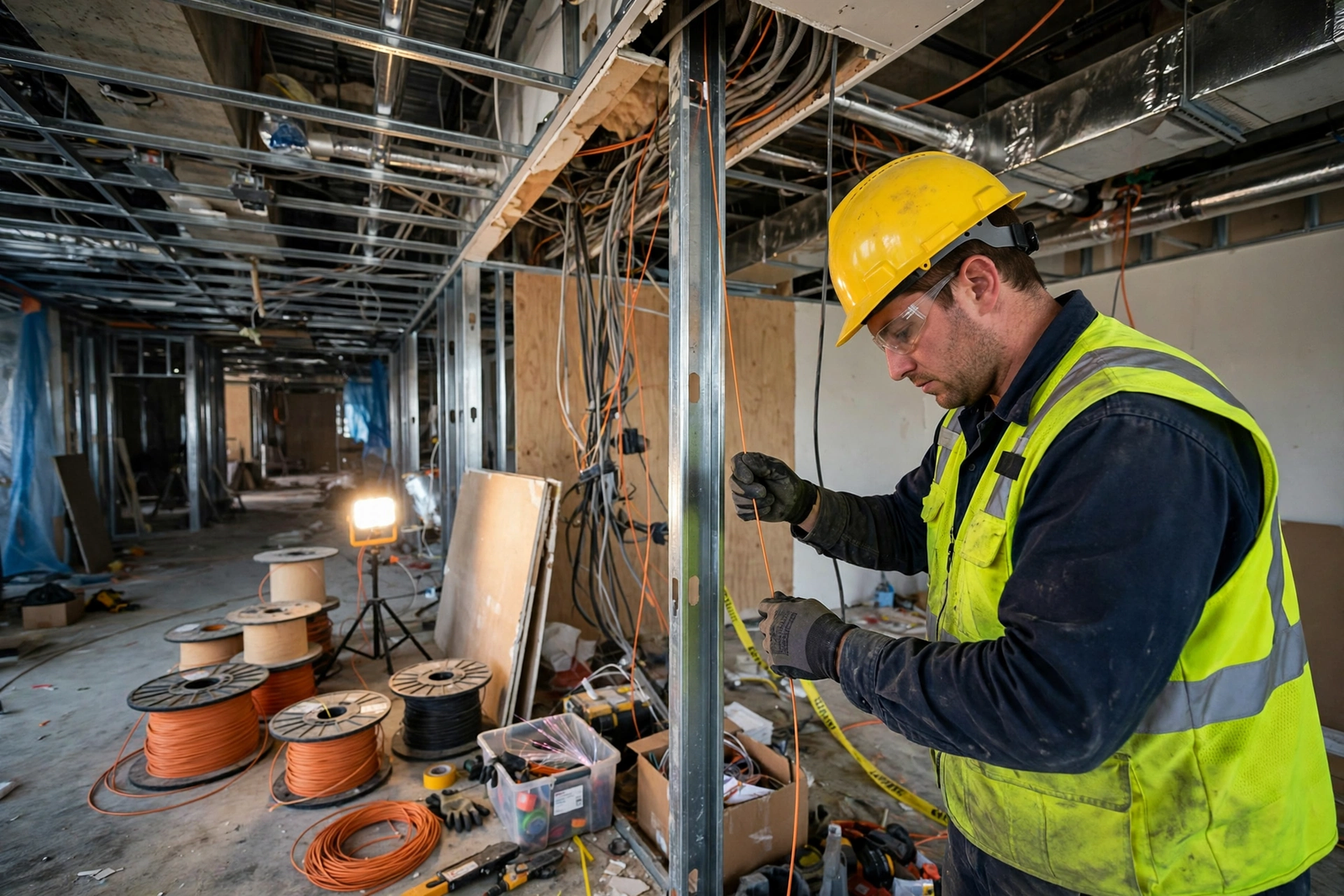
Business fiber internet installation in Atlanta, Georgia follows a clear sequence, and knowing it in advance keeps the project on schedule. The first step is the address check: the provider confirms whether fiber reaches your building and which speeds are available at your suite. The second step is the order: you choose a speed tier, confirm the price, and agree on the contract terms, including whether installation is included. AT&T lists free installation on its current business fiber offers, subject to availability and the terms of the offer. The third step is the site survey, where a technician visits the building, confirms the fiber path, checks riser access and interior wiring, and identifies any construction needed. The fourth step is landlord permission, which is required in most multi-tenant buildings and is the most common cause of delay. The fifth step is the installation visit itself, when the technician runs the fiber to your suite, installs the optical network terminal and the Wi-Fi gateway, tests the connection, and confirms the speeds. The final step is activation and testing: connect your office network, run a wired speed test, check the Wi-Fi coverage, and confirm that the backup feature works if your plan includes one.
Installation day itself usually takes a few hours for a standard install in a building that is already wired, and the technician will need access to the telecom room, the suite, and the location where the gateway will sit. Have someone from your team on site who can approve the gateway placement and confirm the Wi-Fi coverage, because moving a gateway after the technician leaves means another visit. If your office uses its own router, switches, or a firewall, have that hardware on site and configured in advance, and tell the technician whether the provider gateway should run in bridge mode or as the main router. The full ordering process, including the site survey and what to expect on installation day, is covered in our guide to how to order and install AT&T Business Fiber.
Business Fiber Internet Installation Steps and Requirements in Atlanta, Georgia
The installation steps and requirements for business fiber internet in Atlanta, Georgia depend on whether the building is already connected to the provider’s fiber network. In a building that is already lit, the timeline is short: the address check takes minutes, the order takes a day, the site survey and installation can often be scheduled within a week, and the installation visit takes a few hours. The requirements are simple: a signed order, landlord permission for the technician to access the telecom room and the suite, a power outlet near the gateway location, and someone on site during the visit. In a building that is not yet connected, the timeline is longer: the provider must survey the fiber path, obtain permits where needed, run fiber to the building, and complete interior wiring, which can take several weeks and, in the worst cases, several months. The requirements are heavier too: a construction agreement, landlord approval for the building work, and sometimes a contribution to the construction cost.
Three requirements catch Atlanta businesses by surprise. First, historic buildings and older retail strips in neighborhoods such as Inman Park, Grant Park, and parts of Downtown Atlanta, Georgia can have restrictions on drilling and exterior work, which slow the installation and sometimes rule out a fiber drop entirely. Second, multi-tenant office towers often have a single approved provider list or an exclusive wiring agreement, which means your preferred provider may need building management approval before it can install. Third, the gateway placement matters more than most buyers expect: a gateway tucked in a back closet will not cover a large open office, and the fix is either a better location or mesh extenders, which should be planned before installation day rather than after. The practical rule is to start the fiber order as soon as you sign a lease, not when you need the internet, and to keep a 5G fixed wireless gateway as a temporary connection while the fiber work completes. Our guide on how to choose business internet explains how to weigh installation timelines against speed and price when you are choosing between providers.
Disclaimer: This article contains affiliate links to AT&T Business services; we may earn a commission at no extra cost to you. Ortelcom.com is an independent publisher not affiliated with or endorsed by AT&T. Pricing, speeds and availability are not guaranteed, were checked 8 November 2026, and vary by address and promotions. Confirm all details before ordering. AT&T trademarks belong to their owner.
Business Fiber Internet Speeds and Equipment in Atlanta, Georgia
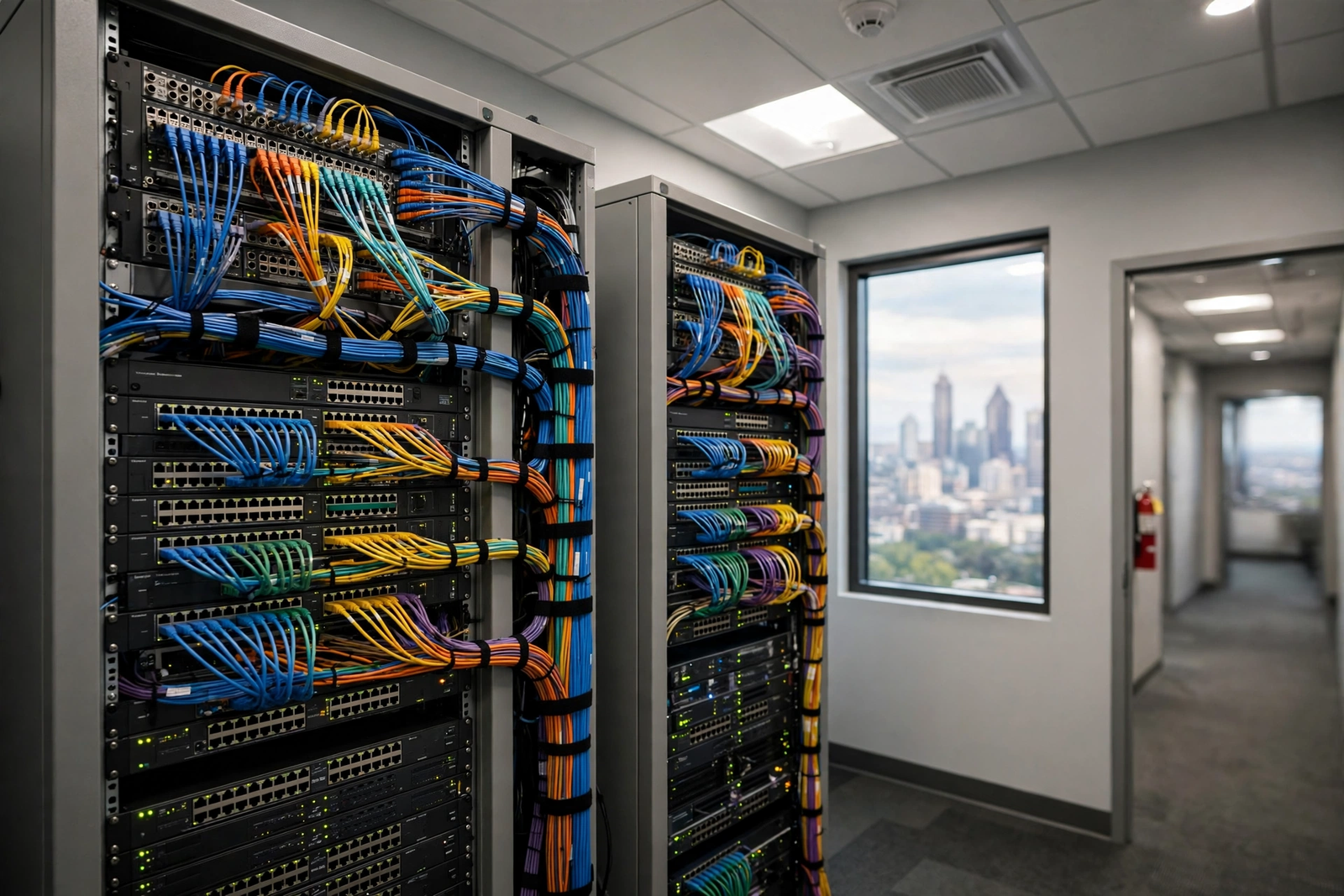
Business fiber internet speeds and equipment in Atlanta, Georgia are straightforward once you understand what the numbers mean. AT&T Business Fiber offers symmetrical speeds of 300 Mbps, 500 Mbps, 1 GIG, 2 GIG, and 5 GIG, with the 5 GIG tier carrying a stated single-device wired maximum of 4.7 Gbps. Google Fiber offers symmetrical 1 Gig, 2 Gig, 5 Gig, and 8 Gig in the areas it serves. Symmetrical means the upload speed matches the download speed, which is the feature that separates fiber from cable, where uploads are typically a small fraction of downloads. For most Atlanta offices, 1 GIG is the right tier: it handles dozens of staff, concurrent video calls, cloud apps, and nightly backups without strain, and it includes the built-in 5G backup on AT&T. A small office with light cloud use can manage on 300 Mbps, and only a business that moves very large files all day, such as a media production house or an architecture firm, needs 2 GIG or above.
The equipment is part of the package on the main Atlanta fiber plans. AT&T Business Fiber includes a Wi-Fi gateway, with more capable gateways on the higher tiers, including the specified gateway needed for the built-in 5G backup on 1 GIG and above. Google Fiber includes Wi-Fi hardware on its published tiers. The equipment that costs extra is what sits beyond the gateway: mesh Wi-Fi extenders for a large office, a business-grade router if you prefer your own hardware, network switches, and structured cabling for additional drops. A full office fit-out can run from a few hundred to a few thousand dollars depending on size. Static IP addresses are an add-on with most providers, quoted per address, and are needed if you host your own servers, run a VPN, or need remote access to office systems. Ask the provider whether using your own router affects support or the backup feature, because on AT&T the built-in 5G backup needs the specified gateway, and test the speeds on a wired connection, since Wi-Fi speeds are always lower than the wired speed the plan advertises.
Business Fiber Internet Costs in Atlanta, Georgia
Business fiber internet costs in Atlanta, Georgia start at $60 per month and rise with speed. AT&T Business Fiber lists $60 per month for 300 Mbps, $100 for 500 Mbps, $140 for 1 GIG, $185 for 2 GIG, and $285 for 5 GIG, plus taxes and fees, with lower prices of $40, $60, $90, $135, and $235 when bundled with an eligible business wireless plan. Google Fiber publishes $70 per month for 1 Gig, $100 for 2 Gig, $125 for 5 Gig, and $150 for 8 Gig, with no data caps and no annual contract on the published tiers, although business plans are quoted per address. Comcast Business fiber is quoted per address and is priced as dedicated or enterprise service rather than a standard small-business tier. Installation is typically included on current AT&T business fiber offers, and fixed costs beyond the monthly price are limited to taxes and fees, which add roughly several dollars to more than ten dollars per month, and any add-ons such as static IP addresses or extra Wi-Fi hardware.
Worked over 24 months, AT&T Business Fiber 1 GIG costs $3,360 at list price before taxes and fees, or $2,160 with the wireless bundle discount, assuming the list price does not change. Google Fiber 1 Gig costs $1,680 over the same period at its published flat price, which makes it the cheapest gigabit in the city where it is available. The 300 Mbps tier from AT&T costs $1,440 over 24 months at list price, or $960 bundled. Those figures assume the service is available at the address, exclude installation and construction charges where a building needs new fiber work, and exclude taxes, fees, and add-ons. A realistic annual budget for a small Atlanta office on AT&T Business Fiber 1 GIG is about $1,680 for the service plus roughly $100 to $200 in taxes and fees, for a total near $1,800 to $1,900 per year. For a full breakdown of the same prices with hidden fees and installation charges, see our business internet cost in Tampa, Florida guide, which prices the identical AT&T tiers for a different market.
Limitations of Business Fiber Internet in Atlanta, Georgia
Business fiber internet in Atlanta, Georgia has limitations, and an honest guide names them. The largest is coverage: AT&T Business Fiber reaches about 75 percent of addresses, Google Fiber about 19 percent, and Comcast Business fiber about 11 percent, which means a meaningful minority of Atlanta businesses cannot buy fiber at all and must use cable or fixed wireless. The second limitation is installation time: a building that is not already wired can take weeks or months to connect, with landlord permission and construction as the usual delays, and historic buildings can face restrictions that slow or block a fiber drop. The third limitation is the built-in 5G backup on AT&T 1 GIG and higher tiers, which does not work during a power loss and does not cover static IP or voice service, so it is a useful safety net rather than a complete failover solution. The fourth limitation is that shared fiber is not dedicated fiber: speeds are advertised as up to, the connection is shared with other businesses, and there is no service level agreement with guaranteed repair times on the standard plans. The fifth limitation is price at the top end: 5 GIG at $285 per month is more than most small businesses need, and the local network hardware required to use it can cost more than the service itself.
None of those limitations is a reason to avoid fiber. Each one is a reason to check your address, start the order early, get landlord permission in writing, plan a backup connection, and buy the speed tier your business actually needs rather than the fastest one advertised. A business that does those five things will get the full benefit of fiber in Atlanta, Georgia: symmetrical speeds, no data caps, low latency, and a connection that keeps up with the team as it grows.
Business Fiber Internet in Atlanta, Georgia: FAQ
Which Business Fiber Internet Providers Offer Service in Atlanta, Georgia?
AT&T Business Fiber is the main business fiber internet provider in Atlanta, Georgia, reaching about 75 percent of addresses with speeds up to 5 Gbps. Google Fiber offers fiber to about 19 percent of the city, concentrated in Midtown, Buckhead, Inman Park, and nearby neighborhoods. Comcast Business sells fiber to about 11 percent of addresses, mainly for larger sites and dedicated service. Always check your exact address, because fiber availability changes street by street.
How Long Does Business Fiber Internet Installation Take in Atlanta, Georgia?
In a building that is already wired for fiber, installation in Atlanta, Georgia usually takes a few days to a week from order to activation, with the installation visit itself lasting a few hours. In a building that needs new fiber construction, the timeline can stretch to several weeks or months, depending on permits, landlord permission, and the distance to the nearest fiber point. Order as soon as you sign a lease, and keep a 5G fixed wireless gateway as a temporary connection while the fiber work completes.
What Business Fiber Internet Speeds Are Available in Atlanta, Georgia?
AT&T Business Fiber offers symmetrical speeds of 300 Mbps, 500 Mbps, 1 GIG, 2 GIG, and 5 GIG in Atlanta, Georgia, with a stated single-device wired maximum of 4.7 Gbps on the 5 GIG tier. Google Fiber offers symmetrical 1 Gig, 2 Gig, 5 Gig, and 8 Gig where it is available. Comcast Business fiber advertises speeds up to 10 Gbps for enterprise and dedicated service. For most offices, 1 GIG is the right tier, and only businesses moving very large files all day need 2 GIG or above.
Is Business Fiber Internet Installation Free in Atlanta, Georgia?
It depends on the provider and the building. AT&T lists free installation on its current business fiber offers, subject to availability and the terms of the offer, and a standard install in a building that is already wired usually costs nothing beyond the monthly price. Installation is not free when construction is needed to bring fiber into a building, when landlord permission and interior wiring are required, or when a dedicated line is ordered, and those charges are quoted after a site survey. Ask for the installation charge in writing before you sign.
What Business Fiber Internet Backup Is Available in Atlanta, Georgia?
AT&T Business Fiber includes built-in 5G backup on its 1 GIG and higher tiers, using a cellular connection when the wired line fails, although it needs the specified gateway, does not work during a power loss, and does not cover static IP or voice service. Comcast Business sells a wireless backup add-on, and both T-Mobile and Verizon 5G fixed wireless can serve as a backup circuit for a fiber primary. The most reliable setup is two connections on different technologies, such as fiber plus fixed wireless, so a single cut or outage cannot take the office offline. Businesses comparing backup options in another market can see the same method applied in our best business internet providers in Denver, Colorado guide.
Business fiber internet in Atlanta, Georgia is a strong buy for most offices, and the decision is simpler than the number of providers suggests. Check AT&T Business Fiber first, because it reaches three out of four addresses with symmetrical speeds and transparent pricing. Check Google Fiber second if your building is in its footprint, because flat pricing makes it the cheapest gigabit in the city where it is available. Ask Comcast Business about fiber if you run a larger site or need dedicated service. Start the order as soon as you sign a lease, get landlord permission in writing, plan for a few hours on installation day, and keep a 5G fixed wireless gateway in reserve until the fiber is live. That combination covers nearly every Atlanta business, from a two-person studio in the Old Fourth Ward to a hundred-seat office in Buckhead.

