
If you run a business in New Orleans, Louisiana, the short answer to the question of whether business fiber internet is worth it is this: check AT&T Business Fiber first, because it offers symmetrical speeds from 300 Mbps to 5 GIG with no data caps and no annual contract, and if it reaches your building, it is the best connection most New Orleans businesses can buy. The catch is availability, and in New Orleans, Louisiana the catch is a large one: AT&T Fiber reaches roughly a third to three-fifths of homes depending on the dataset, while Spectrum cable reaches 90 to 99 percent, so the fiber decision is really two decisions, first whether fiber reaches your address at all, and second what the installation will involve once you order it. This guide to business fiber internet in New Orleans, Louisiana covers both: which providers sell fiber, where it is available by neighborhood, the speeds and prices, the installation steps from the address check to the day the technician leaves, the equipment and the 5G backup, and what happens when the building is a historic property in the French Quarter or the Garden District where new wiring needs permission.
One fact shapes the whole New Orleans, Louisiana fiber market and must be understood before anything else: Charter closed its purchase of Cox Communications on 20 August 2026, and on 16 September 2026 Spectrum plans and pricing launched in all former Cox markets including New Orleans, Louisiana, so the Cox brand is gone and the wires are the same. Do not shop for Cox and Spectrum as if they were two separate providers, because they are now one provider under the Spectrum name, and most of what that provider sells in New Orleans, Louisiana is cable, not fiber: its fiber pockets cover only 3.4 to 12 percent of homes. The two names that matter for fiber in New Orleans, Louisiana are AT&T Business Fiber, which is the main fiber network in the city, and Spectrum, which is the near-universal cable fallback where fiber has not arrived. Every price in this guide was checked in November 2026, is shown before taxes and fees, and varies by address, promotions, and contract terms, so treat every figure as a planning number and confirm the written quote for your own address before you sign anything.
Check Business Fiber Internet Availability for Your New Orleans, Louisiana Address
Symmetrical fiber speeds from 300 Mbps to 5 GIG, with no data caps and a gateway included.
Business Fiber Internet in New Orleans, Louisiana: Providers and Availability
The table below summarizes business fiber internet in New Orleans, Louisiana: which providers sell fiber, what technology they actually sell, how much of the city they reach, and the fastest speed they advertise. The distinction that matters most is between full fiber to the premises, where a fiber cable runs all the way into the building, and hybrid fiber-coax cable, where fiber runs to the street and coaxial cable covers the last stretch into the building. AT&T Business Fiber is full fiber to the premises, with symmetrical upload and download speeds. Spectrum is mostly hybrid fiber-coax cable in New Orleans, Louisiana, with fiber pockets covering only a small share of homes, and its cable speeds are asymmetrical, with uploads far slower than downloads. EarthLink resells the same AT&T fiber network rather than building its own, so it is a resale alternative, not a second fiber network.
| Provider | Technology | New Orleans coverage | Max advertised speed | Starting price |
|---|---|---|---|---|
| AT&T Business Fiber | Fiber to the premises | Roughly a third to three-fifths of homes | 5 Gbps symmetrical | $60 per month |
| Spectrum (formerly Cox) | Cable, with fiber pockets | 90 to 99 percent cable; 3.4 to 12 percent fiber | 2 Gbps download, 500 Mbps upload | $50 per month (one-year promo) |
| EarthLink | Fiber resale of AT&T network | Same as AT&T Fiber | Same as AT&T Fiber | By quote |
| Lumen / CenturyLink | Enterprise and dedicated fiber | Central Business District, by quote | By quote | By quote |
| AT&T Internet Air | 5G fixed wireless | Where AT&T 5G reaches | Speeds vary by signal | $65 per month |
| T-Mobile 5G Business Internet | 5G fixed wireless | About 91 to 99 percent | Up to about 400 Mbps | $35 per month with a voice line |
| Verizon 5G Business Internet | 5G fixed wireless | Varies by address | Up to 400 Mbps | $35 per month bundled |
Get A Free AT&T Business Fiber Quote
Symmetrical fiber speeds from 300 Mbps to 5 GIG, with no data caps and a gateway included.
Two things stand out in that comparison. First, no single provider reaches every New Orleans, Louisiana business address with fiber, which is why the address check matters more than any ranking, and the two providers that matter most reach the city in opposite ways: AT&T Fiber is symmetrical but reaches only roughly a third to three-fifths of homes, while Spectrum cable reaches almost everywhere but is asymmetrical. Second, the fiber coverage figure itself is disputed: one comparison source puts AT&T Fiber at 32 percent of New Orleans homes and another at 62 percent, so this guide states the range and the reason for it, and a third source puts it at 95 percent, which this guide names as an outlier and sets aside rather than using on its own. For the full provider-by-provider comparison behind these figures, including the 5G options and the buying steps, see our guide to the best business internet providers in New Orleans, Louisiana, which covers coverage, speeds, and pricing across the whole market.
AT&T Business Fiber Speeds, Pricing and Availability in New Orleans, Louisiana
AT&T Business Fiber is the first provider to check for most New Orleans, Louisiana businesses, because it combines the widest fiber footprint in the city with symmetrical speeds. Its coverage is genuinely uncertain between sources, at 32 percent of New Orleans homes on one comparison source and 62 percent on another, so the honest statement is roughly a third to three-fifths of homes, depending on the Federal Communications Commission dataset, and the address check is not optional. Where it reaches, it offers symmetrical speeds from 300 Mbps to 5 GIG, and upload speeds match download speeds exactly. That symmetry is the feature that matters most for real business work: cloud backups, large file uploads, video conferencing with many participants, hosted voice, and point-of-sale systems that push data to the cloud all depend on upload capacity, and cable connections in New Orleans, Louisiana typically cap uploads at a small fraction of their download speed. A 300 Mbps fiber plan uploads at 300 Mbps, while a 500 Mbps Spectrum cable plan uploads at about 10 Mbps, so the fiber plan is thirty times faster on the upload even though its download speed is lower.
The published AT&T Business Fiber list prices, checked in November 2026, are $60 per month for 300 Mbps, $100 for 500 Mbps, $140 for 1 GIG, $185 for 2 GIG, and $285 for 5 GIG, plus taxes and fees. With an eligible AT&T business wireless plan, those prices fall to $40, $60, $90, $135, and $235 per month respectively. The plans include a Wi-Fi gateway, no data caps, and no annual internet contract on the shared fiber plans. The 1 GIG tier and above also include built-in 5G backup, which keeps the connection alive during a wired outage, although it needs the specified gateway, does not work during a power loss, and does not cover static IP service or AT&T voice service. The 5 GIG tier has a stated single-device wired maximum of 4.7 Gbps. For most New Orleans, Louisiana offices, the 1 GIG tier is the sweet spot: it is fast enough for a busy office, it includes the backup feature, and at $140 per month list, or $90 with an eligible wireless plan, it is priced well below a dedicated line of similar speed. You can check AT&T Business Fiber availability and pricing for your New Orleans, Louisiana address before you compare anything else, because if fiber reaches your suite, the rest of the comparison becomes much simpler.
AT&T Business Fiber is not available everywhere in New Orleans, Louisiana, and the gaps are real and uneven. The Central Business District has the best fiber coverage in the city, at 69.3 percent of homes, with about nine providers at a typical address, while the French Quarter has fiber at only 26.3 percent of homes and the Garden District at only 24.4 percent, so a business in a historic neighborhood is far more likely to need cable or fixed wireless than a business downtown. Lakeview, at 99.8 percent fiber, and Elmwood, at 98.7 percent, are the strongest fiber areas in the metro, while the Lower Ninth Ward, the Seventh Ward at 3.4 percent fiber, and eastern New Orleans, Louisiana remain largely cable or fixed wireless. Businesses in that situation should not wait: order the cable or fixed wireless fallback in parallel, and keep the fiber order moving, because every week without a connection costs more than the price difference between the plans. Never quote the landing-page promotional price as the plan price: the affiliate landing pages for these products show dealer promotional pricing that differs from the official list prices used in this guide, and the list prices above are the ones to budget against.
Spectrum Fiber and Cable Internet in New Orleans, Louisiana
Spectrum, formerly Cox, is the dominant cable provider in New Orleans, Louisiana, and understanding the name change matters, because older guides, bills, and shopfront signs still say Cox while the service is now sold as Spectrum. Charter closed its $34.5 billion purchase of Cox Communications on 20 August 2026, and on 16 September 2026, a date the company called Spectrum Day, Spectrum plans and pricing launched in all former Cox markets including New Orleans, Louisiana. The Cox brand is gone, the wires are the same, and the business plans now on sale are Spectrum plans. Spectrum cable reaches 90 to 99 percent of New Orleans homes, which makes it the coverage champion in the city and the provider most New Orleans businesses can actually buy. Its fiber pockets, by contrast, cover only 3.4 to 12 percent of homes, so most New Orleans businesses that buy Spectrum are buying hybrid fiber-coax cable, not full fiber to the premises, and the quote should be read with that distinction in mind: a Spectrum quote that says fiber may mean a fiber pocket, or it may mean the hybrid network, and the upload speed on the quote will tell you which one it is.
Spectrum Business publishes four main tiers in New Orleans, Louisiana: 500 Mbps at $65 per month, or $50 per month on a one-year online or bundled promotion, 750 Mbps at $95 per month, 1 Gig at $115 per month, and 2 Gig at $165 per month, with no contract and no data caps. Maximum cable speeds run to 2,000 Mbps download and 500 Mbps upload on the top tier. Upload speeds are the weak point on the lower tiers: about 10 Mbps on the 500 Mbps tier and about 35 Mbps on the 750 Mbps and 1 Gig tiers, so a business that uploads large files or runs cloud backups all day will feel the difference against fiber. The no-contract terms are a genuine advantage over providers that lock you into a one-year agreement with an early termination fee, and the $50 promotional figure on the 500 Mbps tier should be confirmed in writing as a one-year online or bundled promotion, because the standard price is $65. Choose Spectrum first when speed of activation matters more than symmetrical speed, or when fiber simply does not reach your building, which is the common case in the French Quarter, the Garden District, the Seventh Ward, and eastern New Orleans, Louisiana. It also works well as a second wired circuit for businesses that already have fiber as their primary connection, because it runs on different infrastructure and keeps the office online if the fiber line is cut.
Business Fiber Internet Speeds and Pricing in New Orleans, Louisiana
The table below sets out business fiber internet speeds and pricing in New Orleans, Louisiana for the main fiber tiers, with the two-year totals shown so the real cost can be compared honestly. The totals assume the list price unless stated otherwise, and no change in the list price over the two years, which is an assumption that should be checked against the quote, because providers can change their list prices. Installation, equipment, taxes, and fees are not included in these totals, and they should be added from the written quote before the decision is made. The 1 GIG tier is the sweet spot for most offices, and the 300 Mbps tier is enough for a small shop or studio that works in the cloud but does not move very large files, while the 2 GIG and 5 GIG tiers suit larger offices, creative studios, and businesses that run their own servers or move video all day.
| AT&T Business Fiber tier | Speeds | Monthly list price | With eligible wireless | 24-month total at list |
|---|---|---|---|---|
| 300 Mbps | 300 Mbps symmetrical | $60 | $40 | $1,440 |
| 500 Mbps | 500 Mbps symmetrical | $100 | $60 | $2,400 |
| 1 GIG | 1 Gbps symmetrical | $140 | $90 | $3,360 |
| 2 GIG | 2 Gbps symmetrical | $185 | $135 | $4,440 |
| 5 GIG | 5 Gbps symmetrical | $285 | $235 | $6,840 |
Choosing the right fiber speed is a matter of counting the work, not of buying the biggest number on the advertisement. A ten-person office that buys 5 GIG at $285 per month when 1 GIG at $140 would handle the work is spending $145 per month, or $1,740 per year, on speed nobody uses, and that money would be better spent on a backup connection. Count the staff, the concurrent video calls, the cloud backup volume, and the point-of-sale traffic, then pick the tier with headroom for growth, and revisit the tier once a year, because a connection that is just fast enough today will be too slow in a year. The wireless bundle discount is the biggest saving available to most New Orleans, Louisiana businesses: it cuts the fiber price by $20 to $50 per month depending on the tier, or $240 to $600 per year, and for a business that already pays for mobile lines, moving those lines to an eligible AT&T business wireless plan can pay for itself through the internet saving alone. A realistic annual budget for a small New Orleans, Louisiana office on 1 GIG fiber is about $1,680 for the service at list price, plus roughly $100 to $200 in taxes and fees, for a total near $1,800 to $1,900 per year, and the same office with an eligible wireless plan pays about $1,080 for the service, for a total near $1,200 to $1,300 per year once taxes and fees are added.
Business Fiber Internet Installation in New Orleans, Louisiana: Step by Step
Business fiber installation in New Orleans, Louisiana follows five steps, and knowing them in advance is how a business avoids a delayed opening or a surprise construction charge. Step one is the address check: the provider confirms whether fiber reaches the exact suite, not just the street, because fiber availability changes building by building, and a check that says the street is covered does not mean the suite is covered. The address check is free, it takes minutes, and it should be done with AT&T Fiber, Spectrum, and the fixed wireless carriers at the same time, so the business knows its full set of options before it commits to any one of them. Step two is the order and the written quote: the provider states the monthly price, the total monthly bill including taxes and fees, the installation charge, and any construction charge, and the business should get all four figures in writing before the order is placed, because a quote that shows only the monthly plan price will always understate the real first-year cost.
Step three is the site survey, which is the step most buyers underestimate. A technician or surveyor visits the building to confirm where the fiber enters, how it reaches the suite, whether the building riser has capacity, and whether any new cabling, drilling, or exterior work is needed. The survey is where a historic building, a multi-tenant office, or a converted residential property can add time and cost, and it is also where the provider discovers that the suite has never had fiber and needs a new drop from the street. Ask the surveyor to state any construction charges in writing, ask who pays if the survey finds extra work, and ask the landlord or building manager for permission before the survey if the lease requires it, because a survey that finds work nobody approved is a delay, not a solution. Step four is installation day: a technician fits the fiber termination point, runs the cable to the suite, installs the gateway, and tests the connection, and the business should have someone on site who knows where the equipment should go, where the desks will sit, and where the Wi-Fi needs to reach, because a gateway fitted in the wrong corner of a large floor is a problem that lasts for years. Fiber installation usually needs a technician visit and can take days to weeks depending on whether the building is already wired, and a business that is already lit can be installed in days, while a building that needs a new drop can take weeks.
Step five is testing and handover, and it should never be skipped. Test the download and upload speeds at the actual workstations, not just at the gateway, test the Wi-Fi in every room the team will use, test the point-of-sale system, the hosted voice lines, and the cloud backup, and test the failover if the plan includes 5G backup, because a backup that has never been tested is not a backup. Keep the installation paperwork, the quote, and the gateway details together, and return any old equipment from a previous provider on time, because providers charge a fee for equipment that is not returned, with the amount stated in the agreement and varying by provider and by device. Cable installation can often be completed in days, and fixed wireless gateways can be self-installed the same day they arrive, so a business that needs to trade while the fiber work completes should order a fixed wireless gateway in parallel and keep it in reserve. The full ordering process, including the site survey and what to expect on installation day, is covered in our guide to how to order and install AT&T Business Fiber, which walks through each step in detail.
Fiber Installation in Historic New Orleans, Louisiana Buildings and the French Quarter
Historic buildings are where fiber installation in New Orleans, Louisiana gets complicated, and the French Quarter is the clearest example. Fiber reaches only 26.3 percent of homes in the French Quarter, and cable reaches 99.1 percent, so a French Quarter business will almost always be choosing between Spectrum cable and fixed wireless, and a new wired install that needs exterior work may need extra permission and extra time under historic-preservation rules. The same pattern applies in the Garden District, where fiber reaches only 24.4 percent of homes, and in other older retail strips and converted residential properties across the city, where the building was never designed for a fiber drop and the cabling has to be fitted around protected facades, shared walls, and listed interiors. The practical rule is to start the order early, to ask the landlord or building manager which providers are already wired into the building before signing a lease, and to get the permission in writing before the technician arrives, because a technician who arrives without permission is a wasted visit and a delayed opening.
The workaround that works in historic neighborhoods is fixed wireless, and it is worth planning for it from the start rather than discovering it after the fiber order stalls. AT&T Internet Air, T-Mobile 5G Business Internet, and Verizon 5G Business Internet all use a gateway that can be self-installed the same day it arrives, with no drilling, no exterior work, and no permission needed, which makes fixed wireless the fastest way to get a historic building online and a reliable backup once the wired connection is in place. A French Quarter cafe or shop can trade on a fixed wireless gateway while the fiber or cable install is scheduled, and a business that cannot get a new wired drop at all can run on fixed wireless as its primary connection, provided it tests the speed at its own address first, because performance depends on signal strength, building materials, and network congestion. The other workaround is to use the wiring that is already there: if the building already has a Spectrum cable drop, a cable install can often be completed in days without new exterior work, and if the building already has fiber to a neighbouring suite, the survey may find that extending it is simpler than a new drop from the street. Always ask what is already in the building before assuming a new installation is needed.
Business Fiber Internet Equipment and Gateway Setup in New Orleans, Louisiana
AT&T Business Fiber includes a Wi-Fi gateway in the plan price, with no separate monthly rental shown on the published price list, and the gateway is the heart of the installation: it terminates the fiber, provides the Wi-Fi, and, on the 1 GIG tier and above, provides the built-in 5G backup through the specified gateway. The gateway should be placed where the Wi-Fi needs to reach, not where it is easiest to fit, and a large floor, a thick-walled historic building, or a multi-room office may need additional access points or a mesh Wi-Fi system, which is bought or rented separately and should be budgeted in the first year rather than discovered after the install. A business that needs more than the supplied gateway, such as a managed router, additional access points, or a battery backup for the gateway, will pay for that hardware separately, and those costs belong in the first-year budget, because overspending on networking hardware before the team needs it is money that would be better spent on a faster tier or a backup connection. Always ask for the equipment charge to be shown as a separate line on the quote, and keep the quote, because an equipment fee that is waived in the first year and charged from month thirteen is one of the commonest hidden costs in business internet.
The cost of equipment should be counted in the first year rather than hidden inside the monthly price. The most useful question to ask any provider is the total cost over two years, not the monthly list price, and the comparison should include the first month’s setup, the installation charge, the first month’s bill, and any equipment bought or rented, because a cheaper monthly price can cost more over two years once those first-year costs are added. Ask whether the price shown is a promotion or the standard rate, when the promotion ends, and what the price becomes after the promotion, because the gap between the promotional price and the standard rate is one of the commonest surprises in a business internet bill, and it matters most for businesses that plan to stay with the same provider for years rather than switch every twelve months. The prices in the table above are the list prices checked in November 2026, so a business that is comparing providers should treat them as the starting point for a quote rather than the final figure, and should get the total cost over two years in writing before signing.
Business Fiber Internet 5G Backup and Failover in New Orleans, Louisiana
Every business in New Orleans, Louisiana should plan for an internet outage, because the city’s weather and the storm season make outages a question of when, not if, and a business that cannot take a payment, look up a booking, or send an email during an outage is losing money for every hour it is offline. The right backup depends on the primary connection: a fiber connection with a cable backup, a cable connection with a fixed wireless backup, or a fiber connection with 5G backup built in, as AT&T Business Fiber provides on the 1 GIG tier and above through the specified gateway. A second wired connection from the same provider is not a backup if both use the same cable into the building, so the backup should come from a different network, a different technology, or both, and it should be tested at least once before it is needed, because a backup that has never been tested is not a backup.
Fixed wireless is the most useful backup for most small businesses in New Orleans, Louisiana, because the gateways are self-installed, the plans are month-to-month, and the backup can be added without a site survey or a new wired drop. AT&T Internet Air costs $65 per month as a standalone plan and $35 per month with an eligible wireless plan, and T-Mobile 5G Business Internet costs $35 per month with a voice line and $45 per month as a standalone plan, while Verizon 5G Business Internet costs $35 per month bundled with a voice line and $45 per month as a standalone plan, so a backup gateway costs little more than the price of a lunch for a small team each month, and it keeps the business trading during the outage that would otherwise cost far more. The backup gateway should be tested at the address where it will be used, because the speed depends on signal strength and building materials, and it should be kept plugged in and charged so that it is ready when the primary connection fails. A backup is not the whole of it.
Disclaimer: This article contains affiliate links to AT&T Business services; we may earn a commission at no extra cost to you. Ortelcom.com is an independent publisher not affiliated with or endorsed by AT&T. Pricing, speeds and availability are not guaranteed, were checked 10 November 2026, and vary by address and promotions. Confirm all details before ordering. AT&T trademarks belong to their owner.
Business Fiber Internet in New Orleans, Louisiana: Fiber vs Cable vs 5G Fixed Wireless

The table below compares business fiber internet in New Orleans, Louisiana against its two alternatives, cable and 5G fixed wireless, on the measures that actually decide which one a business should buy. Fiber wins on upload speed, consistency, and the absence of data caps, cable wins on coverage, because it reaches 90 to 99 percent of homes against roughly a third to three-fifths for fiber, and fixed wireless wins on speed of installation, because a gateway can be self-installed the same day it arrives. No single technology wins on every measure, which is why most New Orleans, Louisiana businesses end up with two of them: a wired primary and a wireless backup, or a fiber primary where it reaches and a cable fallback where it does not. The comparison should always be made on the upload speed and the two-year cost, not on the download speed alone, because the download speed is where the three technologies look most alike and the upload speed is where they differ most.
| Measure | AT&T Business Fiber | Spectrum cable | 5G fixed wireless |
|---|---|---|---|
| Upload speed | Symmetrical, 300 Mbps to 5 Gbps | About 10 Mbps on 500 Mbps tier, about 35 Mbps on 1 Gig | Varies by signal and congestion |
| Coverage in New Orleans, Louisiana | Roughly a third to three-fifths of homes | 90 to 99 percent of homes | About 91 to 99 percent, varies by address |
| Starting price | $60 per month | $50 per month on one-year promo | $35 per month with a voice line or bundled |
| Data caps | None | None | Varies by plan |
| Contract | No annual contract | No contract | Varies by carrier |
| Installation | Technician visit, days to weeks | Often completed in days | Self-install, same day |
| Backup included | 5G backup on 1 GIG and above | None built in | Often used as the backup itself |
| Best for | Offices that upload and back up daily | Where fiber does not reach | Temporary sites, historic buildings, backup |
Choose fiber first when the business uploads anything, because the symmetrical upload is the difference that shows up every day, and choose cable when fiber does not reach the building, because a cable connection that exists is worth more than a fiber connection that does not. Choose fixed wireless as a primary connection only for a small site, a temporary office, or a historic building where a new wired drop is hard to permit, and always test it at the actual location first, because a $35 fixed wireless plan that slows during congestion can cost a business far more in lost productivity than the $25 it saves against a $60 fiber plan. The most reliable setup for a New Orleans, Louisiana business that cannot afford downtime is two connections on different technologies, such as fiber plus fixed wireless, so a single cut or outage cannot take the office offline, and the cost of the second connection should be planned from the start rather than discovered later. A business that buys fiber as its primary connection and fixed wireless as its backup gets the best of both technologies for about $95 to $175 per month combined, depending on the tiers, which is less than the cost of a single dedicated line.
Business Fiber Internet Costs and Installation Charges in New Orleans, Louisiana
The cost of business fiber internet in New Orleans, Louisiana is more than the monthly price, and the installation charges are the part that varies most by address. A standard installation, where the building is already wired and the provider only needs to activate the line and fit the gateway, is commonly included in the plan price or charged as a modest one-off fee, and some providers advertise free standard installation, but that figure should always be confirmed in writing for your address, because the word standard does a lot of work in these offers. The cost rises steeply when the building needs new work: a new fiber drop from the street, interior cabling to a suite that has never had fiber, a run through a multi-tenant building riser, or exterior work on a historic building that needs permission before anyone drills a hole. Those construction charges are quoted per building, are not published, and can run into hundreds of dollars or more depending on distance, access, and the permissions involved, so a business that budgets only the monthly price can be surprised by a one-off charge larger than a whole year of service. Always ask the sales representative to state the installation charge, the construction charge, and any survey fee in writing before the order is placed, and ask who pays if the survey finds extra work.
Beyond installation, the fiber bill has the same hidden fees as any other business internet bill, and they should be checked before signing. Taxes and surcharges are added on top of the advertised plan price, and the amount varies by parish, by plan, and by whether the service is classed as internet, voice, or a bundle; as a planning figure, taxes and fees commonly add roughly $100 to $200 a year on a 1 GIG fiber plan, but that is a planning figure only, and the only reliable number is the total monthly bill stated in writing on the quote for your address. A static IP address is priced separately and by quote, and it matters for fiber buyers because AT&T static IP service does not fail over to the built-in 5G backup, so a business that needs a static IP should confirm both its price and its backup behaviour in writing. Voice lines, managed Wi-Fi, security add-ons, and priority support are all charged separately, and each one should be a deliberate choice rather than a line that appears on the first bill. For the full cost breakdown behind these figures, including the two-year totals and the hidden fees, see our guide to business fiber internet in Orlando, Florida for a comparable southern market, although the New Orleans, Louisiana figures in this guide are the ones to budget against for a New Orleans, Louisiana address.
Business Fiber Internet Availability by New Orleans, Louisiana Neighborhood
Business fiber internet availability in New Orleans, Louisiana changes by neighborhood, and the differences are large enough to change your shortlist. The Central Business District has the best fiber coverage in the city, at 69.3 percent of homes, with about nine providers at a typical address, which makes it one of the few areas where a business can realistically get two competing fiber quotes and use them to negotiate, and where the $60 to $140 fiber tiers are most often available. Lakeview, at 99.8 percent fiber, and Elmwood, at 98.7 percent, are the strongest fiber areas in the metro, although Elmwood sits outside the city proper and should be treated as a metro-area figure rather than a New Orleans neighborhood figure, and a business in either area will usually find fiber the cheapest option once uploads are counted. The French Quarter has fiber at only 26.3 percent of homes and cable at 99.1 percent, so a French Quarter business will almost always be choosing between Spectrum cable and fixed wireless, and historic-preservation rules complicate new wired installs, which makes fixed wireless a common workaround there and can add permission time and cost to any new wired drop. The Garden District has fiber at only 24.4 percent of homes, a similar picture to the French Quarter, and businesses there should plan on cable as the wired default with fixed wireless as the backup.
The weaker areas for fiber in New Orleans, Louisiana are the Lower Ninth Ward, the Seventh Ward at 3.4 percent fiber, and eastern New Orleans, Louisiana, which remain largely cable or fixed wireless, with Spectrum cable as the near-universal fallback and T-Mobile or Verizon fixed wireless as the alternative where the wired options are thin. Metairie is a separate community in Jefferson Parish, not New Orleans proper, and it is mentioned here only as a metro-area note clearly labelled as outside New Orleans proper: AT&T Fiber reaches about 72 percent of homes there, which is stronger than the New Orleans citywide range, but it is not a New Orleans figure and should not be used as one. The pattern to remember is that new commercial buildings and recently renovated offices are far more likely to be fiber-ready than older retail strips and converted residential properties, and that historic neighborhoods trade character for wiring difficulty. Always ask the landlord or building manager which providers are already wired into the building before you sign a lease, because a building that is already lit can save weeks of installation time and a large one-off construction charge, and start the order early in a historic neighborhood, keeping a fixed wireless gateway in reserve so the business can trade while the wired work completes.
Choosing Business Fiber Internet in New Orleans, Louisiana: Contracts and Buying Steps
Buying business fiber internet in New Orleans, Louisiana is a five-step process, and skipping any step is how businesses end up locked into the wrong plan. First, check availability at your exact address with AT&T Fiber, Spectrum, T-Mobile, and Verizon, and write down which technologies each one offers at your suite, not just at your street, remembering that Spectrum and the former Cox are now the same provider and should be checked once, not twice. Second, measure your real needs: count your staff, your concurrent video calls, your cloud backup volume, and your point-of-sale traffic, then pick a speed tier with headroom, because a connection that is just fast enough today will be too slow in a year. Third, compare the full two-year cost, not the first-year price, including installation, equipment, taxes, and the post-promotion rate, and remember that AT&T Business Fiber lists no annual contract on its shared fiber plans and Spectrum sells its business plans with no contract, so there is no early termination fee on those plans, although dedicated internet and enterprise quotes do usually carry a term. Fourth, read the contract terms: the length, the early termination fee, the price guarantee, and whether a service level agreement is included, and note that Verizon offers a 10-year price guarantee in select areas. Fifth, plan your backup before you need it, because a single connection is a single point of failure, and in a city where storms and flooding are a real risk, a backup on a different technology is not a luxury.
The questions to ask every sales representative are the same regardless of provider. What speed will I actually get at my address, and is the upload speed symmetrical? What happens to my price in month thirteen, and can I get that in writing? Is installation included, and what construction charges might appear, especially in a historic building where exterior work needs permission? Is there a data cap or a fair-use limit? What is the early termination fee, and is there a price guarantee? What support is included, and what are the repair response times? A provider that answers those questions clearly is a provider you can trust, and a provider that dodges them is telling you something too. For a deeper framework on matching speed tiers to team size and workloads, our how to choose business internet guide uses the same buying method for a different market, and the method transfers directly to New Orleans, Louisiana, while businesses that have already compared fiber in another southern city will recognize the pattern from our best business internet providers in Chicago, Illinois guide, where fiber availability also varies sharply by neighborhood.
Business Fiber Internet Installation Limitations in New Orleans, Louisiana
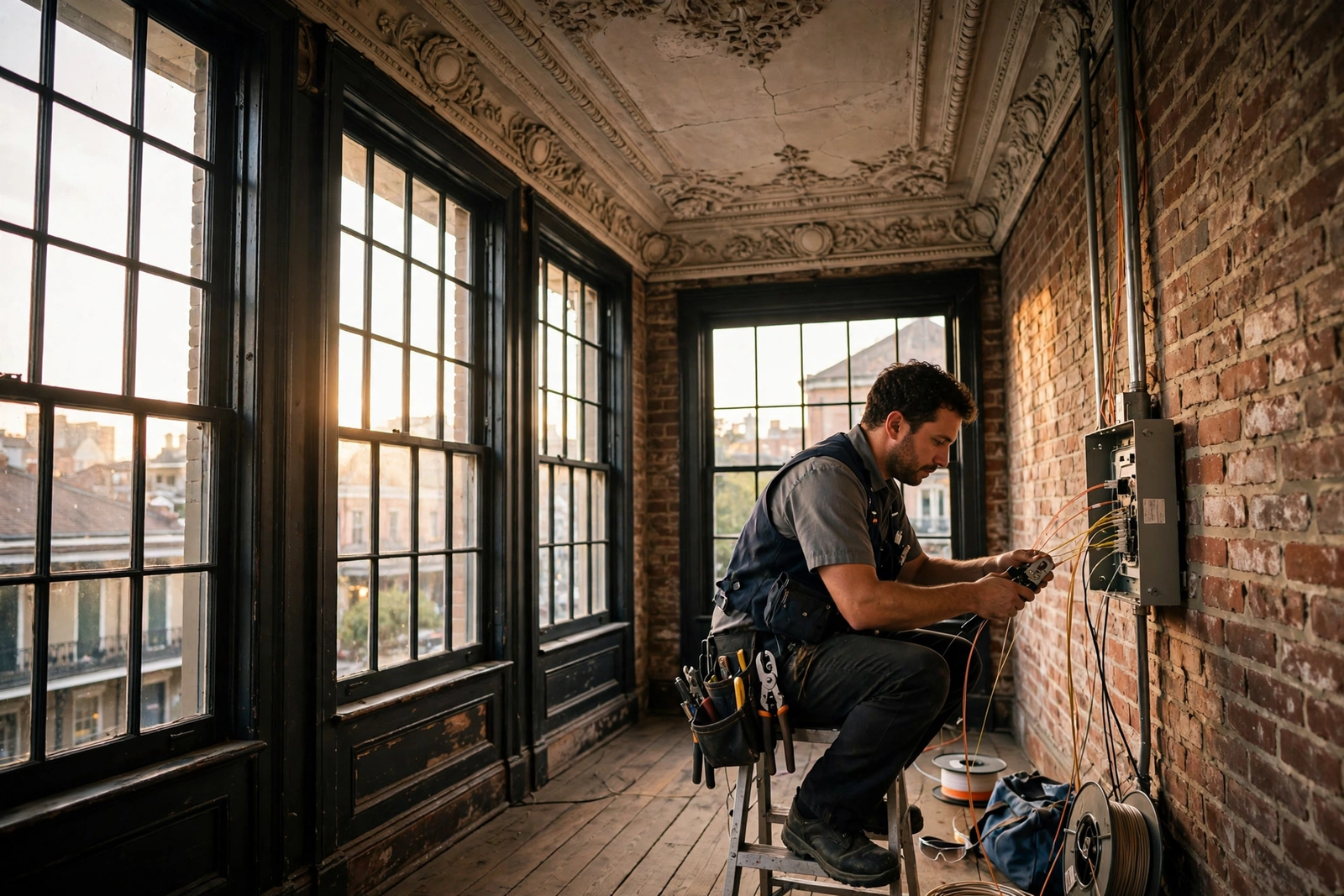
Every business fiber internet option in New Orleans, Louisiana has limitations, and an honest guide names them. AT&T Business Fiber does not reach roughly two-fifths to two-thirds of New Orleans homes, depending on which dataset you trust, installation can require landlord permission and interior wiring that adds weeks and cost, and the built-in 5G backup on 1 GIG and higher tiers does not work during a power loss and does not cover static IP or voice service. Spectrum fiber pockets cover only 3.4 to 12 percent of homes, so most Spectrum customers in New Orleans, Louisiana are on cable, not fiber, and its cable uploads are far slower than downloads on the lower tiers. Fixed wireless from T-Mobile, Verizon, and AT&T Internet Air varies with signal and congestion, and is not a like-for-like replacement for wired fiber for a team that uploads heavily or depends on stable video calls all day. Xfinity is only a marginal presence at about 4.3 percent of homes, so it is not a real option for most addresses. Dedicated internet is expensive, slow to install, and quoted per address, with no published price from Lumen in the Central Business District. None of those limitations is a reason to avoid the provider; each one is a reason to check your address, read the contract, and plan a backup.
The other limitation is information itself. Prices, promotions, and coverage change constantly, and comparison sites disagree with each other because they check different addresses on different dates, which is why this guide states a range where sources conflict: AT&T Fiber is stated as roughly a third to three-fifths of homes because the sources say 32 percent and 62 percent, and the 95 percent outlier is named and set aside rather than used. The Spectrum and Cox name change is a second information trap: any guide that still lists Cox and Spectrum as two separate New Orleans, Louisiana providers is out of date since Spectrum Day on 16 September 2026, and any price quoted under the Cox name should be checked against the current Spectrum price list. Treat every price here as a planning figure checked in November 2026, confirm the quote for your own address, and get the post-promotion rate, the installation charges, and the construction charges in writing before you sign anything, because a provider that will not put the total in writing is a provider whose price will rise.
New Orleans, Louisiana Business Fiber Internet: FAQ
Which Providers Offer Fiber Internet for Businesses in New Orleans, Louisiana?
AT&T Business Fiber is the main fiber provider in New Orleans, Louisiana, reaching roughly a third to three-fifths of homes depending on the dataset, with speeds up to 5 Gbps symmetrical. Spectrum fiber pockets cover only 3.4 to 12 percent of homes, so most Spectrum customers in New Orleans, Louisiana are on cable, not fiber. EarthLink resells the same AT&T fiber network, and Lumen offers enterprise and dedicated fiber on a quote-only basis in the Central Business District. Always check your exact address, because fiber availability changes street by street, and the Central Business District at 69.3 percent and Lakeview at 99.8 percent are far better served than the French Quarter at 26.3 percent or the Seventh Ward at 3.4 percent.
How Fast Is Fiber Internet for a Business in New Orleans, Louisiana?
The fastest advertised business fiber internet in New Orleans, Louisiana is AT&T Business Fiber at up to 5 Gbps symmetrical, where it is available, with a stated single-device wired maximum of 4.7 Gbps on the 5 GIG tier. In practice, the fastest connection your business can actually buy is the fastest one that reaches your building, and for most New Orleans, Louisiana addresses that is either AT&T Business Fiber at 1 GIG or above, or Spectrum cable at 1 Gig or 2 Gig. Fixed wireless from T-Mobile and Verizon reaches up to about 400 Mbps, and NOLA Broadband reaches up to 100 Mbps. For most offices, the 1 GIG fiber tier is the sweet spot, because it is fast enough for a busy office and includes the built-in 5G backup.
How Long Does Business Fiber Internet Installation Take in New Orleans, Louisiana?
Business fiber internet installation in New Orleans, Louisiana usually needs a technician visit and can take days to weeks, depending on whether the building is already wired. A building that is already lit can be installed in days, while a building that needs a new fiber drop from the street, interior cabling, or permission for exterior work can take weeks, and historic buildings in the French Quarter or the Garden District can take longer still, because historic-preservation rules complicate new wired installs. Cable installation can often be completed in days, and fixed wireless gateways can be self-installed the same day they arrive, so order early and keep a fixed wireless gateway in reserve while the fiber work completes.
How Much Does Fiber Internet Cost for a Business in New Orleans, Louisiana?
Business fiber internet in New Orleans, Louisiana costs $60 per month for 300 Mbps, $100 for 500 Mbps, $140 for 1 GIG, $185 for 2 GIG, and $285 for 5 GIG at list price, plus taxes and fees, with lower prices of $40, $60, $90, $135, and $235 per month with an eligible AT&T business wireless plan. Over two years, 1 GIG fiber costs $3,360 at list price or $2,160 bundled, before taxes and fees. Installation charges vary by address and building, are quoted per building, and should be confirmed in writing, while a standard installation is commonly included or charged as a modest one-off fee.
Is Business Fiber Internet Available in Historic Buildings in New Orleans, Louisiana?
Yes, but it depends on the building and the neighborhood. Fiber reaches only 26.3 percent of homes in the French Quarter and 24.4 percent in the Garden District, and historic-preservation rules can complicate new wired installs that need exterior work, adding permission time and cost. A business in a historic building should ask the landlord or building manager which providers are already wired into the building before signing a lease, start the order early, and keep a fixed wireless gateway in reserve, because it can be self-installed the same day it arrives with no drilling or exterior work. If the building already has a cable drop, a Spectrum cable install can often be completed in days without new exterior work.
New Orleans, Louisiana gives a business a clear fiber choice once the name change is understood and the address is checked: check AT&T Business Fiber first, because it is the only symmetrical fiber with broad coverage in the city, fall back to Spectrum, formerly Cox, where fiber has not arrived, because its cable reaches 90 to 99 percent of homes with no contract, and keep a 5G fixed wireless plan in reserve for the day the wired line goes down or for a historic building where a new wired drop is hard to permit. Check your exact address first, compare the two-year cost rather than the first-year price, insist on symmetrical speeds if your team uploads anything, start the order early if the building is historic, and buy a backup before you need one. That combination covers nearly every New Orleans, Louisiana business, from a two-person studio in the French Quarter to a hundred-seat office in the Central Business District.

