
If you run a business in Boston, Massachusetts, the short answer to the question of which fiber internet to buy is this: start with Verizon Fios where it reaches your building, because it is the only fiber network with a broad footprint inside the city, reaching roughly 42 to 46 percent of Boston homes with symmetrical speeds up to 2.3 Gbps, and keep Xfinity from Comcast as the fallback, because its cable network reaches the large majority of Boston addresses with download speeds up to 2 Gbps, plus fiber pockets that reach about a third of homes in the downtown area. The two names that matter in Boston, Massachusetts are Verizon and Xfinity, and one important fact shapes the whole market: AT&T does not sell its shared wired AT&T Business Fiber plans in Boston, Massachusetts, so a Boston business that wants AT&T uses AT&T Internet Air over 5G or an enterprise dedicated internet quote, not a shared fiber order. This guide to business fiber internet in Boston, Massachusetts compares the real fiber options, explains what fiber installation actually involves in a city of brownstones and historic districts, and gives you the buying steps that keep you from signing the wrong contract.
Boston, Massachusetts is a market where the address check matters more than any ranking. Verizon Fios fiber reaches roughly 42 to 46 percent of Boston homes depending on the dataset, Xfinity cable reaches about 68 percent in the audited downtown ZIP codes and up to 98 percent in some citywide datasets, Astound Broadband, formerly RCN, reaches about 29 percent of homes on cable and 9 percent on fiber, and Starry fixed wireless reaches a smaller slice of buildings that have a clear line of sight to a rooftop transmitter. The Seaport District, Downtown, Back Bay, and Beacon Hill each have a completely different mix of options, and an office in a new Seaport tower, a shop in a North End brownstone, and a warehouse in Hyde Park can each have a completely different set of providers. Every recommendation in this guide comes with the same condition: check your exact address before you believe any coverage claim, and every price here was checked in November 2026, before taxes and fees.
Check AT&T Business Fiber Availability for Your Boston Address
Symmetrical fiber speeds from 300 Mbps to 5 GIG, with no data caps and a gateway included.
Business Fiber Internet in Boston, Massachusetts: Providers and Speeds Comparison
The table below summarizes the business fiber internet options in Boston, Massachusetts, the technology each one sells, the speeds comparison sources report, and the type of business each one suits best. Shared fiber is the right choice for most businesses, because it is fast, symmetrical, and far cheaper than a dedicated line. Cable is the fallback where fiber does not reach a building, and 5G fixed wireless is the fast backup or temporary option. Prices are published starting prices checked in November 2026, before taxes and fees, and every one of them varies by address, promotions, and contract terms, so treat the table as a comparison tool, not a quote.
| Provider | Technology | Max advertised speed | Boston coverage (FCC data) | Starting price |
|---|---|---|---|---|
| Verizon Fios Business | Fiber | 2.3 Gbps symmetrical | About 42 to 46 percent of homes | $69 per month |
| Xfinity (Comcast Business) | Cable, fiber pockets | 2 Gbps cable, up to 10 Gbps fiber | About 68 to 98 percent (cable) | $70 per month |
| Astound Broadband (RCN) | Cable, fiber pockets | 1.5 Gbps cable, 2 Gbps fiber | About 29 percent cable, 9 percent fiber | By quote for business |
| Starry | Fixed wireless | Up to 1 Gbps | Selected buildings only | By quote for business |
| AT&T Internet Air | 5G fixed wireless | Speeds vary by signal | Where AT&T 5G reaches | $65 per month |
| T-Mobile 5G Business Internet | 5G fixed wireless | Up to about 400 Mbps | Varies by address | $35 per month with a voice line |
Get A Free AT&T Business Fiber Quote
Symmetrical fiber speeds from 300 Mbps to 5 GIG, with no data caps and a gateway included.
Two things stand out in that comparison. First, no single provider reaches every Boston, Massachusetts business address, which is why the address check matters more than any ranking, and the two providers that matter most reach the city in opposite ways: Xfinity cable reaches the large majority of addresses but is asymmetrical, while Verizon Fios is symmetrical but reaches only about two-fifths to just under half of homes. Second, the cheapest starting price is rarely the cheapest two-year cost, because several providers raise their rates after the first 12 months, while AT&T Business Fiber lists no annual contract on its shared fiber plans in the markets where it is sold. Those contract differences matter as much as the monthly number, and the sections below walk through each provider in detail so you can weigh them properly. One figure in the table deserves a warning: some aggregator pages claim AT&T Fiber is available across Boston, Massachusetts, but the underlying datasets list AT&T in Boston as a 5G provider only, so this guide does not present AT&T Fiber as a wired Boston option and states the position honestly instead.
Verizon Fios Business Fiber Internet Speeds and Pricing in Boston, Massachusetts
Verizon Fios is the first provider to check for most Boston, Massachusetts businesses that want fiber, because it is the only fiber network with a substantial footprint inside the city. Its coverage is genuinely address-specific: BroadbandNow puts Fios fiber at 45.6 percent of Boston homes, while an FCC Broadband Data Collection audit of downtown Boston ZIP codes puts it at 42 percent, so the honest statement is roughly two-fifths to just under half of homes, and the address check is not optional. Where it reaches, it offers symmetrical fiber speeds, and upload speeds match download speeds exactly. That symmetry is the feature that matters most for real business work: cloud backups, large file uploads, video conferencing with many participants, hosted voice, and point-of-sale systems that push data to the cloud all depend on upload capacity, and cable connections in Boston, Massachusetts typically cap uploads at a small fraction of their download speed.
The published Verizon Business Fios prices, checked in November 2026, are $69 per month for 300 Mbps, $99 for 500 Mbps, $149 for 1 Gig, and $179 for 2 Gig, on a two-year agreement, plus about $18 per month to rent the router, with no data caps. Residential Fios plans in Boston, Massachusetts start at $30 per month for 300 Mbps and run to 2 Gig, which shows how the business tiers carry a premium for business support and service terms. Fios is concentrated along the Interstate 95 corridor and in the metro core, and in Boston, Massachusetts it is strongest in Downtown, Back Bay, and Beacon Hill, where the fiber was built into the dense commercial core. Verizon paused its fiber expansion years ago and has only resumed building more recently, so coverage has not changed much, and a street without Fios today is unlikely to gain it soon. If Fios reaches your suite, it is the default fiber choice in Boston, Massachusetts, and the rest of the comparison becomes much simpler.
Xfinity Business Fiber and Cable Internet Speeds in Boston, Massachusetts
Xfinity, sold by Comcast, is the dominant cable provider in Boston, Massachusetts, and it is also the provider with a real, if limited, fiber footprint in the city. Its cable network reaches about 68 percent of homes in the audited downtown ZIP codes and up to 98.3 percent in one citywide dataset, which makes it the coverage champion in Boston, Massachusetts and the provider most Boston businesses can actually buy. Its fiber service reaches about 2.2 percent of Boston homes in one dataset and about 32 percent in the downtown audit, with advertised speeds up to 10 Gbps in those fiber pockets, so most Boston businesses that buy Xfinity are buying hybrid fiber-coax cable, not full fiber to the premises, and the quote should be read with that distinction in mind. Xfinity cable download speeds run to 2 Gbps, while upload speeds on cable top out at about 35 Mbps on the residential tiers and remain far below download speeds on the business tiers, which is the single biggest weakness of the service for an upload-heavy office.
Comcast Business publishes four main tiers in Boston, Massachusetts: 300 Mbps from $70 per month, 500 Mbps from $100, 1.25 Gig from $150, and 2 Gig from $180, on one-year pricing with AutoPay and paperless billing, and a five-year price lock is available at $110, $140, $190, and $220 per month for the same tiers. A promotional Business Internet Essential plan is advertised at $60 per month for 12 months for 300 Mbps, rising to $100 per month for months 13 to 24 and $140 for months 25 to 36, which is exactly the step-up a buyer must get in writing before signing. Comcast Business plans include unlimited data and the equipment is included, and dedicated internet over fiber is available up to 10 Gbps on a quote-only basis. Choose Xfinity first when speed of activation matters more than symmetrical speed, or when fiber simply does not reach your building, and as a second wired circuit for businesses that already have fiber as their primary connection, because it runs on different infrastructure and keeps the office online if the fiber line is cut.
Astound Broadband Fiber Internet in Boston, Massachusetts: RCN Coverage and Pricing
Astound Broadband, the national brand for the former RCN network in Boston, Massachusetts, is the third wired option in the city, and it is worth checking wherever it reaches because its fiber pockets are genuinely symmetrical. Astound operates both cable and fiber in Boston, Massachusetts: its cable network reaches about 29 percent of homes with speeds up to 1.5 Gbps, and its fiber network reaches about 9 percent of homes with symmetrical speeds up to 2 Gbps. Its residential plans run from 300 Mbps at $30 per month for 12 months to 1 Gig at about $40 to $45 per month on a one-year term or a price-for-life plan, and 1.5 Gig at about $60 to $65 per month, with no contract and a free modem. Business pricing is by quote, so a Boston business should ask Astound for a written business quote rather than assuming the residential prices apply, and should confirm whether the address is on cable or fiber before comparing speeds, because the two technologies have very different upload performance.
Astound is a regional provider, not a national carrier, and that shows in its footprint: it serves specific neighborhoods where it built infrastructure, and two streets apart can mean the difference between having access to its 2 Gbps fiber and having no Astound service at all. Its fiber is hard to find even in large metro areas, and in Boston, Massachusetts it is concentrated in parts of the city and the inner suburbs rather than spread evenly. Its prices also rise after the promotional period, typically by $20 to $40 per month after 12 to 24 months, so the post-promotion rate matters more than the first-year figure. Astound is combining with GFiber, formerly Google Fiber, in a deal announced in March 2026 and expected to close in the fourth quarter of 2026, which may change the brand and the network over time. For now, treat Astound as a strong second fiber check: if its fiber reaches your building, it competes directly with Verizon Fios, and if only its cable reaches you, it is a useful alternative to Xfinity cable.
Starry Fixed Wireless Internet in Boston, Massachusetts
Starry is the most Boston, Massachusetts-specific option in this guide: it is a fixed wireless provider headquartered in Boston, Massachusetts, and it delivers internet from rooftop transmitters using millimeter-wave radio signals rather than cables in the street. Its plans run up to 1 Gbps, with residential tiers at $30 per month for 200 Mbps, $40 for 500 Mbps, and $45 for 1 Gig, and business service is priced by quote. Starry serves selected buildings only, because the technology needs a clear line of sight between the rooftop base station and the building, and tall buildings, trees, and dense construction can block the signal. One comparison source puts Starry at about 46.5 percent of Boston homes on one measure and about 4 percent on another, which shows how differently the sources count building-level coverage, so the honest statement is that Starry reaches a minority of Boston buildings and the address check is essential.
Starry filed for Chapter 11 bankruptcy in February 2023 and emerged focused on five cities, including Boston, Massachusetts, with about 100,000 subscribers. In October 2025 Verizon announced it would acquire Starry, with the deal expected to close in early 2026, which means the brand, the pricing, and the network may change under Verizon ownership, and a business that signs with Starry should ask what happens to its contract if the service is folded into Verizon. Starry earns its place in Boston, Massachusetts for buildings where a new wired drop is difficult or expensive, such as older multi-tenant buildings where the landlord will not approve new exterior wiring, and as a fast primary connection for a small office that can see a Starry transmitter. It is not a like-for-like replacement for wired fiber for a team that uploads heavily, because its upload speeds run to about 250 to 500 Mbps on the top tiers and its performance depends on local radio conditions.
AT&T Business Fiber in Boston, Massachusetts: What Boston Businesses Need to Know
This section needs to be honest, because a Boston, Massachusetts business that searches for AT&T Business Fiber will find pages that appear to offer it in the city. AT&T does not operate a wired residential or small-business fiber network in Boston, Massachusetts, and it does not sell its shared AT&T Business Fiber plans, the 300 Mbps to 5 GIG tiers, to Boston addresses. The underlying coverage datasets list AT&T in Boston, Massachusetts as a 5G provider only, and the AT&T business page for Boston is a generic template that appears for every city, which is why it mentions fiber even where no wired footprint exists. Some aggregator pages claim AT&T Fiber reaches Boston, Massachusetts, but those claims do not survive a check against the coverage data, and this guide does not repeat them. A Boston business should still run the AT&T availability check for its exact address, because AT&T enterprise fiber and dedicated internet are sold in Boston, Massachusetts on a quote-only basis, and because availability can change, but it should not plan a move or a fit-out around a shared AT&T Fiber order in Boston, Massachusetts.
What AT&T does offer in Boston, Massachusetts is AT&T Internet Air for Business, a 5G fixed wireless service with published list prices of $65 per month for the Standard plan and $105 per month for the Premium plan, checked in November 2026. Internet Air is the AT&T option that can reach Boston addresses where 5G covers, and it fits a small shop, cafe, or office that needs a connection fast, a business in a building where fiber has not arrived, or a backup circuit on a different network from a wired primary. Its speed at your address depends on signal strength, building materials, and network load, so it should be tested at the actual location before it becomes the only connection for a business that depends on stable video calls or large uploads. You can check AT&T Business Fiber availability and pricing for your Boston address to confirm what AT&T can actually offer at your building, and if the check returns Internet Air rather than wired fiber, that result is the honest answer for Boston, Massachusetts. For the full ordering process in markets where wired fiber is sold, see our guide to how to order and install AT&T Business Fiber.
Spectrum Internet in Boston, Massachusetts: Greater Boston Coverage Limits
Spectrum is a name that confuses Boston, Massachusetts buyers, because it is a major provider in the wider region but not the cable franchise inside Boston city proper. Spectrum serves parts of Greater Boston where the Xfinity network may not reach, with cable speeds up to 2 Gbps and about 33 percent availability on one citywide measure, and it is best understood as a suburban provider for the communities around Boston, Massachusetts rather than a city-proper option. Boston city proper is Comcast territory for cable, and a business inside the city limits should plan on Xfinity cable as the wired fallback, not Spectrum. A business in the inner suburbs, such as Brookline or Cambridge, should check Spectrum as well as Xfinity, because the franchise boundaries change street by street outside the city. Spectrum Business publishes 500 Mbps at $65 per month, or $50 on a one-year online or bundled promotion, 750 Mbps at $95, 1 Gig at $115, and 2 Gig at $165, with no contract and no data caps, but those prices apply where Spectrum actually serves the address, and a Boston, Massachusetts business should not count on them until the address check confirms coverage.
Boston, Massachusetts Fiber Availability by Neighborhood: Where Business Fiber Reaches
Business fiber internet availability in Boston, Massachusetts changes by neighborhood, and the differences are large enough to change your shortlist. Downtown Boston, Massachusetts has the strongest fiber position in the city, because the dense commercial core is where Verizon Fios and Xfinity fiber were built first, and a business in a downtown tower can usually get two competing fiber quotes. Back Bay and Beacon Hill also have Fios coverage, but the brownstone building stock complicates the last part of the installation, because running new fiber through a historic brownstone needs landlord permission and interior work that a new tower does not. The Seaport District is the opposite case: the new towers were built fiber-ready, with multiple providers wired in from construction, so a business moving into the Seaport should ask the building manager which providers are already lit before ordering anything, because a building that is already wired can save weeks of installation time.
The weaker areas for fiber in Boston, Massachusetts are the outer neighborhoods, where the housing stock is older and the commercial buildings are smaller. South Boston, Charlestown, and Hyde Park have strong Xfinity cable coverage but thinner fiber, so a business there will usually be choosing between Xfinity cable and fixed wireless, with Fios as a bonus where it reaches. Fenway-Kenmore and Allston have a mix of Fios, Xfinity, and Astound, and the student-heavy rental stock means some buildings are wired for one provider only. Roxbury, Mattapan, and South Dorchester are largely cable or fixed wireless, and a business there should order the cable or fixed wireless fallback in parallel with any fiber enquiry rather than waiting. The pattern to remember is that new commercial buildings and recently renovated offices are far more likely to be fiber-ready than older retail strips and converted residential properties, and that historic neighborhoods trade character for wiring difficulty. Always ask the landlord or building manager which providers are already wired into the building before you sign a lease. Businesses weighing a move can also read our cost comparison for a similar market in the business internet cost in Denver, Colorado guide, which shows how the same providers price differently by city.
How Fiber Installation Works for Boston, Massachusetts Businesses: Step by Step
Fiber installation for a Boston, Massachusetts business follows five steps, and skipping any of them is how a move-in date slips by weeks. First, check availability at your exact address with Verizon Fios, Xfinity, and Astound, and write down which technology each one offers at your suite, not just at your street, because a building can have cable on one floor and fiber on another. Second, ask the landlord or building manager which providers are already wired into the building and whether a new fiber drop needs written permission, because in Boston, Massachusetts the landlord controls the riser closets, the roof, and the exterior wall, and a missing permission letter can stop an install on the day. Third, book a site survey if the provider offers one, because the survey finds out whether the fiber needs to come through the street, the basement, or an existing conduit, and whether any construction is needed before the install day. Fourth, agree the construction charges in writing before work starts, because a standard install is usually included in the order, but trenching, drilling, or new conduit can add hundreds or thousands of dollars. Fifth, plan the install day itself, because a fiber install needs a technician visit, access to the telecom room, and someone on site who can approve the placement of the optical network terminal and the gateway.
On installation day itself, the technician runs the fiber from the street or the building entry point to your suite, installs the optical network terminal, which converts the light signal into an ethernet connection, connects the gateway or router, and tests the connection at the agreed speed. A straightforward install in a building that is already fiber-ready can take two to four hours, while an install that needs new interior wiring can take a full day or more, and an install that needs construction can take days to weeks from the first survey to the first working connection. Cable installation is usually faster, often completed in days, and fixed wireless gateways can be self-installed the same day they arrive, which is why many Boston, Massachusetts businesses order a fixed wireless gateway as a temporary connection while the fiber install is scheduled. Keep the temporary connection until the fiber has been tested at full speed for a full working day, because a connection that works at 9 in the morning can slow down when the building fills up. For a deeper framework on matching speed tiers to team size and workloads, our how to choose business internet guide uses the same buying method for a different market city, and the method transfers directly to Boston, Massachusetts.
Boston, Massachusetts adds two complications that other cities do not. The first is historic buildings: Back Bay, Beacon Hill, and the North End are full of brownstones and brick buildings where exterior work needs care, and in the historic districts a new exterior fiber drop may need review before it can be drilled into a facade, which adds time and sometimes changes the route the fiber takes into the building. The second is winter: fiber construction that needs street work slows down in the cold months, and a business that orders in late autumn should ask for a realistic install date in writing rather than a best-case estimate. Neither complication is a reason to avoid fiber, but both are reasons to start the order early, to keep a fixed wireless gateway in reserve, and to get the landlord permission in writing before the provider books the technician. A business that signs a lease in Boston, Massachusetts should make fiber availability a lease condition, not an afterthought, because the cheapest rent in the city is no bargain if the building cannot get the connection the business needs.
Fiber Installation Costs and Hidden Fees for Boston, Massachusetts Businesses
The monthly price is only part of what a Boston, Massachusetts business pays for fiber, and the one-off costs are where most buyers get surprised. A standard fiber installation is often included in the order, but construction charges are separate and quoted per address: trenching, drilling, new conduit, and interior wiring can add hundreds or thousands of dollars, and a building that has never had fiber before is the most likely to need them. Verizon Business Fios charges about $18 per month to rent the router on its business plans, and a business that buys its own compatible router avoids that fee but takes on the support for it. Comcast Business includes the equipment in its published prices, but its promotional prices step up after 12 months, and the Essential 300 Mbps plan rises from $60 to $100 per month in months 13 to 24 and to $140 in months 25 to 36, which is a hidden fee in all but name if the buyer did not read the fine print. Astound charges for equipment separately on some plans and raises its rates after 12 to 24 months, typically by $20 to $40 per month.
The other costs to budget for are the ones that never appear on the provider quote. A static IP address, which a business needs for a payment gateway, a remote-access server, or a security camera system, is an add-on on most shared fiber plans and is priced by quote. A second connection for backup, whether a fixed wireless gateway or a second wired circuit, is a separate monthly charge, and a business that cannot afford downtime should budget for it from the start rather than adding it after the first outage. Taxes and fees sit on top of every published price, and a realistic annual budget for a small Boston, Massachusetts office on a 1 Gig fiber plan is about $1,800 for the service plus roughly $100 to $200 in taxes and fees, for a total near $1,900 to $2,000 per year, before any construction charges. Get the installation charges, the post-promotion rate, and the equipment fees in writing before you sign anything, and compare the full two-year cost rather than the first-year price, because that is the number that decides whether a plan is actually cheap.
Disclaimer: This article contains affiliate links to AT&T Business services; we may earn a commission at no extra cost to you. Ortelcom.com is an independent publisher not affiliated with or endorsed by AT&T. Pricing, speeds and availability are not guaranteed, were checked 10 November 2026, and vary by address and promotions. Confirm all details before ordering. AT&T trademarks belong to their owner.
Business Fiber Internet Equipment for Boston, Massachusetts Offices
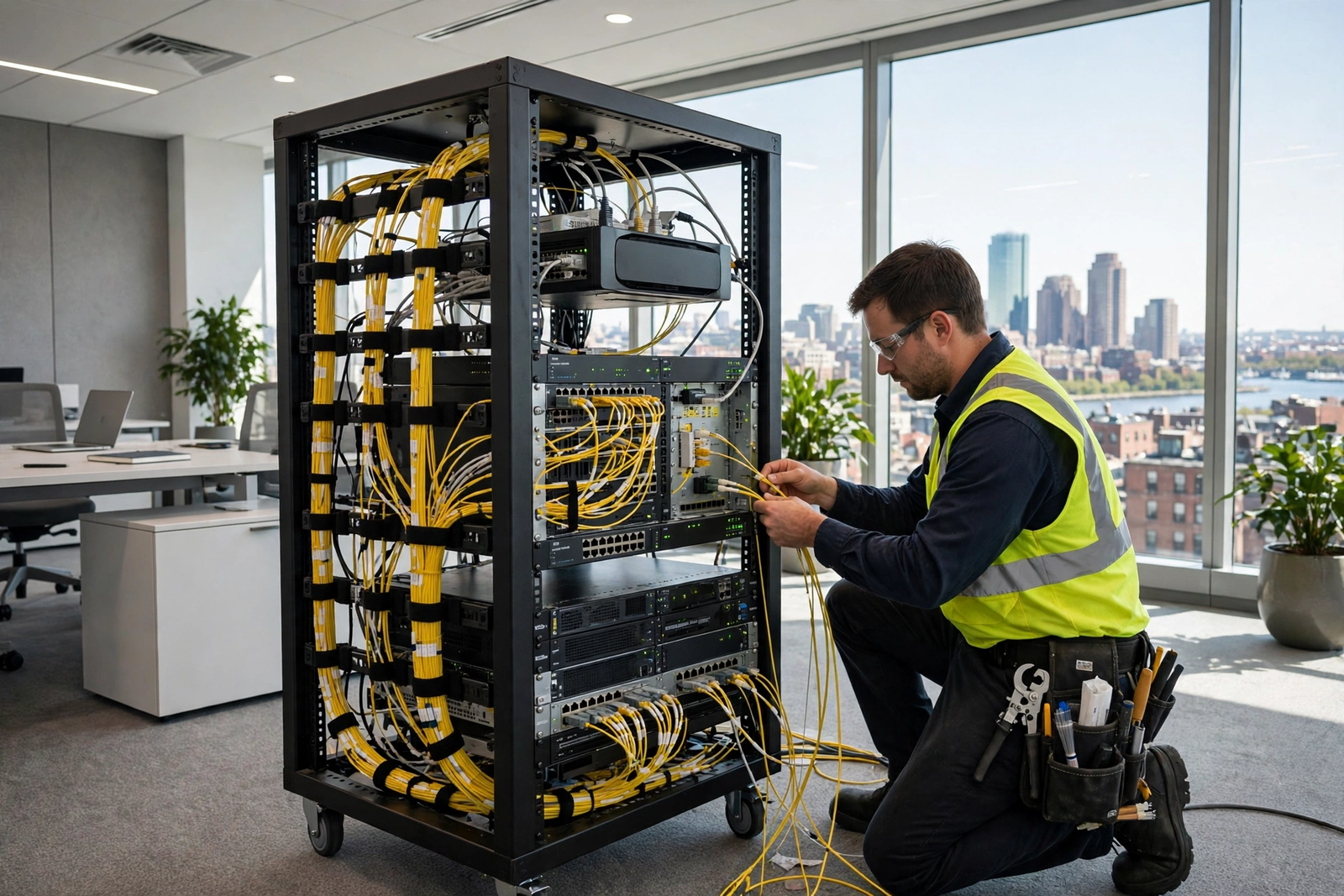
The equipment a Boston, Massachusetts business needs for fiber is simpler than most buyers expect, but each piece has a job and a cost. The optical network terminal is the box the provider installs where the fiber enters the suite, and it converts the light signal into an ethernet connection that a router can use. The gateway or router is the device that creates the office Wi-Fi network and connects the wired devices, and on Verizon Business Fios it costs about $18 per month to rent, while on Comcast Business it is included in the published price. A business with a large floor, thick brick walls, or multiple rooms will usually need mesh Wi-Fi access points as well, because a single gateway in a Boston brownstone rarely covers the whole office, and the mesh nodes are priced separately. A business that runs a payment gateway, a remote-access server, or security cameras will also need a static IP address, which is an add-on on most shared fiber plans. The same equipment questions come up in every market, and our guide to business fiber internet in Orlando, Florida walks through the same gateway and mesh choices for a different city.
Two equipment decisions matter more than the brand of the router. The first is whether to rent or buy: renting puts the replacement and support on the provider, while buying avoids the monthly fee but leaves the business responsible when the hardware fails, and for a small office the rental is usually the simpler choice. The second is whether the gateway supports the backup feature the business plans to use: AT&T Business Fiber includes built-in 5G backup on its 1 GIG tier and above in the markets where it is sold, but that feature needs the specified gateway and does not work during a power loss, and the same logic applies to any provider backup that depends on the gateway staying powered. A business in Boston, Massachusetts should also budget for a battery backup for the gateway and the terminal, because a fiber connection that survives a street outage is no use if the equipment in the office has no power. Test the Wi-Fi coverage on a busy working day before the install team leaves, because a dead zone found on day one is free to fix and a dead zone found a month later is not.
Fiber vs Cable vs 5G Business Internet in Boston, Massachusetts
Fiber, cable, and 5G are three different answers to the same question, and a Boston, Massachusetts business should choose between them on upload speed, reliability, and cost, not on the headline download number. Fiber is the best primary connection for most offices, because its upload speed matches its download speed, its latency is low, and its performance does not fall when the neighbours get home and start streaming. Verizon Fios at 1 Gig uploads at 1 Gbps, while Xfinity cable at 1 Gig uploads at a small fraction of that, and the difference shows up every time the team backs up to the cloud, uploads video, or runs a video call with many participants. Cable is the best fallback where fiber does not reach, because Xfinity reaches the large majority of Boston addresses, installs quickly, and costs less per month than a dedicated line, and it is also a good second wired circuit for a business that already has fiber, because it runs on different infrastructure. Fixed wireless is the best temporary connection and the best backup, because a 5G gateway can be self-installed the same day it arrives and keeps the business trading while a wired install is scheduled.
The numbers make the trade-off concrete. A 1 Gig fiber plan from Verizon Business Fios costs $149 per month with symmetrical uploads, while a 1.25 Gig Comcast Business plan costs $150 per month with far slower uploads, so the two plans cost almost the same and the fiber plan does more work. A 300 Mbps fiber plan at $69 per month from Verizon uploads at 300 Mbps, while a 300 Mbps Comcast Business plan at $70 per month uploads at a fraction of that speed, so the fiber plan is the better value at the same price. Fixed wireless is cheaper still, with T-Mobile 5G Business Internet at $35 per month with a voice line and Verizon 5G Business Internet at $35 per month bundled, but its speeds vary with signal strength, building materials, and network congestion, and it is not a like-for-like replacement for wired fiber for a team that uploads heavily. The right answer for most Boston, Massachusetts businesses is fiber as the primary connection, cable or fixed wireless as the backup, and a written quote for dedicated internet only if the business cannot afford any shared-connection risk. Businesses that have already compared providers in other markets will recognize the pattern from our best business internet providers in Chicago, Illinois guide, where the same fiber-first logic applies, although in Boston, Massachusetts the fiber provider is Verizon rather than AT&T.
Business Fiber Internet Backup Options in Boston, Massachusetts
A single connection is a single point of failure, and a Boston, Massachusetts business that cannot afford downtime needs a backup before it needs it, not after the first outage. The most reliable setup is two connections on different technologies, such as fiber plus fixed wireless, so a single cut or outage cannot take the office offline. AT&T Business Fiber includes built-in 5G backup on its 1 GIG tier and above in the markets where it is sold, using a cellular connection when the wired line fails, although it needs the specified gateway, does not work during a power loss, and does not cover static IP or voice service, and a Boston business should remember that this feature is not available on a shared AT&T Fiber order in Boston, Massachusetts because the wired service is not sold there. The practical Boston backup is therefore a separate 5G gateway, such as AT&T Internet Air at $65 per month for Standard or $105 for Premium, T-Mobile 5G Business Internet from $35 per month with a voice line, or Verizon 5G Business Internet from $35 per month bundled, kept powered and tested as the failover circuit.
Xfinity cable can also serve as a second wired circuit for a business whose primary is Verizon Fios, because it runs on different infrastructure from fiber, and a cut to the fiber line does not take the cable line with it. The backup only works if it is tested: a business should test the failover before it is needed, confirm that the point-of-sale system, the hosted voice, and the cloud backups all work on the backup connection, and confirm that the switch happens automatically or that someone on site knows how to make it happen. A battery backup for the gateway and the terminal is part of the same plan, because a backup connection that dies with the power is no backup at all, and Boston, Massachusetts winters make power outages a real risk. A business that depends on its connection for revenue should also ask about a service level agreement on any dedicated circuit, because shared fiber plans do not carry the same repair guarantees as dedicated internet, and the four-hour repair windows that come with enterprise fiber are a different product at a different price.
Boston, Massachusetts Business Fiber Internet Pricing Comparison

The pricing comparison below shows the published starting prices for the main Boston, Massachusetts business fiber and fallback options, with the two-year reality noted alongside. Verizon Business Fios starts at $69 per month for 300 Mbps and rises to $179 for 2 Gig, on a two-year agreement, plus about $18 per month for the router, which means the price you start with is the price you keep for the term, subject to Verizon changing its list prices. Comcast Business starts at $70 per month for 300 Mbps on one-year pricing, with a promotional Essential plan at $60 for 12 months that rises to $100 in months 13 to 24 and $140 in months 25 to 36, so its two-year total for the 300 Mbps tier is about $1,920 before taxes and fees, against about $1,656 for Verizon 300 Mbps fiber at list price over the same period, although the two plans are not like for like, because the fiber plan uploads at 300 Mbps and the cable plan uploads at a fraction of that. AT&T Internet Air lists $65 per month for Standard and $105 for Premium. T-Mobile 5G Business Internet starts at $35 per month with a voice line and $60 standalone on its Rely tier, and Verizon 5G Business Internet starts at $35 per month bundled and $65 on offer standalone on its 100 Mbps tier.
| Plan | Provider | Monthly price | 24-month total |
|---|---|---|---|
| 300 Mbps fiber | Verizon Fios Business | $69 | About $1,656 |
| 1 Gig fiber | Verizon Fios Business | $149 | About $3,576 |
| 300 Mbps cable | Comcast Business | $70 ($60 promo year 1) | About $1,920 |
| 1.25 Gig cable | Comcast Business | $150 | About $3,600 |
| Internet Air Standard | AT&T Internet Air | $65 | About $1,560 |
| Rely 5G | T-Mobile Business Internet | $35 with voice line | About $840 |
The cheapest option on that list is not automatically the best value. A $35 fixed wireless plan that slows during congestion can cost a business far more in lost productivity than the $34 it saves against a $69 fiber plan. A $60 cable plan with a slow upload can bottleneck a team that uploads video or backs up to the cloud every night. Value means the right speed, the right upload capacity, the right reliability, and a price that does not jump after a year, and on that measure Verizon Fios at 1 Gig is the strongest all-round value for most Boston, Massachusetts offices, at $149 per month, working out to $3,576 over 24 months before taxes, fees, and the router rental. Comcast Business at 1.25 Gig is the strongest cable value where fiber does not reach, and T-Mobile 5G Business Internet is the strongest fixed wireless value where a fast, no-contract connection is needed. A business that needs dedicated internet should budget from the national broker ranges of about $300 to $700 per month for 100 Mbps and about $700 to $2,000 per month for 1 Gbps, always on a written quote, and never applied to a named provider in this guide.
Limitations of Business Fiber Internet in Boston, Massachusetts
Every business fiber internet option in Boston, Massachusetts has limitations, and an honest guide names them. Verizon Fios does not reach roughly half of Boston homes, installation can require landlord permission and interior wiring that adds weeks, and the router rental adds about $18 per month to the published price. Xfinity cable uploads are far slower than downloads, its fiber pockets reach only a minority of addresses, and its promotional prices step up sharply after 12 months. Astound serves only specific neighborhoods, its prices rise after the promotional period, and its brand and network may change as the GFiber deal closes. Starry needs a clear line of sight, serves selected buildings only, and its future under Verizon ownership is not yet settled. AT&T shared wired fiber is not sold in Boston, Massachusetts at all, so a Boston business that wants AT&T is limited to Internet Air or an enterprise dedicated quote. None of those limitations is a reason to avoid the provider; each one is a reason to check your address, read the contract, and plan a backup.
The other limitation is information itself. Prices, promotions, and coverage change constantly, and comparison sites disagree with each other because they check different addresses on different dates. Where sources conflict in this guide, the range is stated and the reason is given: Verizon Fios is stated as roughly 42 to 46 percent of homes because the sources say 42 percent and 45.6 percent, and Xfinity cable is stated as about 68 to 98 percent because the downtown audit and the citywide dataset measure different areas. The AT&T Fiber claim is a second information trap: any guide that lists AT&T Fiber as a wired Boston, Massachusetts provider is repeating a generic template, not a coverage fact, and any price quoted for AT&T Fiber in Boston, Massachusetts should be checked against the address tool. Treat every price here as a planning figure checked in November 2026, confirm the quote for your own address, and get the post-promotion rate and the installation charges in writing before you sign anything.
Business Fiber Internet in Boston, Massachusetts: FAQ
Which Fiber Internet Providers Serve Boston, Massachusetts Businesses?
Verizon Fios is the main fiber provider for Boston, Massachusetts businesses, reaching roughly 42 to 46 percent of homes with symmetrical speeds up to 2.3 Gbps. Xfinity from Comcast has fiber pockets reaching about a third of homes in the downtown area, with speeds up to 10 Gbps, and Astound Broadband, formerly RCN, has fiber reaching about 9 percent of homes with symmetrical speeds up to 2 Gbps. Fidium Fiber is a smaller fiber presence in parts of the city. AT&T does not sell its shared wired fiber plans in Boston, Massachusetts; its AT&T option there is Internet Air over 5G. Always check your exact address, because fiber availability changes street by street, and Downtown is far better served than the outer neighborhoods.
How Much Does Business Fiber Internet Cost in Boston, Massachusetts?
Verizon Business Fios costs $69 per month for 300 Mbps, $99 for 500 Mbps, $149 for 1 Gig, and $179 for 2 Gig, plus about $18 per month for the router, on a two-year agreement. Comcast Business costs $70 per month for 300 Mbps, $100 for 500 Mbps, $150 for 1.25 Gig, and $180 for 2 Gig on one-year pricing, with a five-year price lock available at higher rates. Astound business pricing is by quote, and its residential 1 Gig runs about $40 to $45 per month. AT&T Internet Air lists $65 per month for Standard and $105 for Premium. Construction charges for a new fiber drop are quoted per address and can add hundreds or thousands of dollars, so get them in writing before you sign.
How Long Does Business Fiber Installation Take in Boston, Massachusetts?
A straightforward fiber install in a building that is already fiber-ready can take two to four hours on the day, and a few days from order to activation. An install that needs new interior wiring can take a full day or more, and an install that needs construction, landlord permission, or work in a historic district can take days to weeks from the first site survey to the first working connection. Cable installation can often be completed in days, and fixed wireless gateways can be self-installed the same day they arrive. Start the order early, keep a fixed wireless gateway in reserve, and get the landlord permission in writing before the provider books the technician.
Is AT&T Business Fiber Available in Boston, Massachusetts?
No. AT&T does not sell its shared wired AT&T Business Fiber plans in Boston, Massachusetts, and a Boston business cannot order the 300 Mbps to 5 GIG shared fiber tiers for a Boston address. The coverage datasets list AT&T in Boston, Massachusetts as a 5G provider only, and the AT&T business page for the city is a generic template. What AT&T does offer in Boston, Massachusetts is AT&T Internet Air for Business over 5G, at $65 per month for Standard and $105 for Premium, and enterprise dedicated internet on a quote-only basis. Run the AT&T availability check for your exact address to confirm what AT&T can offer at your building.
What Business Internet Backup Is Available in Boston, Massachusetts?
AT&T Internet Air, T-Mobile 5G Business Internet, and Verizon 5G Business Internet can all serve as a backup circuit for a fiber or cable primary, and Xfinity cable can serve as a second wired circuit because it runs on different infrastructure from fiber. AT&T Business Fiber includes built-in 5G backup on its 1 GIG tier and above in the markets where it is sold, but that feature is not available on a shared AT&T Fiber order in Boston, Massachusetts because the wired service is not sold there. The most reliable setup for a Boston, Massachusetts business that cannot afford downtime is two connections on different technologies, such as fiber plus fixed wireless, so a single cut or outage cannot take the office offline, and the failover should be tested before it is needed.
Boston, Massachusetts gives a business a clear choice once the AT&T position is understood: check Verizon Fios first, because it is the only symmetrical fiber with a broad footprint in the city, fall back to Xfinity cable where fiber has not arrived, because its cable reaches the large majority of addresses, check Astound and Starry where they reach your building, and keep a 5G fixed wireless plan in reserve for the day the wired line goes down or for a historic building where a new wired drop is hard to permit. Check your exact address first, compare the two-year cost rather than the first-year price, insist on symmetrical speeds if your team uploads anything, and buy a backup before you need one. That combination covers nearly every Boston, Massachusetts business, from a two-person studio in the North End to a hundred-seat office in the Seaport District.

