
Business fiber internet in Las Vegas, Nevada is the fastest and most reliable connection a local business can buy — where it is available. Quantum Fiber offers symmetrical speeds up to 8 Gbps from around $45 to $50 per month in selected neighborhoods. Google Fiber offers up to 8 Gig from $70 per month, expanding outward from its first Summerlin neighborhoods. AT&T Business Fiber offers symmetrical 300 Mbps to 5 GIG plans from $60 per month, but only in small pockets of the city. Cox Business sells fiber where its fiber network reaches a building, priced per address. The fiber is real, the speeds are real, and the prices are competitive — but no single fiber provider reaches the whole valley, so the first question for any Las Vegas business is never “which fiber plan is best” but “which fiber reaches my building.”
That availability question is more important in Las Vegas than in most American cities, because the valley’s fiber was built in patches rather than all at once. FCC-based coverage data puts Quantum Fiber at roughly 14 to 40 percent of Las Vegas depending on the source and the dataset, and shared AT&T Business Fiber at about 3.2 percent of Las Vegas homes citywide — with much higher coverage in individual neighborhoods. Cox cable, by contrast, reaches nearly every commercial address in the valley, which is why most Las Vegas businesses still run on cable even though fiber is faster. A business in a newer Summerlin development may have three fiber providers to choose from; a business in an older building Downtown may have none, and will need cable or 5G fixed wireless instead. This guide maps the real fiber footprint in Las Vegas, Nevada, compares the providers and prices, and walks through installation step by step so a business knows exactly what to expect before it orders.
Every price and availability figure in this guide was checked November 2026, and every figure varies by address and promotion. Fiber installation in Las Vegas typically takes days to weeks depending on whether the fiber is already in the building, and the cost of installation ranges from free to hundreds of dollars — or more where construction is needed. Read the availability section before the pricing section, run the address checkers, and only then compare the plans. A fiber plan that does not reach your address is not a plan at all.
Check AT&T Business Fiber Availability for Your Las Vegas, Nevada Address
Symmetrical fiber speeds from 300 Mbps to 5 GIG, with no data caps and a gateway included.
Business Fiber Internet in Las Vegas, Nevada at a Glance
Fiber internet carries data as light through glass strands, which is why it delivers symmetrical upload and download speeds, lower latency, and far more headroom than cable or 5G fixed wireless. For a Las Vegas business, the practical difference is simple: a fiber connection uploads as fast as it downloads, so cloud backups finish in minutes instead of hours, video calls stay sharp while files upload in the background, and a whole office can work in the cloud at once without the connection becoming the bottleneck. The table below summarizes the fiber options a Las Vegas business can realistically choose from, with prices as published or reported in November 2026.
| Business Fiber Provider in Las Vegas, Nevada | Speeds Up To | Starting Price | Las Vegas, Nevada Availability |
|---|---|---|---|
| Quantum Fiber | 8 Gbps symmetrical | From $45 to $50 per month | Selected neighborhoods, newer developments |
| Google Fiber | 8 Gig | From $70 per month | Summerlin, expanding |
| AT&T Business Fiber | 5 GIG symmetrical | From $60 per month | Small pockets only |
| Cox Business Fiber | Up to 2 Gbps | Quoted per address | Where Cox fiber reaches |
| AT&T Dedicated Fiber | 10 Gbps symmetrical | From around $518 per month | Quoted per address, large sites |
Get A Free AT&T Business Fiber Quote
Symmetrical fiber speeds from 300 Mbps to 5 GIG, with no data caps and a gateway included.
The pattern in that table is the pattern of the whole Las Vegas fiber market: the cheapest and fastest fiber is the least widely available, and the most widely available wired network is cable, not fiber. A Las Vegas business should therefore check fiber availability first and treat the result as the single most important fact in its decision. If Quantum Fiber, Google Fiber, or AT&T Business Fiber reaches the building, the business should take fiber and compare the fiber providers against each other. If none of them reaches the building, the business should order the best cable or 5G connection available and re-check fiber availability every six to twelve months, because the build is still expanding — Google Fiber only lit up its first Summerlin neighborhoods in March 2026, and new streets are being added as construction continues.
Business Fiber Internet Providers in Las Vegas, Nevada
Four providers sell business fiber in Las Vegas, Nevada, and they differ in footprint, price, and the kind of business they serve best. Quantum Fiber, the fiber brand of Lumen Technologies, is the fastest and cheapest fiber in the valley where it is available, with symmetrical speeds up to 8 Gbps, plans from $50 per month for up to 500 Mbps and up to 1 Gig, a limited-time 1 Gig offer at $45 per month for new customers, no annual contract, and no data caps. Its weakness is availability: coverage estimates range from about 14 percent to about 40 percent of Las Vegas depending on the source, and the footprint is concentrated in newer developments and selected neighborhoods rather than spread evenly across the city. A business that can get Quantum Fiber should usually take it, because no other Las Vegas provider matches its combination of symmetrical gigabit speeds and a roughly $50 monthly price.
Google Fiber is the newest fiber provider in Las Vegas, Nevada, launching service in Summerlin in March 2026 with 100 percent fiber-to-the-home connections, no data caps, and no annual contracts. Its published pricing is 1 Gig from $70 per month, 3 Gig from $100 per month, and 8 Gig from $150 per month, with Wi-Fi routers included. Its footprint is the smallest of the four today, concentrated in Summerlin with construction continuing across Las Vegas and Clark County, and its offering is marketed primarily as a residential service — so a business at a Summerlin address where Google Fiber is live should ask directly for a business quote and confirm business support terms rather than assuming the residential terms apply. AT&T Business Fiber, covered in detail in the next section, offers symmetrical 300 Mbps to 5 GIG plans from $60 per month in small pockets of the city. Cox Business Fiber is priced per address where the Cox fiber network reaches a building, and it competes on symmetrical performance with Quantum Fiber while benefiting from Cox’s established local business support. EarthLink Fiber is listed by some comparison sites as offering fiber speeds up to 5 Gbps in parts of North Las Vegas, typically as a reseller riding other networks — a quote is worth checking if its checker shows availability, but the business should confirm whose fiber it runs on and what the service level agreement covers.
Quantum Fiber Business Internet in Las Vegas, Nevada
Quantum Fiber deserves a closer look, because it is the provider most likely to change a Las Vegas business’s mind about what fiber should cost. Its Las Vegas tiers, as reported for the city in November 2026, start with up to 500 Mbps symmetrical from $50 per month plus tax and up to 1 Gig symmetrical from $50 per month plus tax, with a limited-time 1 Gig offer at $45 per month for new customers, and higher tiers running to multi-gigabit speeds up to 8 Gbps where the top tier is offered. Equipment is typically included, there is no annual contract on the standard fiber tiers, and there are no data caps. For a Las Vegas business, the comparison is stark: Quantum Fiber’s 1 Gig symmetrical at around $50 per month costs less than half of Cox’s 1 Gbps cable at around $115 per month, and it uploads roughly twenty times faster. The only reason every Las Vegas business is not already on Quantum Fiber is that most Las Vegas buildings cannot get it yet.
One development matters for any business signing up with Quantum Fiber in Las Vegas, Nevada. AT&T announced in May 2025 that it would acquire around 95 percent of Lumen’s Quantum Fiber business, and that deal closed on 2 February 2026, with the service rebranded as Quantum Fiber from AT&T. Quantum Fiber subscribers are expected to transition to AT&T Fiber customers over time, but the transition does not change what a business orders today: availability is still checked and service is still ordered as Quantum Fiber, and the business should confirm the current brand, billing, and support arrangements at the time of signup. Our comparison of the business fiber internet in Denver, Colorado shows Quantum Fiber playing the same role in another market — the cheapest symmetrical fiber where it reaches, and the provider whose address checker is worth running first.
Cox Business Fiber Internet in Las Vegas, Nevada
Cox Business Fiber is the quiet option in the Las Vegas fiber market: less advertised than Quantum Fiber, less new than Google Fiber, but available in more commercial buildings than either of them in some districts, because Cox’s network is already in the ground across the valley. Cox does not publish a single national fiber price list — fiber pricing depends on location and the plan chosen — so a Cox fiber quote is always address-specific and follows a site check. Where Cox fiber is available, it delivers symmetrical speeds that remove the upload weakness of Cox cable, and it comes with Cox’s established business support, optional static IP addresses, and service level agreement options on the higher tiers. A Las Vegas business that already runs Cox cable should ask for a fiber quote before renewing a cable contract, because the upgrade may cost less than the business expects and the upload improvement is immediate. A business comparing fiber providers should get the Cox fiber quote in writing alongside the Quantum Fiber and AT&T quotes, so the comparison is fiber against fiber rather than fiber against cable.
AT&T Business Fiber in Las Vegas, Nevada: Availability Reality Check
AT&T Business Fiber is the product this guide’s featured offer is built around, so its Las Vegas position needs a straight answer. Shared AT&T Business Fiber — symmetrical 300 Mbps to 5 GIG, no data caps, a gateway included, no annual contract — is available only in limited pockets of Las Vegas, Nevada. FCC-based business coverage data puts AT&T Business Fiber at about 3.2 percent of Las Vegas homes citywide, with speeds up to 5,000 Mbps where it is available. That citywide figure hides enormous variation: in the Huntridge neighborhood, the same data source puts AT&T Business Fiber coverage at about 62 percent of homes. Nevada is generally outside the historic AT&T Fiber footprint, and the fiber that does exist in the valley comes from later builds and acquired assets rather than from the legacy AT&T network that serves cities in the Southeast and Midwest. A Las Vegas business should treat AT&T Business Fiber as a real possibility worth checking, not as a safe assumption.
AT&T’s own Las Vegas page does not help a business decide, because it is a generic location template that advertises AT&T Fiber speeds up to 5 GIG “where available” and invites the visitor to check availability, without saying anything specific about which Las Vegas neighborhoods are actually served. That template pattern is common for national providers, and it is the reason this guide relies on FCC-based coverage data and independent reporting instead of repeating the template’s claims. Where shared AT&T Business Fiber is available at a Las Vegas address, the national business list pricing applies: 300 Mbps at $60 per month, 500 Mbps at $100 per month, 1 GIG at $140 per month, 2 GIG at $185 per month, and 5 GIG at $285 per month, or $40, $60, $90, $135, and $235 per month respectively with an eligible AT&T business wireless plan. If shared fiber is not available, AT&T Internet Air at $65 or $105 per month reaches most Las Vegas addresses over 5G, and dedicated AT&T fiber can be quoted per address for larger sites. The fastest way to find out which category your address falls into is to check AT&T Business Fiber availability for your Las Vegas, Nevada address before spending more time comparing plans.
AT&T Business Fiber Speeds and Pricing in Las Vegas, Nevada
Where it is available, AT&T Business Fiber pricing in Las Vegas, Nevada follows the national business list, and the tiers are worth understanding before the order. The 300 Mbps tier at $60 per month, or $40 with an eligible wireless plan, suits a small office with light cloud use. The 500 Mbps tier at $100 per month, or $60 with wireless, suits a small business with regular video calls and cloud apps. The 1 GIG tier at $140 per month, or $90 with wireless, is the sweet spot for most businesses: symmetrical gigabit speeds, an included gateway, and 5G backup built in. The 2 GIG tier at $185 per month, or $135 with wireless, and the 5 GIG tier at $285 per month, or $235 with wireless, suit businesses moving very large files or serving many simultaneous users. All tiers are symmetrical with no data caps and no annual contract on the shared plans. 5G backup is built in on 1 GIG and higher tiers using a specified gateway, and it does not work during a power loss — a limitation worth knowing for a Las Vegas business that needs connectivity through a summer power outage, where a battery backup or a second connection is the real answer. Our guide to the how to order and install AT&T Business Fiber process explains the ordering steps for addresses where fiber is available.
Business Fiber Internet Speeds in Las Vegas, Nevada: What the Tiers Mean
Fiber speed tiers are easy to overbuy and easy to underbuy, so here is what each tier actually means for a Las Vegas business. A 300 Mbps symmetrical connection handles a solo professional or a two-person office with ease — email, cloud documents, video calls, and light file sharing, all at once. A 500 Mbps symmetrical connection handles a retail shop or a small office with point-of-sale terminals, guest Wi-Fi, and a handful of staff on video calls. A 1 Gig symmetrical connection handles a professional office with ten to twenty staff, heavy cloud use, and large file transfers without breaking a sweat, and it is the tier most Las Vegas businesses should default to when fiber is available, because the price difference between 500 Mbps and 1 Gig is usually small. A 2 Gig connection suits a media, design, or engineering firm moving very large files daily, and a 5 Gig or 8 Gig connection suits a hotel, a venue, a data-heavy operation, or a business serving hundreds of simultaneous users.
Two cautions belong with those recommendations. First, the advertised speed is a maximum, not a guarantee, and the speed a business actually experiences depends on its own network: a 1 Gig fiber line feeding an old router or a single Wi-Fi access point will not deliver 1 Gig to the far corner of the office, and the business should budget for modern Wi-Fi equipment as part of the installation. Second, upload speed is the reason to buy fiber rather than cable, so a business should not compare a 1 Gbps cable plan with a 1 Gig fiber plan as if they were the same thing — the cable plan may download at 1 Gbps and upload at 35 Mbps, while the fiber plan does 1 Gbps in both directions. For a Las Vegas business that uploads constantly, that difference is worth more than any price difference between the two plans. The same speed logic applies in other fiber markets, and our guide to the best business internet providers in Kansas City, Missouri makes the same point about sizing for uploads rather than downloads.
Business Fiber Versus Cable Versus 5G in Las Vegas, Nevada
A Las Vegas business choosing between fiber, cable, and 5G fixed wireless is choosing between three different trade-offs, and the right answer depends on what the business does all day. Fiber wins on speed, symmetry, latency, and consistency: symmetrical uploads, low latency, no data caps on the business fiber tiers, and performance that does not dip when the neighbors get home in the evening. Cable wins on availability: Cox reaches nearly every commercial address in the valley with gigabit-class downloads, and it can be installed quickly where the cable is already in the building. 5G fixed wireless wins on speed of setup and price: a gateway arrives, plugs in, and the business is online within days for $35 to $105 per month, with no construction and no technician visit. The honest ranking for a Las Vegas business that can get all three is fiber first, cable second, and 5G as a backup or a temporary line. The honest ranking for a business that can only get cable and 5G is cable as the primary line and 5G as the backup.
The comparison table below puts the three technologies side by side on the factors that matter to a Las Vegas business, rather than on the marketing claims.
| Factor | Business Fiber in Las Vegas, Nevada | Cable in Las Vegas, Nevada | 5G Fixed Wireless in Las Vegas, Nevada |
|---|---|---|---|
| Upload speed | Symmetrical, same as download | Much slower than download | Slower than download, varies by signal |
| Latency | Lowest | Low to moderate | Higher, varies by congestion |
| Consistency | Most consistent | Can dip at peak hours | Varies with signal and congestion |
| Availability | Selected neighborhoods | Nearly valley-wide | Most addresses |
| Setup time | Days to weeks | Days | Days, self-install |
| Starting price | From $45 to $60 per month | From $65 per month | From $35 per month bundled |
That table explains why so many Las Vegas businesses end up with two connections rather than one: a fiber or cable primary line for the heavy work, and a 5G fixed wireless backup line for the day the primary line fails. The combination costs $100 to $200 per month for most small businesses, and it is the cheapest resilience a Las Vegas business can buy. A business that takes card payments, runs cloud point-of-sale, or serves customers online should treat the backup line as part of the primary decision, not as an afterthought, because the cost of a single outage on a busy weekend exceeds a year of backup fees.
Disclaimer: This article contains affiliate links to AT&T Business services; we may earn a commission at no extra cost to you. Ortelcom.com is an independent publisher not affiliated with or endorsed by AT&T. Pricing, speeds and availability are not guaranteed, were checked 11 November 2026, and vary by address and promotions. Confirm all details before ordering. AT&T trademarks belong to their owner.
Business Fiber Installation in Las Vegas, Nevada: Step by Step
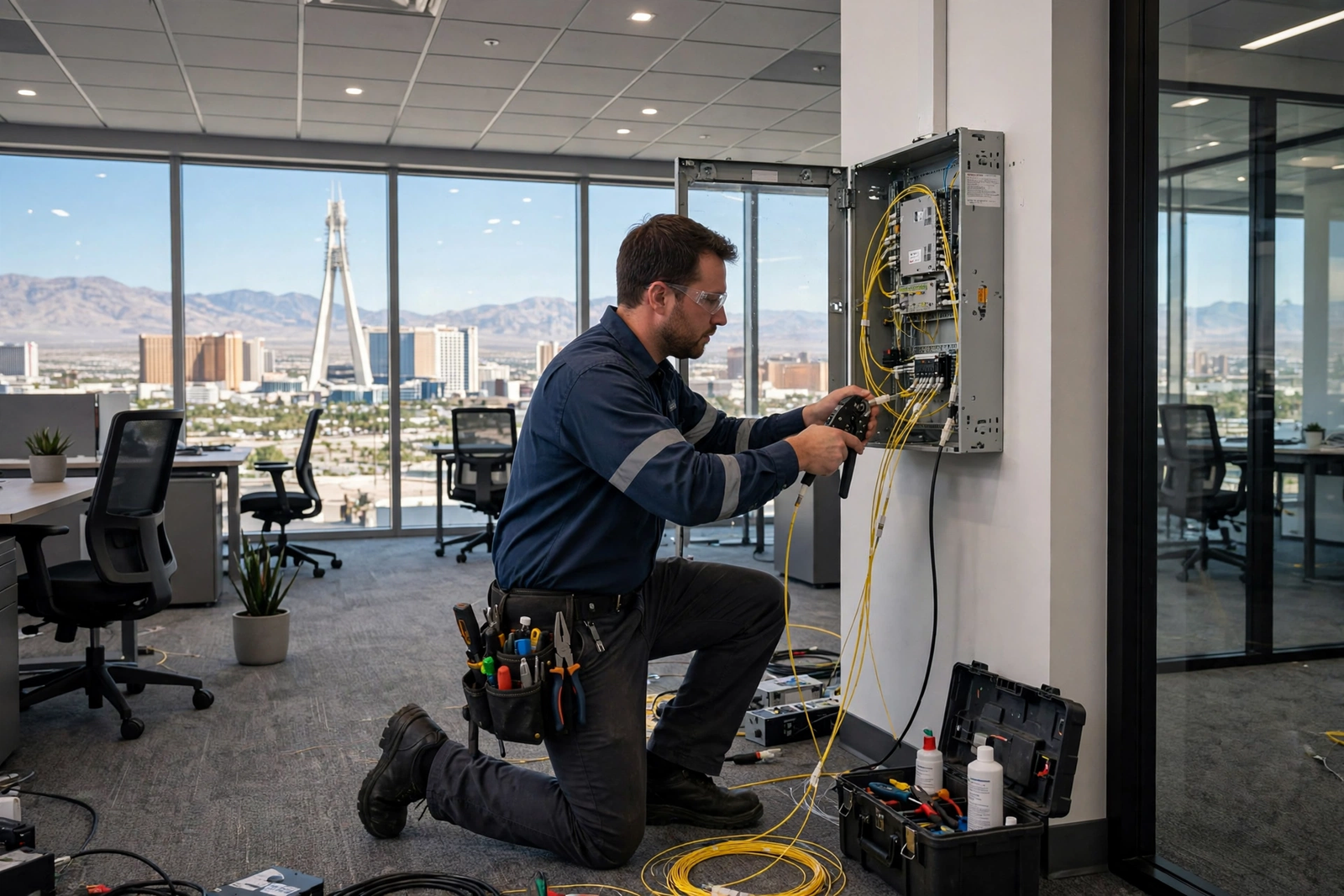
Business fiber installation in Las Vegas, Nevada follows a predictable sequence, and knowing it in advance removes most of the surprises. The process starts with the availability check: the business enters its exact address, including suite number, on the provider’s checker or gives it to a sales representative, and the provider confirms whether fiber reaches the building and which speeds are offered. This step takes minutes, and it is the step that decides everything else — if fiber does not reach the building, the installation conversation ends here and the business should compare cable or 5G options instead. If fiber does reach the building, the business chooses a speed tier, confirms the monthly price, the equipment included, and the contract terms, and places the order. A written order confirmation should state the plan, the price, the installation date, and any installation or construction charges before the business signs anything.
The second step is the site survey, which applies when the fiber is in the street but not yet in the building, or when the provider needs to confirm the route into the suite. A technician visits the address, checks where the fiber enters the building, where the gateway and the network equipment will sit, and whether any drilling, conduit, or cabling is needed inside the suite. For a building where fiber is already installed to the suite, the survey may be skipped entirely and the installation booked directly. For a building that needs fiber brought in from the street, the survey determines the construction scope and the cost, and the business should get that cost in writing before authorizing the work — construction charges are the largest variable in fiber installation, and they range from zero to thousands of dollars depending on distance, permits, and whether the building owner must approve the work.
The third step is the installation appointment itself. A technician runs the fiber from the entry point to the gateway location, installs the optical network terminal that converts the light signal to an electrical one, connects the gateway, and tests the connection. The business should expect the technician to need access to the telecom room or closet, the suite’s network cabinet if there is one, and the area where the gateway will sit, and should have a decision-maker on site who can approve the gateway placement and confirm that the work is acceptable. The fourth step is the network setup: the technician or the business’s IT person connects the office network to the gateway, configures Wi-Fi, sets up any static IP addresses, and tests the speeds at several points in the office. The fifth and final step is the speed test and sign-off: the business runs a wired speed test at the gateway, confirms the speeds match the ordered tier, tests Wi-Fi in the areas where staff work, and only then signs off on the installation. A business that skips the testing step often discovers weeks later that the Wi-Fi does not reach the back office, and by then the technician is gone.
Business Fiber Installation for Multi-Tenant Buildings in Las Vegas, Nevada
Multi-tenant buildings in Las Vegas, Nevada add one step that single-tenant buildings do not have: the building owner’s permission. Fiber installation in a shared building usually requires the provider to run cable through common areas, risers, or telecom rooms, and most commercial leases require the landlord’s written approval before that work begins. A business in a multi-tenant building should ask the landlord early — ideally before ordering — whether fiber is already in the building, which providers have agreements with the building, and what the approval process looks like. Some Las Vegas buildings, particularly newer ones in Summerlin and the southwest valley, are already fiber-ready with multiple providers in the telecom room; others, particularly older buildings Downtown or on the Strip, may have only one provider’s equipment in place, or none at all. A business that discovers the landlord issue after ordering can lose weeks waiting for approval, while a business that asks first can often have the approval in hand before the installation is booked.
How Long Does Business Fiber Installation Take in Las Vegas, Nevada?
Business fiber installation in Las Vegas, Nevada takes anywhere from a few days to several weeks, and the range depends almost entirely on whether the fiber is already in the building. If the fiber is already installed to the suite and only the gateway needs to be connected and activated, the installation can be completed within a few days of ordering, sometimes within a single appointment. If the fiber is in the building but not in the suite, the installation typically takes one to two weeks, allowing time for the site survey, the internal cabling, and the appointment. If the fiber is in the street but not in the building, the installation typically takes two to six weeks, allowing time for the survey, the landlord’s approval, any permits, and the construction work to bring the fiber into the building. And if the fiber has not yet been built to the street at all, the installation becomes a construction project with a timeline measured in months, and the business should not plan around it — it should order cable or 5G now and revisit fiber when the build arrives.
Three factors stretch the timeline most often in Las Vegas. The first is permits and landlord approval, which can add days or weeks in a multi-tenant building or a property with a strict management company. The second is construction, particularly where the fiber must cross a parking lot, a roadway, or a landscaped area to reach the building. The third is the summer heat: outdoor construction work in the Las Vegas valley slows during the hottest months, and a business planning a move or an opening in July or August should allow extra time for any outdoor work. The practical advice is to order fiber as early as possible — at least four to six weeks before the date the business needs to be online — and to keep a 5G fixed wireless line as a temporary connection while the fiber installation is completed. A business that orders fiber the week it needs it will almost always be disappointed; a business that orders it six weeks early will usually be online on time.
Business Fiber Installation Costs in Las Vegas, Nevada
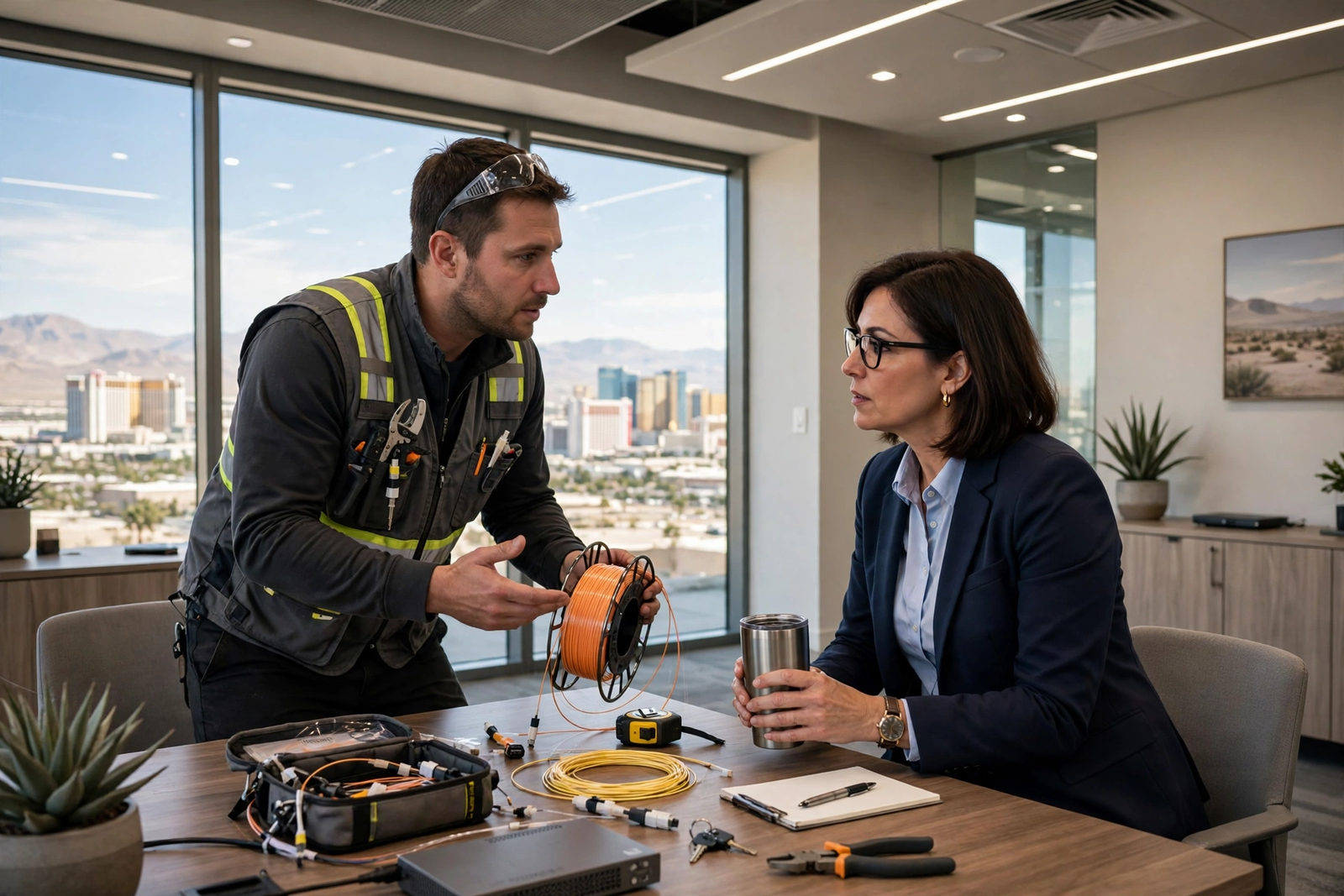
Business fiber installation costs in Las Vegas, Nevada range from free to thousands of dollars, and the honest answer is that the cost depends on how much work the provider must do to reach the suite. A standard installation where the fiber is already in the building typically costs $0 to $99, and many providers waive the installation fee entirely for a new business customer or for a business that signs a term. An installation that needs internal cabling — running fiber from the telecom room to the suite, or from the suite entrance to the gateway location — typically costs $100 to $500 depending on the distance and the complexity of the route. An installation that needs construction to bring fiber from the street into the building can cost $500 to several thousand dollars, and in some cases the provider absorbs the construction cost for a business that signs a longer term, while in other cases the business pays it directly. The business should always ask for the installation and construction costs in writing before authorizing the work, and should ask whether the cost is waived, discounted, or amortized over the contract term.
Equipment costs are the second part of the installation bill. The optical network terminal is usually provided by the fiber provider as part of the service, and the gateway is included on AT&T Business Fiber plans and typically included on Quantum Fiber plans. A business that needs its own router, a managed switch, or additional Wi-Fi access points should budget for that hardware separately: a business-grade router costs $150 to $500, and each additional Wi-Fi access point costs $100 to $300, plus the cost of installation if the business does not install them itself. Those are one-time costs, but they are real, and a business that budgets only for the monthly price will be surprised by the first invoice. The full cost picture for a Las Vegas fiber installation is therefore the monthly price, plus installation and construction, plus equipment, plus taxes — and the business should compare providers on that full picture rather than on the monthly price alone. Our breakdown of business internet cost in Boston, Massachusetts shows the same installation cost structure in a very different market, which confirms that these are industry-wide patterns rather than Las Vegas-specific surprises.
Who Pays for Fiber Construction in Las Vegas, Nevada?
Who pays for fiber construction in Las Vegas, Nevada is a negotiation, not a fixed rule, and a business that knows that can often save thousands of dollars. Providers sometimes absorb the construction cost for a business that signs a two- or three-year term, because the provider recovers the cost from the monthly fees over the life of the contract. Providers sometimes share the cost with the building owner, because the fiber increases the building’s value and makes it more attractive to future tenants. And sometimes the business pays the full cost directly, particularly for a short-term contract or a building where the provider has no other customers to justify the investment. A business facing a construction charge should ask three questions: can the charge be waived or reduced for a longer term, can the building owner contribute, and can another provider reach the building without construction. The answer to the third question is often the most valuable, because a competing provider whose fiber is already in the building eliminates the construction question entirely.
What to Prepare Before Fiber Installation Day in Las Vegas, Nevada
Preparation makes the difference between a fiber installation that finishes in one visit and one that takes three. Before installation day, the business should confirm the gateway location: a central spot in the suite, near power, with ventilation, and as close as possible to where the network equipment will sit. The business should confirm access: the technician needs entry to the building, the telecom room, and the suite, and a business in a managed building should arrange that access in advance rather than on the day. The business should confirm power: the gateway and the optical network terminal need power outlets, and a business that wants connectivity through a power cut should have an uninterruptible power supply ready — remembering that AT&T’s built-in 5G backup does not work during a power loss, so the battery backup is doing the real work. And the business should confirm the network plan: how many wired drops are needed, where the Wi-Fi access points will go, which devices need static IP addresses, and who will configure the network once the gateway is live.
On installation day itself, the business should have a decision-maker on site, a list of the devices that need to be connected, and the login details for any cloud services that need to be tested. The technician will install and test the fiber connection, but the business’s own network — the Wi-Fi, the point-of-sale terminals, the cameras, the printers — is the business’s responsibility unless it has paid for managed installation. After the technician leaves, the business should run a wired speed test at the gateway, a Wi-Fi speed test in every area where staff work, a test call on the voice system if it runs over the internet, and a test transaction on the point-of-sale system. Any problem found on installation day is the provider’s problem to fix; any problem found a month later is a support ticket. The extra hour of testing on installation day is the cheapest insurance in the whole project.
Las Vegas, Nevada Neighborhoods and Business Fiber Availability
Business fiber availability in Las Vegas, Nevada changes by neighborhood and often by block, and the pattern is worth understanding before a business chooses a location. Summerlin is the fiber leader in the valley: Quantum Fiber has a real presence there, Google Fiber launched its first Las Vegas service in Summerlin in March 2026, and AT&T Business Fiber appears in pockets including some newer Summerlin developments. The Strip and the resort corridor have near-universal Cox cable coverage, strong 5G from all three carriers, and dedicated fiber options for the large properties, with shared fiber availability depending on the individual building. Downtown Las Vegas and the Arts District have strong Cox coverage and growing fiber in newer and renovated buildings, with 5G fixed wireless widely available as a fast alternative. Spring Valley and Paradise have broad Cox coverage, patchy Quantum Fiber, and strong 5G, with fiber availability varying by subdivision and building age. Centennial Hills and the northwest valley have growing fiber in newer developments alongside broad Cox and 5G coverage.
Henderson and North Las Vegas are separate cities from Las Vegas, with their own fiber patterns: Henderson’s Green Valley and newer districts have strong Quantum Fiber and Cox coverage, and North Las Vegas has Quantum Fiber in parts of the city alongside near-universal Cox and CenturyLink coverage. None of those neighborhood descriptions replaces an address check, and a business choosing between two Las Vegas locations should run the provider checkers for both addresses before signing a lease. The difference between a fiber-ready building and a cable-only building is worth real money every month for years, and it is the kind of difference that is easy to check before signing and expensive to discover after. The same neighborhood-first logic applies in other cities, and our guide to the best business internet providers in Chicago, Illinois walks through the same availability patterns for a larger and older city.
Frequently Asked Questions About Business Fiber Internet in Las Vegas, Nevada
Is fiber internet available for businesses in Las Vegas, Nevada?
Yes, but only in selected areas. Quantum Fiber offers business fiber in selected Las Vegas neighborhoods with speeds up to 8 Gbps, Google Fiber offers fiber in Summerlin with speeds up to 8 Gig, AT&T Business Fiber is available in small pockets with speeds up to 5 GIG, and Cox Business Fiber is available where the Cox fiber network reaches a building. Cox cable reaches nearly every commercial address in the valley, so a business without fiber access still has a fast wired option, and 5G fixed wireless from T-Mobile, Verizon, and AT&T Internet Air reaches most addresses. Check your exact address with each provider before deciding.
How much does business fiber internet cost in Las Vegas, Nevada?
Business fiber in Las Vegas, Nevada starts from $45 to $50 per month for Quantum Fiber up to 1 Gig, $60 per month for AT&T Business Fiber 300 Mbps, and $70 per month for Google Fiber 1 Gig, with higher tiers rising to $285 per month for AT&T Business Fiber 5 GIG and $150 per month for Google Fiber 8 Gig. Cox Business Fiber is quoted per address. Installation ranges from free to hundreds of dollars, or more where construction is needed. Compare the two-year total, including equipment and taxes, rather than the first month’s price.
How long does business fiber installation take in Las Vegas, Nevada?
Installation takes a few days when fiber is already in the suite, one to two weeks when fiber is in the building but not the suite, and two to six weeks when fiber must be brought in from the street, allowing time for the survey, landlord approval, permits, and construction. If fiber has not been built to the street at all, the timeline is measured in months. Order at least four to six weeks before the date the business needs to be online, and keep a 5G line as a temporary connection in the meantime.
Is AT&T Business Fiber available in Las Vegas, Nevada?
Yes, in limited pockets. FCC-based business coverage data puts shared AT&T Business Fiber at about 3.2 percent of Las Vegas homes citywide, with much higher coverage in individual neighborhoods such as Huntridge, where it reaches about 62 percent of homes. AT&T’s own Las Vegas page is a generic template that says fiber is available “where available” without naming neighborhoods, so the only reliable answer comes from checking your exact address. If shared fiber is not available, AT&T Internet Air at $65 or $105 per month reaches most Las Vegas addresses over 5G.
Is business fiber better than cable in Las Vegas, Nevada?
For most businesses, yes — where fiber is available. Fiber uploads as fast as it downloads, has lower latency, and does not slow down at peak hours the way shared cable can. Cable’s advantage is availability: Cox reaches nearly every commercial address in the valley, while fiber reaches only selected neighborhoods. A business that can get fiber should usually take it; a business that cannot should take the best cable tier available and add a 5G backup line.
Final Take: Business Fiber Internet in Las Vegas, Nevada
Business fiber internet in Las Vegas, Nevada is the best connection a local business can buy, and the only question that matters is whether it reaches your building. Check Quantum Fiber first for the cheapest symmetrical gigabit speeds, check AT&T Business Fiber for the pockets it serves, check Google Fiber if you are in Summerlin, and check Cox Business Fiber if you already run Cox cable. If fiber reaches your address, take it, size the tier to your busiest hour, and budget for the installation and the network equipment as well as the monthly price. If fiber does not reach your address, order the best cable or 5G connection available, keep a backup line, and re-check fiber availability every six to twelve months — the build is still expanding, and the street that has no fiber today may have three providers competing for your business tomorrow.

